


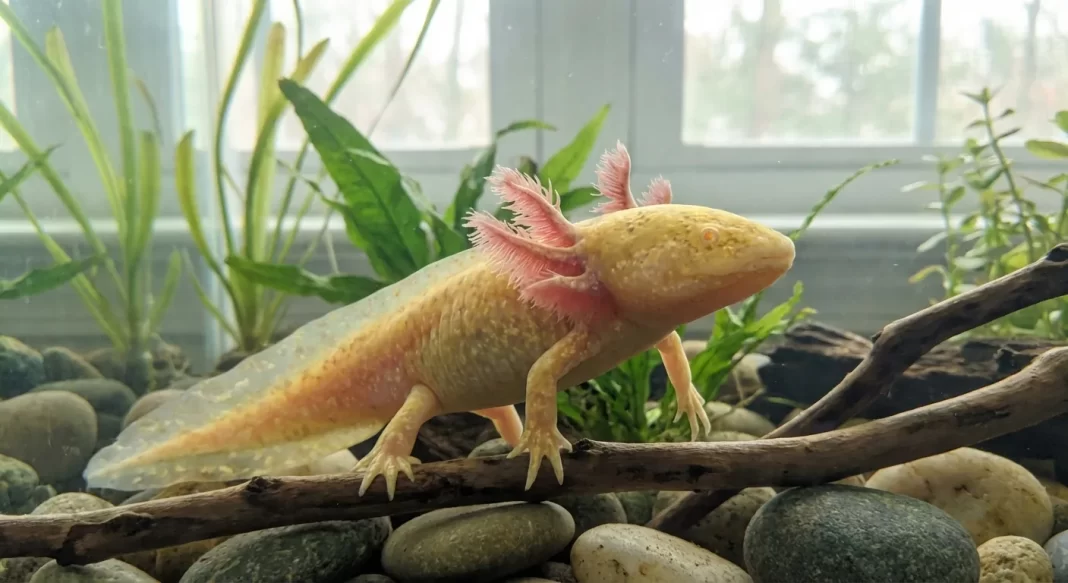
Most axolotls on a varied whole-prey diet do not need vitamin or mineral supplements. Earthworms plus quality sinking pellets plus occasional treats cover nutritional requirements. Narrow scenarios warrant vet-directed calcium or B-complex. Reptile multivitamins are contraindicated due to underwater delivery failure plus inappropriate vitamin D and A levels. Over-supplementation risks fat-soluble accumulation, water quality degradation, and masking underlying problems.
Does a properly fed axolotl need supplements?
A healthy adult axolotl eating earthworms two to three times a week with quality sinking pellets and occasional treats does not need supplements. Per AxolotlCentral, earthworms and night crawlers meet the nutritional requirements of your axolotl better than any other option, as they contain over 60% protein and a Ca:P ratio greater than 1 (source: AxolotlCentral care guide). Diet variety covers the rest.
The default-vs-warranted decision table maps the seven common scenarios a keeper might encounter to whether supplementation is warranted, whether vet direction is needed, and the underlying note. Most rows return “no supplementation needed.” A few narrow rows return “yes, but only with vet direction.” None return “yes, self-direct with reptile-grade powder.”
| Scenario | Default action | Vet direction needed? | Notes |
|---|---|---|---|
| Healthy adult on varied diet (earthworms + quality pellets + occasional treats) | No supplementation | No | Varied diet covers vitamin and mineral requirements |
| Juvenile on pellet-only diet | Diet correction (offer chopped earthworms, blackworms, daphnia) | No | Solution is diet variety, not supplement powder |
| Breeding female pre-spawn or post-spawn | Increase earthworm feeding frequency | Vet-direction preferred, not required | Active breeding cycles can deplete calcium reserves; dietary recovery preferred over powder |
| Post-illness or post-injury recovery | Vet-directed calcium or B-complex if prescribed | YES | Specific deficiencies require clinical assessment |
| Documented metabolic bone disease | Vet-supervised calcium plus dietary correction | YES | Not self-treatment with over-the-counter powder |
| Captive-bred-only feeder rotation (no variety) | Diversify feeders before supplementing | Vet-direction if symptoms persist | Thiamine concern if heavy bloodworm-only diet |
| Soft or floppy limbs observation | Vet evaluation BEFORE supplementing | YES | Multiple differential causes; supplementation can mask diagnosis |
Earthworm staple as nutritional baseline
Earthworms are the gold standard staple food. Per AxolotlCentral, earthworms and night crawlers meet the nutritional requirements of your axolotl better than any other option, as they contain over 60% protein and a Ca:P ratio greater than 1 (per AxolotlCentral care guide). The 2:1 calcium-to-phosphorus ratio commonly cited for amphibians is naturally met by earthworms. This is why insect-based diet protocols that require calcium dusting do not apply to axolotls. The axolotl care guide covers the husbandry framework that the feeding decisions sit inside. The axolotl feeding schedule by age guide covers feeding frequency by age.
Quality pellet rotation
High-quality sinking carnivore pellets serve as a convenient secondary food. Commercial axolotl pellets and aquatic-carnivore formulations are typically calibrated with calcium, vitamin D3, and other micronutrients at species-appropriate levels for aquatic carnivores. When pellets serve as a secondary food alongside earthworms, the combined diet covers nutritional requirements without separate supplementation. The what do axolotls eat guide covers the broader diet overview including non-live food types.
Occasional treats for enrichment
Per Axolotl.org/feeding, make sure what you’re feeding is balanced in terms of protein and vitamin content (source: Axolotl.org feeding). Frozen bloodworms, live blackworms, daphnia, and brine shrimp add variety and enrichment without nutritional risk when offered as occasional treats. They are lower in nutritional density than earthworms and should not be a primary staple. The axolotl live food safety guide covers the safety dimension of the live-food subset.
Long-time hobbyist breeders consistently observe that supplement-related problems in axolotls stem from adding products the animal does not need rather than from genuine deficiency. The pattern is predictable. A keeper reads reptile care guides, buys reptile-grade calcium powder or multivitamin dust, applies it to axolotl food, and creates a water-quality or toxicity problem that did not exist before. The corrective framing is straightforward: supplements are a veterinary intervention for specific diagnosed deficiencies, not a routine addition to a healthy axolotl diet.
When supplementation may be warranted
Five narrow scenarios warrant supplementation. Breeding females during egg formation may need calcium support via earthworm-frequency increase. Post-illness recovery may need vet-directed B-complex or calcium. Post-injury regeneration may need vet-directed calcium. Captive-bred-only feeder rotation without natural variety risks thiamine deficiency. Documented metabolic bone disease requires vet-supervised calcium plus dietary correction. None are self-treatment scenarios.
| Scenario | Sign | Supplement type | Vet direction required? |
|---|---|---|---|
| Breeding female pre-spawn or post-spawn | Active breeding cycle; recent egg-laying | Calcium support via earthworm-frequency increase (dietary preferred) | Preferred but not required |
| Post-illness recovery | Recent recovery from infection or appetite-loss episode | B-complex or calcium if clinically indicated | YES |
| Post-injury regeneration | Limb loss, severe gill damage, surgical intervention | Calcium support during active regeneration | YES |
| Captive-bred-only feeder rotation | Heavy bloodworm-only or single-feeder diet without rotation | Diversify feeders first; thiamine if symptoms persist | YES if symptoms persist |
| Documented metabolic bone disease | Progressive skeletal softening; deformity; difficulty moving | Vet-supervised calcium plus dietary correction | YES |
Juvenile on pellet-only diet
Juvenile axolotls under six months are growing rapidly and forming skeletal structures that depend on adequate calcium intake. If a keeper feeds only pellets during this growth window because the juvenile is too small for whole earthworms, the pellet’s calcium content may be borderline depending on the formulation. The safer solution is not calcium powder but rather diet correction: offering appropriately sized live foods like chopped earthworm segments, blackworms, or daphnia, which carry naturally balanced mineral profiles. The axolotl feeding schedule by age covers juvenile food sizing in detail.
Breeding females
Breeding females producing eggs deposit significant calcium into egg casings. Repeated breeding cycles without dietary recovery periods can deplete calcium reserves. Breeders who maintain active breeding colonies often increase earthworm feeding frequency during pre-conditioning and post-spawning periods to restore mineral balance naturally. The axolotl breeding setup guide covers the breeding cycle framework including calcium-support framing.
Post-illness recovery
An axolotl with prolonged appetite loss from illness may develop measurable nutrient depletion. A veterinarian may prescribe calcium or B-complex supplementation, typically through calcium-enriched food rather than water additives. This is a vet-directed intervention, not a keeper judgment call. The axolotl refusing food guide covers the food-refusal diagnostic framework that often precedes post-illness recovery. The axolotl emergency care checklist covers the broader emergency-response framework.
Post-injury regeneration
An axolotl recovering from limb loss, severe gill damage, or surgical intervention may receive calcium supplementation to support regeneration. Axolotls regenerate limbs, gill filaments, and skin, and active regeneration requires calcium for new bone and cartilage formation. The veterinarian determines the form and duration based on the animal’s condition. The axolotl injury and regeneration guide covers the regeneration framework.
Documented metabolic bone disease
Metabolic bone disease presents as progressive skeletal softening and deformity. It results from chronic calcium deficiency, often in animals fed exclusively on a single food type for months. Treatment involves dietary correction plus veterinary-supervised calcium supplementation, not over-the-counter powder applied at home. The axolotl when to see a vet guide covers the vet-escalation decision tree.
Contraindicated supplements: what NOT to add
Six categories of supplement are contraindicated for axolotls. Reptile multivitamins are formulated for terrestrial UVB-basking insectivores. Vitamin D3 powder risks soft tissue calcification in aquatic amphibians. UVB lamps cause stress without nutritional benefit. Copper-based water additives damage organs. Iron-rich additives accumulate toxic. Fish-aquarium all-in-one treatments contain parasite or fungus medication, not supplementation.
| Supplement | Risk | Safer alternative |
|---|---|---|
| Reptile multivitamin powders | Formulated for terrestrial UVB-basking insectivores; vitamin D3 and A concentrations inappropriate for aquatic amphibians; powder disperses underwater | Earthworm staple plus quality pellets cover requirements |
| Vitamin D3 powder | Soft tissue calcification (hypervitaminosis D) in aquatic amphibians; calcium deposits in organs, joints, blood vessels | No supplementation; cutaneous and dietary vitamin D pathways operate without exogenous source |
| UVB lamps | Stress from excessive light exposure; no biological requirement for UVB-driven vitamin D3 synthesis | Standard low-light or no-light setup per art28 lighting-guide |
| Copper-based water additives | Organ damage; copper accumulates in tissue and cannot be excreted | No copper additives; fix water chemistry through standard parameter management |
| Iron-rich water additives | Toxic accumulation; iron disrupts oxygen-binding mechanisms | Address actual deficiency via vet diagnosis if symptoms persist |
| Fish-aquarium all-in-one treatments | Often contain parasite or fungus medication, not nutritional supplementation; can cross-react with axolotl physiology | Use vet-directed medication when actually needed per art39 medication-safety |
Reptile multivitamin powders
Multivitamin powders designed for reptiles are formulated for animals that eat insects and require fortification because feeder insects have poor calcium-to-phosphorus ratios and low vitamin content. The dusting protocol works in reptile husbandry because the animal eats a dry insect coated in powder. The powder stays on the prey item and is consumed with it. This logic does not transfer to axolotls. The axolotl medication safety guide covers do-not-confuse-medication-with-supplementation framing.
Vitamin D3 powder
Exogenous vitamin D3 powder added to axolotl food introduces a compound the animal does not need in supplemental form and creates a risk of hypervitaminosis D. The condition produces soft tissue calcification: calcium deposits forming in organs, joints, and blood vessels. In amphibians, signs of vitamin D toxicity include lethargy, loss of appetite, and impaired mobility from calcified joint tissue. These signs overlap with many other axolotl illnesses, making over-supplementation difficult to diagnose without veterinary imaging.
UVB lamps
Axolotls are fully aquatic and do not bask under sunlight. They have no evolutionary history requiring UVB-driven vitamin D3 synthesis. Adding a UVB bulb to an axolotl tank causes stress from excessive light exposure and provides no nutritional benefit. Their calcium absorption pathway operates differently from terrestrial reptiles. The axolotl lighting guide covers the lighting framework appropriate for aquatic amphibians.
Copper-based water additives
Copper is a categorical concern for axolotls. Per Axolotl.org/health, anything containing metals such as copper or manganese should also be avoided (per Axolotl.org health). The metal accumulates in tissue and damages organs at concentrations that fish or invertebrates can tolerate. Some aquarium algae treatments and parasite medications contain copper compounds. Read every product label before adding anything to an axolotl tank. The axolotl medication safety guide covers the broader categorical-no list for additives.
Iron-rich water additives
Iron supplements designed for planted-tank fertilization can accumulate to toxic concentrations in an axolotl tank. The species does not benefit from iron supplementation. Use plant-friendly substrates if growing live plants, not water-column iron additives. The axolotl water parameters guide covers the parameter targets that supplements should not push outside.
Fish-aquarium all-in-one treatments
“All-in-one” fish-tank treatments often contain parasite or fungus medication, not supplementation. Applying them to an axolotl tank introduces the medication systemically without diagnosis. The axolotl fungus guide covers the do-not-use-all-in-one-fish-medications framing.
The delivery-mechanism failure: why powder underwater does not work
Powder applied to food disperses into the water column within seconds underwater. The axolotl ingests a fraction of the intended dose. The rest dissolves into the tank water, contributing to organic loading. The delivery method fails for aquatic animals even when the nutritional content would be appropriate. Gut-loading insects is the only marginal exception, but axolotls rarely eat terrestrial insects.
| Delivery attempt | What actually happens | Consequence |
|---|---|---|
| Calcium powder dusted on earthworm | Powder washes off into water column within seconds underwater | Axolotl gets little to none of intended dose; dissolved calcium contributes to organic loading |
| Multivitamin powder dusted on pellets | Powder dissolves into the tank water as the pellet sinks | Feeds heterotrophic bacteria; competes with beneficial nitrifying bacteria in biological filter |
| Liquid vitamin dropped into tank water | Dissolves directly into water column; not ingested at intended dose | Alters water chemistry; potentially destabilizes nitrogen cycle |
Powder on food disperses
Axolotls eat underwater. Any powder applied to food disperses into the water column within seconds. This is a delivery-mechanism failure, not a nutritional decision. Even if the nutritional content were appropriate for axolotls, the aquatic feeding environment makes powder-based supplementation impractical and counterproductive.
Dissolved supplement feeds bacteria
Supplements dissolved in tank water increase dissolved organic compounds. In an axolotl tank running at the species-appropriate temperature range, bacterial growth is slower than in tropical tanks but still responds to nutrient loading. Dissolved supplement residue feeds heterotrophic bacteria that compete with the beneficial nitrifying bacteria in the biological filter, potentially destabilizing the nitrogen cycle. The axolotl water parameters guide covers the parameter framework. The axolotl water testing guide covers test cadence that catches early destabilization.
Water chemistry shift
A destabilized cycle produces ammonia and nitrite spikes that directly harm the axolotl. The keeper adds a supplement to improve health and instead triggers a water quality crisis. Catching the cycle shift early requires regular testing.
Risks of over-supplementation
Four risks accompany over-supplementation. Fat-soluble vitamins (A, D, E, K) accumulate because the body cannot excrete excess through urine. Dissolved supplements feed heterotrophic bacteria that destabilize the biological filter. Self-treating a perceived deficiency masks underlying conditions that need veterinary diagnosis. Thermal-metabolic interaction adds stress at warm temperatures. Each develops slowly, often over weeks, and is difficult to reverse.
| Risk | Mechanism | Signs | Prevention |
|---|---|---|---|
| Direct toxicity from fat-soluble accumulation | Vitamins A, D, E, K accumulate in tissue; not excreted through urine | Lethargy, appetite loss, joint stiffness, skin lesions, organ damage | Do not add fat-soluble vitamin supplements without vet direction |
| Water quality degradation | Dissolved organics destabilize nitrogen cycle | Ammonia spike, cloudy water, gill irritation | Keep supplements out of tank water; test parameters regularly |
| Masking underlying problems | Supplementation treats symptom while ignoring root cause | Persistent symptoms despite supplementation | Consult vet before supplementing; pursue diagnosis first |
| Thermal-metabolic interaction at warm temperatures | High temperatures accelerate metabolism and stress; supplements add load to compromised system | Faster onset of any of the above; harder to reverse | Maintain species-appropriate temperature per art10 |
Direct toxicity
Fat-soluble vitamins (A, D, E, K) accumulate in tissue because the body cannot excrete excess amounts through urine the way it handles water-soluble vitamins (B complex, C). Per Axolotl.org/health, when fed exclusively on these foods (white worms, tubifex), occurrences of sclerosis of the liver increase (source: Axolotl.org health). The same accumulation logic that produces liver problems from chronic dietary fat applies to fat-soluble vitamin over-supplementation. Vitamin A toxicity in amphibians causes skin lesions, organ damage, and reproductive failure. Vitamin D toxicity causes soft tissue calcification. These conditions develop slowly, often over weeks or months of well-intentioned supplementation, and are difficult to reverse once established.
Water quality degradation
In an axolotl tank, bacterial growth responds to nutrient loading even at the cool species-appropriate temperature range. Dissolved supplement residue feeds heterotrophic bacteria that compete with the beneficial nitrifying bacteria in the biological filter. A destabilized cycle produces ammonia and nitrite spikes. The axolotl water parameters guide covers the parameter framework. The axolotl obesity guide covers cumulative-overfeeding patterns that overlap with over-supplementation in body-condition outcomes.
Masking underlying problems
A keeper who supplements to “fix” a perceived deficiency may be treating a symptom while ignoring the root cause. An axolotl with soft limbs may have calcium deficiency, but it may also have a genetic metabolic disorder, chronic low-grade ammonia exposure, or a systemic infection. Supplementing without diagnosis delays veterinary evaluation and can make the underlying condition worse. The axolotl when to see a vet guide covers the vet-escalation decision tree.
Thermal-metabolic interaction
At warmer temperatures, axolotl metabolism accelerates. Stress hormones rise. Immune function suppresses. Any supplement load layered on top of thermal stress compounds the risk. Maintaining species-appropriate temperature is the foundation that supplement decisions sit on. The axolotl temperature guide covers the comfort band framework.
Why vitamin D and UVB do not apply to axolotls
Axolotls are fully aquatic. They do not bask under sunlight. They have no evolutionary requirement for UVB-driven vitamin D3 synthesis. Their calcium metabolism operates through dietary intake and cutaneous absorption from the water column. Adding a UVB bulb causes stress from excessive light exposure and provides no nutritional benefit. Reptile-care supplement logic does not transfer to axolotls.
No UVB basking behavior
Reptiles synthesize vitamin D3 through UVB exposure and use it to absorb dietary calcium. Without adequate UVB or dietary vitamin D3, reptiles develop metabolic bone disease. This logic does not transfer to axolotls. Axolotls live at the bottom of their tanks, are nocturnal in the wild, and have no evolutionary history of basking. Their physiology does not include UVB-mediated vitamin D synthesis as a primary pathway.
Cutaneous and dietary vitamin D pathway
Aquatic amphibians absorb calcium through the skin and gills directly from the water column and obtain vitamin D metabolites through whole-prey consumption rather than photosynthesis. This dual pathway covers the species’ vitamin D requirements without UVB. Adding reptile-grade vitamin D3 powder introduces a compound the animal does not need in supplemental form and risks hypervitaminosis D. The axolotl lighting guide covers the lighting framework for axolotl tanks.
What matters more than supplements: diet variety and quality
Diet variety replaces the supplement impulse. Earthworms as the primary staple two to three times a week meet protein, calcium, phosphorus, and broad micronutrient requirements. Quality sinking pellets as rotation partner add formulated vitamin and mineral coverage. Occasional treats add enrichment without nutritional risk when used as supplements not replacements. Foods to avoid include raw terrestrial meats.
| Food role | Specific foods | Frequency | Cross-link |
|---|---|---|---|
| Primary staple | Nightcrawler earthworms (Lumbricus terrestris) | 2 to 3 times per week | art06 feeding-schedule-by-age + art12 what-do-axolotls-eat |
| Rotation partner | Quality sinking carnivore pellets | Alternating with earthworms | art12 what-do-axolotls-eat |
| Occasional treats | Frozen bloodworms, live blackworms, daphnia, brine shrimp | No more than 10 to 15 percent of total diet by volume | art45 live-food-safety + art12 what-do-axolotls-eat |
| Foods to avoid | Raw terrestrial meats; feeder fish; freeze-dried as primary; insects with chitin | Never | art45 live-food-safety + art39 medication-safety |
Earthworm staple
Nightcrawler earthworms are the gold standard. Per AxolotlCentral, earthworms and night crawlers meet the nutritional requirements of your axolotl better than any other option, as they contain over 60% protein and a Ca:P ratio greater than 1 (per AxolotlCentral care guide). Per Axolotl.org/feeding, earthworms are a good food source for adult axolotls, but be sure to get them from a source that doesn’t use chemicals (per Axolotl.org feeding). Adult axolotls should receive earthworms as their primary food, offered two to three times per week. The axolotl portion size guide covers feeding amounts by age and body weight to prevent overfeeding.
Pellet rotation
Quality sinking carnivore pellets serve as a convenient secondary food. They are formulated with added vitamins and minerals, including calcium and vitamin D3 at levels calibrated for aquatic carnivores. Using pellets alongside earthworms ensures nutritional coverage without separate supplementation.
Occasional treats
Per Axolotl.org/feeding, make sure what you’re feeding is balanced in terms of protein and vitamin content (per Axolotl.org feeding). Frozen bloodworms, live blackworms, daphnia, and brine shrimp add variety and enrichment when used as occasional treats. They should constitute no more than 10 to 15 percent of the total diet by volume. The axolotl live food safety guide covers the per-feeder safety dimension.
Foods to avoid
Raw terrestrial meats (chicken, beef, pork) lack the appropriate nutrient profile and contain fats axolotls cannot metabolize efficiently. Per Axolotl.org/feeding, live “feeder fish” in particular are known to carry disease and are often infected with parasites (per Axolotl.org feeding). Freeze-dried foods lose nutrient integrity. Per Axolotl.org/health, mealworms are quite low in calcium, which can lead to a number of problems (per Axolotl.org health), and the same low-calcium concern applies to insect feeders generally for axolotls. The axolotl live food safety guide covers the full categorical-NEVER list.
Reviewing axolotl nutrition inquiries across keeper communities consistently surfaces one pattern. The single most common mistake is complexity. Keepers add multiple supplements, rotate vitamin products, and micromanage mineral intake when the animal would thrive on earthworms three times a week with quality pellets filling the gaps. Simplicity is the correct approach to axolotl nutrition.
When a veterinarian may prescribe supplements
Four veterinary contexts may warrant supplement prescription. Post-surgical or post-injury recovery may need calcium-enriched food or injectable calcium gluconate. Chronic illness with documented nutritional deficiency may need targeted vitamin or mineral support. Metabolic bone disease needs vet-supervised calcium plus dietary correction. Breeding colony management may benefit from calcium support protocols. In every case, the distinguishing factor is veterinary direction.
| Situation | Default action | Vet-evaluation pathway |
|---|---|---|
| Soft limbs observation | Vet evaluation; test water parameters; confirm temperature; rule out infection and metabolic disorder | Vet exam plus possible blood chemistry if available; supplementation protocol if deficiency confirmed |
| Suspected post-illness deficiency | Diagnostic sequence per art47 refusing-food; resume normal feeding | Vet exam if symptoms persist; targeted B-complex or calcium if clinically indicated |
| Documented metabolic bone disease | Vet referral immediately | Vet-supervised calcium plus dietary correction; long-term monitoring |
Post-surgical or post-injury recovery
An axolotl recovering from limb loss, severe gill damage, or surgical intervention may receive calcium supplementation to support regeneration. The veterinarian determines the form (calcium-enriched food, injectable calcium gluconate in severe cases) and duration based on the animal’s condition. The axolotl injury and regeneration guide covers the regeneration framework. The axolotl emergency care checklist covers the broader emergency-response framework.
Chronic illness with documented nutritional deficiency
An axolotl with prolonged appetite loss from illness may develop measurable nutrient depletion. Blood chemistry analysis (where available for amphibians) or clinical presentation guides the veterinarian’s supplementation protocol. The axolotl refusing food guide covers the food-refusal diagnostic framework. The axolotl when to see a vet guide covers the vet-escalation decision tree.
Metabolic bone disease
MBD in axolotls presents as progressive skeletal softening and deformity. It results from chronic calcium deficiency, often in animals fed exclusively on a single food type (bloodworms alone, or low-quality pellets alone) for months. Treatment involves dietary correction plus veterinary-supervised calcium supplementation, not over-the-counter powder applied at home.
Breeding colony management
A veterinarian advising a breeding operation may recommend specific calcium support protocols for females in active breeding rotation, calibrated to the breeding frequency and the female’s body condition. The axolotl breeding setup guide covers the breeding cycle framework.
Frequently asked questions
Should I add calcium powder to my axolotl’s earthworms?
No. Earthworms already contain calcium and phosphorus in a ratio that supports axolotl skeletal health. Per AxolotlCentral, earthworms and night crawlers contain over 60 percent protein and a Ca:P ratio greater than 1 (per AxolotlCentral care guide). Adding calcium powder to earthworms before offering them underwater is ineffective because the powder washes off immediately in the water column. The axolotl gets little to none of the intended supplement, and the dissolved calcium contributes to water hardness changes and organic loading. If you are concerned about calcium intake, feed more earthworms rather than adding powder to them.
Can I put a cuttlebone in my axolotl tank for calcium?
No, not as standard practice. Cuttlebone dissolves slowly in water and raises general hardness (GH) and carbonate hardness (KH). Axolotl tanks already target specific GH and KH ranges per the pH-GH-KH guide. Uncontrolled mineral additions from a dissolving cuttlebone can push hardness outside the safe range. If your water is soft and you need to raise GH, use a measured mineral supplement rather than an uncontrolled dissolving cuttlebone. The axolotl pH GH KH guide covers the hardness framework.
My axolotl’s legs look soft and floppy. Should I add calcium?
No, not as a first action. Soft or floppy limbs can indicate calcium deficiency, but they can also indicate ammonia exposure, systemic infection, genetic metabolic disorder, or chronic thermal stress. Self-treating with calcium supplements without a diagnosis risks missing the actual cause and delaying effective treatment. Test your water parameters first. Confirm temperature is in the 12-to-20-degree-Celsius (53.6-to-68-degree-Fahrenheit) comfort band per AxolotlCentral verbatim. Consult an exotic-animal veterinarian for evaluation before adding any supplement.
Do axolotls need UVB light for vitamin D like reptiles do?
No. Axolotls are aquatic and do not bask. They have no biological requirement for UVB-driven vitamin D3 synthesis. Their calcium metabolism operates through dietary intake and cutaneous absorption from the water column, not through UV-mediated pathways. Adding a UVB bulb to an axolotl tank causes stress from excessive light exposure and provides no nutritional benefit. Reptile-care supplement logic does not transfer to aquatic amphibians.
Are reptile multivitamins safe for axolotls?
Reptile multivitamins are formulated for terrestrial animals eating dusted insects. They contain vitamin D3 and vitamin A concentrations calibrated for reptile metabolism, which may be inappropriate for aquatic amphibians. The powder delivery method fails underwater because the powder washes off in seconds. The fat-soluble vitamin concentrations create accumulation risk over time. Do not use reptile multivitamin products on axolotl food unless specifically directed by an exotic-animal veterinarian who has examined your axolotl and determined a specific deficiency.
- Axolotl care guide: complete husbandry hub for new keepers
- Axolotl feeding schedule by age: age-by-frequency feeding cadence
- Axolotl live food safety: per-feeder risk-tier classification
- What do axolotls eat: broader diet overview including pellets and frozen
- Axolotl portion size guide: how much to feed per session by size and food type
- Axolotl refusing food: cause matrix and diagnostic sequence
- Axolotl obesity guide: body-condition scoring and weight management
- Axolotl water parameters: ammonia, nitrite, nitrate, pH, and temperature targets
- Axolotl water testing guide: parameter test cadence and how to interpret readings
- Axolotl breeding setup: breeding-cycle framework
- Axolotl injury and regeneration guide: regeneration support framework
- Axolotl medication safety: do-not-confuse-medication-with-supplementation
- Axolotl when to see a vet: vet-escalation decision tree
- Axolotl emergency care checklist: post-illness recovery framework
- Axolotl symptoms guide: A-to-Z symptom-to-diagnosis reference
- Axolotl health red flags: chronic-symptom catalog
- Axolotl fungus guide: do-not-use-all-in-one-fish-medications
- Axolotl pH GH KH guide: hardness framework
- Axolotl temperature guide: comfort band for metabolic framing
- Axolotl lighting guide: lighting framework for aquatic amphibians
By the ExoPetGuides editorial team (AI-assisted drafting; human-reviewed), reviewed by an exotic-animal veterinarian
Updated 2026-05-20
Primary sources: Axolotl.org feeding, Axolotl.org health, AxolotlCentral care guide
Disclaimer: This content is for educational purposes only and is not a substitute for professional veterinary advice. Always consult a qualified veterinarian, ideally an exotic-animal specialist, for any health concern about your pet. Care recommendations may vary based on species, individual animal, and local regulations.