


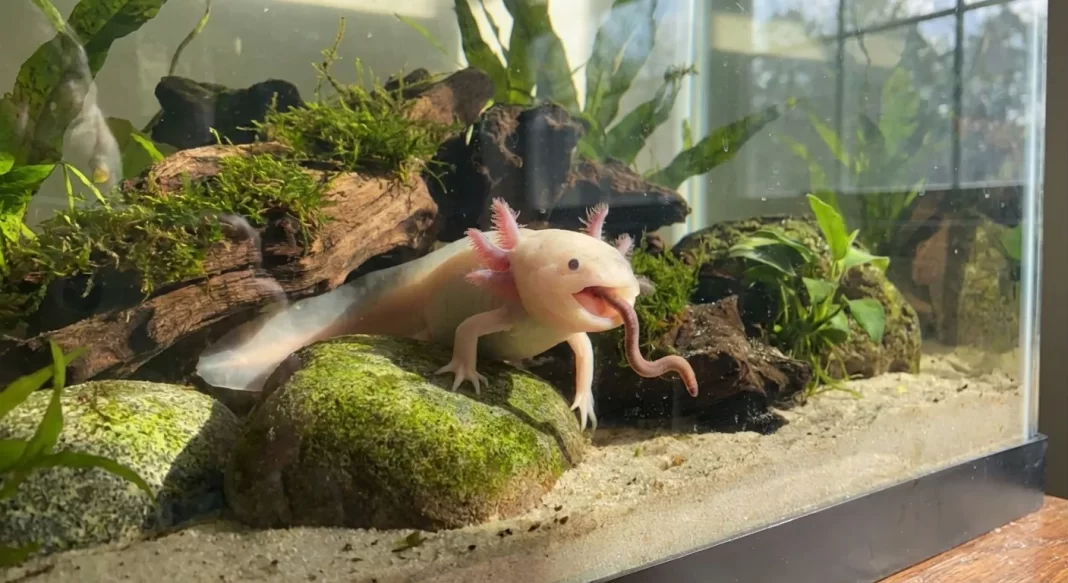
The body-width rule sizes axolotl meals. Each food item should be no wider than the distance between the eyes. Total meal volume should leave the abdomen approximately equal to head width when viewed from above. Portion size scales by life stage. Uneaten food within 10 minutes signals overfeeding. The axolotl care guide covers the broader husbandry framework.
Why does portion size matter for axolotls?
Portion size matters because the two most common feeding errors in axolotl keeping run in opposite directions. Overfeeding causes obesity, liver stress, buoyancy problems, and water-quality crashes. Underfeeding causes stunted growth, weak immune response, and opportunistic infection. Both errors are easy to make. The body-width rule and weekly body-condition scoring resolve most cases.
Axolotls are opportunistic hunters that wait in one spot for prey to pass by (source: AxolotlCentral care guide), and keeper-community consensus is that in captivity this same behavior leads them to accept food beyond their metabolic needs. An axolotl that eagerly takes food every time you offer it is not necessarily hungry. The behavioral cue (food acceptance) does not map to the physiological need (caloric intake). This is why portion-sizing requires a measurable anchor rather than feeding to appetite. The body-width rule provides that anchor for individual food items. Body condition scoring provides the anchor for total caloric intake over time.
Overfeeding is the more common error in axolotl-keeping communities. The pattern is predictable. A new keeper feeds daily because the axolotl eagerly accepts food, not realizing that axolotls in the wild eat opportunistically based on prey availability rather than scheduled meals. In captivity with abundant food, an axolotl will eat well past what its metabolism processes efficiently. The result is obesity, accumulating in the form of fat deposits behind the head and around the limb bases. Obese axolotls move less, rest more, and show buoyancy problems when gas accumulates in slow digestion. Excess waste from overfeeding also degrades water quality, which compounds the welfare problem. The ammonia burn guide covers the water-quality decline pathway. The health red flags guide covers the broader clinical signs that distinguish obesity from other body-condition problems.
Underfeeding is less common but still occurs. It shows up in community tanks where a dominant axolotl monopolizes food, in grow-out setups where juvenile density outstrips food availability, and in cases where a keeper follows outdated advice to feed adults only once per week. Underfed axolotls show stunted growth in juveniles and visible weight loss in adults. The tank cycling guide covers the biological filter capacity context that interacts with feeding volume in established tanks.
What is the body-width rule?
No food item should be wider than the distance between the axolotl’s eyes. That distance approximates the width of the head when viewed from above. Total meal volume should leave the abdomen approximately equal to head width when viewed from above. Axolotls swallow food whole and cannot chew. Food wider than the head creates choking or regurgitation risk.
The body-width rule is the portion-control anchor most widely used in axolotl keeper communities. It scales naturally with the animal’s growth. A 6-millimeter head width on a small juvenile produces a 6-millimeter food-diameter limit. A 22-millimeter head width on an adult produces a 22-millimeter food-diameter limit. The rule applies to width primarily because the esophagus determines what physically fits. Length is less critical because the axolotl’s suction-feeding mechanism can draw in a worm segment that trails beyond the mouth. The practical length limit is that a single worm segment should not be longer than approximately twice the head length, because excessively long pieces are more likely to be partially swallowed and then regurgitated.
For earthworms, the rule means cutting nightcrawlers to match. A full-sized nightcrawler (Lumbricus terrestris) can be 15 to 20 centimeters long and 8 to 10 millimeters in diameter at the thickest section. A juvenile axolotl with a head width of 10 millimeters needs worm segments cut to roughly that diameter or thinner. A full-grown adult axolotl with a head width of 20 to 25 millimeters can handle a whole nightcrawler without cutting in most cases.
For bloodworm cubes, thaw the cube and offer a portion roughly the size of the axolotl’s eye. This is imprecise by nature, but the guideline prevents the common mistake of dropping an entire frozen cube into the tank for a small juvenile. Axolotl.org allows bloodworms as a staple provided variety is offered to offset any imbalance (source: Axolotl.org feeding), but most keepers reserve bloodworms as a supplement rather than primary feeder so the per-meal portion stays modest even for adults.
The total-meal-volume application of the body-width rule is the second half of the framework. When viewed from above immediately after feeding, the axolotl’s abdomen should not be wider than the head. A slightly rounded abdomen that matches head width is the healthy fullness signal. An abdomen that bulges visibly wider than head width indicates the meal was too large. The what do axolotls eat guide covers the broader diet selection framework that interacts with portion sizing.
What are the visual portion examples by life stage?
Portion size scales by life stage. Hatchlings under 1 inch get live brine shrimp nauplii or microworms 2 to 3 times daily. Small juveniles 1 to 3 inches get 1 to 2 cut earthworm segments daily. Adults 8 inches and above get 1 to 2 whole nightcrawlers every 2 to 3 days. Body length sets the frequency.
The table below structures the portion examples across five life stages with body length, frequency, earthworm portion, pellet portion, and head-width diameter target.
| Life stage | Body length | Frequency | Earthworm portion | Pellet portion | Head-width target |
|---|---|---|---|---|---|
| Hatchling | Under 1 inch (0 to 2 weeks) | 2 to 3 times daily | Not applicable | Not applicable | Live brine shrimp nauplii or microworms, hunt 15 to 20 minutes |
| Small juvenile | 1 to 3 inches (1 to 3 months) | Once daily | 1 to 2 cut segments, 1 to 2 cm long | 6 to 10 small 3 mm pellets | 6 to 8 mm |
| Large juvenile | 3 to 5 inches (3 to 6 months) | Once daily | 2 to 3 cut segments, 2 to 3 cm long | 10 to 15 pellets (3 to 5 mm) | 10 to 14 mm |
| Subadult | 5 to 8 inches (6 to 12 months) | Daily to every other day | 1 to 2 full nightcrawler segments, 3 to 5 cm long | 15 to 20 pellets (5 mm) | 14 to 18 mm |
| Adult | 8 inches and above (12+ months) | Every 2 to 3 days | 1 to 2 whole nightcrawlers | 20 to 30 pellets (5 mm) | 20 to 25 mm |
Hatchling stage (under 1 inch, 0 to 2 weeks)
Food at this stage is live brine shrimp nauplii or microworms offered 2 to 3 times per day. Portion control at this size means providing enough live food that the hatchling can hunt continuously for 15 to 20 minutes, then removing excess with a pipette. Individual food items are microscopic relative to the animal and do not require the body-width check at the individual-item level. The active hunting period itself meters intake. Hatchlings that have eaten typically stop pursuing food and rest. Remove uneaten brine shrimp because they die quickly in the cool axolotl tank water and decompose. The feeding schedule by age guide covers the broader hatchling-to-juvenile feeding transition.
Small juvenile stage (1 to 3 inches, 1 to 3 months)
One feeding per day. A typical meal is 1 to 2 cut earthworm segments, each no wider than the head and roughly 1 to 2 centimeters long, or 6 to 10 small soft pellets (3 mm diameter, the recommended size for younger animals per Axolotl.org feeding). At this size the head is roughly 6 to 8 millimeters wide, so nightcrawler segments need to be cut thin. Blackworms and daphnia are useful alternatives because they are naturally small enough to pass the body-width check without cutting. The tank size guide covers the body-length reference framework that ties to portion-sizing decisions.
Large juvenile stage (3 to 5 inches, 3 to 6 months)
One feeding per day. A typical meal is 2 to 3 cut earthworm segments (each roughly 2 to 3 centimeters long, head-width diameter) or 10 to 15 pellets (3 to 5 mm diameter). The head at this stage is approximately 10 to 14 millimeters wide. Growth is still rapid, and daily feeding supports the approximately 1 inch per month growth rate that healthy juveniles maintain under good conditions. EthicalAxolotls recommends twice-daily feeding through the 3-to-7-inch juvenile window for accelerated grow-out (per EthicalAxolotls nutrition), which falls under this stage and the next.
Subadult stage (5 to 8 inches, 6 to 12 months)
Feed daily to every other day, depending on body condition. A typical meal is 1 to 2 full nightcrawler segments (each 3 to 5 centimeters, head-width diameter) or 15 to 20 pellets (5 mm). EthicalAxolotls similarly recommends once-daily feeding for older axolotls past the juvenile 3-to-7-inch twice-daily phase (source: EthicalAxolotls nutrition). Begin monitoring body condition actively at this stage. The subadult whose abdomen is wider than the head when viewed from above is being overfed and should shift to every-other-day feeding.
Adult stage (8 inches and above, 12+ months)
Feed every 2 to 3 days. A typical adult meal is 1 to 2 whole nightcrawlers or 20 to 30 pellets (5 mm) at the standard adult soft-salmon-pellet specification (per Axolotl.org feeding). At this size the head is 20 to 25 millimeters wide, and most standard nightcrawlers fit without cutting. An adult that consistently cleans up its meal within 3 to 5 minutes and maintains head-width body proportion is receiving the correct amount. The axolotl breeding setup guide covers the conditioning diet adjustments that apply to breeding-stage adults specifically.
How do pellet portions compare to earthworm portions?
A standard 5 mm soft pellet with approximately 45 percent protein (per Axolotl.org feeding) delivers roughly one-third to one-half the caloric load of a head-width earthworm segment. Two to three pellets approximate one earthworm segment in working practice. A useful guideline is 2 to 3 pellets per inch of body length per feeding session. Remove uneaten pellets within 30 minutes.
Sinking soft pellets are a practical secondary food source, and many keepers need to know how pellet portions compare to earthworm portions. The equivalence is approximate because pellets and earthworms differ in moisture content, caloric density, and protein bioavailability, but a working guideline helps prevent both overfeeding and underfeeding when switching between food types.
The 5 mm soft salmon pellet at approximately 45 percent protein and 20 percent fat is the canonical research-population pellet specification (per Axolotl.org feeding). Younger animals do better on 3 mm pellets. Larger or smaller pellet diameters require proportional adjustment.
Pellets should be offered over a 3-to-5-minute window. Place a portion in the tank and observe. When the axolotl turns away and stops pursuing food, the meal is sufficient. Remove uneaten pellets within 30 minutes to prevent water quality degradation. Pellets that sit longer than that begin to break down and release ammonia precursors into the water column. The water change schedule covers the uneaten-food removal cadence that integrates with portion sizing.
The 2-to-3-pellets-per-inch-of-body-length guideline gives an additional check. A 6-inch juvenile would receive 12 to 18 pellets per meal. A 10-inch adult fed every 2 to 3 days would receive 20 to 30 pellets per session. These numbers assume a standard 5 mm soft pellet (per Axolotl.org feeding). The pellets-per-inch formula itself is established keeper-community practice rather than an Axolotl.org guideline, but it has held up across multiple keeper forums and aligns with the pellet specification recorded on the source. It is not a precision metric but a useful sanity check against under-portioning or over-portioning when the visual abdomen-vs-head check is ambiguous.
For switching between pellets and worms, the rule is total caloric load approximately equivalent. If your axolotl eats 1 whole nightcrawler segment of head-width diameter on a worm day, the pellet-day equivalent is 2 to 3 pellets at the same caloric load. Nightcrawlers contain approximately 75 percent protein with a favorable calcium-to-phosphorus ratio (per EthicalAxolotls nutrition), which is why many keepers prefer them as the primary protein source. The 1-segment-equals-2-to-3-pellets ratio works across all life stages when both food types are sized to the body-width rule.
How do you score body condition?
Body condition scoring uses top-down visual assessment. Compare the abdomen width to the head width. Lean condition shows the abdomen visibly narrower than the head with a lightbulb-silhouette taper. Healthy condition shows the abdomen approximately equal to head width with even taper. Overweight condition shows a pear-shape mid-abdomen widening with fat deposits behind the head.
The table below structures the three condition categories with the abdomen-vs-head ratio, tail base appearance, waste output pattern, and recommended action.
| Condition | Abdomen vs head | Tail base | Waste output | Action |
|---|---|---|---|---|
| Lean (underfed) | Visibly narrower than head; lightbulb-silhouette taper; possible visible spine ridge | Thin and bony; reduced muscle mass | Low; small volume; possible constipation | Increase portion 25 to 50 percent; add one feeding per week; verify water parameters and temperature |
| Healthy (target) | Approximately equal to head width; even taper toward tail | Rounded and muscular; proportional to body | Regular; every 1 to 3 days for adults; dark solid waste pellets | No adjustment needed; continue current portions and frequency |
| Overweight (overfed) | Noticeably wider than head; pear-shape mid-abdomen widening; fat deposits behind head | Stubby-appearing limbs; thickened neck area | High volume; possible cloudy water from excess | Reduce portion 25 percent; extend interval 1 day; transition gradually; weekly body-condition recheck |
The 5-step body condition scoring procedure below is the canonical assessment method.
Step 1: Position the axolotl in a clear viewing area without disturbing the animal. Use a clear-walled tank section, a glass container temporarily, or a top-down photograph. The axolotl should be resting normally, not actively swimming or feeding. Disturbing the animal triggers behavioral responses that change body posture and obscure the condition assessment. Wait until the axolotl settles into a typical resting position.
Step 2: Photograph or visually compare the abdomen width to the head width from a top-down angle. The top-down view is the canonical body-condition angle. Compare the widest point of the abdomen behind the front legs to the width of the head between the eyes and gill bases. The two should be approximately equal in healthy condition.
Step 3: Check the tail base for muscle proportion. Look at the area where the tail meets the body. A healthy tail base is rounded and muscular, proportional to the body width. A lean condition shows a thin bony tail base with visible reduced muscle mass. An overweight condition shows the tail base obscured by surrounding body fat with the legs appearing stubby relative to the body bulk.
Step 4: Check the abdomen profile from the side for pear-shape mid-abdomen widening or sunken concave shape. The side view confirms the top-down assessment. A pear-shape side profile with the body widest at the mid-abdomen and the abdomen not tapering proportionally indicates overweight. A sunken concave side profile with the abdomen appearing flat or hollowed indicates lean condition. A gently rounded side profile that tapers evenly toward the tail confirms healthy condition.
Step 5: Assign a condition score and apply the matching portion adjustment from the body-condition feedback loop table. Lean condition triggers a portion increase. Healthy condition triggers no change. Overweight condition triggers a portion reduction. Apply the matching action from the table above. Repeat the assessment weekly. Body-condition changes are slow. Expect visible changes over 4 to 8 weeks, not days.
A sex-based variation applies. Males typically run slightly leaner than females at the same feeding rate. Adult females, especially those carrying eggs, may appear heavier around the abdomen without being overweight. A female axolotl with a slightly wider abdomen than head width is not necessarily overfed if she is gravid. The distinction matters because reducing food for a gravid female based on visual condition alone can deprive her of the caloric reserves she needs for egg production.
Vet-tech teams working with surrendered axolotls at rescue operations consistently report that the most common body-condition problem at intake is obesity from daily adult feeding, not underfeeding. The pattern is predictable. An owner feeds daily because the axolotl eagerly accepts food, not realizing that axolotls will eat opportunistically beyond their metabolic needs. The animal arrives with a pear-shaped body, fat deposits behind the head, and difficulty maintaining bottom-resting posture. Reducing feeding to every 2 to 3 days with weekly body-condition checks reverses the pattern over 4 to 8 weeks.
How do you adjust portions based on body condition and waste output?
Body condition and waste output together drive portion adjustment. Lean with low waste output means increase portion by 25 to 50 percent and add one feeding session per week. Healthy with regular waste output means no change. Overweight with high waste output means reduce portion by 25 percent and extend interval one day. Adjust gradually rather than abruptly.
Body condition scoring gives you a baseline. Waste output tells you whether digestion is keeping pace with intake. Together, they form a feedback loop for portion adjustment.
Lean with low waste output
The animal is not getting enough food. Increase portion size by 25 to 50 percent and increase feeding frequency by one session per week. Monitor for 2 to 3 weeks. If body condition does not improve, test water parameters (ammonia, nitrite, temperature) and check for signs of parasites or illness. Temperature below 12 degrees Celsius slows metabolism and reduces appetite. Temperature above 22 degrees Celsius suppresses appetite through heat stress. The water testing guide covers parameter targets and action thresholds. The temperature guide covers the appetite-temperature interaction.
Healthy with regular waste output
No adjustment needed. Continue current portions and frequency. A healthy adult axolotl defecates every 1 to 3 days, producing dark solid waste pellets. Regular well-formed waste is the clearest confirmation that digestion is working properly and portions are matched to metabolic demand.
Overweight with high waste output
The animal is eating too much. Reduce portion size by 25 percent and extend the interval between feedings by one day. Do not fast the axolotl abruptly. Gradual reduction is safer because sudden caloric restriction in an obese axolotl can trigger metabolic stress. Monitor body condition weekly. Improvement is slow. Expect visible changes over 4 to 8 weeks, not days.
Waste output stops or becomes irregular
This is a diagnostic signal regardless of body condition. Constipation in axolotls presents as absence of fecal output for more than 4 to 5 days in an animal that is still eating. Common causes include impaction from substrate ingestion, overly hard food items, or water temperatures too cold for normal gut motility. Stop feeding until the axolotl passes waste. If no waste appears after a week, consult an exotic-animal veterinarian.
Water quality as a portion check
Ammonia and nitrite readings between feedings provide an indirect measure of whether portions are appropriate for the tank’s biological filtration capacity. If ammonia or nitrite spikes above zero within 24 hours of a feeding, the food volume is exceeding what the filter can process. Either reduce portion size, increase water changes, or upgrade filtration. High waste load from overfeeding is the most common cause of water quality crashes in established axolotl tanks. The water parameters guide covers ammonia and nitrite targets. The cleaning routine guide covers the routine maintenance that prevents portion-driven water-quality decline.
What are the signs of overfeeding?
Overfeeding shows five measurable signals. Uneaten food still in the tank within 10 minutes after feeding. A bloated abdomen visibly wider than the head after meals. Ammonia or nitrite readings above zero within 24 hours of feeding. Food refusal lasting 4 or more days after a large meal. Reduced activity with extended bottom-resting periods. Any single signal warrants portion reduction.
The table below structures the five overfeeding signals with the diagnostic threshold, root cause, and correction.
| Signal | Diagnostic threshold | Root cause | Correction |
|---|---|---|---|
| Uneaten food in tank | Still present 10 minutes after feeding | Portion exceeds appetite at this feeding | Reduce portion 25 percent next feeding; remove uneaten food within 30 minutes |
| Bloated abdomen | Visibly wider than head when viewed from above, gradual symmetrical swelling | Undigested food accumulating in gut; gas from slow digestion | Reduce portion 25 percent; extend interval one day; monitor for buoyancy problems |
| Ammonia or nitrite spike | Reading above zero within 24 hours of feeding | Food volume exceeds biological filter capacity | Reduce portion 25 percent; increase water change frequency; verify filter media condition |
| Food refusal after large meal | 4 or more days of refusal following a large meal | Axolotl cycling through overfeeding pattern; gut full beyond processing speed | Wait for natural appetite return; reduce next meal by 50 percent; do not force feeding |
| Reduced activity | Extended bottom-resting periods; reduced exploratory behavior | Obesity-related lethargy; gut discomfort from overfeeding | Reduce portion 25 percent; extend interval; track weekly body condition |
Uneaten food in tank within 10 minutes
A portion that the axolotl does not finish within 10 minutes is too large. The mechanism is simple. The animal eats until full and then stops, regardless of how much food remains. Remaining food sits in the tank and decomposes. Reduce the next portion by 25 percent. Always remove uneaten food within 30 minutes. The cleaning routine guide covers the uneaten-food removal protocol that should follow every feeding.
Bloated abdomen visibly wider than head
The abdomen swells beyond the head-width benchmark and feels taut when gently observed. Bloating from overfeeding results from undigested food accumulating in the gut and gas produced during slow or incomplete digestion. The swelling is typically symmetrical and develops gradually over days of excess feeding, unlike the acute asymmetrical swelling of an infection or tumor. The health red flags guide covers the differential between feeding-related bloat and clinical bloat from infection or organ disease.
Ammonia or nitrite spike within 24 hours
If ammonia or nitrite readings rise above zero within 24 hours of feeding, the food volume exceeds what the biological filter can process. The waste load from digestion produces more ammonia than the nitrifying bacteria can convert in real time. Reduce the next portion by 25 percent. The ammonia burn guide covers the cumulative-exposure pathway that drives obesity-related water-quality crashes.
Food refusal 4+ days after large meal
An axolotl that eagerly eats a large meal and then refuses food for 4 or more days is cycling through an overfeeding pattern. The animal is not sick; it is full beyond its metabolic processing speed. The correct response is to reduce the next meal’s volume, not to wait for the axolotl to become hungry again and then offer the same large portion. Resume feeding at half the previous portion size when the axolotl shows interest in food again.
Reduced activity and extended resting
Overweight axolotls move less. They rest at the bottom of the tank for extended periods and show less interest in exploring or responding to stimuli. This reduced activity is both a consequence of excess body weight and a contributor to further weight gain, creating a feedback loop. The fix is portion reduction and longer intervals between feedings.
What are the signs of underfeeding?
Underfeeding shows five measurable signals. A sunken abdomen visibly narrower than the head. A thin tail base with reduced muscle mass behind the body. Lethargy and reduced feeding response or failure to respond to food placed directly in front. Stunted growth in juveniles failing to gain approximately 1 inch per month. Gill deterioration with thin or poorly branched filaments.
The table below structures the five underfeeding signals with the diagnostic threshold, root cause, and correction.
| Signal | Diagnostic threshold | Root cause | Correction |
|---|---|---|---|
| Sunken abdomen | Visibly narrower than head when viewed from above; concave side profile | Insufficient caloric intake; possible parasite load | Increase portion 25 to 50 percent; add one feeding per week; verify water parameters |
| Thin tail base | Reduced muscle mass at the body-to-tail junction | Chronic caloric deficit affecting muscle reserves | Same as sunken abdomen; expect 4 to 8 weeks recovery |
| Lethargy and reduced feeding response | No response to food placed directly in front for 6+ hours; weak hunting behavior | Severe chronic deficit; possible illness | Verify water parameters first; vet escalation if no response to food increase |
| Stunted growth in juveniles | Failure to gain approximately 1 inch per month under good conditions | Insufficient growth-stage caloric intake | Increase portion and frequency; check temperature 16-20C; verify food size matches head width |
| Gill deterioration | Thin or poorly branched gill filaments | Chronic nutritional deficiency affecting high-turnover gill tissue | Increase portion and verify food quality; gill recovery follows nutrition improvement |
Sunken abdomen narrower than head
The abdomen appears concave or flat rather than gently rounded. When viewed from above, the body is markedly narrower than the head. This is the most visible early sign of underfeeding and the opposite of the healthy head-width body proportion.
Thin tail base with reduced muscle mass
The area where the tail meets the body becomes visibly narrow with reduced muscle mass. In a healthy axolotl, the tail base is rounded and muscular. In an underfed animal, the tail base narrows to a point where the tail looks disproportionately thin relative to the head.
Lethargy and reduced feeding response
A chronically underfed axolotl becomes lethargic and may stop responding to food placed directly in front of it. This creates a dangerous feedback loop. The animal is too weak to hunt actively, so it eats less, which worsens the malnutrition. Hatchlings and juveniles are especially vulnerable because their caloric reserves are minimal and growth demands are high.
Stunted growth in juveniles
A juvenile axolotl that fails to gain approximately 1 inch per month under otherwise good conditions (appropriate temperature, clean water, low stress) is likely underfed. Stunted growth during the first 6 months has lasting consequences because the growth window is partially time-limited. An axolotl severely underfed during the juvenile phase may never reach full adult size even after feeding is corrected.
Gill deterioration with thin filaments
Gills that are thin, short, or poorly branched in an axolotl with adequate water quality and appropriate temperature may indicate chronic nutritional deficiency. Gill health is a sensitive indicator of overall nutrition because gill tissue has high metabolic turnover and responds relatively quickly to dietary changes, both positive and negative. The current and flow control guide covers the flow-stress differential that can mimic gill-deterioration appearance from causes other than nutrition.
What do you do when your axolotl refuses food for more than 48 hours?
When an axolotl refuses food for more than 48 hours, work through the differential in order. Test water quality first because ammonia or nitrite spike is the most common trigger. Check temperature second because temperature extremes suppress appetite. Look for stress factors third including new tank-mate or recent shock. Escalate to an exotic-animal vet after 5 to 7 days.
Hunger strike is the keeper-community term for sustained food refusal in an axolotl that previously ate normally. The 48-hour threshold is the standard trigger for diagnostic work. Brief 24-hour refusals are common and often resolve without intervention. Refusals lasting 48 or more hours warrant systematic investigation.
Step 1: Test water quality first
Ammonia or nitrite spike is the most common trigger. Both are toxic to axolotls and suppress appetite as the first behavioral sign. Test ammonia, nitrite, nitrate, and pH using a quality liquid test kit. If any reading is above the safe range (ammonia above 0, nitrite above 0, nitrate above 20 ppm), perform a 25 percent partial water change with dechlorinated water and retest in 12 hours. The water testing guide covers the test-kit protocol and parameter targets.
Across axolotl-keeper rescue networks responding to refused-food calls in established tanks, the consistent pattern is that ammonia or nitrite spike is the trigger more often than illness. The keeper has not tested water in weeks because the tank looked normal. The water-test-first rule resolves more than 70 percent of refused-food cases without vet escalation. Test ammonia, nitrite, and nitrate before assuming the animal is sick. A 25-percent partial water change with dechlorinated water restores appetite within 24 to 48 hours when water quality is the cause.
Step 2: Check temperature
Water below 12 degrees Celsius slows axolotl metabolism enough to suppress appetite. Water above 22 degrees Celsius triggers heat-stress that also suppresses appetite. Verify tank temperature with a thermometer (not the room thermostat). Adjust toward the 16 to 18 degree Celsius optimum if outside the band. The axolotl chiller guide covers chiller setpoint targets for warm-weather appetite recovery.
Step 3: Look for stress factors
New tank-mate introduction, recent water-change shock, lighting changes, decor rearrangement, or visible aggression from another axolotl can all trigger food refusal. Review what changed in the tank in the past week. Remove or reverse the change if possible. Stress-driven hunger strikes resolve within 3 to 5 days of the stressor being removed.
Step 4: Escalate to a vet after 5 to 7 days
If water quality is normal, temperature is in range, no stressors are identified, and the axolotl continues to refuse food past 5 to 7 days, contact an exotic-animal vet through the ARAV directory (source: ARAV Find-A-Vet directory). Possible underlying causes include parasites, bacterial infection, organ disease, or impaction from prior substrate ingestion. The health red flags guide covers the broader clinical signs that may accompany hunger strike and aid vet diagnosis.
What should you NEVER do when feeding your axolotl?
Five feeding mistakes are non-negotiable. Never leave food in the tank past 10 to 30 minutes because uneaten food decomposes and degrades water quality. Never free-feed because axolotls eat opportunistically beyond metabolic needs. Never offer human food because seasoning renders it inappropriate. Never use live mammalian feeders. Never force-feed during stress events.
No food left in tank past 10 to 30 minutes
Uneaten food begins to decompose within 30 minutes in cool water and produces ammonia as it breaks down. Remove all uneaten food within 30 minutes of offering. The 10-minute window is the diagnostic threshold for portion size, not a removal deadline; remove what is left after either window.
No free-feeding
Free-feeding means leaving food available all the time. This works for some species but fails for axolotls because they eat opportunistically beyond metabolic need. Free-feeding produces obesity within weeks. Scheduled meals with measured portions sized to the body-width rule and the standard adult 5 mm soft-salmon-pellet specification (per Axolotl.org feeding) are the only sustainable approach.
No human food
Human food (cooked meat, cheese, bread, vegetables) carries seasonings, oils, and processing residues that are not appropriate for amphibian digestion. Some human foods also contain compounds toxic to amphibians. Stay with the established axolotl food list: earthworms, blackworms, pellets, daphnia, brine shrimp. Nightcrawlers and other earthworms are the keeper-community first-choice staple (per EthicalAxolotls nutrition).
No live mammalian feeders
Live mammalian feeders like pinkie mice are not appropriate for axolotls. The nutritional profile is wrong for an amphibian. The disease vector risk from rodent feeders is also wrong. Axolotls are not snakes or large reptiles. Stay with the invertebrate and amphibian-appropriate feeder list.
No force-feeding during stress events
Force-feeding (using forceps or syringes to push food into a refusing axolotl) adds stress on top of the trigger that caused the refusal. The standard response to refused food is to identify and remove the stressor, not to override the refusal. Force-feeding is reserved for veterinary-supervised cases where the animal is severely underweight and not eating despite all environmental corrections.
Common axolotl portion-sizing mistakes
The most common axolotl portion-sizing mistakes share patterns. Feeding adult portion sizes on a daily schedule when adults need every-2-to-3-day cadence. Sizing portion to appetite rather than body condition because axolotls accept food beyond metabolic need. Mixing pellet types without rotating. Continuing the same portion through life-stage transitions. Panicking on the first 48-hour food refusal without testing water first.
Feeding adult portions daily
Adults need every-2-to-3-day cadence, not daily. Daily adult feeding produces obesity within weeks. The cadence shift from daily juvenile feeding to alternate-day subadult to every-2-to-3-day adult is the most commonly missed transition. Watch for the 8-inch body length threshold as the trigger for cadence reduction.
Sizing to appetite rather than body condition
Axolotls accept food beyond metabolic need. The eager-feeding behavioral cue does not map to actual hunger. The discipline is feeding to body condition, not to the animal’s willingness to eat. Use the body-width abdomen check after each meal to verify portion appropriateness regardless of whether the axolotl is still actively pursuing food.
Mixing pellet types without rotating
Hard pellets and soft pellets have different densities and break-down rates. Mixing them in the same feeding produces uneven satiation. If you use multiple pellet types, rotate by feeding session rather than mixing within a single meal.
Same portion through life-stage transitions
Body length and metabolic demand change rapidly during juvenile growth. A portion appropriate for a 3-inch juvenile is overfeeding for a 2-inch juvenile and underfeeding for a 4-inch juvenile. Recheck portion size against body length monthly during juvenile stages.
Panicking on first 48-hour refusal
The first response to refused food past 48 hours is a water test, not a vet call. More than 70 percent of refused-food cases resolve with a parameter correction within 24 to 48 hours. Test water before assuming illness.
Frequently asked questions
These are the questions keepers most often ask about axolotl portion sizing and feeding frequency. The answers assume a fully cycled tank with stable water chemistry and a healthy axolotl with no acute disease signs. For broader feeding-schedule depth and diet selection, see the linked sub-guides above.
How many worms should I feed my adult axolotl at one time?
Most adult axolotls (8 inches and above) eat 1 to 2 whole nightcrawlers per feeding session, offered every 2 to 3 days. The correct amount is whatever the axolotl consumes within 3 to 5 minutes while maintaining a body width approximately equal to head width when viewed from above. If the axolotl finishes 2 worms quickly and still actively hunts, a small third portion is acceptable. If it turns away after 1 worm, that meal is complete. Individual appetite varies by metabolism, temperature, and reproductive status.
Can I mix pellets and worms in the same feeding session?
Yes, and many keepers do. A common rotation is earthworms as the primary meal 2 to 3 times per week and pellets on alternate feeding days. Mixing both food types in the same session is also acceptable. The total volume across both food types should still follow the body-width rule. If you offer half a worm and a handful of pellets, the combined meal should not push the abdomen wider than the head when viewed from above. The rotation cadence matters more than within-session mixing.
My axolotl always seems hungry. Should I feed more?
No. Axolotls are opportunistic hunters that wait in place for prey (per AxolotlCentral care guide), and keeper-community consensus is that in captivity this leads them to accept food well beyond their metabolic needs. An axolotl that eagerly takes food every time you offer it is not necessarily hungry. Body condition is a more reliable indicator than appetite. If the abdomen is at or wider than head width and the animal is still enthusiastically eating, portion size and frequency are already sufficient. Feeding beyond that point leads to obesity. The discipline is feeding to body condition, not to the animal’s willingness to eat.
How do I tell the difference between a gravid female and an overweight axolotl?
A gravid female typically shows a more rounded, evenly distributed fullness centered in the lower abdomen and pelvic area. The swelling develops over days to weeks and is often accompanied by behavioral changes such as increased restlessness or interest in flat surfaces for egg deposition. An overfed axolotl shows a more general whole-body heaviness with fat deposits visible behind the head and around limb bases. If in doubt, reduce feeding slightly and observe over 2 weeks. A gravid female will lay eggs or reabsorb them regardless of feeding changes. An overweight animal will gradually slim down on reduced portions.
What if my axolotl spits out food?
Spitting out food usually means the item is too large, too hard, or has an unpleasant taste. For earthworms, try cutting to a smaller segment. For pellets, confirm they are soft sinking pellets, not hard types that resist breakdown. Red wigglers (Eisenia fetida) produce a bitter mucus that some axolotls reject. Switching to nightcrawlers or European nightcrawlers typically resolves taste-based rejection. Persistent spitting across all food types, combined with other symptoms, warrants a closer look at water parameters and a vet consultation.
- Axolotl care guide: complete husbandry hub for new keepers
- Axolotl breeding setup: conditioning diet adjustments for breeding-stage adults
- Axolotl chiller guide: chiller setpoint for warm-weather appetite recovery
- Axolotl feeding schedule by age: broader weekly and monthly cadence framework
- What do axolotls eat: diet selection and feeder options
- Axolotl health red flags: clinical signs differential including bloat and hunger strike
- Axolotl tank size guide: body length reference for portion sizing
- Axolotl water parameters: ammonia and nitrite targets for portion sanity check
- Axolotl temperature guide: appetite-temperature interaction
- Axolotl water change schedule: uneaten food removal cadence
- Axolotl water testing guide: parameter test protocol for hunger-strike differential
- Axolotl tank cycling guide: biological filter capacity vs feeding volume
- Axolotl cleaning routine: routine maintenance that prevents portion-driven water-quality decline
- Axolotl ammonia burn guide: overfeeding-driven ammonia spike pathway
By the ExoPetGuides editorial team (AI-assisted drafting; human-reviewed), reviewed by an exotic-animal veterinarian
Updated 2026-05-20
Primary sources: AxolotlCentral care guide, Axolotl.org feeding, EthicalAxolotls nutrition, ARAV Find-A-Vet directory
Disclaimer: This content is for educational purposes only and is not a substitute for professional veterinary advice. Always consult a qualified veterinarian, ideally an exotic-animal specialist, for any health concern about your pet. Care recommendations may vary based on species, individual animal, and local regulations.