


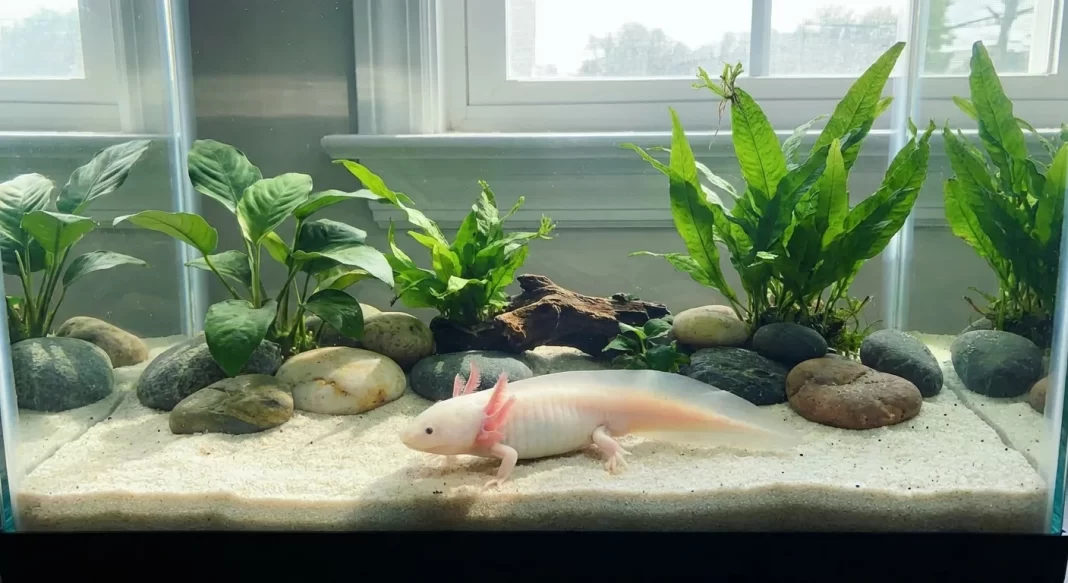
A clean axolotl tank is not one that looks sterile. It is one where ammonia reads 0 ppm, nitrite reads 0 ppm, nitrate stays below 20 ppm, and the biological filter is undisturbed. Daily takes 5 to 10 minutes. Weekly adds a water change and parameter test. Monthly rinses filter media in old tank water, never tap.
What does “clean” actually mean for an axolotl tank?
A clean axolotl tank is not a tank that looks sterile. It is a tank where ammonia reads 0 parts per million, nitrite reads 0 parts per million, nitrate stays between 5 and 20 parts per million, and the biological filter remains undisturbed. Most axolotl health problems trace back to water-chemistry failures that a consistent routine catches before they become emergencies.
This frame-reset matters because the visual-sterility instinct is exactly what causes preventable problems. Keepers who scrub the inside of the tank with detergent, rinse filter media under the tap, or replace all substrate at once routinely crash the cycle. Ammonia spikes follow. The axolotl pays the price. The job of a cleaning routine is to maintain stable water chemistry, observe the animal daily, and intervene before chemistry drifts. Visible algae on the glass is cosmetic. Cloudy water that looks dirty is sometimes the bacterial bloom of a healthy cycling process or a recovering tank; sometimes the dim early sign of a problem. Test results decide. The axolotl care guide covers the broader husbandry framework. The water parameters guide covers per-parameter target depth, and the water testing guide covers test-kit selection and interpretation.
The table below structures the maintenance cadence by interval, core tasks, and typical time required. Every interval handles a different category of accumulation. Daily catches waste before it decomposes. Weekly removes accumulated nitrate and dissolved organics through a partial water change (per Axolotl.org captive requirements). Monthly addresses what the water column alone cannot reach. Seasonal catches silent equipment failures before they become emergencies.
| Interval | Core tasks | Time required |
|---|---|---|
| Daily | Observation + uneaten food removal + waste spot-check + temperature glance | 5-10 minutes |
| Weekly | 20% partial water change + ammonia/nitrite/nitrate/pH test + glass cleaning | 30-45 minutes |
| Monthly | Filter media rinse in old tank water + substrate vacuum (sand only) + equipment function check | 45-60 minutes |
| Seasonal / annual | Silicone seal inspection + tubing inspection + heater-or-chiller deep service + bulb replacement | 1-2 hours |
The standard weekly partial water change comes from the primary keeper-authority literature. The captive-care page at Axolotl.org records the cadence directly. Keepers should regularly replace 20 percent of the water each week (source: Axolotl.org captive requirements). The water-chemistry targets come from AxolotlCentral’s care standards: ammonia 0 ppm, nitrite 0 ppm, nitrate between 5 and 20 ppm, pH between 7.2 and 8.4, GH 7 to 14 dGH, KH 3 to 7 dKH (source: AxolotlCentral care guide). The water change schedule covers full procedure depth for the weekly change, and the tank cycling guide covers the cycled-tank prerequisite that this entire cleaning routine depends on.
Daily cleaning tasks: observation and waste removal
Daily maintenance takes 5 to 10 minutes. Remove uneaten food with a turkey baster. Spot-check and remove visible waste from the substrate or bare bottom. Glance at the thermometer to confirm temperature is in range. Observe the axolotl for gill condition, skin appearance, and appetite. The goal is observation combined with targeted waste removal, not scrubbing or disinfecting.
Daily tasks catch problems before they compound. The animal lives in a few dozen gallons of water. Decomposing food and accumulated waste both release ammonia directly into the water column. Catching them within hours rather than days keeps the chemistry stable between weekly water changes.
Remove uneaten food
Axolotls are messy eaters. An earthworm dropped at feeding time may be partially consumed. Fragments sink to the substrate or settle behind decor. Uneaten food decomposes within hours. It releases ammonia directly into the water column. A turkey baster is the most-used tool for daily spot removal. It lets you suction small debris without disturbing the substrate or startling the axolotl. If you feed pellets, remove any uneaten pellets within 20 to 30 minutes. If you hand-feed earthworms, pick up any dropped fragments right after the feeding session.
Spot-check and remove waste
Axolotl waste is visible and sizable relative to the animal’s body. A healthy adult produces solid, dark-colored waste. It is easy to spot on bare-bottom tanks and slightly harder to see on sand. Use the turkey baster to remove any visible waste during your daily check. On bare-bottom setups, waste sits in plain view. You can remove it in under a minute. On sand, look along the edges of hides, behind plants, and in low-flow corners where waste tends to settle. Leaving waste in the tank for multiple days accelerates ammonia production. In smaller tanks (20 gallons), even one missed day of waste removal can produce a detectable ammonia reading by the next morning.
Check the temperature
Glance at your thermometer during every daily check. Axolotls require cool water. The optimum is 60 to 64 degrees Fahrenheit (16 to 18 Celsius) (per Axolotl.org captive requirements). The acceptable upper boundary is 68 degrees Fahrenheit (20 Celsius) (per AxolotlCentral care guide). A reading outside this range is a signal to investigate before the next scheduled maintenance. Room temperature changes from seasonal shifts, heating system cycles, or direct sunlight exposure on the tank can push water temperature out of range within hours. The temperature guide covers correction protocols when readings fall outside the safe window, and the chiller guide covers active cooling equipment when room temperature regularly exceeds the safe ceiling.
Observe the axolotl
Daily observation is a cleaning-adjacent task that experienced keepers never skip. Look at the gills. Healthy gill filaments are full, feathery, and spread outward. Gills that appear curled forward, clamped against the head, or reduced in filament density are early stress indicators. Check for white cotton-like patches on the skin or gills (early fungal growth), loss of appetite compared to normal feeding behavior, and changes in activity level. Increased surface gulping can also signal low dissolved oxygen, which falls as water warms (per USGS Water Science School on dissolved oxygen). If symptoms persist, locate an exotic-animal vet through the ARAV Find-A-Vet directory. The health red flags guide covers the symptom catalog the daily observation pass checks against.
Across axolotl-keeper rescue networks reviewing recovered animals, the recurring pattern is that visible health problems almost always follow 3 to 5 days of subtle behavioral changes that a quick daily check would have caught. Reduced appetite, forward-curled gills, increased surface gulping, and a subtle lethargy that inexperienced keepers mistake for normal resting behavior. These are the early signals. A daily 5-minute observation pass shortens the lag between problem onset and keeper response.
Weekly cleaning tasks: water change, parameter test, and glass cleaning
Weekly maintenance adds a 20 percent partial water change with dechlorinated, temperature-matched replacement water. Test ammonia, nitrite, nitrate, and pH with a liquid test kit before the water change, not after. Clean interior glass algae with an aquarium-safe scraper or magnet. Use only aquarium-safe tools. Household glass cleaners are toxic to axolotls.
Weekly tasks are the backbone of axolotl tank maintenance. They maintain the chemical stability that daily spot cleaning cannot address alone.
Perform a 20 percent partial water change
The standard weekly maintenance for an established, fully cycled axolotl tank is a 20 percent partial water change (per Axolotl.org captive requirements). This removes accumulated nitrate, dissolved organic compounds, and hormones that no filter can eliminate. The water change schedule covers the full procedure, including temperature matching, dechlorination, and when to increase frequency based on tank size and bioload.
Replacement water must be treated with dechlorinator before it enters the tank. Chlorine and chloramine in untreated tap water burn gill tissue. They also kill the beneficial bacteria that power the nitrogen cycle. Seachem Prime is the most widely used product in the keeper community. It neutralizes chlorine and chloramine. It also temporarily binds free ammonia at standard dose. You can emergency-dose at higher concentrations during cycle problems (source: Seachem Prime product page). Temperature-match the new water to within 2 degrees Fahrenheit (1 Celsius) of the tank water to prevent thermal shock. The dechlorinator guide covers product selection and dosing.
Test water parameters
Test ammonia, nitrite, nitrate, and pH at least once per week using a liquid test kit. The API Freshwater Master Test Kit measures five parameters by liquid reagent in test tubes, which keepers prefer to test strips for accuracy (source: API Freshwater Master Test Kit product page). Target readings for a healthy axolotl tank are ammonia 0 ppm, nitrite 0 ppm, nitrate between 5 and 20 ppm, and pH 7.2 to 8.4 (per AxolotlCentral care guide). The water testing guide covers how to interpret results, action thresholds for each parameter, and when to test more frequently.
Test before the water change, not after. Pre-change readings tell you what the tank accumulated over the past week. That tells you whether your current schedule is adequate. If nitrate is consistently above 15 ppm before your weekly change, consider increasing the change volume to 25 to 30 percent or running the change twice per week. Some keeper-rescue programs prefer a larger 50-percent weekly change as the default cadence (per Ethical Axolotls care parameters).
Clean the interior glass
Algae buildup on aquarium glass is cosmetic rather than dangerous, but it reduces visibility for daily observation and, in heavy cases, competes with the biological filter for nutrients. Clean interior glass surfaces weekly using a magnetic algae scraper or an aquarium-safe algae pad. Do not use household glass cleaners. They contain surfactants and chemicals that are toxic to aquatic animals.
Work the scraper gently to avoid disturbing the substrate or dislodging decor. If you use a magnetic cleaner, keep the outside magnet moving slowly to prevent the inside magnet from trapping sand grains against the glass, which can scratch the surface. On acrylic tanks, use only acrylic-safe pads to avoid micro-scratching.
Monthly cleaning tasks: filter media, substrate, and equipment
Monthly maintenance rinses filter media in old tank water, never tap water. Tap water chlorine kills the nitrifying bacteria that handle the nitrogen cycle. Vacuum sand substrate top layer only, in sections, never all at once. Check filter flow rate, heater or chiller cycling, air pump output, thermometer accuracy, and the lighting timer schedule.
Monthly tasks address the components that accumulate waste more slowly than the water column but still require regular attention to prevent long-term degradation.
Rinse filter media in old tank water
This is the single most important rule in axolotl tank maintenance. Rinse filter media in old tank water removed during a water change. Never rinse filter media under tap water. Tap water contains chlorine or chloramine. Both kill the nitrifying bacteria (Nitrosomonas and Nitrospira) on the media surface. These bacteria are the engine that converts ammonia to nitrite to nitrate. Destroying them causes a partial or complete cycle crash. Ammonia and nitrite spikes follow. Both are toxic to your axolotl.
To rinse filter media safely, remove the sponge, ceramic rings, or bio-balls from the filter housing. Place them in a bucket of old tank water siphoned during your water change. Gently squeeze sponge media or swirl ceramic media to dislodge trapped debris. The water in the bucket will turn brown. This is normal. You are removing physical waste while preserving the bacterial colony. Put the media back into the filter. Discard the dirty water. Do not rinse until the water runs clear. Excessive rinsing removes more bacteria than necessary.
Mechanical filter media (filter floss, coarse sponge pads) can be replaced when visibly degraded or clogged beyond effective rinsing, typically every 2 to 3 months depending on bioload. Replace one media type at a time, never all media simultaneously, to preserve bacterial populations across the transition. The filtration guide covers media replacement schedules by filter type, and the tank cycling guide covers the cycling-from-scratch protocol that applies when a cycle crash happens.
Vacuum the substrate (sand tanks only)
Bare-bottom tanks do not require substrate vacuuming because waste sits on the exposed glass surface where daily spot cleaning handles it. Sand substrate traps waste particles in the top layer, where decomposition releases ammonia below the surface. A monthly substrate vacuum with a gravel siphon removes this trapped debris without removing the sand itself.
To vacuum sand safely, hold the siphon tube 1 to 2 inches above the sand surface and let the suction pull debris upward without sucking sand into the tube. If sand enters the tube, pinch the hose briefly to let the sand settle back down. Work in sections, covering roughly one-third to one-half of the tank floor per session to avoid disrupting too much of the substrate’s bacterial surface at once.
Check equipment
Monthly equipment checks prevent the silent failures that cause overnight emergencies. Inspect filter flow rate. If output flow has dropped since last month, check for impeller blockage, intake obstruction, or media compaction. Reduced flow means reduced filtration. Verify heater or chiller function. If you use a chiller or fan-based cooling system, confirm it cycles on and off at the correct thresholds. The chiller guide covers chiller-specific maintenance including the every-2-to-3-month condenser coil cleaning. Check air pump and air stone output. Reduced bubble output signals a failing diaphragm or clogged stone. Replace air stones every 3 to 6 months or when output drops. Verify thermometer accuracy. Compare your tank thermometer against a second thermometer. Digital thermometers can drift. An inaccurate reading masks temperature problems. Confirm the lighting timer is consistent. Erratic lighting stresses axolotls and feeds algae.
Seasonal and annual deep service: silicone, tubing, and equipment longevity
Seasonal and annual deep service catches silent equipment failures. Inspect silicone seals for cracking. Check tubing and hoses for stiffness or kinking. Inspect heater element end caps for water intrusion. Clean chiller condenser coils thoroughly. Replace aquarium-light bulbs every 12 to 18 months as output degrades.
Silicone seal inspection
Aquarium silicone seams hold the tank together. Visual cracks, yellowing, peeling, or visible separation between glass panels and the silicone bead are early warning signs of seal failure. A seal failure on a full 40-gallon tank produces a slow leak that can become catastrophic over hours. Check seals annually at minimum. For tanks older than 5 years or tanks that have been moved recently, check every 6 months. Address any visible degradation by reseating the silicone or replacing the tank entirely. The tank setup guide covers tank-selection rules that apply when replacement becomes necessary.
Tubing and hose inspection
Vinyl tubing on canister filters, chillers, and powerheads degrades over time. Stiff, brittle, or visibly cracked tubing produces leaks under pressure and can fail suddenly. Replace any tubing that has lost flexibility, shows surface cracking, or has visible buildup that does not flush out with a vinegar-water rinse. Check tubing twice per year on equipment that runs continuously.
Heater and chiller deep service
If your tank includes a submersible heater, inspect the end caps annually for water intrusion. A heater with compromised seals can fail in either direction (cooked element produces electrical hazard; stuck-on element produces lethal heat spike). For chillers, the every-2-to-3-month condenser coil cleaning and every-6-month vinegar-water heat-exchanger flush continue. The annual deep service also includes verifying the refrigerant-circuit performance is not declining. The chiller guide covers chiller maintenance and the 8-year replacement boundary. The breeding setup guide covers the conditioning-phase faster water-change cadence that this monthly schedule supports.
Aquarium light bulb replacement
LED aquarium lights degrade gradually over 12 to 24 months even when they appear to still work. Replace bulbs annually if your setup includes live plants or any photoperiod-dependent function. For tanks with only ornamental decor and no live plants, bulb life is less critical, but a fully dim or flickering bulb still needs replacement.
Safe cleaning agents and what each one does
Three cleaning agents are safe for use around an axolotl tank with proper rinsing. White vinegar cleans mineral deposits but does not disinfect. Three percent hydrogen peroxide disinfects mildly and breaks down to water and oxygen. Dilute chlorhexidine is a veterinary-grade broad-spectrum disinfectant. Bleach is effective only on a fully drained tank with chlorine-tested refill. Soap is never safe.
When you need to clean tank surfaces, decor, or equipment beyond a simple water rinse, only a few cleaning agents are safe for use around aquatic amphibians. The guiding principle is straightforward. If a residue of the cleaning agent enters the tank water, it must not harm the axolotl’s permeable skin, external gills, or the biological filter. The table below summarises the safe options against the dangerous ones.
| Cleaning agent | Use | Concentration | Cleaner or disinfectant | Residue risk | Verdict |
|---|---|---|---|---|---|
| White vinegar | Mineral-deposit removal | 5% acetic acid (full strength or 50/50) | Cleaner only | Low; rinse with dechlorinated water | SAFE with rinse |
| Hydrogen peroxide | Decor disinfection | 3% household | Mild disinfectant | Breaks down to water + oxygen; rinse with dechlorinated water | SAFE with rinse |
| Chlorhexidine (Nolvasan) | Veterinary-grade disinfection | Dilute to ~10% | Broad-spectrum disinfectant | Low if rinsed thoroughly | SAFE with rinse |
| Bleach (sodium hypochlorite) | Empty-tank deep disinfection only | 10% (1:9 with water) | Effective disinfectant | HIGH; chlorine-test 0 ppm required before refill | EMPTY TANK ONLY |
| Soap or detergent | Any | Any | Cleaner | Surfactant residue toxic | NEVER |
| Ammonia-based cleaners | Any | Any | Cleaner | Direct ammonia toxicity | NEVER |
White vinegar for mineral deposits
White vinegar at 5 percent acetic acid removes hard-water mineral deposits (calcium scale). Use it on glass surfaces, lids, light fixtures, and equipment exteriors. It is a cleaner, not a disinfectant. Vinegar does not reliably kill pathogenic bacteria or fungi. It does dissolve mineral buildup that water alone cannot remove. Use full-strength or a 50-50 mix with water. Apply to the surface. Scrub. Rinse with dechlorinated water before returning the item to the tank. Vinegar is not suitable for disinfecting decor after a disease outbreak. It lacks bactericidal and fungicidal potency at standard concentrations.
Hydrogen peroxide for mild disinfection
Hydrogen peroxide at the standard 3 percent household concentration is a mild disinfectant. It is safe for cleaning aquarium decor, artificial plants, and equipment outside the tank. It breaks down into water and oxygen. No toxic residue remains after rinsing. Apply it to surfaces. Let it sit for 10 to 15 minutes. Rinse with dechlorinated water before returning items to the tank. Hydrogen peroxide is more effective than vinegar against bacteria and mild fungal contamination. It is less effective than bleach for serious pathogen elimination. Do not mix hydrogen peroxide with vinegar. The combination produces peracetic acid, which is highly caustic and releases dangerous fumes.
Chlorhexidine for veterinary-grade disinfection
Chlorhexidine (sold as Nolvasan and other brands) is a veterinary-grade disinfectant. It works against a broad spectrum of bacteria. It is commonly used in amphibian and reptile husbandry for disinfecting enclosure surfaces and equipment. Dilute to about 10 percent before use. Unlike bleach, chlorhexidine does not require as aggressive a rinse cycle. It does not produce volatile toxic compounds. Rinse all treated surfaces with dechlorinated water before returning them to the tank as a precaution. Exotic-animal veterinarians most commonly recommend chlorhexidine for amphibian enclosure cleaning.
How to clean tank decor and hides safely
For routine decor cleaning, scrub items under dechlorinated water with a dedicated aquarium sponge. Soak stubborn algae in a 50-50 vinegar-water solution for 15 to 20 minutes, then rinse with dechlorinated water. For decor disinfection after a disease outbreak, soak in 3 percent hydrogen peroxide for 15 minutes. Replace porous items that cannot be fully disinfected.
Hides, artificial plants, rocks, and other decor accumulate biofilm, algae, and trapped waste over time. Cleaning them periodically prevents these surfaces from becoming sources of water quality degradation. The cleaning approach branches based on whether the cleaning is routine or part of disease response.
Routine decor cleaning (monthly or as needed)
Remove the item from the tank. Scrub it under running dechlorinated water using a soft brush or clean aquarium sponge dedicated to tank use. For stubborn algae, soak the item in a 50-50 white vinegar and water solution for 15 to 20 minutes, scrub again, and rinse thoroughly with dechlorinated water. Return the item to the tank. This level of cleaning is sufficient for routine maintenance when there is no disease concern.
Decor disinfection (after disease or contamination)
If a tank has experienced a fungal outbreak, bacterial infection, or chemical contamination, decor needs disinfection beyond a simple scrub. Soak items in 3 percent hydrogen peroxide for 15 minutes, then rinse thoroughly with dechlorinated water. For heavier contamination, use a 10 percent chlorhexidine solution. For porous items like unglazed ceramic hides that cannot be fully disinfected, replacement is safer than attempted cleaning because porous surfaces harbor pathogens in crevices that no rinse can reach.
Live plants cannot be disinfected without killing them. If a tank has a disease outbreak, live plants from the affected tank should not be transferred to a clean setup. Quarantine or discard them. Hardy plants like java fern and anubias may tolerate a brief dilute-peroxide dip (described in the FAQ section); delicate plants like hornwort generally do not.
What you should never do when cleaning an axolotl tank
The most dangerous cleaning mistakes share patterns. Never rinse filter media in tap water. The chlorine kills the nitrifying bacteria. Never use soap or detergent on aquarium equipment. The surfactant residue is toxic. Never use household glass cleaners or ammonia-based products. Never replace all filter media at once. Never use bleach in an occupied tank.
This NEVER-DO checklist is the single most important section of the entire cleaning routine. Every item below maps to a category of acute-injury risk to the animal or to the biological filter that keeps the animal alive.
Never rinse filter media in tap water. Tap water chlorine and chloramine kill the nitrifying bacteria on the media. The result is a partial or complete cycle crash. Ammonia and nitrite spikes follow. Both are toxic on contact. Rinse media in old tank water siphoned during a water change.
Never use soap, detergent, or dish soap on aquarium equipment. Surfactants in soap leave invisible residues. The residue coats gill filaments and disrupts gas exchange. It cannot be fully rinsed out. Dedicate buckets, sponges, and tools to aquarium use only. Never let aquarium tools contact household cleaning products.
Never use household glass cleaners or ammonia-based products. Glass cleaners contain surfactants and ammonia compounds toxic to axolotls. Aerosol spray near an open tank can introduce ammonia into the water through surface deposition. Use aquarium-safe magnetic algae scrapers and dedicated aquarium pads only.
Never replace all filter media simultaneously. The bacterial colony that handles the nitrogen cycle lives on the media surface. Replacing all media at once destroys the colony. The cycle crashes. Replace one media type at a time. Keep at least 4 weeks between media changes to preserve the bacterial population.
Never substrate-vacuum the full tank floor in a single session. The substrate hosts part of the nitrifying bacterial colony. Vacuuming the entire floor at once disrupts too much of that surface. Work in sections. Cover one-third to one-half of the floor per monthly session.
Never use bleach in an occupied tank. Sodium hypochlorite is lethal to axolotls, their gill tissue, and the nitrifying bacteria. It must never enter a tank that contains an axolotl or has an active biological filter. A dilute bleach solution can be used on a fully drained tank during teardown. Every surface must be rinsed repeatedly. Neutralize with heavy dechlorinator dosing. Verify 0 ppm chlorine with a test kit before refill (per Seachem Prime product page).
Never reuse tools that contacted household cleaning products. Even after rinsing, sponges, buckets, and brushes that have touched soap or glass cleaner can carry residual surfactants in their porous structure. Dedicate aquarium tools to aquarium use only. Store them away from household cleaning supplies.
When should you do an emergency deep clean?
An emergency deep clean is a last resort. Three situations justify a full teardown. A confirmed disease outbreak that does not respond to in-tank treatment. A complete nitrogen cycle crash that water changes and emergency Prime dosing cannot recover. A chemical contamination event. Otherwise, water changes and targeted treatment handle most problems.
An emergency deep clean disrupts the biological filter, stresses the axolotl, and requires a full or partial recycle of the tank afterward. The only situations that justify a full teardown are genuine emergencies where the tank environment cannot be recovered with water changes and targeted treatment alone.
Confirmed disease outbreak unresponsive to in-tank treatment
If a fungal infection, bacterial infection, or parasitic infestation persists despite treatment in the main tank, a deep clean removes the pathogen reservoir. Move the axolotl to a clean dechlorinated quarantine tub with an air stone and daily 100 percent water changes. Drain the main tank. Remove all substrate, decor, and equipment. Disinfect hard surfaces with 3 percent hydrogen peroxide or dilute chlorhexidine. Rinse everything repeatedly. Discard porous items that cannot be fully disinfected. Refill with fresh, dechlorinated, temperature-matched water. Restart the nitrogen cycle. The axolotl stays in the quarantine tub until the main tank cycles. That typically takes 4 to 6 weeks.
Complete nitrogen cycle crash unrecoverable
A cycle crash occurs when the beneficial bacteria population collapses. Ammonia and nitrite spike to toxic levels. Common causes include rinsing filter media in tap water, long power outages that stop filter flow, antibiotic treatments that kill nitrifying bacteria, and temperature spikes that exceed bacterial survival thresholds. If ammonia or nitrite stays above 1 ppm despite multiple 50 percent water changes and 5x Seachem Prime emergency dosing (per Seachem Prime product page), the colony may be unrecoverable in place. Tub the axolotl, deep clean the tank, and restart the cycle. The cloudy water fix covers cycle-disruption diagnostics, and the ammonia burn guide covers the clinical-injury risk that drives the response urgency.
Chemical contamination
If a foreign substance enters the tank water, the safest response is a full reset. Causes include cleaning product overspray, pesticide drift from nearby room treatment, or a spilled substance reaching the tank. Remove the axolotl. Drain and discard all water. Deep clean every surface. Start fresh. Water changes alone cannot reliably remove chemical contaminants. They bind to substrate, silicone seals, and filter media.
The 12-step deep clean procedure
The procedure below structures the full teardown. Work through every step in sequence. Skipping or shortcutting steps recreates the conditions that caused the emergency.
Step 1. Move the axolotl to a clean quarantine tub with dechlorinated, temperature-matched water and an air stone.
Step 2. Drain the main tank completely using a siphon and discard all water.
Step 3. Remove all substrate and discard it. Sand is inexpensive to replace and difficult to fully sterilize.
Step 4. Remove all decor, hides, and artificial plants from the tank.
Step 5. Clean hard decor with 3 percent hydrogen peroxide or dilute chlorhexidine. Rinse thoroughly with dechlorinated water. Discard porous items that cannot be fully disinfected.
Step 6. Clean the tank interior walls and bottom with white vinegar to remove mineral deposits, then rinse with plain water.
Step 7. Clean the filter housing and impeller. Discard old filter media and replace with new media because the bacterial colony is being restarted from scratch.
Step 8. Rinse all tubing, intake strainers, and output nozzles.
Step 9. Refill the tank with dechlorinated, temperature-matched water.
Step 10. Add new filter media and begin a fishless cycle with a bottled ammonia source.
Step 11. Maintain the axolotl in the quarantine tub with daily 100 percent water changes until the main tank cycle completes (ammonia 0 ppm, nitrite 0 ppm, nitrate present, for 7 consecutive days without an ammonia dose).
Step 12. Return the axolotl to the fully cycled tank.
Among keepers consulting on post-deep-clean recovery, the most common mistake is rushing the return. Keepers who tub the axolotl during a deep clean often feel pressure to return the animal early. Tubbing feels temporary and labor-intensive. But returning an axolotl to an uncycled tank recreates the exact conditions that caused the emergency. The cycle must complete fully before the axolotl goes back.
Common axolotl tank cleaning mistakes
The most common cleaning mistakes share patterns. Rinsing the biofilter in tap water crashes the cycle. Replacing all filter media at once removes the bacterial colony. Vacuuming the whole substrate in one session disturbs too much bacterial surface. Skipping the chlorine neutralization check after bleach cleaning leaves toxic residue. Reused household-cleaner tools contaminate the tank.
Tap-water rinsing the biofilter
This is the single most common mistake that crashes axolotl tank cycles. Chlorine in tap water kills the nitrifying bacteria within minutes. Always rinse media in old tank water siphoned during a water change.
Replacing all filter media at once
A new sponge plus new ceramic media installed simultaneously removes the bacterial colony entirely. Replace one media type at a time with at least 4 weeks between changes.
100 percent substrate vacuum in one session
Vacuuming the full tank floor in a single monthly session disrupts too much of the substrate-bound bacterial colony. Work in sections, covering one-third to one-half of the floor per session.
Bleach cleaning without neutralization verification
A bleach-cleaned empty tank that is refilled before chlorine is verified at 0 ppm exposes the next axolotl to acute chlorine toxicity. After bleach cleaning, refill with water heavily dosed with dechlorinator (5x the standard rate). Let it sit for several hours. Drain. Refill with plain water. Dose dechlorinator again. Use a chlorine test kit to verify 0 ppm before introducing any animal or filter media.
Household-cleaner tool cross-contamination
A bucket, sponge, or brush that has contacted dish soap or household cleaner once carries residual surfactants in its porous structure. Dedicate aquarium tools to aquarium use only. Store them away from household cleaning supplies.
Mixing vinegar and hydrogen peroxide
Vinegar (acetic acid) and hydrogen peroxide combine to form peracetic acid, which is highly caustic and releases dangerous fumes. Use the two agents separately and rinse between if you switch from one to the other.
Using aerosol spray near an open tank
Glass cleaner, multi-surface spray, and ammonia-based cleaners aerosolize during use. Tiny droplets can deposit onto the open tank surface and enter the water. Close the tank lid before any aerosol use in the same room, or move household cleaning to a separate space entirely.
Cleaning with the axolotl in the tank during a deep clean
A deep clean involves draining the tank, removing substrate, and disinfecting surfaces. The axolotl must be in a separate quarantine tub during this work. Attempting any of those steps with the animal still in the tank exposes it to contaminated water, drained-tank dryness, and direct chemical exposure.
Frequently asked questions
These questions cover the most common cleaning errors, tool safety, and when to remove the axolotl during maintenance. All answers assume a fully cycled tank with stable ammonia, nitrite, and nitrate. For full water-change procedure, dechlorinator dosing, and the cycled-tank prerequisite, see the linked sub-guides above.
Can you use a regular household sponge to clean an axolotl tank?
No. Household sponges often contain antimicrobial treatments, embedded soap, or chemical coatings that leach into water on contact. Use only new, unscented, untreated sponges or pads sold for aquarium use. Even a sponge that looks clean after rinsing can carry residual surfactants in its porous structure. Dedicate all cleaning tools (sponges, buckets, brushes, siphons) to aquarium use only. Never allow them to contact household cleaning products. Replace dedicated aquarium sponges every few months or when they show visible degradation.
How do you clean algae off live plants without harming them?
Gently rub affected leaves between your fingers under running dechlorinated water to dislodge soft algae. For stubborn algae on hardy plants like java fern or anubias, a brief dip in a dilute hydrogen peroxide solution (1 part 3 percent hydrogen peroxide to 3 parts water) can kill surface algae without damaging the plant. Keep the dip to 2 to 3 minutes. Rinse the plant with dechlorinated water before returning it to the tank. Delicate plants like hornwort, cabomba, or wisteria may not tolerate peroxide dips. Clean those by hand-rubbing only.
Should you remove your axolotl from the tank during weekly cleaning?
No. Removing an axolotl from its tank causes significant stress and increases injury risk from handling. Routine weekly maintenance (partial water change, glass cleaning, parameter testing) should be done with the axolotl in the tank. Use slow, deliberate movements. Avoid chasing the animal with the siphon. The only situations that require removing the axolotl are emergency deep clean or a medical procedure that needs a quarantine tub. The axolotl care SOP covers the broader handling-and-routine context.
How often should you replace filter media entirely?
Biological filter media (ceramic rings, bio-balls, sintered glass) should not be replaced unless physically deteriorating. These media host the nitrifying bacterial colony, and replacing them removes the bacteria. Mechanical media (filter floss, coarse sponge) can be replaced every 2 to 3 months when clogged beyond effective rinsing. Chemical media (activated carbon) should be replaced monthly if used, though activated carbon is not required for axolotl tanks and is only recommended after medication removal. The filtration guide linked above covers media replacement schedules by filter type in detail.
Is it safe to use a bleach solution to clean an empty tank?
Yes, but with strict precautions. Use no more than a 10 percent bleach solution (1 part household bleach to 9 parts water). Apply to all surfaces. Let sit for 15 minutes. Rinse thoroughly multiple times with plain water. After rinsing, fill the tank with water heavily dosed with dechlorinator (5 times the standard dose). Let it sit for several hours to neutralize any remaining chlorine. Drain. Rinse once more. Verify 0 parts per million chlorine with a test kit before refilling. Never use bleach on a tank that contains an axolotl or has an active biological filter.
Related guides
- Axolotl care guide: complete husbandry hub for new keepers
- Axolotl breeding setup: conditioning-phase faster water-change cadence as an emergency-trigger context
- Axolotl chiller guide: monthly chiller-function check as part of the broader maintenance schedule
- Axolotl tank setup guide: cycled-tank base prerequisite that this routine depends on
- Axolotl tank cycling guide: cycle-from-scratch protocol for post-deep-clean recovery
- Axolotl water change schedule: full procedure for the weekly 20% partial water change
- Axolotl water testing guide: test-kit selection and parameter interpretation
- Axolotl water parameters: per-parameter target depth and biological mechanism
- Axolotl dechlorinator guide: product selection and dosing for replacement water and emergency binding
- Axolotl filtration guide: filter selection and media replacement schedules
- Axolotl cloudy water fix: cycle-disruption and bacterial-bloom diagnostics
- Axolotl ammonia burn guide: clinical-injury risk that drives cleaning-routine urgency
- Axolotl health red flags: symptom catalog the daily observation pass checks against
- Axolotl temperature guide: temperature management framework
- Axolotls as pets: keeper-readiness and routine-maintenance commitment framing
- Axolotl care SOP: broader handling-and-routine context
By the ExoPetGuides editorial team (AI-assisted drafting; human-reviewed), reviewed by an exotic-animal veterinarian
Updated 2026-05-19
Primary sources: Axolotl.org captive requirements, AxolotlCentral care guide, Seachem Prime product page, API Freshwater Master Test Kit product page, Ethical Axolotls care parameters, USGS Water Science School on dissolved oxygen, ARAV Find-A-Vet directory
Disclaimer: This content is for educational purposes only and is not a substitute for professional veterinary advice. Always consult a qualified veterinarian, ideally an exotic-animal specialist, for any health concern about your pet. Care recommendations may vary based on species, individual animal, and local regulations.