


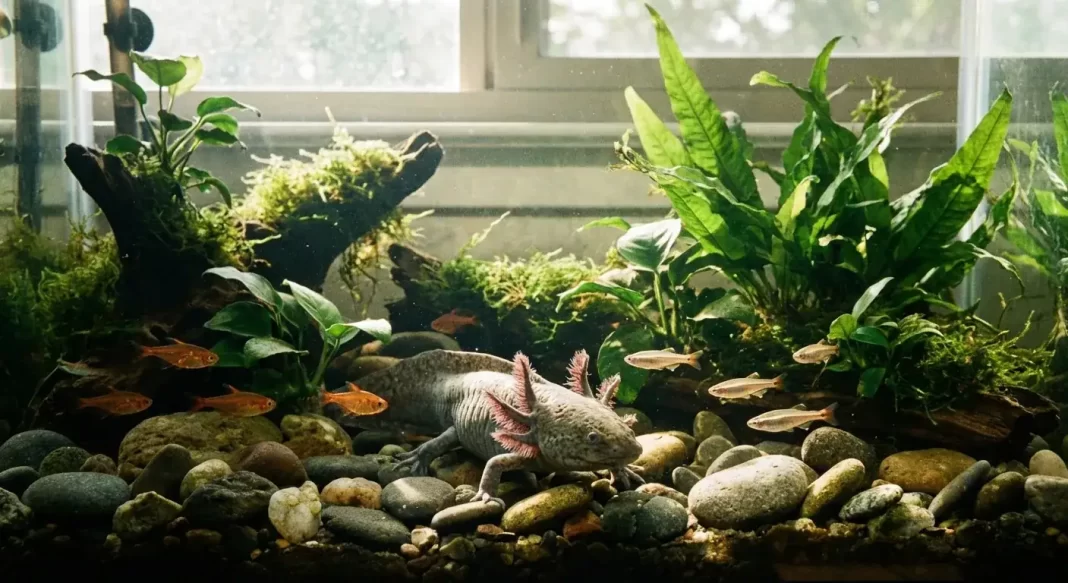
No, axolotls should not live with fish. Almost every fish either nips an axolotl’s delicate gills, carries disease, gets eaten and causes a dangerous blockage, or needs water too warm for an axolotl to tolerate. Even the most-recommended “safe” fish fail on at least one of these counts, so the responsible answer is a fish-free tank.
Why do fish damage axolotl gills?
Fish damage axolotl gills because the feathery red filaments look and move like food. A fish swims up, investigates, and nips, and a single bite can sever filaments. That open wound becomes an entry point for bacterial and fungal infection, and the worst part is that the damage often does not show for weeks.
The mechanism catches keepers off guard because it is slow. After a fish is added, the axolotl can look fine for days. Then over weeks 2 through 6, the gill filaments shorten, ragged edges appear, and infection sometimes sets in. By the time it is obvious, the harm has been accumulating quietly. This is not limited to aggressive fish. Even the calmest community species, white cloud minnows, guppies, endlers, will investigate those waving gill filaments and take experimental bites. Curiosity is enough; the fish does not need to be a predator. Because axolotls have permeable skin and exposed external gills, they are unusually vulnerable to this kind of low-grade, repeated injury (source: LafeberVet basic information sheet). Once a gill is bitten and infected, you are into health-problem territory, and an open wound on an axolotl warrants a check with an exotic-animal veterinarian. The gill curl guide and the injury and regeneration guide show what damaged gills look like and how they heal, or fail to.
How do fish introduce disease and parasites?
Fish bring pathogens that axolotls have little defense against, and the treatments for those pathogens are often toxic to axolotls. Pet-store fish in particular carry parasites and bacteria from crowded supplier tanks. Quarantine reduces this risk but does not remove it, which is why disease alone is a strong reason to skip fish entirely.
The specific threats matter, because each one is hard to handle once an axolotl is involved:
- Ich (white spot disease): a common parasite. The usual treatment chemicals are toxic to axolotls, so you cannot medicate the tank normally (source: Silly Axolotls on aquarium treatments).
- Columnaris: an opportunistic bacterial infection that takes hold in stressed animals and damaged tissue, exactly the condition a nipped gill creates. It is hard to manage in an axolotl tank because a common fish remedy, raising the temperature, is off the table for a cool-water animal.
- Anchor worm: a crustacean parasite that embeds in tissue and usually needs a vet to remove safely.
- Saprolegnia: a water mold that colonizes damaged tissue, so a nipped gill is exactly what it looks for.
Quarantining new fish for several weeks before adding them lowers the odds of importing one of these, and it is good practice for any animal. But quarantine is not a guarantee. Some pathogens are subclinical, present without visible symptoms, and clear quarantine only to flare later. From a rescue-intake perspective, the fish-tankmate failures I see most are not dramatic attacks, they are an axolotl that slowly declined from a low-grade infection nobody traced back to the “harmless” fish. If you do introduce any new animal to a system, the quarantine guide covers how to do it properly, and the water parameters guide covers the conditions that keep an axolotl’s immune system strong.
What happens when an axolotl eats a fish?
Often the axolotl wins, and that is its own problem. Axolotls are ambush predators that hunt by suction-snapping: they wait, then strike and swallow prey whole. If a fish fits in the mouth, it usually goes down whole, and fish bones and rigid fin spines can cause a dangerous internal blockage called impaction.
The risk is highest at night, when axolotls are most active and a sleeping or slowed fish is easy to catch. So even a fish that seemed too fast to catch during the day can disappear overnight. Swallowing a fish whole is not like eating a soft worm. Many fish have sharp dorsal or pectoral spines that lock outward, and those can lodge in the throat or gut (source: Practical Fishkeeping on locking catfish spines). Impaction is a serious condition: the axolotl stops passing waste, may float or refuse food, and often needs veterinary intervention. This is one of the clearest reasons the “they can just eat the fish” argument backfires, because the eating itself is the hazard. If your axolotl has swallowed a fish and then floats, bloats, or stops eating, treat it as a possible impaction and consult an exotic-animal veterinarian promptly. Safe protein comes from soft foods like earthworms and blackworms, not live fish; the live food safety guide explains which foods avoid the impaction risk, and the feeding schedule by age covers amounts.
Why does temperature incompatibility rule out most fish?
Temperature alone disqualifies most fish, because axolotls and tropical fish need opposite conditions. Axolotls are cool-water animals with a safe range of 60 to 68 F (15.5 to 20 C). Most popular aquarium fish are tropical and need 74 to 82 F. There is no overlap temperature that keeps both healthy at once.
Axolotls run into trouble fast as water warms. Above about 72 F they show heat stress, and above 75 F it becomes an emergency that can be fatal (source: San Diego Zoo Wildlife Alliance managed-care fact sheet). Tropical fish, meanwhile, become sluggish and sick in cool water, so you cannot simply keep the tank cold and expect them to thrive. Any temperature you pick is a compromise that harms one animal: cool enough for the axolotl is too cold for the fish, and warm enough for the fish is dangerous for the axolotl. This is not a problem you can engineer around with equipment, because it is a biology mismatch, not a heating one. The temperature guide covers how to hold an axolotl in its safe band, and once you see those numbers next to a tropical fish’s needs, the incompatibility is obvious. For the broader question of what belongs in an axolotl tank, the tank mates guide is the parent overview.
Which “safe fish” recommendations fail, and why?
Every commonly recommended “axolotl-safe” fish fails on at least one core risk, usually more. The fish that get suggested most, white cloud minnows and small community species, still nip gills and get picked off at night. The supposedly easy options like goldfish and plecos bring their own serious problems.
Here is how the usual recommendations break down:
| Fish | The pitch | Why it fails |
|---|---|---|
| Guppies | small, peaceful, cheap | Tropical (72 to 82 F), swallowed whole, breed prolifically and spike bioload |
| White cloud minnows | cool-tolerant, most-recommended | 64 to 72 F gives only a narrow overlap, still nip gills, picked off at night, disappear one by one |
| Plecos | algae cleanup crew | Tropical, and rasp the slime coat off slow tankmates, a common preventable injury |
| Goldfish | cold-water, classic pairing | Temperature is fine but bioload is extreme, carry infections, outcompete and harass the axolotl |
| Corydoras catfish | cool-tolerant to 68 F | Rigid locking fin spines lodge in the throat when eaten, a choking emergency |
The white cloud minnow case is the most instructive, because it is the one keepers most often try. The temperature overlap looks workable on paper, but in practice the minnows still nip gills and the axolotl still hunts them after dark, so the school quietly shrinks over weeks. The pleco case is the most underrated hazard: plecos latch onto slow-moving animals and rasp at their slime coat, leaving the axolotl with raw patches that invite infection. None of these are safe; they are degrees of unsafe. When any of these pairings goes wrong, the gill or skin damage routes straight to a vet check; the fungus guide covers the infection that usually follows.
Is there any fish that reliably works, and what are the warning signs?
No fish reliably works. No species is endorsed by professional breeders, exotic-animal vets, or welfare-focused keepers as a safe long-term axolotl tankmate. Every fish introduces at least one of the core risks, and positive reports online are survivorship bias, the tanks that failed simply do not post updates.
Even when nothing catastrophic happens, a fish tankmate tends to cause chronic low-grade stress, the axolotl hides more, eats less, and lives on edge. That slow toll is real even in a tank that never has a dramatic incident. The keeper consensus against fish tankmates is long-standing in the hobby community (source: Caudata.org keeper community). So the honest answer is that a fish-free tank is the only setup with no built-in risk. If you currently keep fish with an axolotl, watch for these warning signs and be ready to separate:
- Gill damage: shortened or ragged filaments, missing tips, redness or swelling, white cottony patches, or curling.
- Behavioral change: reduced appetite, more hiding, gulping at the surface, or general lethargy.
- Water quality decline: ammonia or nitrite above 0, nitrate climbing, or cloudy water from the added bioload.
Any of these means the fish are harming the axolotl, and an open wound or a refusing animal warrants a call to an exotic-animal veterinarian. The behavioral cues overlap with general distress, which the stress signs guide details, and the underlying husbandry that keeps an axolotl resilient lives in the axolotl care guide. If you are still setting up and deciding what kind of tank to run, the axolotls as pets overview and the common beginner mistakes both make the case for keeping it simple.
Frequently asked questions
Can I use feeder fish as enrichment for my axolotl?
It is not worth the risk. Feeder fish from a store carry the same parasites and bacteria as any other fish, and swallowing one whole brings the impaction risk from bones and spines. The “enrichment” benefit is marginal and the downside can be a vet bill or a dead animal. Earthworms and blackworms give the same hunting-and-eating behavior with far less risk, so use those instead. If you want your axolotl to chase live food, keep it to soft invertebrates.
Will my axolotl get lonely without a fish to keep it company?
No. Axolotls are solitary animals and do not feel loneliness or seek companionship the way social pets do. Adding a fish does nothing for the axolotl’s wellbeing and only adds risk. A single axolotl alone in a properly maintained, cool tank is content and is the safest possible setup. If you want more activity in the tank, focus on hides, plants, and enrichment rather than another living animal that the axolotl may eat or be harmed by.
My fish and axolotl have lived together for months. Are they safe now?
Past stability does not predict future safety. These risks are probabilistic: each night the axolotl might hunt, each week a gill might get nipped, each new fish might import disease. The longer the pairing continues, the higher the cumulative chance that one of those events finally happens. A tank that has been fine for months can fail in a single night. If they are currently coexisting, that is luck holding, not a guarantee, and separating before harm occurs is the safe call.
Can axolotls live with African dwarf frogs instead?
No. African dwarf frogs are small enough to be eaten by an adult axolotl, they are tropical and need warmer water than an axolotl tolerates, and they can carry chytrid fungus, which is dangerous to amphibians (source: TFH Magazine on chytrid in African dwarf frogs). They fail on the same three counts as fish: predation, temperature, and disease. They are not a safe substitute tankmate, and the better answer remains a single-species tank.
Are snails or shrimp safer tankmates than fish?
Some are lower-risk, though none are risk-free. Large mystery or apple snails over about 1.5 inches are usually too big to swallow and are among the lower-risk options. Ghost shrimp are best thought of as occasional live food rather than permanent residents, since axolotls will eat them. Small ramshorn and bladder snails are generally low-risk and often arrive on plants. The tank mates guide covers invertebrate options in more detail, but for fish specifically the answer stays no.
Related guides
- Axolotl care guide: complete husbandry hub for new keepers
- Axolotls as pets: the full commitment before you buy
- Axolotl beginner mistakes: the setup errors that cost the most
- Axolotl tank mates guide: who can and cannot share an axolotl tank
- Axolotl temperature guide: holding the safe cool-water range
By the ExoPetGuides editorial team (AI-assisted drafting; human-reviewed), reviewed by an exotic-animal veterinarian.
Updated 2026-06-08.
Primary sources: San Diego Zoo Wildlife Alliance, LafeberVet, Caudata.org keeper community.
Disclaimer: This content is for educational purposes only and is not a substitute for professional veterinary advice. Always consult a qualified veterinarian, ideally an exotic-animal specialist, for any health concern about your pet. Care recommendations may vary based on species, individual animal, and local regulations.