


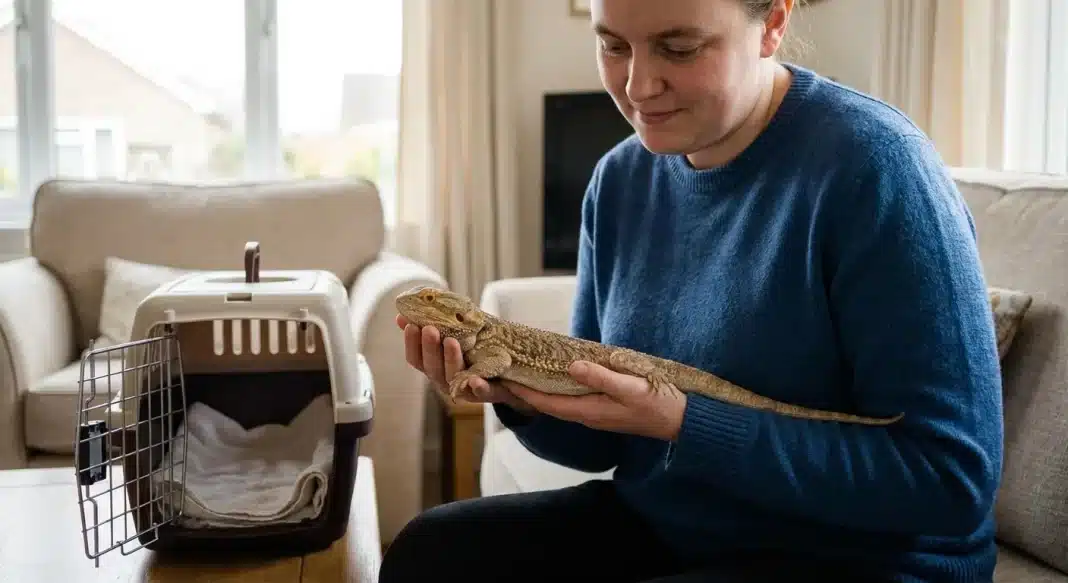
Emergencies with bearded dragons rarely come with warning. A fall from a height, sudden collapse, suspected poisoning, a power outage in winter — these situations demand a calm, prepared response in the first few minutes while you arrange veterinary care.
This guide is about those first few minutes. It covers what to do for the most common bearded dragon emergencies, what to have in a first aid kit, and the one rule that applies to every scenario:
Call an exotic or reptile-specialist vet first. Everything else is stabilisation until you reach them.
Quick Answer: Bearded Dragon Emergency Care
For any bearded dragon emergency: call an exotic or reptile-specialist vet immediately. While you arrange care, keep the dragon warm (75–85°F / 24–29°C), calm, and in a secure, ventilated container. First aid is stabilisation only — not a substitute for veterinary treatment. Have a stocked first aid kit and your vet’s number ready before an emergency occurs.
Before an Emergency Happens: Preparation
The best time to prepare for an emergency is now, not during one.
Your Reptile Vet’s Information
Have stored and accessible:
– Name and phone number of your regular exotic/reptile vet
– Their emergency after-hours procedure (do they have an emergency line? A clinic they refer to?)
– Nearest 24/7 emergency animal hospital that treats exotics
Use ARAV to find reptile-specialist vets near you before you need one urgently.
First Aid Kit
Assemble the following items and store them together in a clearly labelled container:
Wound care:
– Betadine (Povidone-Iodine): must be diluted before use — dilute with water until the solution is the colour of weak tea. Never use at full concentration on reptile skin.
– Original Neosporin antibiotic ointment: ORIGINAL FORMULA ONLY. Do not use versions with added pain relievers (pramoxine hydrochloride, lidocaine) — these additives are toxic to reptiles.
– Styptic powder or cornstarch: stops minor bleeding from clipped nails
– Sterile saline (preservative-free contact lens saline): eye flushing; gentle wound irrigation
– Sterile gauze and medical tape: wound covering
– Cotton balls and Q-tips: application
Hydration and nutrition support (vet-directed use only):
– Unflavoured electrolyte solution (Pedialyte or equivalent): for rehydration support under vet guidance
– Digital kitchen scale (grams): essential for weight monitoring and for vet dosing if medication is prescribed
Heat and transport:
– Reptile-specific heat packs (e.g., UniHeat): NOT human handwarmers (they get too hot too fast and can burn). Reptile heat packs are formulated for safer temperature ranges.
– Small secure container with ventilation (transport and hospital soak use)
– Soft towel: wrapping, cushioning, transport
Records:
– Your dragon’s last known weight
– Current medication if applicable
– Vet contact information card
Emergency Action Order (All Scenarios)
- Call your vet first — describe what happened; they will tell you what to do while you come in, whether to come immediately or monitor, and the best transport method
- Keep the dragon warm — 75–85°F / 24–29°C for transport; a reptile heat pack wrapped in a towel, placed outside (not inside) the transport container
- Minimise stress — cover the container, reduce noise and movement, handle as little as possible
- Document — note the time, what you observed, and what home care you’ve given; the vet needs this
Common Emergencies and Stabilisation Steps
Trauma / Fall / Physical Injury
Bearded dragons have fragile bones. Falls from height — even a few feet — can cause fractures that aren’t immediately visible externally.
Do:
– Place the dragon gently in a soft-lined, secure container
– Keep warm; minimise movement of the dragon
– Call vet immediately
– Do not offer food or water before the vet sees the animal — digestion under stress is contraindicated, and swallowing may worsen an injury
Don’t:
– Attempt to manipulate suspected fractures
– Apply heat directly to the injured area
Wound / Bleeding (Minor)
For small wounds (scratch from cage décor, nail trimmed too short, minor bite):
- Apply gentle pressure with sterile gauze to stop bleeding
- Styptic powder or cornstarch for minor nail bleeding
- Clean the wound gently with diluted Betadine (tea-coloured dilution) on a cotton ball
- Apply a thin layer of Original Neosporin (no pain reliever)
- Cover with sterile gauze and secure with medical tape if needed
- Monitor for infection (redness spreading, swelling, odour)
Any wound from cohabitating dragon bites, puncture wounds, or wounds that appear deep or don’t stop bleeding: vet.
Not Moving / Collapsed / Unresponsive
This is a veterinary emergency. While you call and arrange transport:
- Check enclosure temperature — if it’s cold, the dragon may be hypothermic. Warm the environment first (move to a warm area; heat pack outside transport container) and observe for response.
- If temperatures are correct and the dragon still isn’t responding: vet same day, immediately
- Do not force food or water on an unresponsive dragon — aspiration risk
- Transport warm, secure, and with minimal handling
Suspected Respiratory Emergency (Laboured Breathing / Gaping)
- Call vet immediately — this is urgent
- Ensure the enclosure is at the high end of the temperature range (correct temperatures support immune function)
- Reduce humidity immediately (remove water bowl; improve ventilation)
- Do not attempt to treat with any over-the-counter product
- Transport warm to vet
Suspected Poisoning / Toxic Ingestion
Bearded dragons may ingest toxic plants, household chemicals, or inappropriate feeders (fireflies are extremely toxic to bearded dragons — even one can be fatal).
- Call your vet immediately — describe exactly what was ingested, the quantity, and when
- Do not attempt to induce vomiting
- Do not give food or water
- Your vet may advise activated charcoal in very specific scenarios — this is only on vet instruction
- If you can’t reach your vet, call the Animal Poison Control hotline (US: ASPCA 888-426-4435) for guidance while en route to an emergency clinic
Fireflies (lightning bugs), avocado, and rhubarb are acutely toxic. If ingested: vet same day, no exceptions.
Power Outage
- Move the dragon to a pre-prepared transport container with a reptile heat pack (UniHeat type) wrapped in a towel, placed outside the container
- Stop feeding immediately — without basking temperatures, the dragon cannot digest food. Undigested food in the gut during cold = serious illness risk.
- Monitor temperature inside the container with a thermometer; maintain 75–85°F
- If power is restored within a few hours: return dragon to enclosure; resume normal schedule
- Extended power outage (24+ hours): find a heated location, or consult your vet about reptile boarding options
Suspected Impaction (Hind Leg Weakness / Not Pooping)
See the impaction guide for the full protocol. Emergency trigger: any hind leg weakness = vet same day. Do not attempt home treatment if neurological signs are present.
Transporting Your Dragon to the Vet
- Use a small, secure, ventilated container — a clean plastic tub with holes works well
- Line with a soft, clean towel for cushioning and grip
- Reptile heat pack (UniHeat): activate, wrap in a thick towel, place on the outside of the container — never in direct contact with the dragon
- Maintain 75–85°F in the container; a digital thermometer inside helps confirm
- Keep the container covered (reduces visual stress during transport)
- No food or water during transport
What’s NOT First Aid
Knowing what not to do is as important as knowing what to do:
- No DIY antibiotics — you cannot safely self-prescribe or dose reptile antibiotics
- No DIY dewormers — parasite species must be identified first; wrong drug = treatment failure
- No force-feeding a collapsed dragon — aspiration can kill
- No water for a paralysed or unresponsive dragon — drowning risk even with very small amounts
- No heat rocks or heat mats under the dragon — bearded dragons don’t recognise heat-from-below as dangerous; burns are common
Key Takeaways
Emergency preparedness has two parts: knowing what to do, and having the right items ready before you need them.
The first aid kit (wound care, electrolytes, heat packs, scale) costs very little and could make a significant difference in a crisis. Knowing your vet’s number, their emergency protocol, and the nearest 24/7 exotic emergency clinic costs nothing.
Do those things today, before an emergency. When one happens, you’ll be glad you did.
This article is for educational purposes. It describes stabilisation measures only — first aid for bearded dragons is not a substitute for veterinary care. In any genuine emergency, contact a qualified exotic or reptile-specialist veterinarian immediately.
Frequently Asked Questions
Is this emergency care guide the same as the symptoms guide, or do they serve different purposes?
They serve different purposes. The symptoms guide helps you interpret what you’re observing and determine urgency — it’s a reference for working out what might be wrong. This emergency care guide is an action guide: what to do right now when your dragon is in crisis, before a vet can be reached. Start with the symptoms guide if you’re unsure whether something is an emergency; come to this guide when you know it is.
Does this guide recommend specific medications or treatments to administer at home?
No. This guide covers stabilisation only — temperature management, hydration support, transport, and what to tell your vet. Administering medications, injectable treatments, or performing any invasive procedures at home are not appropriate without veterinary direction. Any advice you read elsewhere suggesting home-administered calcium injections, antibiotics, or surgical intervention (e.g., attempting to remove stuck eggshells) should be treated with extreme caution and discussed with a vet first.
Where does this guide fit relative to the vet guide?
This guide is for the immediate crisis period — the first minutes to hours before or during transport to a vet. The vet guide covers finding a reptile-specialist vet before an emergency occurs, what to expect at appointments, and how to navigate costs. The key recommendation from both guides is the same: locate your reptile vet now, before you need one urgently.
Is egg-binding (dystocia) covered in this emergency guide?
Dystocia — a female unable to lay eggs — is a reproductive emergency covered in this guide’s reproductive emergencies section. The breeding guide covers normal egg-laying and the conditions under which dystocia becomes likely. If you suspect dystocia, this guide provides the immediate stabilisation context; the breeding guide provides the diagnostic background.
Can I use this guide for other reptile species in an emergency?
Some principles apply broadly (warmth, hydration, minimal stress during transport), but specific thresholds, normal vs. abnormal behaviours, and escalation criteria are calibrated for Pogona vitticeps. Do not apply bearded dragon emergency parameters to chameleons, geckos, or other reptile species — seek species-specific guidance or call a reptile vet directly for any reptile emergency.