


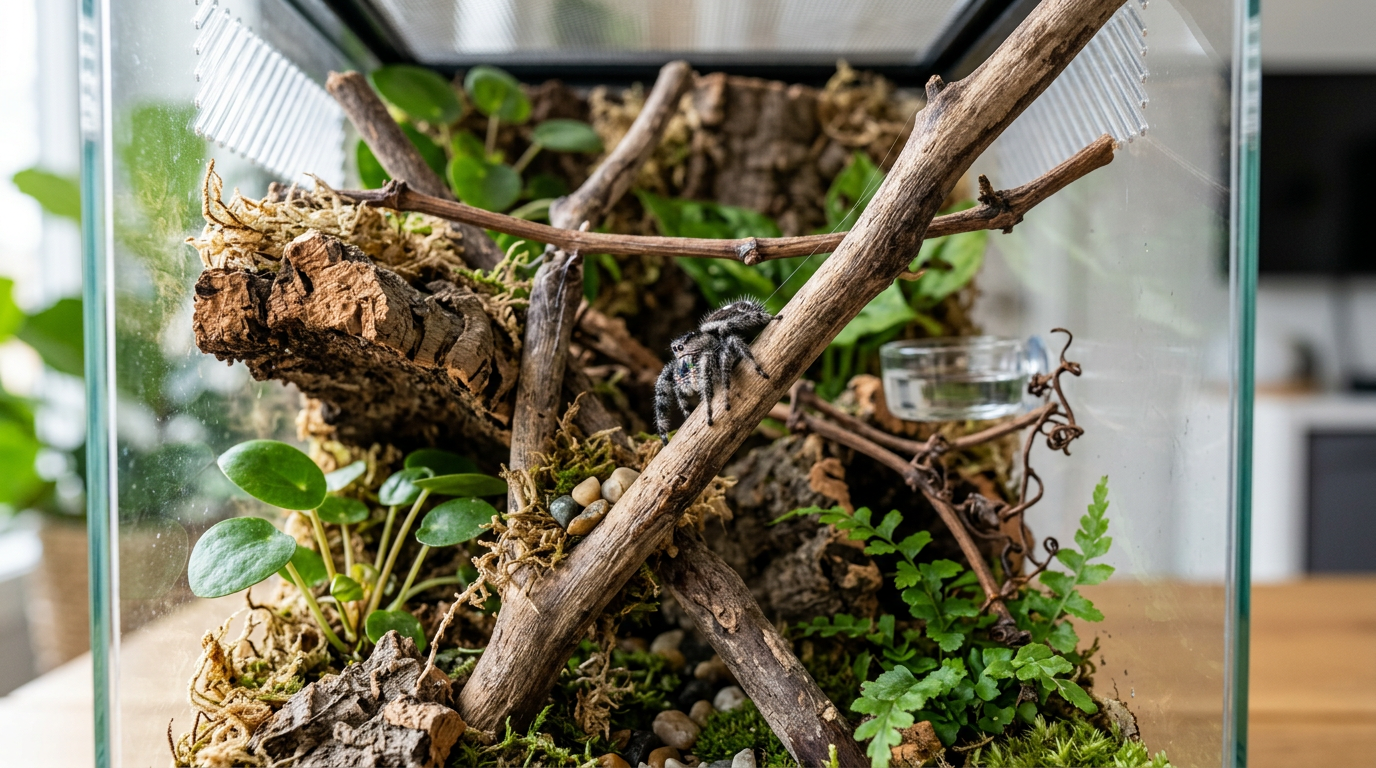
Jumping spider enrichment is the deliberate design of an enclosure and a care routine that gives this highly visual, cognitively complex predator opportunities to climb, hunt, explore, and re-map novel space the way it would in the wild. Salticids are active visual hunters with documented detour planning, route selection, mirror-image responses, habituation and dishabituation to visual stimuli, and individual recognition (source: eLife), so a bare enclosure with substrate and a water droplet wastes most of the nervous system the spider arrived with. This guide covers the welfare logic behind enrichment for jumping spiders, the practical structures and materials that produce the largest behavioral lift, layout rearrangement, hunt-style feeding, supervised exploration sessions, mirror and screen stimuli with the correct stress limits, DIY ideas you can build from cheap craft supplies, life-stage adjustments from sling cups to adult terrariums, and the behavioral signs that tell you enrichment is actually working rather than just looking enriched on a shelf.
Why Jumping Spiders Need Enrichment
Jumping spiders need enrichment because they are arboreal visual hunters with measurable cognition, not passive web-sitters, and a barren enclosure suppresses the behaviors their brains and visual systems are built to run. Wild Phidippus regius lives across open fields, palms, palmettoes, shrubs, and building walls (source: UF/IFAS Featured Creatures), navigating three-dimensional space and stalking diverse prey daily. Captive welfare standards have to track that reality.
Cognitive research on salticids is now substantial. Spartaeinae jumping spiders execute planned detours through visually complex obstacle courses and show pause-and-correct behavior consistent with an internal route plan (source: Journal of the Experimental Analysis of Behavior). Portia labiata systematically scans alternative routes with its principal eyes before choosing a path, biasing scanning toward the complete route by the end of the inspection (source: Animal Behaviour). Phidippus regius distinguishes a previously seen conspecific from a novel one (source: eLife), and Menemerus semilimbatus habituates and dishabituates to visual stimuli independent of bold/shy personality (source: Animal Behaviour, 2024). These are not parlor tricks; they are the cognitive baseline the species evolved for.
Environmental complexity has measurable developmental consequences too. Jumping spiders raised in physically enriched enclosures with moss, leaves, bark, and varied objects grew larger arcuate bodies (a higher-order visual integration center) and explored more readily in novel-object tests than siblings raised in barren cups (source: Frontiers in Ecology and Evolution). Recent invertebrate-welfare reviews now apply the Five Domains model (nutrition, environment, health, behavior, mental state) to arachnids and explicitly recommend enrichment in display and pet contexts (source: Animals).
The practical picture: an enriched spider is more active, eats with more drive, builds and maintains a stable retreat, and responds to keepers with the alert, head-tilting attention salticids are known for. A spider in a barren enclosure becomes sedentary, hides for most of the day, and shows the kind of reduced behavioral repertoire that older keeper guides sometimes mistake for “calm.” If the foundation is still settling, work through our jumping spider enclosure setup guide before layering on enrichment elements.
Climbing Structures and Vertical Space
Jumping spiders are arboreal animals that move vertically as much as horizontally, so the single highest-impact enrichment decision is loading the enclosure with vertical climbing surfaces at varied heights. Salticid feet carry dense scopulae pads that grip bark, leaves, and even smooth glass via van der Waals adhesion (source: Journal of Experimental Biology), so any textured vertical surface becomes usable terrain.
Cork Bark
Cork bark is the single most recommended enrichment material for jumping spider enclosures. It is lightweight, textured for excellent scopulae grip, mold-resistant, and slow to rot. A vertically placed cork bark slab creates a climbing wall, a silk-anchoring surface, and a sheltered gap behind it for a secondary retreat.
- Place one piece vertically against an enclosure wall to create a climbing surface and a sheltered gap behind it.
- Cork bark rounds (tube-shaped pieces) serve as both climbing structures and ready-made retreat locations.
- Source from reptile or aquarium suppliers. Avoid cork treated with pesticides, fungicides, or sealing varnishes.
- Cork bark is safe for all commonly kept jumping spider species, including Phidippus regius, P. audax, Hyllus diardi, and Hasarius adansoni.
Artificial Plants and Vines
Artificial plants add climbing surfaces, silk-anchoring points, and visual cover. They also break up sight lines, which reduces stress for spiders that feel exposed in open enclosures.
- Use small reptile-grade artificial succulents, ivy vines, or leafy plants without sharp wire stems that could snag legs or dragline silk.
- Position plants at different heights so the spider can route a climb from substrate to lid without ever touching glass.
- Hot-glue or aquarium-safe-silicone vines to enclosure walls for permanent paths; let any silicone cure for 24 hours before reintroducing the spider.
Live Plants
Live plants are an option for keepers running a bioactive or naturalistic setup. Suitable species include small pothos, air plants (Tillandsia), and clumping moss.
- Live plants contribute to ambient humidity through transpiration, which benefits species that prefer moderate humidity. Our jumping spider temperature and humidity guide covers species-specific ranges.
- Quarantine any new plant for one to two weeks and rinse thoroughly. Greenhouse plants often carry residual pesticides or systemic neonicotinoids that are dangerous to invertebrates.
- Live plants need their own light and water cycles, which raises maintenance. For most pet keepers, artificial plants give comparable enrichment with less risk.
Twigs and Branches
Small, untreated hardwood twigs (oak, maple, birch) provide natural climbing and perching surfaces with bark texture that scopulae grip easily. Wild-collected wood must be baked at 100 degrees Celsius (210 degrees Fahrenheit) for 30 to 60 minutes to kill mites, mold spores, and pathogens before use. Avoid softwoods (pine, cedar) because resin volatiles can irritate invertebrates.
Rearranging the Enclosure
Periodically rearranging the enclosure layout is one of the cheapest, most effective enrichment techniques because it forces the spider to re-map its territory using the same scanning and route-planning behavior documented in Portia detour studies (source: Animal Behaviour). A new configuration engages exactly the visual cognition the captive enclosure normally suppresses.
How to rearrange safely:
- Move decorations, plants, and climbing structures to new positions every two to four weeks.
- Do not remove or relocate the spider’s silk retreat. The retreat is the home base, and moving it causes measurable stress and reduced feeding for several days.
- Change positions of elements around the retreat so the spider has new approach routes and sight lines to its core territory.
- After a rearrangement, give the spider 24 hours before any handling or feeding. It will be busy exploring.
What to watch for. A spider responding well to enrichment immediately begins patrolling, investigating new structures, and depositing fresh draglines. A spider that retreats to its hammock and stays hidden for more than 48 hours has been over-stressed by the change. Restore one or two familiar elements (return a cork bark slab to its old position, for example) and try smaller changes next round.
This is the rule that catches new keepers: enrichment is not a fixed amount. The right intensity is the amount the individual spider engages with positively. A bold P. audax may patrol every change you make; a shyer specimen may need smaller, slower adjustments.
Hunt-Style Feeding (Active Prey Presentation)
Active prey presentation gives a jumping spider significantly more enrichment than dropping pre-killed crickets on the substrate, because it triggers the full hunting sequence: detection, evaluation, anchor-line attachment, stalk, and pounce. The visual cognition that makes salticids fascinating is the same circuitry that drives hunting, and bypassing it with passive feeding is the single most common missed enrichment opportunity.
Live prey release. Release a single feeder insect (flightless fruit fly, small cricket, green bottle fly) into the enclosure and let the spider detect, stalk, and catch it naturally. This engages the full hunting sequence and is the closest simulation to wild foraging. Remove uneaten prey within 24 hours so it does not hide in corners or molt and disturb the spider.
Tong-feeding with movement. Hold a feeder insect in soft-tipped feeding tongs and move it slowly within the spider’s visual field, about 5 to 10 cm from the spider. Movement triggers predatory attention, and the spider stalks and pounces on the tong-held prey. Tong-feeding gives you control over where the prey ends up and avoids loose feeders.
Elevated prey placement. Place a feeder on a cork bark perch or artificial plant so the spider has to climb to reach it, adding a navigation step to the hunting task. This is especially valuable for older adults whose hunting drive sometimes dulls in over-easy enclosures.
Prey-type rotation. Rotate between two or three feeder types over a typical week (flightless fruit flies, small dubia roaches, green bottle flies, pinhead crickets, occasional waxworms as a low-frequency treat). Rotation gives varied movement signatures, nutrient profiles, and chase distances. The jumping spider feeding schedule covers prey sizing and frequency by life stage so the enrichment side does not overshoot total food intake.
Supervised Exploration Outside the Enclosure
Supervised time outside the enclosure exposes the spider to surfaces, lighting, and spatial challenges the fixed enclosure cannot replicate, but it requires real preparation and constant attention. Done well, it gives the spider novel-environment exploration that mirrors the open-field tests used in enrichment research. Done badly, it loses the spider in your house.
How to provide safe exploration time:
- Choose a small, enclosed area: a bed, a desk with raised edges, or the inside of a dry bathtub. The space should be one the spider cannot easily escape from.
- Remove hazards before the session: open water containers, sticky tape surfaces, lit candles, fans, other pets, and any open windows.
- Place a few novel objects (a textured fabric scrap, a small plant pot, a crumpled piece of paper) in the exploration zone for the spider to investigate.
- Supervise continuously. Stay within arm’s reach for the entire session. Jumping spiders can clear distances of 10 to 50 times their body length and will find escape routes you did not anticipate.
- Limit sessions to 10 to 15 minutes to prevent dehydration and stress.
- When the session ends, let the spider walk onto your hand or into a catch cup, then return it to the enclosure. Never grab.
Species suitability. Phidippus regius and P. audax are calm enough for supervised exploration. Smaller, faster species (Hasarius adansoni, juveniles of most species, slings of any species) are harder to manage outside the enclosure and are better enriched in-enclosure. For species-specific temperament guidance, see the best jumping spider species for pets guide. For the broader handling-safety frame, our jumping spider handling guide covers reading body language and recognizing stress signals before they escalate.
Visual Stimulation: Mirrors and Screens
Jumping spiders rely on vision more than any other sense, so visual enrichment is a category unique to this family. The two practical tools are short mirror exposures and slow-moving video, both used in research, both with stress limits keepers need to respect.
Mirror Exposure
Many salticids display toward their mirror image because they recognize a same-sex conspecific in the reflection (source: Animal Behaviour). Males perform courtship leg waves and body vibrations; females may adopt threat postures with front legs raised. Some individuals approach cautiously and investigate, and most habituate to the mirror after several short exposures.
- Place the mirror outside the enclosure, not inside. Mirrors inside an enclosure provide sustained exposure to a perceived intruder and can cause chronic territorial stress.
- Limit sessions to 5 to 10 minutes, no more than a few times per week.
- Remove the mirror as soon as the spider disengages, retreats, or begins repeatedly turning away. Habituation is a real cognitive process in this species (source: Animal Behaviour, 2024), not a sign the spider is “calm.”
- Recent comparative work suggests mirror exposure also modulates aggression in some salticids, with isolated Toxeus magnus showing reduced aggressiveness after seeing a mirror image (source: Chinese Academy of Sciences). The implication for pet keepers is that short, controlled mirror sessions are a real stimulus, not background scenery.
Screens and Slow Video
Salticids track movement on phone and tablet screens, consistent with their motion-sensitive visual hunting circuitry. Laboratory work uses computer monitors with controlled stimulus presentation to study attention, distractor responses, and biological-motion preferences (source: Journal of Experimental Biology).
- Use slow, smooth nature footage rather than fast-cut content. Insect close-ups, leaves moving in wind, and slow pans work best.
- Place the screen 20 to 30 cm from the enclosure. Brightness should be moderate, not glaring.
- Limit sessions to 5 to 10 minutes. Stop if the spider retreats and stays hidden after the screen turns off.
- There is no peer-reviewed evidence that screen video provides full behavioral enrichment equivalent to a live prey hunt. Treat screens as a low-cost supplemental stimulus, not a replacement for in-enclosure complexity.
DIY Enrichment from Cheap Materials
You do not need specialized products to enrich a jumping spider’s life. Many of the most effective enrichment items are household objects or basic craft supplies. The table below lists items keepers in our community have found useful, with the practical reasoning for each.
| Item | How to use it | Why it works |
|---|---|---|
| Pipe cleaners (chenille stems) | Bend into climbing frames or bridges between cork bark and plants | Textured surface; customizable shape; easy to rearrange and replace |
| Small wooden craft beads | Place on substrate as scattered obstacles | Spider must navigate around or over them; changes ground terrain |
| Crumpled tissue paper | Place a small ball in one corner of the enclosure | Novel texture and hiding spot; spider often investigates and may anchor silk to it |
| Dried seed pods | Anchor to wall with aquarium-safe silicone | Natural perching platforms with varied textures and cavities |
| Small terracotta pot shards | Lean against a wall to create a shaded shelter | Secondary retreat option; thermal mass holds a slight temperature gradient |
| Magnifying glass (held outside enclosure) | Slowly move in front of the spider’s visual field | Creates magnified visual stimuli; spider tracks the lens through its principal eyes |
| Colored paper strips | Place inside the enclosure as visual contrast features | Some keepers observe preference for certain hues; likely brightness-driven rather than color-symbolic |
Safety notes. Anything placed inside the enclosure must be free of chemical treatments, residual adhesives (except fully cured aquarium-safe silicone), dyes that run when wet, and sharp edges. Rinse new items in hot water and dry completely before use. Avoid anything that off-gasses noticeably; invertebrates are extremely sensitive to volatile organic compounds.
Enrichment by Life Stage
Enrichment needs and methods change as the spider grows from a deli-cup sling to a full adult terrarium resident. The general rule is to match enrichment complexity to enclosure size: more space, more elements, more vertical options. Do not over-furnish a sling cup, and do not under-furnish an adult terrarium.
Slings
Sling enrichment is constrained by enclosure size (typically a 2 to 4 oz deli cup). The goal is one or two simple structures the sling can climb, anchor silk to, and use as a retreat.
- A single tiny piece of cork bark, a small artificial leaf, or a short pipe-cleaner climb.
- Live prey (flightless fruit flies, springtails) released one at a time so the sling practices the full hunting sequence rather than receiving pre-killed prey.
- A small textured surface (piece of dry paper towel folded into ridges, a sliver of twig) on the cup floor for varied terrain.
For the full sling husbandry walkthrough including feeding by instar and hydration without drowning risk, see the jumping spider spiderling care guide.
Juveniles
Juveniles are growing, exploring, and graduating through enclosure upgrades every few molts. Each upgrade is a built-in enrichment event because the new enclosure forces re-mapping.
- Graduated enclosure upgrades with new layout exploration each time (cork bark in different positions, new plant heights).
- Multiple climbing surfaces at different heights so the juvenile can route a climb without stepping on glass.
- Varied feeder types (rotating between flightless fruit flies, small crickets, occasional waxworms as treats).
Adults
Adults have stable behavioral patterns and a long-established silk retreat. Enrichment for adults focuses on novelty inserted into a known territory rather than constant overhaul.
- Regular enclosure rearrangement every two to four weeks, leaving the retreat undisturbed.
- Hunt-style feeding with active prey presentation as the standard, not the exception.
- Supervised exploration sessions outside the enclosure for calmer species.
- Periodic short mirror or slow-video sessions as visual enrichment.
For end-to-end age-appropriate care across the full lifespan, see our jumping spider care guide. Keepers focused on the most-kept hobby species should also read the Phidippus regius care guide for species-specific microhabitat detail (the wild ecology in palms, palmettoes, and open woodland is what an enriched captive enclosure tries to abstract from).
Substrate as Enrichment
Substrate is often treated as a humidity-management decision, but it is also an enrichment surface. A bare paper-towel floor gives almost no foraging texture; a layered substrate with leaf litter, small bark chips, and a moss patch creates micro-terrain that the spider explores, walks differently across, and occasionally hunts on. In a bioactive setup, a springtail or isopod cleaning crew adds movement at ground level that the spider sometimes tracks as low-grade prey practice.
- For arboreal species, a 1 to 2 cm layer of slightly damp coconut fiber with a top dressing of dried oak or magnolia leaves works well.
- Avoid loose, fine substrates that can stick to scopulae or get inhaled during a fall.
- Do not use cedar, pine, or any aromatic wood-based substrate. The same softwood-resin rule that applies to twigs applies to substrate chips.
For substrate selection by species and humidity goal, our jumping spider substrate guide walks through bioactive vs simple setups with worked tradeoffs.
Signs That Enrichment Is Working
A well-enriched jumping spider shows clear behavioral markers that distinguish it from a barren-enclosure spider. Use this checklist as the practical test rather than relying on how the enclosure looks.
- Active enclosure patrol. The spider moves through the enclosure regularly, investigating surfaces and depositing fresh draglines on new climbing routes.
- Confident hunting. The spider detects, stalks, and pounces on prey with decisiveness rather than ignoring or fleeing from feeders.
- Silk investment. The spider builds and reinforces its retreat over time. A spider that does not invest in retreat silk may be too stressed or under-stimulated to settle.
- Responsive visual attention. The spider tracks movement, tilts its head to evaluate objects, and approaches novel items with curiosity rather than fleeing on first contact.
- Varied activity patterns. The spider alternates between resting, patrolling, hunting, and retreat maintenance instead of staying in one spot doing one thing.
If your spider spends most of its time motionless in its retreat despite stable temperature, humidity, and feeding, an enrichment deficit is a plausible contributor. Rule out health causes first with the jumping spider health signs guide, then layer in more environmental complexity: a second climbing structure, a rearrangement cycle, hunt-style feeding rather than pre-killed prey, and one or two new DIY elements from the table above.
In our keeper community, the husbandry pattern that consistently produces the most behaviorally varied spiders is the combination of a vertically loaded enclosure, two-to-four-week rearrangement cadence, hunt-style feeding as the default, and occasional supervised exploration for calm-tempered adults. None of that is expensive, and none of it requires specialized products.
Common Enrichment Mistakes
The most damaging enrichment mistakes in our experience are not under-stimulation but over-disturbance: too-frequent rearrangements, retreat relocation, mirror sessions left running for hours, and handling sessions stacked on top of enrichment changes. The spider needs predictable rest periods between novel events to consolidate spatial memory and re-anchor its silk.
- Moving the silk retreat. The retreat is the spider’s home base. Move everything else; leave the retreat alone.
- Permanent mirror placement. Sustained mirror exposure is chronic stress, not enrichment. Use short sessions, then remove.
- Daily enclosure changes. Two to four weeks between rearrangements gives the spider time to map, settle, and re-explore. Daily reshuffles destabilize spatial memory.
- Skipping live prey entirely. Pre-killed feeders are useful for slings, sick spiders, and stuck-molt rescues, but a fully fit adult that never hunts loses the central behavioral repertoire of the species.
- Treating the enclosure as a museum display. A perfectly photographed enclosure with no rearrangement, no feeder rotation, and no supervised exploration is not enriching the spider; it is enriching your camera roll.
For the broader list of husbandry traps that hurt long-term welfare, see our jumping spider mistakes guide.
Frequently Asked Questions
Do jumping spiders need toys?
Jumping spiders do not play with toys in the mammalian sense, but they respond strongly to environmental complexity, novel objects, and active prey. Climbing structures, varied textures, hunting challenges, and periodic rearrangement serve the same behavioral-outlet function that toys serve for higher vertebrates. Treat enrichment as a category of welfare provisioning, not a recreational accessory. Research on physically enriched salticids shows measurably higher exploration and larger arcuate-body brain regions than barren-cup controls.
How often should I change my jumping spider’s enclosure layout?
Every two to four weeks is a reliable baseline. Move plants, cork bark, and decorations to new positions while leaving the silk retreat undisturbed. Faster cycles (every week or two) are fine if your spider responds with immediate exploration. Dial back to every four weeks if it retreats and hides for more than 48 hours after a change. Track which individual behaves how; P. regius adults and curious juveniles tolerate more frequent changes than skittish or freshly-molted specimens.
Can I put a mirror inside the jumping spider enclosure?
No. A mirror placed inside the enclosure provides constant exposure to a perceived intruder, which causes chronic territorial stress and elevated display behavior with no resolution. Short, supervised mirror sessions from outside the enclosure (5 to 10 minutes, a few times per week) provide enrichment without sustained stress. Remove the mirror as soon as the spider disengages or retreats. Habituation is a real cognitive process in salticids and looks similar to disinterest from the keeper side.
What is the best enrichment material for jumping spiders?
Cork bark. A single vertically placed slab adds a climbing surface, a silk-anchoring texture, a sheltered gap for a secondary retreat, and visual cover in one material. Artificial plants are a close second because they create multi-level climbing routes and break up sight lines. The combination of cork bark plus artificial plants is the most consistently behaviorally rich captive setup at minimal cost.
Do jumping spiders get bored?
Jumping spiders do not experience boredom in the human emotional sense, but they show measurable reductions in behavioral diversity and exploration in understimulating environments. A spider in a barren enclosure spends more time inactive in its retreat. This is not contentment; physically enriched salticids in research settings explore more and develop larger higher-order visual brain regions than deprived siblings. Reduced activity in a barren cup is behavioral shutdown from lack of stimulation, not preference.
Is it safe to let my jumping spider explore my desk?
Yes, with supervision and preparation. Remove open water containers, sticky surfaces, fans, other pets, lit candles, and any path to an open window before the session. Stay within arm’s reach the entire time and limit sessions to 10 to 15 minutes. Phidippus regius and P. audax adults are the best species for supervised exploration due to their calm temperament and manageable size. Smaller, faster species and any sling or juvenile of any species are better enriched in-enclosure.
Will screens and TV enrich my jumping spider?
Slow-moving nature video on a screen placed 20 to 30 cm from the enclosure produces visible tracking behavior in many salticids, consistent with their motion-sensitive visual system. Laboratory research uses screens to study attention and biological-motion preferences, so screen tracking is real. There is no peer-reviewed evidence that screens fully replace live-prey hunting as enrichment, however. Treat screens as a supplemental low-cost stimulus, not a primary enrichment tool.
Does my jumping spider recognize me?
Possibly, in a limited visual-discrimination sense. A 2024 eLife study reported that Phidippus regius distinguishes a previously seen conspecific from a novel one, and keeper experience commonly describes individual spiders showing different responses to familiar versus unfamiliar humans. Whether this constitutes true individual recognition of human keepers across long timescales is not settled, but it is more plausible than older guides assumed. Either way, calm, consistent handling and predictable feeding routines produce more confident pet spiders than erratic interaction does.
This article was researched and written by the ExoPetGuides editorial team with AI-assisted drafting. All husbandry parameters, behavioral claims, and cognition references were independently verified against peer-reviewed arachnology and animal-cognition literature, recognized husbandry authorities, and experienced keeper community sources. ExoPetGuides does not sell spider care products and has no affiliate relationship with any brand named in this guide.
This guide provides general husbandry and enrichment information based on current species-authority consensus. It is not a substitute for professional veterinary advice. If your jumping spider shows signs of illness or persistent behavioral distress that does not resolve with parameter correction and environmental adjustment, consult a qualified exotic veterinarian experienced with invertebrates.