


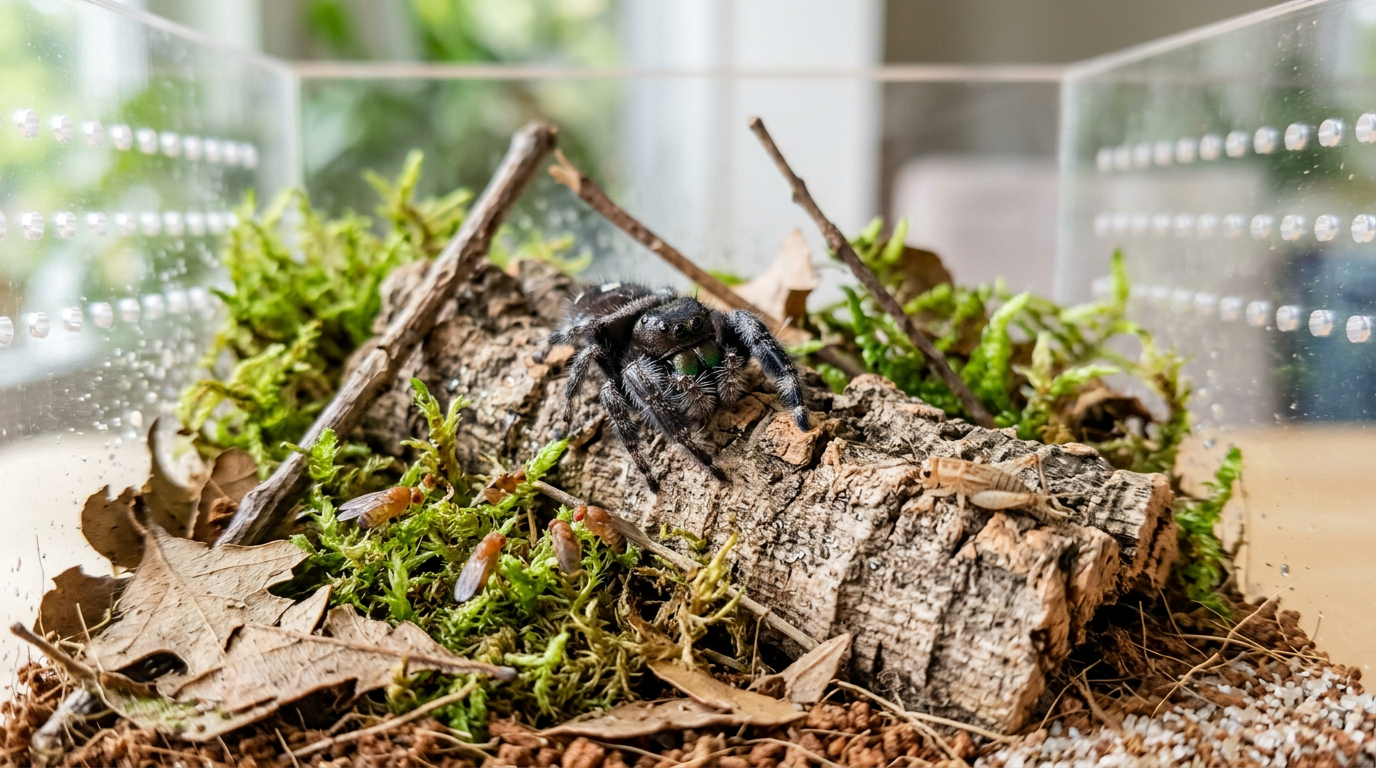
The best feeder insects for jumping spiders are flightless fruit flies (Drosophila melanogaster for spiderlings and D. hydei for late slings and small juveniles), pinhead and small house or banded crickets, blue and green bottle flies, and small black soldier fly larvae for sub-adults and adults, supplemented occasionally by freshly molted mealworms and the rare waxworm. This guide compares every commonly available feeder by quantitative nutrition (protein, fat, moisture, Ca:P), price, culturing yield, sourcing risk, and life-stage fit, then ships a decision matrix by spider size and a monthly cost worked example. In our keeper community we have cycled hundreds of Phidippus regius, Phidippus audax, Hyllus diardi, and Hasarius adansoni through this exact feeder rotation across every life stage from first instar to senescent adult. For the broader diet context this feeder catalog sits inside, see our complete jumping spider diet guide and our feeding schedule by age and species.
At-a-glance feeder comparison
The 9 feeders below cover every commonly kept jumping spider from first instar to a 22 mm adult Phidippus regius female. Use the table as a quick decision aid: the leftmost column maps the feeder to its primary life-stage role, the middle columns give size and difficulty, and the rightmost columns flag injury risk and how the feeder is sourced. Quantitative nutrition (protein / fat / moisture / Ca:P) sits in the next section so you can compare like-for-like.
| Feeder | Best for | Size range | Difficulty to keep | Injury risk | Sourcing |
|---|---|---|---|---|---|
| Drosophila melanogaster (flightless) | 1st-2nd instar slings | 2 to 3 mm | Easy (culture) | None | Online culture or feeder shop |
| Drosophila hydei (flightless) | 3rd instar slings, small adults | 3 to 4 mm | Easy (culture) | None | Online culture or feeder shop |
| House crickets Acheta domesticus | Juvenile to adult (pinhead → 1/2 in) | 1 to 25 mm | Moderate | Moderate (bite, kick) | Pet store, online |
| Banded crickets Gryllodes sigillatus | Juvenile to adult (pinhead → 1/2 in) | 1 to 25 mm | Moderate | Moderate (slightly softer skin than Acheta) | Pet store, online |
| Blue/green bottle flies (Calliphora / Lucilia) | Sub-adult, adult | 8 to 12 mm | Easy (pupae) | None | Online pupae (“spikes”) |
| Curly-wing house flies Musca domestica | Sub-adult, small adult | 6 to 8 mm | Moderate (pupae) | None | Online pupae |
| Black soldier fly larvae Hermetia illucens | Adults (occasional) | 8 to 15 mm | Easy (fridge) | Low | Pet store, online |
| Small mealworms Tenebrio molitor | Adult (supplement) | 10 to 25 mm | Easy (fridge) | Low to moderate (mandibles + pupates into beetle) | Pet store, online |
| Waxworms Galleria mellonella | Occasional treat / underweight rescue | 15 to 25 mm | Easy (fridge) | None | Pet store, online |
| Springtails Folsomia candida & others | 1st instar slings, cleanup crew | 0.5 to 2 mm | Easy (culture) | None | Online culture |
| Dubia roach nymphs Blaptica dubia | Large adult species only | 5 to 10 mm (nymph) | Easy (colony) | Low (burrows, may evade) | Online colony |
The 5 staple feeders for a typical pet jumping spider through its full lifecycle are melanogaster, hydei, small crickets, bottle flies, and small black soldier fly larvae. Everything else on the table above is supplementary or situational.
How do feeder insects compare nutritionally for jumping spiders?
The most nutritionally balanced common feeders for adult jumping spiders are bottle flies, crickets, and black soldier fly larvae, all delivering 18 to 22 percent protein by dry weight with moderate fat. Fruit flies sit lower on protein but are the only practical option for spiderlings. Waxworms and large mealworms are too fat-heavy for routine use. The matrix below compares every common feeder on the four numbers that actually matter for arachnid feeders: protein and fat as percent of dry weight, moisture as percent of total mass, and the calcium-to-phosphorus ratio (relevant for the gut-load decision, not for the spider’s skeletal demand which is chitin-based).
| Feeder | Protein (% dry wt) | Fat (% dry wt) | Moisture (%) | Ca:P ratio | Notes |
|---|---|---|---|---|---|
| Bottle flies (Calliphora / Lucilia) | 59 to 64 | 9 to 15 | 70 to 75 | 0.1:1 | Highest lean-protein feeder; low fat |
| House cricket Acheta domesticus | 61 to 66 | 15 to 22 | 67 to 72 | 0.14:1 | Balanced; best when gut-loaded |
| Banded cricket Gryllodes sigillatus | 60 to 65 | 16 to 24 | 67 to 71 | 0.12:1 | Similar to Acheta; softer body |
| Black soldier fly larvae | 40 to 44 | 28 to 35 | 61 to 65 | 1.5:1 to 2.5:1 | Naturally calcium-rich; medium fat |
| Drosophila melanogaster | 55 to 70 | 10 to 15 | 69 to 70 | 0.15:1 | Wide range — depends on culture media |
| Drosophila hydei | 55 to 70 | 10 to 15 | 69 to 70 | 0.15:1 | As above; larger body, same profile |
| Mealworm Tenebrio molitor larvae | 48 to 54 | 28 to 35 | 62 to 64 | 0.07:1 | High fat; thick chitin; supplemental only |
| Waxworm Galleria mellonella | 34 to 42 | 50 to 60 | 58 to 61 | 0.07:1 | Highest fat; treat only |
| Dubia roach Blaptica dubia (nymph) | 61 to 66 | 22 to 28 | 65 to 68 | 0.4:1 | Slightly higher Ca than crickets |
Values are typical ranges from published feeder-insect proximate analyses (source: Wageningenacademic) and the BSF-specific aggregate review at Individual batch values vary by feeder culture media, and for spiders the gut-load matters more than the proximate-only number, so the table sets expectations rather than prescribing exact intake.
The take-home for jumping spiders: bottle flies and gut-loaded crickets are the highest-quality staples for sub-adults and adults; BSF larvae are a useful supplement when calcium-rich variety is desired (despite the spider not having a major skeletal calcium demand, varied feeders raise micronutrient density); waxworms and large mealworms must stay occasional because their fat profile causes the abdominal distension that shortens adult lifespan. For the full body-condition diagnostic and overfeeding warning signs, see our jumping spider health signs guide.
Fruit flies: the foundational feeder for spiderlings
Flightless fruit flies are the primary feeder from hatch through the late juvenile stage. The two species commercially available — Drosophila melanogaster (2 to 3 mm) and Drosophila hydei (3 to 4 mm) — together cover the entire spiderling-to-small-juvenile size range. Both are inexpensive, easy to culture at home, deliver zero injury risk, and reach the spider’s hunting-response threshold once the spider is large enough to track them visually. The choice between the two species is determined by spider size.
Drosophila melanogaster (small flightless)
Melanogaster is the smallest practical feeder at 2 to 3 mm, and the only commonly available feeder small enough for first and second instar spiderlings of standard pet species (regius, audax, adansoni). Flightless and wingless strains cannot fly, so they walk and crawl, which is exactly the visual signal the spiderling needs to lock on. Cultures are sold in 32 oz vented cups containing pre-loaded media; one starter culture costs $5 to $8 and produces approximately 300 to 500 flies over its 4 to 5 week lifespan (source: Josh’s Frogs).
Culturing melanogaster (yield and timeline):
- Order a starter culture from a feeder supplier. The first flies emerge in 10 to 14 days at room temperature (70 to 80°F / 21 to 27°C).
- Tap 5 to 10 adults into a new cup with fresh media to start the next generation. Repeat every 7 to 14 days so a fresh culture is always producing while the previous one peaks.
- Cultures produce in 3 waves before the medium exhausts: wave 1 at day 14, wave 2 at day 21, wave 3 at day 28. Discard cultures by day 35 even if they still produce, because older media accumulates mold and grain mites.
- One adult melanogaster culture supports one spiderling for 2 to 3 weeks. Two staggered cultures keep a single sling fed indefinitely for under $5/month.
Keep cultures upright on a shelf away from heat sources and direct sunlight. A swarm of flies in the lid means the culture is producing; an empty lid and a grey, foul-smelling medium means the culture is dead and should be sealed and discarded.
Drosophila hydei (large flightless)
Hydei is roughly 50 percent larger than melanogaster at 3 to 4 mm and is the bridge feeder between melanogaster and pinhead crickets. Cultures take longer to mature (first flies emerge at 21 to 28 days vs 10 to 14 for melanogaster) but produce slightly longer (4 to 6 weeks vs 4 to 5). One hydei culture costs $6 to $9 and produces 200 to 400 flies. Hydei works for third instar slings through small adult species like Hasarius adansoni (6 to 8 mm body length adult).
Most keepers run melanogaster and hydei cultures in parallel so the size-jump between fruit-fly stages is gradual. A spider that has outgrown melanogaster but is not yet ready for pinhead crickets feeds on hydei for 2 to 4 weeks of transition.
Gut-loading fruit flies
The culture medium is the gut-load. Commercial media containing brewer’s yeast deliver substantially better nutritional content than homemade media without it. For maximum nutrition transfer, feed fruit flies tapped from a culture that has been actively producing in the last 48 hours rather than from a culture that is running dry. Some keepers dust the inner cup wall with a powdered spirulina or moringa pinch before tapping to lightly coat the fly bodies, which is useful for variety but not required.
Crickets: the adult staple
House crickets (Acheta domesticus) and banded crickets (Gryllodes sigillatus) are the most widely available feeder for juvenile and adult jumping spiders and the highest-leverage feeder for gut-loading. They offer 61 to 66 percent protein by dry weight, accept any reasonable plant-matter gut-load, and come in a continuous size range from pinhead (1 to 2 mm) to full adult (25 mm). The critical rule is sizing: a cricket no longer than the spider’s combined cephalothorax-plus-abdomen length is safe; anything larger can kick, bite, or kill the spider, particularly during a molt.
House cricket vs banded cricket: which to choose
Acheta domesticus has been the US feeder-trade default for decades but has been hit by recurring cricket paralysis virus (Acheta domesticus densovirus, AdDV) outbreaks that crash supplier colonies every 1 to 3 years (source: ScienceDirect). When AdDV hits a supplier, banded cricket Gryllodes sigillatus becomes the substitute. Bandeds are slightly smaller at each size grade, have a softer exoskeleton (lower injury risk during a botched pounce), are quieter (subadult and adult males chirp less), and have similar nutritional profile. The trade-off is that bandeds jump and climb better than Acheta, so they escape enclosures more readily. Most jumping spider keepers can use either species. Buy whichever is in stock at your supplier, and switch to bandeds during AdDV outbreaks.
Cricket sizing by spider stage
| Spider stage / species | Cricket size | Notes |
|---|---|---|
| Late spiderling / early juvenile (4 to 7 mm body) | Pinhead (1 to 3 mm) | Step up from D. hydei; remove uneaten within 4 hours |
| Juvenile (7 to 10 mm body) | 1/8 in (3 to 6 mm) | Pre-crush rear legs before offering to molting spiders |
| Sub-adult (10 to 14 mm body) | 1/4 in (6 to 10 mm) | Most common size for the pet trade |
| Adult small species (Hasarius adansoni, 6 to 8 mm) | 1/8 to 1/4 in (3 to 6 mm) | Size based on spider body not species “adult” |
| Adult medium species (Phidippus audax, 8 to 14 mm) | 1/4 to 3/8 in (6 to 9 mm) | Bottle flies often preferred over crickets here |
| Adult large species (P. regius, H. diardi, 15 to 22 mm) | 1/4 to 1/2 in (6 to 12 mm) | Half-body-length cap holds even for big females |
Gut-loading crickets (24-48 hours pre-feed)
Gut-load crickets 24 to 48 hours before they go into the spider’s enclosure. The cricket’s gut volume is meaningful enough that the gut-load nutrition transfers directly to the spider during the meal. Use:
- Dark leafy greens: collard greens, mustard greens, dandelion greens, kale (small amounts)
- Orange root vegetables: carrot, sweet potato, butternut squash, pumpkin
- Commercial gut-load powders if you keep a larger cricket bin (Repashy Bug Burger, Fluker’s Orange Cube)
- Moisture source: water crystals, damp sponge, or fresh vegetable slices — dehydrated crickets die fast and have lower nutritional value
Avoid: citrus (acidifies the cricket gut and may irritate the spider’s digestive tract), iceberg lettuce (nutritionally near-empty), and white potato (contains solanine). Replace gut-load food daily so the bin does not develop mold or off-odors.
Cricket safety: bite and pupation hazards
Two cricket-specific hazards kill jumping spiders every month in the keeper community:
- Bite during molt: a live cricket left in the enclosure overnight can bite a resting or actively-molting spider. Bite-related fatalities are documented in keeper forums (source: Arachnoboards). Remove any uneaten cricket within 24 hours; remove within 4 hours for sub-adults and molting spiders. For sub-adults and molting spiders, crush the cricket’s head with tweezers or remove its rear jumping legs before offering, which removes both the bite and kick risk.
- Ammonia buildup in dirty bins: crickets kept in crowded, unclean bins die rapidly and develop bacterial loads (e.g., Serratia, Pseudomonas) that can transfer to a spider during feeding. Clean the cricket bin weekly, dump the substrate, and replace egg-carton hiding pieces.
Bottle flies: the premium adult feeder
Blue bottle flies (Calliphora vomitoria) and green bottle flies (Lucilia sericata) are the strongest single feeder for sub-adult and adult jumping spiders. They trigger the strongest hunting response among common feeders because their buzzing flight and erratic movement mimic the natural prey signature jumping spiders evolved to chase (source: Nature). Bottle flies deliver 59 to 64 percent protein by dry weight with low fat, easy-to-pierce bodies, and zero injury risk to the spider. The trade-off is cost: bottle fly pupae are 3 to 5 times more expensive per feed than crickets and cannot be cultured at home without a foul-smelling carrion setup.
Sourcing and hatching bottle flies
Bottle flies are sold as pupae (called “spikes” or “fly castors”) in counts of 50, 100, 250, or 500. A typical order of 100 pupae costs $15 to $20 and supports one adult spider for 6 to 10 weeks if refrigerated. Pupae stay viable in the refrigerator at 4 to 7°C / 39 to 45°F for 4 to 6 weeks. When you need flies, transfer 4 to 6 pupae from the fridge to a small ventilated hatching cup at room temperature; they hatch in 1 to 5 days depending on temperature (source: Josh’s Frogs).
To offer a fly to the spider: open the hatching cup inside the spider’s enclosure with one hand, tap a single fly out, and immediately re-cover the cup. Bottle flies are fast — work in a small room with doors and windows shut. Some keepers chill the hatching cup for 5 to 10 minutes in the refrigerator before transfer to slow the flies; this is optional and recovers in 2 to 3 minutes back at room temperature.
Gut-loading bottle flies (limited but possible)
Adult bottle flies feed on liquids, so the gut-loading window is narrow. Place a slice of mashed banana, a drop of honey water, or a small smear of commercial fly food in the hatching cup the day before transfer to the spider. The fly will feed at least once at the moisture source within the first 24 hours of hatching, which is enough to deliver some gut nutrition. Bottle flies are nutritionally strong even without gut-loading, so this is a polish step, not a requirement.
Black soldier fly larvae: the calcium-rich supplement
Black soldier fly larvae (BSF, Hermetia illucens) are an excellent supplemental feeder for sub-adult and adult jumping spiders. Their key differentiator vs other feeders is the calcium-to-phosphorus ratio of 1.5:1 to 2.5:1 (vs 0.1:1 for bottle flies and 0.14:1 for crickets), driven by the larvae’s habit of accumulating calcium from substrate during development For a jumping spider, the calcium itself does not drive skeletal demand the way it does for a reptile, but BSF larvae deliver a different mineral profile than crickets or flies and add variety to the diet.
BSF larvae are sold in counts of 50 to 250, are slow-moving (no escape risk), and store in the refrigerator for 3 to 4 weeks. Offer one small BSF larva (8 to 10 mm) to an adult spider every 1 to 2 weeks as a rotation supplement, not a staple. They have a slightly tough outer cuticle so spiderlings and small juveniles struggle to pierce them — keep BSF for sub-adult and adult only. Do not let an uneaten BSF larva remain in the enclosure longer than 24 to 48 hours because warm temperatures accelerate their development into the pupal and adult fly stages.
Mealworms and waxworms: occasional supplements
Mealworms (Tenebrio molitor larvae) and waxworms (Galleria mellonella larvae) are convenient supplemental feeders but should never be staples. Both are fat-heavy (28 to 35 percent for mealworms, 50 to 60 percent for waxworms), and routine feeding leads to the abdominal distension that shortens adult lifespan. Use both as variety inputs, not as a primary food source.
Mealworms: the freshly-molted-only rule
Adult mealworms have a thick chitinous exoskeleton that smaller jumping spiders cannot pierce. The exception is the freshly-molted (white, soft-bodied) phase that lasts a few hours after each molt — at this stage the cuticle is soft enough for an adult medium or large species to consume without trouble. Offer freshly molted small mealworms (1/2 inch or less) to adults of large species (regius, audax, Hyllus) every 1 to 2 weeks at most. Watch the colony or supplier batch for white individuals and use those preferentially.
Critical hazard: never leave an uneaten mealworm in the enclosure overnight. Mealworms pupate into darkling beetles within 7 to 14 days at room temperature, and adult darkling beetles can attack and kill a molting jumping spider (source: Entnemdept). Remove any uneaten mealworm within 24 hours.
Gut-load mealworms with carrot, sweet potato, or leafy greens for 24 hours before offering. The standard wheat-bran or oat-bran bedding they ship in is calorie-rich but micronutrient-thin.
Waxworms: the underweight-recovery feeder
Waxworms are the highest-fat common feeder at 50 to 60 percent fat by dry weight. They are soft-bodied, eagerly accepted, and trigger a moderate hunting response. The high fat plus high moisture profile makes them useful in two specific cases: an underweight spider recovering from a difficult molt or a long fast, and a gravid female heading into egg-sac production. Outside those cases, waxworms are a once-every-1-to-2-weeks treat for adults. Regular waxworm feeding leads to distended abdomen, reduced activity, and shortened lifespan.
Curly-wing house flies and house flies
Curly-wing house flies (Musca domestica, a selectively-bred non-functional-wing strain) are a mid-size feeder between fruit flies and bottle flies. At 6 to 8 mm they suit sub-adult and small adult jumping spiders. Their inability to fly makes handling easier than wild houseflies and they walk well across enclosure surfaces. Nutrition is similar to bottle flies (high protein, low fat). They are sold as pupae through the same suppliers that ship bottle fly spikes, hatch in 3 to 7 days at room temperature, and are less commonly stocked but worth sourcing if your spider sits in the size range where hydei fruit flies are too small and pinhead crickets are the only other option.
Standard (winged) house flies caught from the home are not safe feeders because their behavioral history is unknown — they may have contacted pesticides, fly strips, or refuse. Captive-bred curly-wings only.
Springtails: the micro-feeder and cleanup crew
Springtails (Folsomia candida, Sinella curviseta, and similar Collembola species) are the smallest commonly cultured feeder at 0.5 to 2 mm. Their two roles in a jumping spider setup are micro-feeder for first instar spiderlings that are too small for melanogaster, and bioactive cleanup crew that consumes mold, feeder corpses, and organic debris in adult enclosures without harming the spider. Most keepers use springtails primarily for the cleanup role; the feeder use is rare and limited to true first-instar feeding before melanogaster is accepted.
Springtail cultures are easy to maintain in a sealed plastic container with charcoal substrate, a moisture source, and a food source (brewer’s yeast, fish flake, or rice grains). One starter culture costs $5 to $8 and reproduces self-sustainingly for months. A pinch of substrate seeded into a sub-adult or adult enclosure establishes a self-maintaining cleanup colony within 2 to 3 weeks. For a complete bioactive substrate setup including springtails, see our best substrate guide.
Dubia roach nymphs and isopods: the niche options
Two feeders sit in the “useful in specific cases” category for jumping spiders: dubia roach nymphs (Blaptica dubia) for the largest adult species, and isopods (Porcellio scaber, Armadillidium spp.) primarily as cleanup crew with occasional juvenile-isopod feeding by large adults.
Dubia roach nymphs
Dubia roaches are a popular feeder for tarantulas, reptiles, and amphibians but are too heavily armored and too large for most jumping spiders. Small nymphs (5 to 10 mm) work as an occasional feeder for adults of large species like P. regius, H. diardi, and P. audax, but they tend to burrow into substrate which makes them hard for an arboreal spider to hunt. Crickets and bottle flies remain the better staple choice. If you already keep a dubia colony for other pets, the small nymphs are a usable rotation supplement for an adult regius female every 2 to 3 weeks.
Isopods
Isopods are primarily a bioactive cleanup-crew animal, not a primary feeder. Most adult jumping spiders ignore adult isopods (the chitin is heavy and isopods produce defensive chemicals when threatened). Small juvenile isopods (under 3 mm) are occasionally taken by large adult jumping spiders during the spider’s hunting downtime, but this is incidental and not a feeding strategy you should rely on. Keep isopods for their bioactive role: substrate aeration, mold control, and feeder-corpse removal. A handful of Porcellio scaber “powder orange” or Armadillidium vulgare seeded into a sub-adult or adult enclosure with springtails establishes a stable cleanup colony.
Cost economics: monthly feeder budget by spider stage
The all-in monthly cost for feeding one jumping spider runs $4 to $25 depending on life stage and feeder mix. Spiderlings on home-cultured fruit flies cost under $5/month; sub-adults and adults on bottle flies plus crickets run $15 to $25/month. The table below works through a realistic monthly cost for the three life-stage cases keepers most often plan for.
| Life stage | Primary feeders | Monthly feeder count | Per-unit cost | Monthly cost |
|---|---|---|---|---|
| Spiderling (1st-3rd instar) | Home-cultured melanogaster + hydei | ~60 flies (15/wk) | $0.01 to $0.02 (cultured) | $2 to $5 (1 fresh culture every 2-3 weeks) |
| Juvenile / sub-adult | Pinhead/1-8in crickets + occasional hydei | ~20 crickets + 30 flies | Cricket $0.10-0.15; fly cultured $0.02 | $4 to $8 |
| Adult (medium/large species) | Bottle flies + small crickets + occasional BSF or waxworm | ~8 bottle flies + 12 crickets + 2 supplements | Bottle fly $0.20-0.30; cricket $0.12-0.18; BSF/wax $0.20 | $5 to $9 (per spider; supplier shipping can add $5-15 per order) |
Three economics rules from running this calculation across our keeper community: (1) home-cultured fruit flies cut spiderling feeding cost by 70 to 90 percent vs buying flies per-feed; (2) bottle fly pupae bought in bulk (250+ count) cut adult cost by 30 to 40 percent vs small orders, but only if refrigerator storage holds the unhatched pupae viable for 4 to 6 weeks; (3) shipping cost dominates for single-spider keepers — split orders with a fellow keeper or order alongside a substrate or supplement purchase to amortize.
Decision matrix: which feeder for which jumping spider
The decision matrix below maps spider stage and species against the feeders we routinely use vs the feeders we routinely avoid. Use the table to plan a 4-week feeder rotation for any individual spider in your collection. The pattern is: 1-2 staple feeders per stage, 1-2 rotation supplements, and the rest excluded.
| Spider stage / species | Staple feeders | Rotation supplements (1x every 1-2 weeks) | Avoid |
|---|---|---|---|
| 1st-2nd instar sling | Drosophila melanogaster | Springtails (if culture available) | Everything else (size-limited) |
| 3rd instar sling | Drosophila hydei | Late melanogaster | Crickets, BSF, mealworms, waxworms |
| Juvenile (4th-6th instar) | Pinhead crickets, D. hydei | Bottle fly spikes (sized), small BSF | Adult mealworms, waxworms, dubia |
| Sub-adult | Small crickets (1/8 in), bottle flies | Small BSF, curly-wing house flies | Adult mealworms, waxworms (treat only) |
| Adult Hasarius adansoni (small) | Small crickets, bottle flies | Curly-wing house flies | Mealworms, dubia, waxworms (treat only) |
| Adult Phidippus audax (medium) | Bottle flies, small crickets | BSF, freshly molted small mealworm | Adult mealworms, waxworms (treat only), large dubia |
| Adult P. regius / H. diardi (large) | Bottle flies, small to medium crickets | BSF, small dubia nymphs, freshly molted mealworm | Waxworms (treat only), large adult dubia |
For species-specific care including feeder rotation by lifecycle, see our Phidippus regius care guide, Phidippus audax care guide, and Hyllus diardi care guide. For spiderling-stage feeder progression from first instar through dispersal, see our jumping spider spiderling care guide.
Hazards by feeder type: what can hurt your spider
Six hazards are responsible for nearly every preventable feeder-related jumping spider death: oversized prey, live prey left in the enclosure overnight, wild-caught insects with pesticide exposure, parasitic nematodes in wild-caught feeders, mealworm-beetle pupation, and grain-mite contamination of cultures. Each is preventable by a small change to routine, and each has a clear mechanism worth understanding so you know why the rule exists.
Oversized prey (the single biggest cause of feeder injury)
Prey longer than the spider’s combined cephalothorax-plus-abdomen length (legs excluded) can kick, bite, or simply outmuscle the spider during the pounce. The damage is concentrated during molts when the spider’s cuticle is soft. The fix is simple: always size feeders by spider body length, not by published “average prey size” charts. When in doubt, downsize by one feeder class.
Neonicotinoid and other pesticide exposure
Insects from any area where pesticides, herbicides, or systemic insecticides are used carry a poisoning risk that transfers directly to the spider during consumption. Neonicotinoid insecticides (clothianidin, imidacloprid, thiamethoxam) are acutely lethal to spiders at field-realistic doses, and sub-lethal exposure impairs hunting behavior and motor coordination within hours (source: Oxford Academic). Even insects from a “clean” backyard may have contacted herbicide drift or neonicotinoid-treated soil (source: US EPA). Captive-bred feeders only.
Parasitic nematodes in wild-caught insects
Wild-caught crickets, beetles, and orthopterans can carry parasitic nematodes of the family Mermithidae and the order Spirurida that infect their host’s body cavity. When the spider consumes an infected insect, the nematode can survive the spider’s digestion and continue developing inside the spider, occasionally erupting through the cuticle and killing the host The risk is low per individual wild insect but compounds over time. Captive-bred feeders only; never supplement with wild-caught.
Mealworm-beetle pupation
Mealworms pupate into darkling beetles within 7 to 14 days at room temperature. Adult darkling beetles can attack a molting or vulnerable jumping spider. The fix is to remove any uneaten mealworm within 24 hours and refrigerate mealworm batches (4 to 7°C / 39 to 45°F) between feedings, which arrests development at the larval stage.
Grain mites in fruit fly and mealworm cultures
Grain mites (Acarus siro, Tyrophagus spp.) opportunistically colonize fruit fly cultures and mealworm bins, particularly in humid storage conditions. A heavy mite infestation crashes the culture (mites outcompete the flies for media) and can transfer to the spider’s enclosure where they may parasitize an injured or molting spider. Discard any fruit fly culture that develops a visible dusting of mites on the media surface or culture-cup lid, and store cultures in a cool, dry location (under 75°F / 24°C, under 65 percent humidity).
Cricket bite during molt
Live crickets in the enclosure overnight can bite a resting or molting jumping spider. The fix is to remove uneaten crickets within 24 hours (within 4 hours for sub-adults and molting individuals) and to pre-crush the cricket’s head or remove its rear jumping legs before offering it to a sub-adult or molting spider. For a complete walkthrough of molt-stage feeding decisions, see our jumping spider molting guide.
Common feeder-insect mistakes new keepers make
Five preventable mistakes account for nearly every feeder-related problem in jumping spider care. Each is fixed by a small change to routine, and each typically clears within one or two feeding cycles. We see at least one of these in the keeper community every month.
- Leaving uneaten prey in the enclosure overnight. The most common cause of preventable spider death. Remove crickets, mealworms, and BSF larvae within 24 hours; remove within 4 hours for sub-adults and molting spiders.
- Oversizing the feeder. Especially common when stepping a sling up from melanogaster to pinhead crickets. Step through hydei as the intermediate.
- Using wild-caught feeders. Wild insects carry pesticide and parasite risk. Captive-bred only. For wild-jumping-spider observation without bringing wild insects into the enclosure, see our catching wild jumping spiders guide.
- Skipping gut-load on crickets. Grain-fed crickets are nutritionally thin. 24 to 48 hours of leafy greens and root vegetables is the lowest-effort welfare upgrade.
- Letting fruit fly cultures run too long. Cultures past 5 weeks accumulate mold, ammonia, and grain mites. Discard at day 35 even if still producing.
For the wider failure-mode review across all jumping spider keeping, see our common mistakes new owners make guide. If your spider has refused food and you cannot identify the cause, work through our jumping spider not eating diagnostic guide.
Frequently asked questions
Which single feeder is best overall for adult jumping spiders?
Blue or green bottle flies are the single strongest feeder for adult jumping spiders. They deliver 59 to 64 percent protein by dry weight with low fat, trigger the strongest hunting response among common feeders thanks to their buzzing flight pattern, and carry zero injury risk to the spider. The trade-off is cost (3 to 5 times more expensive per feed than crickets) and the inability to home-culture without a foul-smelling carrion setup. Most experienced keepers run bottle flies as one of two staples with small crickets as the other, switching emphasis week to week.
How many feeders should I keep on hand for one adult spider?
For one adult jumping spider, a typical 4-week supply is: 50 to 100 bottle fly pupae (refrigerated), a small cricket bin of 20 to 30 individuals at the right size grade refreshed every 2 weeks, and one active fruit fly culture for emergency small-prey backup. Total cost: $15 to $25 per month including occasional supplements (BSF, freshly molted mealworm). For multiple spiders, scale the cricket order and run 2 to 3 staggered fruit fly cultures so you never have a gap.
Can I culture bottle flies at home?
Technically yes, but the medium required (raw meat or fish + maggots in a sealed bin) produces a smell incompatible with indoor living. Bottle fly cultures are practical for commercial operations and outdoor sheds but not for typical pet keepers. Order pupae and refrigerate — a 250-count order at $25 to $35 supports one adult spider for 4 to 6 months with proper refrigeration, which beats the cost of culturing at home for most single-spider keepers.
Are dubia roaches good feeders for jumping spiders?
Dubia roach nymphs (5 to 10 mm) are a workable rotation supplement for adults of large species (P. regius, H. diardi, large P. audax) every 2 to 3 weeks. They are too large and heavily armored for spiderlings, juveniles, sub-adults, and most small-species adults. Their tendency to burrow into substrate also makes them harder for an arboreal jumping spider to hunt than fast-moving flies. Crickets and bottle flies remain better staples for the species. If you already keep a dubia colony for other pets, use the small nymphs; if you do not, do not start one specifically for a jumping spider.
Are black soldier fly larvae a good staple for jumping spiders?
BSF larvae are a strong supplemental feeder for sub-adult and adult jumping spiders, not a staple. They deliver a calcium-rich nutrition profile that crickets and flies do not match (Ca:P 1.5:1 to 2.5:1 vs 0.1:1 for flies), but their fat content (28 to 35 percent dry weight) is too high for daily feeding, and the slightly tough cuticle makes them less easy for the spider to consume than a bottle fly or cricket. Offer one small BSF larva (8 to 10 mm) every 1 to 2 weeks as a rotation input. Do not let an uneaten BSF stay in the enclosure longer than 24 to 48 hours, as warm temperatures accelerate development into the pupal stage.
Do I need to gut-load fruit flies the same way as crickets?
No. The fruit fly culture medium serves as the gut-load — the flies eat the media constantly. Use a commercial media that includes brewer’s yeast for nutritional density. The gut-loading window for fruit flies is the freshness of the culture: flies tapped from a culture that has been actively producing in the last 48 hours deliver more nutrition than flies from a 4-week-old culture running dry. Refresh cultures every 2 to 3 weeks and discard at day 35.
Can I feed my jumping spider isopods?
Isopods are primarily a cleanup-crew animal, not a primary feeder. Most adult jumping spiders ignore adult isopods because the chitin is heavy and isopods produce defensive chemicals (quinones in some species). Small juvenile isopods under 3 mm are occasionally taken by large adult jumping spiders, but this is incidental rather than a feeding strategy. Use isopods for their bioactive role — substrate aeration, mold control, feeder-corpse cleanup — and rely on flies, crickets, and BSF for the actual feeding.
Related guides
Researched and written by the ExoPetGuides editorial team with AI-assisted drafting. All husbandry parameters and veterinary references independently verified against peer-reviewed sources and species-authority publications. For exotic veterinary care, search the Association of Reptile and Amphibian Veterinarians directory (source: ARAV).
Disclaimer: This content is for educational purposes only and is not a substitute for professional veterinary advice. Always consult a qualified exotic veterinarian for any health concern about your pet. Care recommendations may vary based on species, individual animal, and local regulations.