


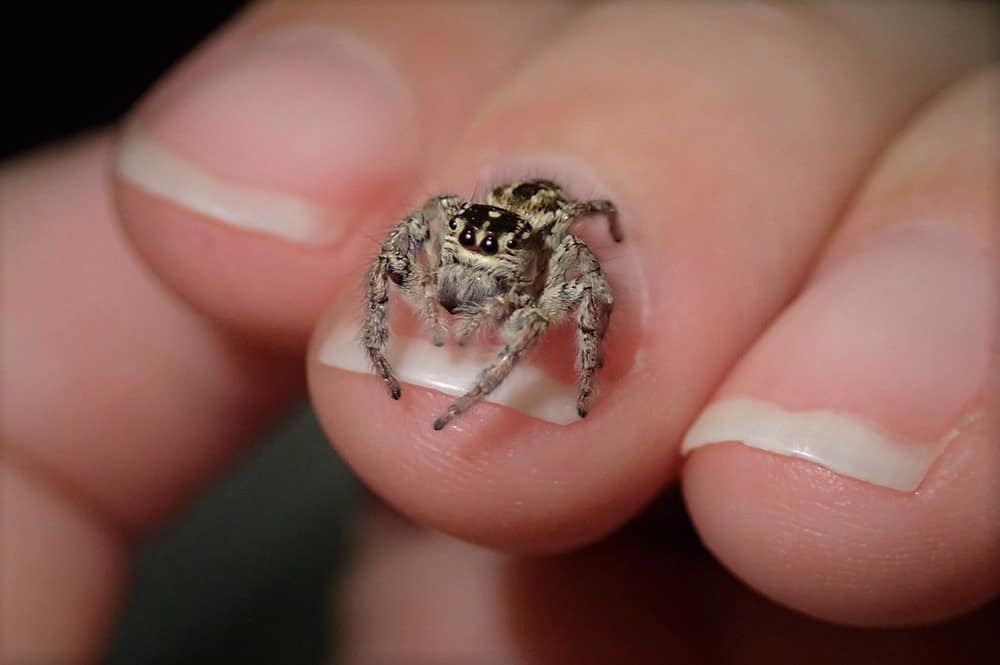
Jumping spiders (family Salticidae) are among the most engaging invertebrate pets in the hobby. With more than 6,400 described species, sharp forward-facing eyes that see in true color, and a curiosity that sets them apart from web-bound spiders, they have become a gateway pet for keepers who want something interactive but apartment-sized (source: American Arachnological Society). This pillar guide is the complete reference for keeping one well: choosing a species, building the right enclosure, feeding correctly, handling safely, and recognizing health problems before they become fatal.
Jumping spiders are not difficult to keep, but they are unforgiving of a few specific mistakes – wrong enclosure orientation, wet substrate, oversized prey, and handling during a molt. Getting the details right from week one is what separates a spider that thrives for two-plus years from one that fails to molt at five months.
In our keeper community, we have raised dozens of Phidippus regius, P. audax, and Hyllus diardi through full lifecycles, and the patterns below reflect what consistently works across all three.
What This Guide Covers
This is the pillar reference for jumping spider husbandry. Quick-jump to any section:
- Choosing your first jumping spider – species comparison + buying logistics
- Enclosure setup – size, ventilation, substrate, temperature, humidity, lighting
- Diet and feeding – prey, frequency, hydration, foods to avoid
- Handling – safe technique, stress signals, when not to handle
- Lifecycle and sexing – instars, sexing 101, lifespan by species
- First 30 days – arrival, acclimation, first feeding, first molt
- Health and common issues – dehydration, dysecdysis, mites, vet referral
- Molting – what to expect and how to support a safe molt
- Costs and budget – setup tiers and ongoing monthly spend
- Enrichment and behavior – what keeps a curious spider engaged
- Frequently asked questions
Choosing Your First Jumping Spider
The best first jumping spider is a captive-bred adult or sub-adult Phidippus regius female. She will live longest (often 18-30 months in captivity), show the boldest personality, and accept a wide range of room temperatures and feeder insects without fuss. Males of the same species mature faster and die younger, often inside 12 months post-maturity, so they suit experienced keepers who want a short breeding cycle, not first-time owners.
Most pet jumping spiders belong to the genus Phidippus. Body sizes for adults run 12 to 22 mm, well inside what a small enclosure can support, and the temperament tolerates the gentle handling that makes jumping spiders so popular (source: American Arachnological Society). Other species enter the hobby every year, but four account for the vast majority of pet keeping.
Species comparison
| Species | Adult size | Temperature | Humidity | Beginner-friendly? | Notes |
|---|---|---|---|---|---|
| Phidippus regius (Regal) | 15-22 mm | 72-82°F (22-28°C) | 50-60% | Yes | Most color morphs; widely captive-bred; boldest with handling |
| P. audax (Bold) | 13-20 mm | 68-80°F (20-27°C) | 50-60% | Yes | Native across the eastern US; sometimes wild-caught (avoid – see below) |
| Hyllus diardi (Heavy) | 16-25 mm | 76-84°F (24-29°C) | 70-80% | Intermediate | Tropical; needs higher humidity and deeper moist substrate |
| Hasarius adansoni (Adanson) | 5-8 mm | 72-82°F (22-28°C) | 55-65% | Experienced | Cosmopolitan but small – harder to feed, harder to enjoy |
For a deeper species walkthrough with photos and morph guides, see our companion guide to the best jumping spider species for pets, plus the dedicated Phidippus regius care guide, Phidippus audax care guide, and Hyllus diardi care guide.
Buying logistics: where and how
Always buy captive-bred. Wild-caught spiders carry parasites, may already be at the end of their lifespan when collected, and removing them harms local insect populations. Captive-bred specimens from reputable breeders arrive parasite-free, acclimated to enclosure life, and with a documented age (source: American Arachnological Society).
Expect to pay between $20 and $80 for a captive-bred sub-adult or adult, depending on species, sex, age, and color morph (source: MorphMarket). Slings (spiderlings) run cheaper but demand more frequent feeding and more attentive humidity management. For a complete pricing breakdown including setup and monthly costs, see our jumping spider cost guide and the where to buy a jumping spider walkthrough.
If shipping, schedule arrival when daytime temperatures at both origin and destination are between 50°F and 85°F. Cold-pack or heat-pack shipping in extreme weather is risky for an invertebrate this small. Track the package, be home for delivery, and unbox the spider in a quiet room within an hour of arrival. Catching one yourself is a separate decision with its own ethics – we cover that in our guide to catching wild jumping spiders.
Enclosure Setup
A jumping spider enclosure should be taller than it is wide, front-opening, and ventilated through two opposing mesh panels. For a single adult, a 4 x 4 x 7 inch (10 x 10 x 18 cm) front-opening acrylic or glass cube works for the entire pet life. Slings start in smaller deli cups (50-100 ml) with pin-prick ventilation and graduate up over four to six months. Front-opening matters because jumping spiders build retreat webs at the top of their enclosure; top-opening lids destroy that retreat every time you open the door.
We have set up more than 50 enclosures in our keeper community, and the three factors that most consistently predict a healthy first year are: (1) at least three vertical climbing surfaces, (2) a retreat anchor point near the ceiling, and (3) ventilation on two opposing walls rather than the lid. For setup walkthroughs with parts lists, see our dedicated guide to jumping spider enclosure setup and the more specific enclosure size by life stage reference.
Substrate
Line the floor with 2-3 cm of moisture-holding substrate. Coconut fiber (coco coir) or a coco/sphagnum-moss blend works for nearly every species. Both hold humidity well when lightly damp, resist mold when not soaked, and are safe if the spider accidentally walks across them. Avoid loose vermiculite, sand, or paper towel: vermiculite can stick to book lungs, sand offers no humidity buffer, and paper towel breeds bacteria the moment it gets wet. For options and a moisture-management primer, see our best substrate for jumping spiders guide.
Decoration and climbing structure
Add at least three climbing pieces: cork bark, artificial vines, small silk or live plants (pothos is safe and forgiving), and one or two thin branches. Position one broad piece near the ceiling – this becomes the retreat anchor where the spider builds its silken hammock for sleeping, molting, and (for females) egg-laying. Bare enclosures produce withdrawn, inactive spiders; well-decorated ones produce confident hunters.
Temperature
Target 72-82°F (22-28°C) for Phidippus species and 76-84°F (24-29°C) for Hyllus diardi. Most homes hit this range without supplemental heating. Below 65°F (18°C), metabolism slows enough to interfere with molting and feeding response. Above 90°F (32°C), the spider risks heat stress and rapid dehydration inside a small enclosure.
If your room drops below 70°F regularly, attach a small heat mat to one side wall of the enclosure (never under it, which can dangerously overheat the substrate). Always pair the mat with a thermostat; an unmonitored heat mat is the single most common cause of preventable spider death. For the full temperature and humidity protocol, see our jumping spider temperature and humidity guide.
Humidity
Keep ambient humidity at 50-60% for Phidippus species, 70-80% for Hyllus diardi, and 55-65% for Hasarius adansoni. Mist one corner of the enclosure with dechlorinated water every two to three days – enough to leave visible droplets on the glass for the spider to drink, but not enough to saturate the substrate. A small section of damp substrate plus a dry climbing zone creates the gradient a jumping spider needs to self-regulate.
For the detailed misting and droplet protocol, including how to identify dehydration early, see our jumping spider hydration guide.
Lighting
Jumping spiders are diurnal – they hunt and explore during daylight hours and sleep at night. Ambient room lighting on a 12-hour-on, 12-hour-off cycle is sufficient. They do not require UVB. They do benefit from a few hours of indirect natural daylight or a small LED desk lamp positioned nearby; bright daylight visibly increases hunting behavior and color display. Never place the enclosure in direct sunlight – the small air volume heats fast and the spider cannot retreat from it. For the lighting deep-dive (including the UVB question), see our jumping spider lighting guide.
Diet and Feeding
Jumping spiders eat live insects. The staple options in captivity are flightless fruit flies (Drosophila melanogaster and D. hydei), pinhead and small crickets, blue and green bottle flies, waxworms, and small mealworms. Feed prey no larger than the spider’s abdomen. Feed slings every 1-2 days, juveniles every 2-3 days, and adults every 3-5 days. Remove uneaten prey within 24 hours so it cannot bite the spider during sleep.
The single most useful skill for new keepers is reading the spider’s abdomen. A plump, rounded abdomen means good condition. A shrunken or wrinkled abdomen means underfeeding or dehydration. A glossy, almost translucent abdomen on a sub-adult often signals premolt. Adjust feeding to the abdomen, not to a calendar.
Prey sizing matrix
| Life stage | Body length | Best prey | Feeding frequency |
|---|---|---|---|
| 1st-2nd instar (sling) | 2-4 mm | D. melanogaster | Daily to every other day |
| 3rd-4th instar | 4-7 mm | D. hydei, pinhead crickets | Every 1-2 days |
| Juvenile | 7-12 mm | Small crickets, blue bottle flies | Every 2-3 days |
| Sub-adult / adult | 12-22 mm | Adult bottle flies, small crickets, occasional waxworm | Every 3-5 days |
For prey-by-prey breakdowns and culture instructions for fruit flies, see our best feeder insects for jumping spiders guide and the feeding schedule by age and species.
Foods to avoid
Never feed wild-caught insects from outdoors. They may carry pesticides, parasitic mites, or pathogens lethal to a jumping spider. Avoid hard-shelled beetles (the spider cannot bite through), ants (they spray formic acid and can outnumber the spider), and any insect larger than the spider’s abdomen. Waxworms are calorie-dense and fine as an occasional treat but should not be a staple – the high fat content can cause obesity in older females. Stick to commercially bred feeders.
Hydration
Jumping spiders drink water droplets directly off enclosure walls and plant leaves. They do not drink from standing bowls reliably and can drown in anything deeper than 2 mm. Misting one corner every two to three days produces the droplets they need. Use dechlorinated, bottled, or filtered water. For deep guidance on what jumping spiders eat across life stages and in the wild, see our complete jumping spider diet guide. If your spider stops eating, work through our jumping spider won’t eat troubleshooting flow.
Handling Your Jumping Spider
Jumping spiders are among the most handleable arachnids. They rarely bite humans, and when they do the venom produces only localized redness comparable to a mild bee sting that resolves within hours (source: US National Park Service). Handling is for the keeper’s enjoyment, however – not the spider’s. A healthy spider tolerates short handling sessions but gains no measurable enrichment from them. Build the routine around the spider’s cues, not your schedule.
How to handle safely
Place an open, flat hand in front of the spider and let it walk on voluntarily. Never pinch, scoop, or grab. A jumping spider can leap 10 to 50 times its body length and will use that distance to escape if it feels grabbed (source: PNAS). Always handle over a soft surface (a sofa or bed) at table height, away from open windows, ceiling fans, vents, and other pets. Keep first sessions under two minutes; build up only if the spider stays calm.
A relaxed spider walks deliberately, pauses to look at you with its large anterior median eyes, and may turn to track a finger. A stressed spider crouches with the front pair of legs raised, presses against the ground, or repeatedly attempts a hard escape jump. Stress signals = session over, return to enclosure. For a full handling protocol with photos and step-throughs, see the how to handle a jumping spider safely guide.
When not to handle
Avoid handling during:
- Premolt: the spider stops eating, becomes sluggish, and may seal itself in its retreat. Handling now can cause a stuck molt (dysecdysis), which is often fatal.
- The first 48-72 hours post-molt: the new exoskeleton is soft and crushable; even careful handling can deform the abdomen permanently.
- The first 7-10 days after arrival: the spider needs time to build a retreat web and acclimate to the new enclosure.
- The hour after feeding: a full spider is sluggish and uncomfortable to move.
For the full body-language vocabulary – threat postures, leg-waving courtship vs. warning, head-tilting curiosity – see our jumping spider behavior guide.
Lifecycle, Sexing, and Lifespan
A jumping spider passes through 5 to 9 molts (instars) from hatching to adult, taking 4 to 9 months depending on temperature, feeding rate, and species. Females mature 1-2 instars later than males of the same species and live roughly twice as long. Phidippus regius females commonly reach 18-30 months in captivity; males of the same species rarely exceed 12 months post-maturity. Knowing your spider’s sex and approximate instar lets you plan feeding, breeding, and lifespan expectations realistically.
Approximate lifecycle timing
| Stage | Time from hatch | Body length | Key markers |
|---|---|---|---|
| Egg sac → 1st instar | 2-4 weeks | 1-2 mm | Inside maternal silk; cannibalism risk after dispersal |
| 2nd-4th instar | 4-12 weeks | 3-6 mm | Active hunting begins; needs daily fruit flies |
| 5th-6th instar (juvenile) | 3-5 months | 7-10 mm | Sexable in some species via pedipalp shape on close inspection |
| Sub-adult | 5-8 months | 10-18 mm | Adult coloration emerges; final 1-2 molts ahead |
| Adult | 6-12 months | 12-22 mm | Mature pedipalps (males) or epigynum (females); breeding possible |
Sexing 101
Mature males develop swollen, boxing-glove-shaped pedipalps used to transfer sperm during mating. Females retain slim, finger-like pedipalps and develop a visible epigynum on the underside of the abdomen. In Phidippus regius, males also display the species’ signature white-and-iridescent-blue chelicerae and a black body, while adult females present in a wide range of cream, peach, orange, and gray morphs. For step-by-step sexing with photos at multiple instars, see our how to sex a jumping spider guide and the visual how to identify jumping spiders reference.
Lifespan by species and sex
Females always outlive males within a given species, sometimes by a factor of two. Phidippus regius females typically reach 18-30 months in captivity; P. audax females reach 12-24 months; Hyllus diardi females reach 12-18 months. Lifespan is shortened by chronic dehydration, poor temperature control, oversized prey injuries, and forced cohabitation. For the full lifespan table by species and the factors that extend or shorten it, see our jumping spider lifespan guide. If your interest is breeding, work through our how to breed jumping spiders guide and the spiderling care walkthrough before pairing.
The First 30 Days
The first 30 days set the trajectory for the rest of the spider’s captive life. The single biggest mistake new keepers make is treating the first week like normal husbandry – handling, frequent feeding, repositioning decor – when the spider needs a quiet acclimation window. Plan the first month as four distinct phases: arrival, first feed, settle, and first handle.
Days 1-3: arrival and acclimation
Unbox the spider in a quiet room within an hour of delivery. Transfer it into a pre-set-up enclosure (substrate damp on one side, retreat anchor in place, lights low). Do not offer food on day 1. Mist one corner lightly. Leave the room for the next several hours. Most spiders will explore the enclosure within 30 minutes, find the top corner, and start a small retreat web by hour 24.
Days 2-4: first feeding
Offer one prey item appropriate to the spider’s size on day 2 or 3 – a small fruit fly for a juvenile, a small cricket for an adult. If the spider eats, you have confirmed health. If it refuses for the first 24 hours, that is normal post-shipping behavior; retry every 24 hours. If refusal lasts beyond 7 days outside of a premolt, see our spider won’t eat troubleshooting flow.
Days 5-14: settle and observe
Maintain a feeding rhythm matched to the lifecycle table above. Mist every 2-3 days. Spot-clean prey remains within 24 hours of each feed. Keep handling at zero. The spider should be visibly active during daylight, hunt eagerly, and maintain a rounded abdomen.
Days 15-30: first handling and first molt watch
From week three, the spider is acclimated enough for a brief handling session if it shows confident body language. Watch for premolt signs throughout the first month: appetite drop, sealing into the retreat, dulling colors. Slings molt every 2-4 weeks; juveniles every 4-8 weeks; adults rarely after their final instar. For complete signs of a healthy spider versus an unhealthy one, see our jumping spider health signs reference and the common new-owner mistakes guide.
Health and Common Issues
The four problems that account for nearly every captive jumping spider death are dehydration, stuck molts (dysecdysis), feeder-introduced mites, and physical trauma from oversized prey or mishandling. Catching any of these in the first 48 hours usually lets you correct course; missing them past 72 hours often does not. The good news is each has a visible signature, so a keeper who checks the spider once a day with a flashlight will catch nearly all of them.
If the spider shows prolonged lethargy outside of premolt, refuses food for more than 14 days, displays curled legs while still breathing, or has a visibly damaged abdomen or carapace, consult an exotic-animal veterinarian. Veterinary care for invertebrates is limited but expanding – the Association of Reptile and Amphibian Veterinarians (ARAV) maintains a searchable directory of exotics-trained vets (source: ARAV).
Dehydration
Dehydration is the single most common health problem in captive jumping spiders. Signs: shrunken or wrinkled abdomen, lethargy, refusal to eat, sluggish response to movement. Treatment: immediately mist the enclosure to produce droplets, place the spider near a droplet, and increase humidity by misting a second corner. Most early dehydration cases resolve inside 24 hours of corrective misting.
Dysecdysis (stuck molt)
A stuck molt happens when the spider cannot fully separate from its old exoskeleton, almost always because humidity was too low entering the molt. The spider may be partially extracted with old cuticle still attached to the abdomen or legs. Do not pull the old cuticle off – tearing the soft new exoskeleton is fatal. Instead, raise humidity by misting around (not on) the spider and leave it undisturbed for 24-48 hours. For full molting protocol and emergency response, see our jumping spider molting guide.
Mites and parasites
Tiny white, tan, or reddish dots moving on the spider’s body or substrate indicate a mite infestation, almost always introduced via feeder insects. Move the spider to a clean temporary enclosure with fresh substrate, then deep-clean the original enclosure. Switch feeder cultures and inspect any incoming feeders before adding them. For full identification and treatment, see our jumping spider parasites and mites guide.
Molting
Molting is how jumping spiders grow – they shed the old exoskeleton, expand, and reharden with a new one over 48-72 hours. Slings molt every 2-4 weeks, juveniles every 4-8 weeks, and adults usually only once or twice before their final mature instar. A molt that proceeds normally is one of the safest events in the spider’s life; a molt that is disturbed, dehydrated, or attempted during handling stress is one of the riskiest. Recognize premolt early and step back.
Premolt signs include loss of appetite for 5-14 days, reduced activity, sealing into the retreat with extra silk, and a darkening or dulling of body color. The spider will not eat during this period and should not be offered live prey. Remove any uneaten feeders. Maintain humidity at the higher end of the species range (60% for Phidippus, 80% for Hyllus). Do not disturb. After the molt, the new exoskeleton is pale and soft for 48-72 hours; resume feeding only when the spider re-emerges from the retreat and shows hunting behavior, typically 3-5 days post-molt. The full molting timeline by life stage is in our jumping spider molting guide.
Costs and Budget
Setting up a jumping spider runs $40-$200 depending on enclosure quality. Ongoing monthly costs are $5-$15. This is among the cheapest exotic pets to maintain, but the setup tier you choose affects how easy the spider is to observe and how easy the enclosure is to maintain.
Setup cost tiers
| Tier | Setup cost | Includes | Best for |
|---|---|---|---|
| Budget | $25-$50 | Deli cup or modified plastic container, cork bark, coir substrate, sphagnum, plastic plant | Slings, secondary enclosures, first-time test runs |
| Mid | $60-$120 | Front-opening acrylic 4×4×7″, mesh ventilation, real cork, silk plants, branches | Most adult keepers |
| High / bioactive | $120-$250 | Glass terrarium, drainage layer, bioactive substrate, springtails, live pothos, LED lighting | Display setups, long-term self-cleaning enclosures |
Ongoing monthly cost is dominated by feeder insects ($5-$10) plus occasional substrate top-ups and a replacement cork or plant. A complete keeper-cost breakdown by species, region, and setup tier is in our jumping spider cost guide.
Enrichment, Behavior, and Cleaning
A jumping spider in a well-decorated enclosure is rarely bored – it has prey to hunt, structures to climb, and the cognitive load of being a visual predator. That said, three small adjustments make a measurable difference: rotating climbing positions every few weeks, occasionally offering a novel safe object to investigate, and varying prey type so the spider engages its hunting sequence on different motion patterns.
Jumping spiders have remarkable visual cognition and have been shown in research to plan multi-step detour routes to prey (source: Current Biology). Keepers commonly notice their spider tracking a finger held against the glass or running across a hand – this is curiosity-driven behavior, not affection, but it makes the species more rewarding than nearly any other arachnid. For enrichment ideas with specific games and objects, see our jumping spider enrichment guide. To decode any specific behavior you see, see our jumping spider behavior guide.
Spot-clean prey boluses (the leftover husks after a feeding) every few days. Replace the entire substrate every 4-6 weeks or any time mold appears. Rinse decorations in warm water without soap during full cleans. For a step-by-step protocol that avoids stressing or losing the spider mid-clean, see our how to clean a jumping spider enclosure guide.
Frequently Asked Questions
Are jumping spiders good pets for children?
Jumping spiders can suit supervised older children (typically 8+) who understand gentle handling and follow rules. Their venom is mild and not medically significant for healthy people, and their small size makes them non-threatening visually. However, a child must be capable of avoiding squeezing, dropping, or chasing the spider. An adult should always supervise handling sessions and own primary responsibility for feeding, misting, and enclosure maintenance. For specifically what to expect day-to-day with a jumping spider as a household pet, see our jumping spiders as pets guide.
Do jumping spiders recognize their owners?
Jumping spiders have exceptional vision and clearly distinguish shapes, colors, and motion patterns, and research has shown they can learn and recall visual stimuli (source: PNAS). Many keepers report their spider behaves differently around the primary feeder versus a stranger. This is most likely learned association with feeding routines rather than emotional bonding, but it produces an interactive experience that no other invertebrate pet matches. For more on what jumping spiders perceive, see our jumping spider facts page.
Can I keep two jumping spiders together?
No. Jumping spiders are solitary predators and will attack, kill, and cannibalize a cagemate within hours. House each spider individually with no exceptions. The one tightly controlled exception is a brief, supervised introduction for breeding, and even then the male must be removed within minutes of mating to avoid being eaten by the female. Breeding is covered in detail in our jumping spider breeding guide.
How often should I clean the enclosure?
Spot-clean prey remains and boluses every few days; do a full substrate replacement every 4-6 weeks or whenever mold appears, whichever comes first. Wash decorations in warm water without soap or chemicals during full cleans – soap residue can persist and irritate the spider. The detailed step-by-step is in our jumping spider enclosure cleaning guide, including how to safely move the spider during a deep clean.
What should I do if my jumping spider escapes?
Stay calm – most escaped jumping spiders are recaptured within 24 hours. They are attracted to light and tend to climb to high points such as window frames, picture rails, and ceiling corners. Check those first. Then place the open enclosure near where you last saw the spider with a live feeder inside as a lure, darken the rest of the room, and leave a single light source near the enclosure. Most spiders walk back into the enclosure within a day. Going forward, double-check the enclosure latch every time you close it.
Do jumping spiders bite, and is it dangerous?
Jumping spiders rarely bite humans; when they do, the bite is comparable to a mild bee sting with localized redness that resolves within a few hours (source: US National Park Service). There are no documented cases of medically significant envenomation in healthy adults from any common pet species. People with known severe insect-venom allergies should still consult a doctor before keeping any venomous invertebrate. The full bite breakdown including first-aid steps is in our do jumping spiders bite guide.
Researched and written by the ExoPetGuides editorial team with AI-assisted drafting. All husbandry parameters and veterinary references independently verified against peer-reviewed sources and species-authority publications.
This article is for educational purposes only and is not a substitute for professional veterinary advice. Always consult a qualified exotic-animal veterinarian for any health concern about your pet. Care recommendations may vary based on species, individual animal, and local regulations.
