


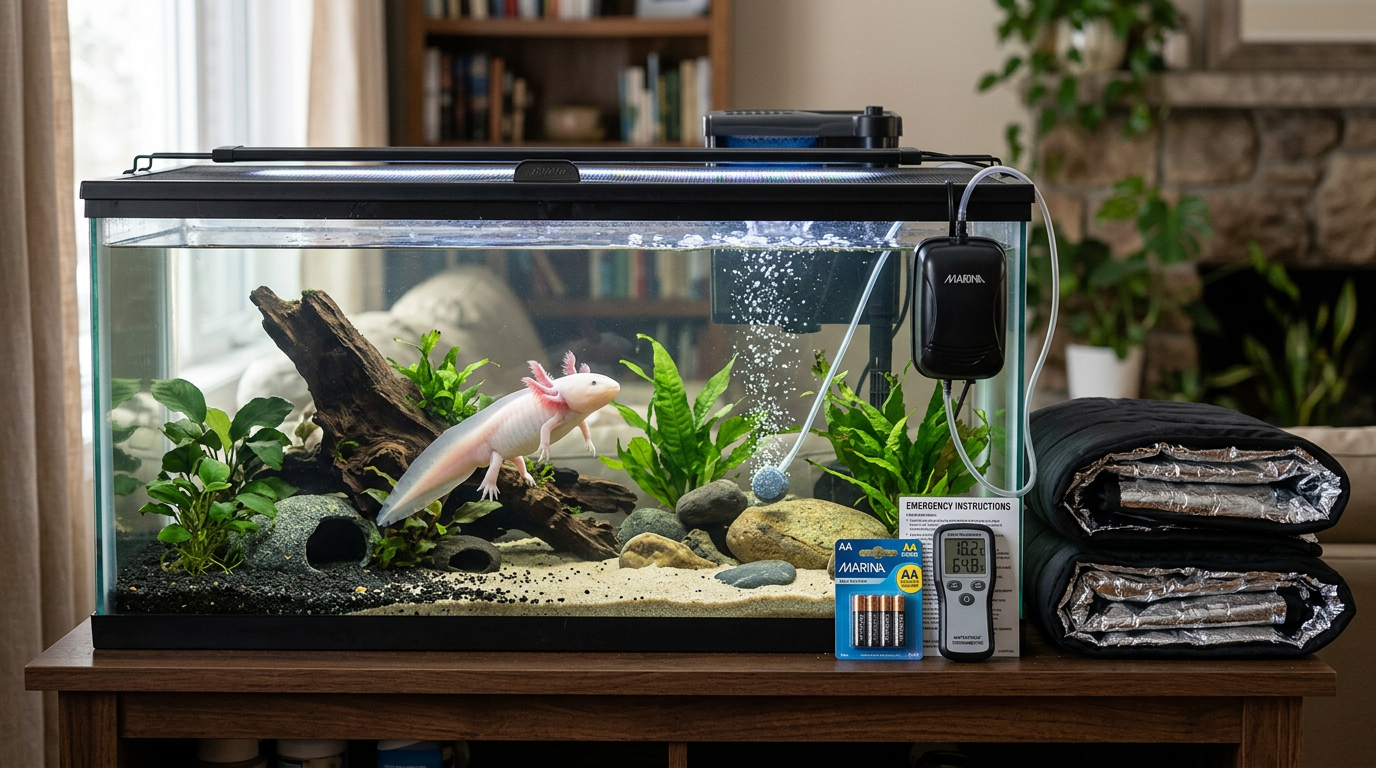
A power outage shuts down your axolotl’s filtration, chiller or fan, and lighting simultaneously, creating three overlapping risks: dissolved oxygen depletion, temperature drift, and ammonia accumulation from stalled biological filtration. The good news is that axolotls tolerate power interruptions better than most aquarium species because they breathe air at the surface, prefer cold water that holds more dissolved oxygen, and can safely fast for days without health consequences. This guide covers the immediate first-10-minute response, protocols scaled by outage duration (under 4 hours, 4 to 24 hours, over 24 hours), seasonal risk differences between summer and winter outages, and a complete emergency kit checklist so you are prepared before the lights go out.
Keepers in communities we collaborate with consistently report that the difference between a stressful power outage and a non-event comes down to preparation. The ones who already own a battery-powered air pump and a sheet of foam insulation board handle 12-hour outages without testing a single parameter outside safe range. The ones caught without preparation spend the outage manually agitating water with a pitcher every 15 minutes.
What happens to an axolotl tank when the power goes out
The moment power cuts, three systems fail at once, and each creates a distinct threat on a different timeline. Understanding which threat arrives first determines your priority order during the outage.
Filtration stops and ammonia begins accumulating. Your biological filter depends on a constant flow of oxygenated water passing over the bacterial colony living in the filter media. When the pump stops, that colony loses its oxygen supply within 20 to 30 minutes. Beneficial bacteria begin dying, and by the 2-hour mark a sponge filter sitting in stagnant water can shift from a biological processing station to an ammonia source as dead bacteria decompose (https://www.aquariumcoop.com/blogs/aquarium/power-outage). This does not mean your tank immediately becomes toxic. In a cycled tank with moderate bioload, measurable ammonia typically does not appear until 6 to 12 hours without filtration, because the existing water volume dilutes the initial waste output. But the clock is ticking.
Temperature begins drifting toward room temperature. A 20-gallon axolotl tank at 64 degrees Fahrenheit in a 78-degree room will gain roughly 1 to 2 degrees per hour depending on insulation, lid fit, and ambient airflow. In a winter outage where the house cools to 55 degrees, the tank will lose temperature at a similar rate. Axolotls tolerate a wide temperature range of 50 to 68 degrees Fahrenheit under normal conditions, with short-term tolerance down to about 40 degrees and up to about 72 degrees before clinical stress begins (https://www.axolotl.org/requirements.htm). The direction of the drift determines which season is more dangerous.
Dissolved oxygen drops gradually. A still water surface exchanges oxygen with the air far less efficiently than agitated water. However, axolotls have a significant advantage over fish: they possess lungs and routinely gulp air from the surface. As long as there is a gap between the water surface and the tank lid, your axolotl can supplement its gill respiration with lung breathing. This makes oxygen the least urgent of the three concerns for axolotls specifically, though it remains critical for any tank mates or for maintaining the aerobic conditions that keep ammonia-processing bacteria alive in the water column.
First 10 minutes: immediate actions when the power cuts
Speed matters less than sequence. Do these steps in order within the first 10 minutes, and you will have addressed the most time-sensitive risks.
Step 1: Stop feeding immediately. Every gram of food your axolotl eats produces waste that your now-offline filter cannot process. A healthy adult axolotl can fast for 7 to 14 days without any health consequences (https://www.watercritters.ca/axolotl-care-sheet/). Do not feed again until power has been restored and the filter has been running for at least 2 hours. If you fed within the last hour before the outage, use a turkey baster or siphon to remove any uneaten food sitting on the substrate.
Step 2: Open or remove the tank lid slightly. Ensure there is adequate air exchange at the water surface. If your tank has a tight-fitting glass lid, slide it back 2 to 3 inches to increase the air-water interface. Do not remove the lid entirely if you have cats, children, or other animals that might access the tank.
Step 3: Activate your battery-powered air pump if you have one. Connect it to an airstone and place it in the tank. This single piece of equipment solves the oxygen problem entirely and also provides enough water movement to slow ammonia accumulation in the water column. If you do not own a battery air pump, move to step 4.
Step 4: Manually agitate the water surface. If you have no battery air pump, use a clean pitcher or cup to scoop water from the tank and pour it back in from about 6 inches above the surface. This breaks the surface tension and drives oxygen into the water. Repeat this for 30 seconds every 15 to 20 minutes during the first few hours. It is tedious but effective (https://life-aquatic.com/power-outage-instructions/).
Step 5: Insulate the tank. Wrap towels, blankets, or foam insulation board around the sides and back of the tank. Place a towel over the top, leaving a gap for air exchange. This slows temperature drift in either direction. In a summer outage, insulation buys you time before the tank reaches dangerous heat. In a winter outage where the house is cooling, insulation retains the tank’s existing warmth.
Short outage protocol: under 4 hours
A power outage lasting less than 4 hours is unlikely to cause measurable harm to a healthy axolotl in a cycled, properly maintained tank. During this window, ammonia production is minimal, temperature drift is manageable, and dissolved oxygen remains adequate if you have taken the immediate steps above.
What to do. Maintain insulation. Run the battery air pump if available. Do not feed. Monitor tank temperature with a portable thermometer (battery-powered or alcohol-based, not a digital unit that requires tank power). Check on the axolotl every 30 to 60 minutes to confirm it is behaving normally: resting on the bottom, gills fanned, no unusual floating or frantic movement.
What not to do. Do not perform a water change during a short outage unless you detect an unusual ammonia spike. Water changes during power loss risk introducing temperature-mismatched water and removing beneficial bacteria that are still clinging to surfaces in the tank. Do not add chemical ammonia binders unless you have tested and confirmed ammonia above 0.25 ppm.
When power returns. Restart all equipment. Listen for normal pump operation. Check that the filter is flowing before walking away. Beneficial bacteria in the filter media may have experienced some die-off, so test ammonia and nitrite daily for the next 3 days to confirm the nitrogen cycle has recovered.
Medium outage protocol: 4 to 24 hours
Between 4 and 24 hours, the risks escalate. Ammonia may become detectable, temperature drift compounds, and the biological filter colony suffers significant losses.
Ammonia management. Test ammonia at the 4-hour mark if you have a liquid test kit (API Master Test Kit or equivalent). If ammonia reads above 0 ppm, perform a 25 percent water change using pre-dechlorinated water that is temperature-matched to the tank. If you do not have pre-prepared water, fill buckets from the tap, add dechlorinator at the recommended dose, and let the water sit for 20 minutes to reach approximate room temperature before adding it slowly to the tank. Experienced keepers tracking ammonia during outages in our community have found that a single 25 percent change at the 6-hour mark is usually sufficient to keep ammonia below the 0.25 ppm action threshold through a 12-hour outage, provided the axolotl is not being fed.
Temperature monitoring. Check temperature every 2 hours. If the tank is climbing toward 72 degrees Fahrenheit in a summer outage, add frozen water bottles (sealed tightly, never loose ice) to the tank. A 500 ml frozen bottle in a 20-gallon tank drops the temperature approximately 2 to 3 degrees over 30 minutes. Remove the bottle before the tank drops below 60 degrees. Rotate bottles as they thaw. If the tank is dropping below 55 degrees in a winter outage, wrap additional insulation around the tank and consider taping a chemical hand warmer (the disposable kind sold at camping stores) to the outside glass, never inside the water.
Ongoing aeration. Continue running the battery air pump. If manually aerating with a pitcher, increase frequency to every 10 minutes during waking hours. Before bed, perform a larger surface agitation session (2 to 3 minutes of pouring) and accept that oxygen levels will drop somewhat overnight. Your axolotl will surface-breathe to compensate.
Filter media preservation. If the outage reaches the 6-hour mark, consider removing your sponge filter or filter media cartridge and placing it in a bucket of tank water with an airstone. This keeps the bacterial colony oxygenated and alive outside the stagnant filter housing. When power returns, reinstall the media and the colony resumes processing immediately rather than requiring a partial re-cycle.
Long outage protocol: over 24 hours
Outages exceeding 24 hours shift from inconvenience to genuine emergency. The nitrogen cycle is likely compromised, temperature control becomes difficult without intervention, and water quality requires active management.
Tubbing the axolotl. If tank temperature has drifted outside the 50 to 72 degree Fahrenheit safe window, or if ammonia has risen above 0.5 ppm despite water changes, move the axolotl to a clean plastic tub with fresh, dechlorinated, temperature-matched water. Use a tub that holds at least 5 gallons. A tub is easier to insulate, easier to change water in, and easier to transport if you need to relocate to a location with power. The quarantine guide covers safe tubbing technique and water volume requirements.
Daily 50 percent water changes. In a tub or tank without filtration, perform 50 percent water changes every 12 to 24 hours using dechlorinated, temperature-matched water. This is the most effective ammonia management available without a functioning filter.
Generator or portable power station. If you own a generator or a portable lithium power station, run the filter and air pump for 2 to 4 hours every 8 hours. This intermittent operation provides enough water circulation to maintain bacterial colony viability and prevent ammonia buildup. A small aquarium sponge filter draws only 3 to 5 watts, meaning even a modest 300-watt-hour portable power station can run it for 60 or more hours.
When to consider relocating. If the outage is expected to exceed 48 hours and you cannot maintain temperature within the 50 to 72 degree range, consider transporting the axolotl to a friend, family member, or local aquarium store with power. Transport in a sealed container with tank water (not tap water), insulated with towels, and minimize transit time. The emergency care checklist covers transport protocols and emergency triage decisions.
Summer outage vs winter outage: different risks require different responses
The season determines which threat kills first. A summer outage and a winter outage are functionally different emergencies even though the trigger is the same.
Summer outage: overheating is the primary danger. Axolotls are cold-water animals. Their ideal range is 60 to 68 degrees Fahrenheit, and stress begins above 72 degrees (https://www.axolotl.org/requirements.htm). Temperatures above 75 degrees suppress immune function and trigger visible stress signs including appetite loss, floating, and pale mucus patches on the skin (https://fantaxies.com/blogs/axolotls/axolotl-water-temperature-ideal-range-limitations). In a house without air conditioning during a summer heat wave, room temperature can reach 85 to 95 degrees, and tank temperature will follow within hours. Warm water also holds less dissolved oxygen, compounding the filtration loss.
Summer-specific actions:
- Float frozen water bottles (sealed) in the tank, rotating every 30 to 60 minutes as they thaw
- Place the tank in the coolest room of the house, ideally a basement or ground-floor interior room
- Remove the tank lid entirely to maximize evaporative cooling (cover with mesh if animal escape is a risk)
- If the tank exceeds 74 degrees and you cannot cool it, tub the axolotl in fresh cool water immediately
- The heat spike emergency guide covers the first-60-minutes cooling protocol in detail
Winter outage: cold is usually not dangerous. Axolotls evolved in the cool, high-altitude lakes of central Mexico and tolerate cold water well. They can survive at temperatures as low as 40 degrees Fahrenheit for several days without harm, though metabolism and appetite slow significantly below 50 degrees (https://fantaxies.com/blogs/axolotls/axolotl-water-temperature-ideal-range-limitations). Extended exposure below 40 degrees for more than 20 days can become dangerous. In most winter power outages in insulated homes, tank temperature stabilizes in the mid-50s, which is uncomfortable but not harmful.
Winter-specific actions:
- Insulate heavily with blankets and foam board
- Do not add hot water directly to the tank (thermal shock from rapid warming is more dangerous than gradual cooling)
- If the house drops below 40 degrees (burst-pipe territory), wrap the tank in sleeping bags and consider relocating
- Reduce aeration frequency since cold water holds more dissolved oxygen naturally
- A winter outage combined with no feeding and adequate insulation is the lowest-risk scenario for axolotls
Building your power outage emergency kit
Preparation takes 30 minutes and costs under $40. Every item on this list is available at pet stores, hardware stores, or online, and the entire kit fits in a single shoebox stored near the tank.
Battery-powered air pump. This is the single most important emergency item. Models with a built-in battery that auto-switches when power drops (such as the Hygger or Uniclife battery backup air pumps) are ideal because they activate automatically without you needing to be home. Budget: $15 to $25. Keep spare AA or D batteries with the kit. Test the pump quarterly by unplugging your main air pump and confirming the backup engages.
Airstone and airline tubing. A spare airstone and 3 feet of airline tubing dedicated to the emergency pump. Do not share tubing between the main system and the backup, because reconnecting under stress wastes time.
Insulation materials. Two 1-inch-thick foam insulation board panels cut to fit the sides of your tank, plus a folded towel or blanket for the back and top. Rigid foam insulates better than towels alone and stores flat behind or beside the tank stand.
Portable thermometer. A battery-powered digital thermometer or a glass alcohol thermometer. Your tank’s digital thermometer may require wall power. Having an independent temperature reading tool is critical during an outage. Keep it with the kit, not mounted in the tank.
Dechlorinator. A small bottle of water conditioner (Seachem Prime or equivalent) stored with the kit. During an outage you may need to prepare emergency water changes from the tap quickly. Having dechlorinator within arm’s reach eliminates the step of searching for it in a cabinet.
Liquid test kit reagents. Ammonia and nitrite test reagents from your API Master Test Kit or equivalent. If your main kit lives in a cabinet, keep a spare set of these two reagents with the emergency kit. Ammonia and nitrite are the only parameters that matter during a power outage.
Frozen water bottles. Keep 2 to 3 sealed 500 ml water bottles in your freezer at all times. These are your temperature management tool during summer outages. Replace any that develop cracks or leaks.
Clean bucket or tub. A 5-gallon food-grade bucket or a 10-gallon plastic storage tub, dedicated to the axolotl (never used for cleaning chemicals). This is your emergency tubbing container if the tank becomes uninhabitable. Store it nested under or behind the tank stand.
The care SOP includes quarterly equipment checks that should incorporate testing your emergency kit: confirm the battery pump works, replace expired batteries, verify dechlorinator has not expired, and confirm frozen bottles are intact.
After power is restored: recovery checklist
Restoring power does not mean the emergency is over. The nitrogen cycle may be compromised, and the filter needs time to re-establish full biological processing capacity.
Restart equipment and verify operation. Turn on the filter, air pump, chiller or fan, and lighting. Confirm flow through the filter. Listen for unusual sounds that indicate a seized impeller or air-locked pump.
Test water parameters immediately. Test ammonia, nitrite, and nitrate. If ammonia or nitrite is above 0 ppm, perform a 25 percent water change with dechlorinated, temperature-matched water. Dose Seachem Prime or equivalent at emergency concentration (5x normal dose temporarily binds ammonia into less toxic ammonium form) if ammonia is above 0.5 ppm.
Continue daily testing for 5 to 7 days. The biological filter may take 3 to 7 days to fully recover its processing capacity after a prolonged outage. During this window, ammonia or nitrite spikes are possible even with normal feeding and maintenance. Test daily and perform water changes as needed to keep both at 0 ppm.
Resume feeding gradually. Wait at least 2 hours after power restoration before the first feeding. Start with half a normal portion. If the axolotl eats and produces waste normally over 24 hours, return to the regular feeding schedule. The temperature guide covers how feeding metabolism relates to water temperature recovery.
Inspect the axolotl for stress signs. Check for forward-curled gills (water quality stress), pale patches on the skin (temperature stress), floating (gas or organ stress), or appetite refusal. Any of these persisting more than 24 hours after power restoration warrants a parameter investigation. The symptoms guide covers differential diagnosis of post-stress symptoms.
Frequently asked questions
How long can an axolotl survive without a filter running?
A healthy adult axolotl in a cycled, lightly stocked tank can survive 24 to 48 hours without filtration, provided you stop feeding, maintain surface aeration (battery pump or manual agitation), and perform a water change if ammonia becomes detectable. The axolotl itself is resilient, but the biological filter colony begins degrading within 2 hours of stagnant conditions. Beyond 48 hours without any filtration, daily water changes become mandatory to prevent ammonia toxicity.
Should I run my filter on a generator intermittently or continuously?
Intermittent operation works. Running the filter for 2 to 4 hours every 8 hours provides enough water circulation to keep the bacterial colony alive and process accumulated ammonia. A small sponge filter draws only 3 to 5 watts. If generator fuel is limited, prioritize filter runtime over lighting or heating, because ammonia buildup is the fastest-acting threat in a power outage.
Can I use a UPS (uninterruptible power supply) for my aquarium?
Yes, and it is one of the most effective solutions for short to medium outages. A standard 600VA UPS running a single sponge filter and air pump (combined draw under 10 watts) can provide 4 to 8 hours of continuous operation automatically. Larger units or lithium portable power stations extend this to 24 hours or more. The UPS activates instantly when power drops, requiring no human intervention, which matters most for outages that begin while you are asleep or away from home.
Do I need to worry about my axolotl during a winter power outage if my house stays above 50 degrees?
In most cases, no. Axolotls tolerate temperatures in the low 50s without clinical stress. Their metabolism slows, appetite decreases, and they become less active, but these are normal cold-temperature responses, not emergencies. The primary concern during a winter outage is still ammonia from stalled filtration, not temperature. Insulate the tank to slow cooling, stop feeding, maintain aeration, and the axolotl will tolerate a multi-day winter outage more comfortably than most aquarium species.
What is the fastest way to cool an axolotl tank during a summer outage with no power?
Float sealed frozen water bottles in the tank. A 500 ml frozen bottle in a 20-gallon tank drops the water temperature roughly 2 to 3 degrees over 30 minutes. Rotate bottles as they thaw and replace with fresh ones from the freezer (which will stay frozen for 24 to 36 hours even without power in a closed, full freezer). Combine this with evaporative cooling by removing the tank lid and positioning a battery-powered fan to blow across the water surface if available.
At what temperature should I emergency-tub my axolotl during an outage?
If tank water exceeds 74 degrees Fahrenheit and you cannot bring it down with frozen bottles within 30 minutes, tub the axolotl in a container of fresh, dechlorinated water at 64 to 68 degrees. If tank water drops below 40 degrees Fahrenheit and continues falling, tub the axolotl in water at 55 to 60 degrees. The goal is to move the animal into water within the safe 50 to 68 degree range while avoiding a temperature swing greater than 5 degrees in under 20 minutes, which risks thermal shock.
Researched and written by the ExoPetGuides editorial team with AI-assisted drafting. All husbandry parameters and emergency protocols independently verified against the Axolotl.org requirements guide (Hauser and Bhatt), the Water Critters axolotl care sheet, the Fantaxies axolotl temperature guide, the Life Aquatic power outage instructions, and community-sourced aquarium emergency preparation resources.
Disclaimer: This content is for educational purposes only and is not a substitute for professional veterinary advice. Always consult a qualified veterinarian — ideally an exotic-animal specialist — for any health concern about your pet. Care recommendations may vary based on species, individual animal, and local regulations.