


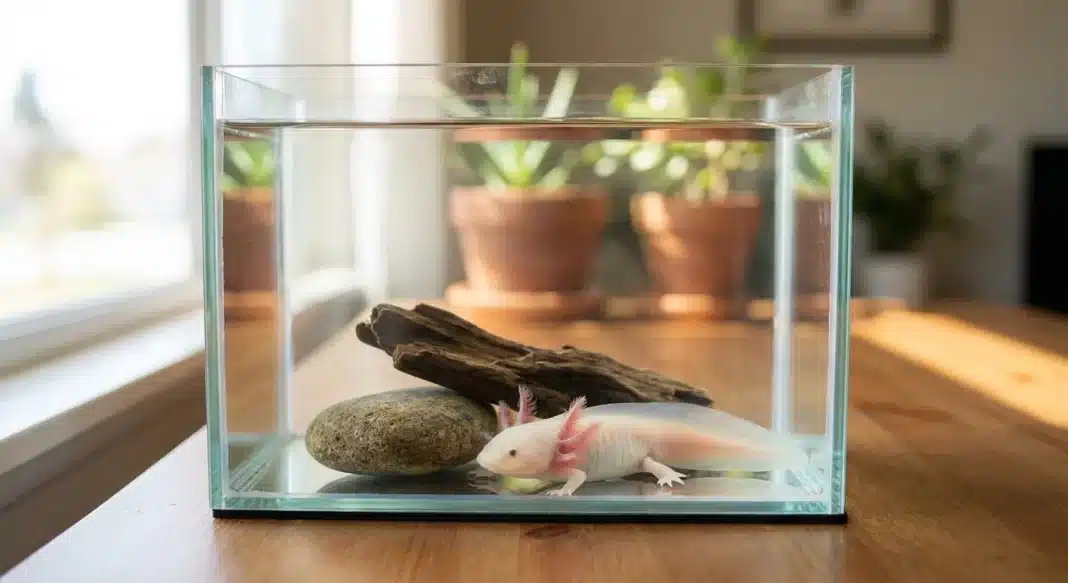
Every new axolotl should spend 30 days in a separate tub before main-tank introduction. Sick axolotls should also be tubbed for treatment. A 6 to 12-quart food-grade plastic tub with a vented lid, bare bottom, one hide, and no filter is the standard setup. Daily 100 percent water changes are mandatory. No medication without veterinary diagnosis.
What equipment do you need for an axolotl quarantine tub?
A quarantine tub uses a 6-quart food-grade plastic container for juveniles under 6 inches or 10 to 12-quart for adults. The setup needs a vented lid, no substrate (bare bottom), one hide, no filter, a dechlorinator like Prime, a thermometer, and a turkey baster for spot cleaning. The minimal setup intentionally prioritizes clean water over complex equipment.
The tub is not a downgrade from a glass aquarium. It is the deliberately simple environment that makes daily 100 percent water changes practical and allows unobstructed observation of the animal. Per Axolotl.org/health, isolation of the affected animal is strongly recommended for any health concern (source: Axolotl.org health). The axolotl care guide covers the broader husbandry framework that the quarantine setup complements.
| Equipment | Spec | Quantity | Purpose |
|---|---|---|---|
| Food-grade plastic tub | 6 quart for juveniles under 6 inches; 10 to 12 quart for adults; up to 5 gallons for larger adults | 1 per animal in quarantine | Primary container; bare bottom is intentional |
| Lid with air holes | Vented snap-on lid or piece of egg crate secured with clips | 1 per tub | Prevents escape jumping; allows gas exchange |
| Dechlorinator | Seachem Prime or equivalent that binds ammonia and heavy metals; dose per product label (typically 2 drops per gallon) | 1 bottle per household | Treats tap water; binds residual ammonia |
| Thermometer | Submersible aquarium thermometer reading 50 to 90 degrees Fahrenheit range | 1 per tub | Verifies 60 to 68 degrees Fahrenheit tub range |
| Hide | Ceramic mug laid on side, PVC pipe section, or smooth ceramic cave | 1 per tub | Provides visual cover; easy to remove and sterilize |
| Turkey baster | Standard kitchen turkey baster or large pipette | 1 per quarantine tub | Spot-cleans waste between full water changes |
| Spare net | Soft-mesh net or transfer cup | 1 per quarantine tub | Gentle transfers during water changes |
| Measuring cup | 1-cup or 2-cup graduated measuring cup | 1 per tub | Verifies dechlorinator dose for the tub volume |
Tub size by axolotl size
For a juvenile axolotl under 6 inches, a 6-quart plastic tub provides adequate space. For a subadult or adult axolotl, use a 10 to 12-quart tub. The axolotl should be able to turn around comfortably without pressing against the walls. Larger tubs (up to 5 gallons) work for adults and make water changes slightly less urgent, but the tradeoff is using more dechlorinated water per change. Use food-grade plastic only. Containers that previously held cleaning chemicals or paint can leach residues even after washing. If unsure about a container’s history, buy a new one.
Lid with air holes
Every quarantine tub needs a lid. Axolotls can and do jump or climb out of open containers, especially when stressed from a new environment. The lid should not be sealed airtight because the water surface needs gas exchange. A standard snap-on storage tub lid with a small gap or a few holes drilled through it works. Some keepers use a piece of egg crate or plastic mesh secured with a clip.
Bare bottom, no substrate
Use bare plastic in the tub. No sand, no gravel, no tiles. Bare plastic is easier to clean, allows you to spot waste and uneaten food immediately, and eliminates substrate-ingestion risk. The axolotl impaction guide covers why bare-bottom is the safest surface for a recovering or newly arrived axolotl, since stressed animals more readily attempt to ingest substrate. The axolotl substrate guide covers the main-tank substrate framework.
One hide for visual cover
Place one hide in the tub. A simple ceramic mug laid on its side, a PVC pipe section, or a smooth ceramic cave works. The axolotl needs a place to retreat from light and visual stimulation. Quarantine without a hide increases stress, which suppresses immune function and slows recovery. Choose a hide that is easy to remove and clean during daily water changes.
No filter
A quarantine tub does not use a filter. The tub is too small for a filter to cycle, and the daily 100 percent water changes make filtration unnecessary. A filter would create water flow in a small space, adding stress to an already stressed animal. The absence of a filter is the reason daily water changes are mandatory, not optional. Without beneficial bacteria processing ammonia, any waste the axolotl produces accumulates directly in the water.
Dechlorinator and water conditioner
Use a dechlorinator that binds ammonia and heavy metals. Seachem Prime is the most commonly used product. Dose at 2 drops per gallon or follow the product label. The axolotl dechlorinator guide covers which conditioners handle chloramine (a chlorine-ammonia compound used in some municipal water supplies) and why that matters for axolotl safety.
Thermometer
Keep a thermometer in the tub to monitor water temperature. Quarantine water should match the temperature of the water the axolotl came from for new arrivals or the main tank for sick animals being removed. Safe quarantine temperature is 60 to 68 degrees Fahrenheit (15.5 to 20 degrees Celsius). Per AxolotlCentral, axolotls are most comfortable kept in water between 12 and 20 degrees Celsius (53.6 to 68 degrees Fahrenheit), with temperatures above 22 degrees Celsius (71.6 degrees Fahrenheit) for extended periods stressful and immune-suppressing, and above 24 degrees Celsius (75.2 degrees Fahrenheit) potentially fatal (source: AxolotlCentral care guide). The axolotl temperature guide covers cooling strategies if your room runs warm.
Turkey baster for spot cleaning
A turkey baster or large pipette is used to spot-clean waste and uneaten food between full water changes. In a small tub, a single piece of waste can produce a measurable ammonia spike within hours. Removing solids as soon as you see them extends the interval before ammonia becomes a problem.
Hobbyist case reports posted across breeder forums consistently describe quarantine as the single intervention that prevents the most avoidable losses. The animals that arrive at rescues with the fewest complications are almost always ones that went through a proper quarantine period at the breeder before shipping and again at the new owner’s home. Both bookends matter.
How do you quarantine a new axolotl for the 30-day window?
New-arrival quarantine runs for at least 30 days to screen for parasites and diseases (per AxolotlCentral care guide). The purpose is threefold: allow the axolotl to acclimate to your water parameters, observe for signs of illness that may not be visible on arrival day, and let the animal recover from shipping stress before tankmate exposure.
The 30-day calendar is the minimum, not the target. Many breeders and rescue organizations use a 6-week standard for added safety. Do not shorten the period because the axolotl appears healthy at day 14. Some pathogens have incubation periods of 2 to 4 weeks and may not produce visible symptoms until well into the quarantine window.
| Day range | Action | Observation focus |
|---|---|---|
| Day 1 (arrival) | Float sealed transport bag in tub for 15 to 20 minutes to equalize temperature, then release axolotl into tub without pouring shipping water. No feeding. Let animal settle for 24 hours. | Initial behavior; gill color; visible injuries from transit |
| Days 2-7 (week 1) | Begin 100% daily water change. Offer food on day 2 or 3 with earthworm pieces and remove uneaten food within 2 hours. Examine animal during each water change. | Gills (full and feathery vs curled or shortened); skin (white cottony patches, red patches, lesions); appetite; waste color and consistency; behavior |
| Days 8-30 (weeks 2-4) | Continue 100% daily water changes throughout. Establish regular feeding schedule (daily for juveniles, every other day for subadults and adults). Build baseline appetite and behavior reference. | Continued daily observation; watch for late-appearing symptoms during incubation window day 10-21; weight monitoring if practical |
Day 1: acclimation and placement
When your new axolotl arrives, float the sealed bag or container in the quarantine tub for 15 to 20 minutes to equalize temperature. Open the bag and gently release the axolotl into the tub. Do not pour the shipping water into the tub. Shipping water contains ammonia from the transit period and potentially pathogens from the breeder’s water system. Discard it. The axolotl may hide immediately, refuse food, or sit motionless on the bottom. This is normal arrival behavior. Do not attempt to feed on day 1. Let the animal settle for 24 hours.
Days 2-7: daily observation and water changes
Beginning on day 2, perform a 100 percent water change every 24 hours. Prepare a second container with fresh, dechlorinated, temperature-matched water. Transfer the axolotl using a soft mesh net or by gently guiding it into a cup, then move it to the fresh container. Clean the original tub, refill it with prepared water, and transfer the axolotl back. Some keepers simplify this by keeping two identical tubs and rotating.
During each water change, examine the axolotl closely. Check the gills for full feathery filaments versus curled forward or shortened or discolored. Gill curl on arrival can indicate shipping stress and often resolves within a week, but persistent curl after 7 days suggests a water quality or health issue. Check the skin for white cottony patches indicating fungus per the axolotl fungus guide, red patches or streaks indicating bacterial infection or ammonia burn per the axolotl ammonia burn guide, or other lesions. Offer food on day 2 or 3. Earthworm pieces are the best test food because most axolotls accept them readily. A new arrival that refuses food for 3 to 5 days is not unusual if it is otherwise behaving normally. Note waste color, consistency, and frequency. Normal axolotl waste is dark brown and firm.
Days 8-30: continued monitoring
By the end of the first week, most healthy new arrivals begin eating regularly and display normal resting behavior. Continue 100 percent daily water changes throughout the full 30-day period. Do not reduce frequency even if the axolotl appears healthy. Some infections and parasites have incubation periods of 2 to 4 weeks. Establish a regular feeding schedule. For juveniles under 6 inches, feed daily. For subadults and adults, feed every other day. Use this time to learn the individual animal’s appetite and food preferences. This baseline becomes your reference for detecting appetite changes later. The axolotl health red flags guide covers chronic-symptom patterns to watch for. The axolotl emergency care checklist covers acute-symptom triage if anything emerges.
Recurring case patterns across breeder forums show that the 30-day window is when most hidden issues surface. A healthy-looking axolotl carrying an internal parasite load typically begins showing signs between days 10 and 21, often as weight loss despite eating, pale or stringy waste, or subtle behavioral changes. Catching these issues while the animal is still isolated prevents the colony-wide treatment scenario that follows premature introduction.
Deworming during quarantine
Some keepers prophylactically deworm new arrivals during the quarantine period. This is a common practice in the axolotl breeding and rescue community, but it should be done with veterinary guidance, not guesswork. The standard deworming agent used by exotic veterinarians for axolotls is levamisole, dosed by body weight, and Axolotl.org/health notes that Peter W. Scott recommends consulting a vet about internal roundworm infestations and the possible use of levamisole injections (per Axolotl.org health). Do not dose based on internet forum recommendations without confirming with a vet, because incorrect dosing can harm the axolotl. The axolotl medication safety guide covers which treatments require veterinary prescription and why self-medicating is risky.
If you choose not to deworm prophylactically, monitor waste closely throughout quarantine. If you see signs suggestive of parasites (white stringy waste, weight loss despite eating, visible worms in waste), collect a fecal sample and bring it to an exotic-animal veterinarian for microscopic examination. The Association of Reptile and Amphibian Veterinarians (ARAV) Find-A-Vet directory locates qualified clinics for amphibian fecal microscopy (source: ARAV Find-A-Vet directory).
How do you quarantine a sick axolotl by tubbing?
Sick-axolotl quarantine uses the same basic setup as new-arrival quarantine but with a more intensive water change schedule. Per Axolotl.org/health, isolation of the affected animal is strongly recommended, and a few weeks in cool water at 5 to 15 degrees Celsius is often helpful to speed recovery (per Axolotl.org health).
Tubbing accomplishes two things at once: it stops a pathogen from reaching tankmates, and it places the sick animal in pristine water where treatment is easier to administer and monitor. Clean water itself is treatment for many mild cases. Most localized fungal infections and minor injuries resolve in clean cool dechlorinated water without any medication, and lower temperatures around 5 to 15 degrees Celsius are described as a general panacea for axolotls (per Axolotl.org health).
| Symptom or trigger | Severity | Tub action | Cross-link |
|---|---|---|---|
| White cottony growth on gills, skin, or limbs | Fungal infection | Tub immediately + 100% daily water changes + escalate to vet if not resolving in 5-7 days | axolotl-fungus-guide for protocol detail |
| Red patches, streaks, or inflamed skin | Possible bacterial infection or ammonia burn | Tub immediately + test main-tank parameters + 100% daily water changes | axolotl-ammonia-burn-guide |
| Visible injuries from tank-mate bites or substrate abrasion | Injury triage | Tub immediately + first-response protocol per injury guide | axolotl-injury-and-regeneration-guide |
| Persistent appetite loss beyond 7 days with no environmental cause | Chronic concern | Tub plus full water-quality check + vet consultation | axolotl-health-red-flags |
| Cloudy eyes or film on skin | Possible bacterial or fungal | Tub plus skin examination + vet consultation | axolotl-fungus-guide |
| Abnormal floating or inability to stay on bottom | Possible impaction or systemic issue | Tub plus parameter check + vet escalation if persistent | axolotl-impaction-guide |
| Main tank water quality crash (ammonia or nitrite above 0 ppm) | Emergency | Tub immediately + investigate main tank cycle | axolotl-ammonia-burn-guide |
When to tub a sick axolotl
Tub your axolotl if you observe any of the trigger symptoms in the table above. Persistent appetite loss beyond 7 days with no obvious environmental cause warrants tubbing for both treatment and observation. Any situation where the main tank water quality has crashed (ammonia or nitrite above 0 ppm) requires immediate tubbing to remove the animal from the toxic environment while the main tank is corrected.
Sick-tub water change protocol
For a sick axolotl, perform 100 percent water changes at least once every 24 hours. For animals with active fungal infections, visible injuries, or ammonia burns, increase to twice daily (every 12 hours). The goal is to keep the axolotl in the cleanest possible water at all times because clean water is itself treatment. Each water change follows the same procedure as new-arrival quarantine: prepare fresh dechlorinated water at the correct temperature, transfer the axolotl, clean the tub, refill, and transfer back. Between full changes, use a turkey baster to remove waste or debris immediately. The axolotl water testing guide covers the test cadence to verify that tub water is staying clean between changes.
Indian almond leaves as supportive addition
Indian almond leaves (Catappa leaves) are a commonly used supportive addition in axolotl quarantine tubs. The tannins released by the leaves have mild antifungal and antibacterial properties and create slightly acidic water conditions that some keepers find beneficial for healing. Place one small leaf or a quarter of a large leaf in the tub. Replace it at each water change. Indian almond leaves are not a substitute for clean water or veterinary treatment, but they are a low-risk addition that many keepers include as standard practice in sick tubs.
Salt and methylene blue baths cross-link
Salt baths and methylene blue baths are discussed frequently in axolotl keeping communities, but they are not default quarantine treatments. Both are stressors in their own right. Salt creates osmotic pressure on the axolotl’s permeable skin and gills, and methylene blue is a chemical dye that can irritate healthy tissue. The verbatim protocols for both treatments are covered in the axolotl medication safety guide. For any treatment beyond clean water and Indian almond leaves, consult an exotic veterinarian before applying.
How do you run multi-tank household hygiene to prevent cross-contamination?
Multi-tank households need strict hygiene to prevent cross-contamination between tanks. Keep separate water-change buckets and nets per tank or sterilize between uses. Wash hands between tanks. Sequence work from the healthiest tank to the least-healthy. Dedicate a hide and turkey baster to each quarantine tub. Do not share filter media between tanks.
The hygiene framework treats each tank as a separate ecosystem with its own microbial community. Cross-contamination through shared equipment is one of the most preventable causes of pathogen spread between tanks in the same household. The axolotl cleaning routine covers the broader cleaning framework that integrates with multi-tank hygiene.
| Hygiene action | Correct approach | Dangerous alternative to avoid |
|---|---|---|
| Water-change bucket | Dedicated bucket per tank, or sanitize between tanks with hot water rinse | Single shared bucket used across multiple tanks without sanitization |
| Net for transfer | Dedicated net per tank, or thoroughly rinse and sun-dry between uses | Single shared net used across multiple tanks without sanitization |
| Hand hygiene | Wash hands with soap before and after each tank | Touching multiple tanks without handwashing between |
| Work sequence | Start with healthiest tank, finish with quarantine or sick tubs | Work in random order or start with sick tubs first |
| Filter media | Never share between tanks | Borrowing media from one tank to cycle another |
Separate equipment per tank
Each tank or tub needs its own bucket, net, and turkey baster, or the equipment must be thoroughly rinsed and sun-dried between uses on different tanks. The simplest setup is dedicated equipment per tank. Hot water rinses sanitize plastic equipment between uses but cold rinsing does not. Bleach soaks (followed by extended fresh-water rinses) work for severe contamination but are overkill for routine multi-tank work.
Hand wash between tanks
Wash hands with soap before and after touching each tank. Hand-borne pathogens transfer easily between tanks when keepers move directly between tubs without washing. This is especially important when one tub holds a sick axolotl.
Sequence healthiest to least-healthy
Start the work session with the healthiest tank. Finish with quarantine or sick tubs. The principle is to avoid carrying contaminants from sick tubs to healthy ones. Reverse the typical clean-as-you-go habit if it means working from sick to healthy.
Dedicated quarantine equipment
The quarantine tub deserves its own dedicated hide, net, turkey baster, and bucket. These items never touch the main tank. After the quarantine ends, the equipment goes into deep sanitization (hot water rinse plus optional dilute bleach soak with extended rinse) before reuse in another quarantine cycle.
What should you NEVER do during quarantine?
Five common mistakes turn quarantine into an additional stressor instead of a healing environment. Adding medication without a diagnosis stresses liver and kidneys. Skipping water changes lets ammonia accumulate. Releasing the axolotl before 30 days defeats the screening purpose. Co-housing new arrivals from different sources allows cross-contamination. Using aquarium gravel creates impaction risk.
Avoiding these mistakes is as important as following the correct protocol. Each item below has been observed enough times across keeper-community case reports to warrant explicit naming.
| Action | Why dangerous | Correct alternative |
|---|---|---|
| Medicating without a diagnosis | Adds chemical stress to liver and kidneys; masks symptoms a vet would use for diagnosis; can cause more harm than the original concern | Tub in clean cool dechlorinated water + test main-tank parameters + observe and document + contact vet via ARAV directory |
| Skipping daily water changes | No filter and no beneficial bacteria means ammonia rises every hour; even 24 hours without a change can push ammonia to gill-damaging levels in a small tub | Commit to daily 100% water changes; if cannot commit, do not bring home a new axolotl until you can |
| Releasing before 30 days | Many infections and parasites have 2-4 week incubation; “looks fine at day 14” can be a healthy-looking carrier; release exposes existing animals to silent pathogens | Honor the 30-day calendar minimum; extend if any symptoms appear during quarantine |
| Co-housing new arrivals from different sources | If one carries a pathogen, both are now exposed; cross-contamination defeats the screening purpose | Each new arrival gets its own quarantine tub; co-house only same-source same-shipment animals if necessary |
| Aquarium gravel in the tub | Stressed and disoriented axolotls are more likely to ingest substrate, leading to impaction | Bare-bottom plastic only; eliminates impaction risk entirely |
No medicating without a diagnosis
Adding antibiotics, antifungals, or antiparasitic drugs to quarantine water without knowing what you are treating is one of the most harmful things you can do. Random medications stress the axolotl’s liver and kidneys, disrupt the skin’s natural protective mucus layer, and can mask symptoms that a veterinarian would use to reach a diagnosis. The Axolotl.org/health guidance is that in cases of disease or stress, isolation in clean water is the first step and that antibiotic delivery should usually be left to an expert (per Axolotl.org health). Only use medications that have been prescribed or recommended by a qualified veterinarian based on an actual examination or diagnostic test. The axolotl medication safety guide covers the full medication-safety framework including the safe-product register and dangerous-products register.
No skipping water changes
A quarantine tub with no filter and no beneficial bacteria is an ammonia-accumulation chamber. Every hour without a water change, ammonia concentration rises. Skipping even a single daily water change in a small tub can push ammonia to levels that cause gill and skin damage. If you cannot commit to daily water changes for 30 days, you are not ready for quarantine, and you should not bring a new axolotl home until you can.
No early release before 30 days
Cutting quarantine short because the axolotl looks fine defeats the purpose. Many infections and parasites are not visible during the first 1 to 2 weeks. The 30-day minimum exists because that timeframe is sufficient for most common axolotl pathogens to produce detectable symptoms. Ending quarantine at day 14 because the animal is eating and active exposes your existing animals to anything the new arrival may be silently carrying.
No co-housing new arrivals from different sources
If you purchase two or more axolotls from different sources, each one gets its own quarantine tub. Co-housing new arrivals from different breeders or stores in a single quarantine tub allows cross-contamination. If one is carrying a pathogen, both are now exposed. If you purchased multiple animals from the same breeder in the same shipment, co-housing them during quarantine is lower risk but still not ideal.
No aquarium gravel in the tub
Stressed and disoriented axolotls are more likely to ingest substrate, leading to impaction per the axolotl impaction guide. A bare-bottom tub eliminates this risk entirely. The quarantine period is already stressful; do not add a preventable gastrointestinal emergency on top of it.
When is it safe to end quarantine?
Quarantine ends when five criteria are met. The 30-day calendar minimum has passed. The axolotl is eating consistently with full portion finished. No visible symptoms remain (no fungal patches, no red skin, no gill curl, no skin lesions, no cloudy eyes, no abnormal mucus production). Waste is normal brown firm regular with no white stringy or visible parasites. Behavior is normal with appropriate resting and responsive feeding.
If any criterion is not met at day 30, extend quarantine until it is. If symptoms appear during quarantine that you cannot resolve with clean water alone within 7 days, consult an exotic veterinarian before ending quarantine, and locate one via the ARAV Find-A-Vet directory if you do not already have an amphibian-experienced clinic (per ARAV Find-A-Vet directory). The axolotl emergency care checklist covers the broader decision framework for when symptoms require escalation.
| Criterion | Sub-detail | Meaning |
|---|---|---|
| 30 days passed | No exceptions for “looking healthy”; 6-week standard used by many breeders for added safety | Calendar minimum, not target |
| Eating consistently | Accepts food at regular intervals (daily for juveniles, every other day for adults) and finishes portion | Appetite baseline established |
| No visible symptoms | No fungal patches, no red skin, no gill curl, no skin lesions, no cloudy eyes, no abnormal mucus | Skin and gill integrity confirmed |
| Waste normal | Brown, firm, regular pattern; no white stringy waste, no diarrhea, no visible parasites | Digestive function confirmed |
| Behavior normal | Rests at bottom, walks around periodically, responds to food, no persistent floating or erratic swimming | Behavioral baseline confirmed |
Introducing to the main tank
Once quarantine ends, feed all animals (the new arrival and any existing tankmates) before the introduction. A recently fed axolotl is less likely to nip at a new tankmate. Transfer the quarantined axolotl gently into the main tank, lowering it close to the substrate to minimize panic swimming. Watch closely for the first 24 to 48 hours for aggressive behavior from either party. If you see persistent chasing, biting, or cornering, separate the animals immediately and reassess compatibility. The axolotl injury and regeneration guide covers tank-mate-bite injury context if aggression occurs.
How do you introduce a quarantined axolotl to the main tank?
Feed everyone first, transfer gently by lowering close to the substrate, then watch the first 24 to 48 hours for aggression. The introduction protocol uses behavior management (recently fed axolotls are less aggressive) plus careful handling (minimize panic swimming) plus close observation (catch problems early). The Pre-introduction feeding is the most underrated step. A well-fed axolotl rarely nips. A hungry axolotl frequently does.
Pre-introduction feeding
Feed both the quarantined animal and any existing tank mates 30 to 60 minutes before the introduction. The fed state reduces aggressive feeding-response behaviors that often drive tank-mate bites in axolotls. Use the same feeder type that all animals are accustomed to.
Transfer technique
Transfer the quarantined axolotl gently into the main tank using a soft mesh net or by guiding into a cup. Lower the container or net close to the substrate before releasing so the axolotl does not have to swim down through unfamiliar water. The axolotl temperature guide covers the temperature-matching context that the main-tank introduction shares with the original day-1 acclimation principle. The axolotl water parameters guide covers main-tank parameter ranges that the new arrival should encounter.
Post-introduction observation
Watch the first 24 to 48 hours for aggression. Persistent chasing, biting, or cornering means separating the animals immediately and reassessing compatibility. Some posturing in the first hours is normal as animals establish territory. Persistent attacks are not. If aggression continues, return the new arrival to quarantine and consider whether the main tank is appropriate for multiple axolotls or whether the size mismatch creates inevitable conflict.
What about live-food quarantine for feeders?
Quarantine is not just for the axolotl itself. Live foods, particularly feeder fish, feeder shrimp, and wild-caught invertebrates, can introduce parasites, bacteria, and diseases into your tank. This is one of the primary transmission routes for internal parasites in captive axolotls.
The safest approach is to avoid feeder fish entirely. They carry a wide range of pathogens including parasites, and the nutritional benefit does not justify the disease risk.
Avoid feeder fish due to disease transmission risk
Feeder goldfish, feeder minnows, and feeder rosy reds are all known carriers of internal parasites and bacterial infections. The disease transmission rate is high enough that most experienced keepers and rescues recommend skipping feeder fish entirely. Earthworms are the gold-standard staple food for adult axolotls because they are soft, highly digestible, and nutritionally complete.
Source earthworms from bait shops or reptile suppliers
If you feed live earthworms (the recommended staple), purchase them from bait shops or reptile suppliers rather than collecting from yards that may be treated with pesticides or fertilizers. Lawn-treatment chemicals concentrate in soil-dwelling invertebrates. An earthworm collected from a treated yard is a chemical exposure vector. The axolotl care SOP covers the proactive feeding framework that minimizes pathogen-introduction risk.
Blackworm and aquatic live food rinse and hold
Blackworms and other aquatic live foods should be rinsed thoroughly and held in clean water for 24 to 48 hours before feeding to flush contaminants from the supplier’s holding water. This mini-quarantine step takes minimal effort and reduces the risk of introducing pathogens through the food supply. Some keepers run a 7-day holding tank for blackworms to allow gut-loading with quality food, which improves the nutritional value of the live worm before feeding.
Frequently asked questions
Can I use my main tank as quarantine if I only have one axolotl?
No. Quarantine requires a separate container because if the new arrival is carrying a pathogen, the main tank’s substrate, filter media, and surfaces become contaminated. Even if you are introducing your first axolotl and have no existing animals, tubbing in a separate container for 30 days gives you time to verify the animal’s health before placing it in a tank that is harder to sterilize. New arrivals often arrive before the main tank has fully cycled, and tubbing provides a safe housing method while the cycle completes.
How do I keep quarantine water cool in a warm room?
Place the tub in the coolest room in your house, away from windows and direct sunlight. If room temperature exceeds 68 degrees Fahrenheit, float a sealed ice bottle in the tub or place the tub in a larger container with cool water around it. Check temperature at least twice daily. Do not add ice directly to the water because rapid temperature changes stress the axolotl. Aim for gradual cooling of no more than 2 degrees per hour. The documented 12 to 20 degrees Celsius comfort band (per AxolotlCentral care guide) applies in tubs as in main tanks.
Do I need to quarantine if I bought from a reputable breeder?
Yes. Even reputable breeders can unknowingly ship animals carrying early-stage infections or internal parasites that are not yet producing visible symptoms. The 30-day quarantine window exists to catch exactly these situations. A responsible breeder will expect and encourage you to quarantine their animals. Your water parameters likely differ from the breeder’s water source, so quarantine also provides acclimation time. Skipping quarantine after purchasing from a reputable breeder is the most common path to colony-wide pathogen introduction in multi-axolotl households.
How do I know if my axolotl has parasites during quarantine?
The most common signs of internal parasites are weight loss despite normal eating, pale or white stringy waste, visibly distended abdomen, and reduced activity. External parasites may appear as small white or gray dots on the skin or gills, or as a cloudy film. If you suspect parasites, collect a fresh fecal sample (within 2 hours of excretion) and bring it to an exotic veterinarian for microscopic examination. Do not treat for parasites based on visual suspicion alone because the symptoms overlap with other conditions.
Should I quarantine when moving an axolotl to a new tank within my home?
If you are transferring your own axolotl from one established tank to another within your home with the same water source, formal 30-day quarantine is not necessary. However, if you are rehoming an axolotl from someone else’s setup, treat it exactly like a new arrival and quarantine for the full 30 days. You do not know the water-quality history, health history, or pathogen exposure of the previous owner’s setup. The previous-owner-context is the deciding factor, not the geographic distance of the move.
- Axolotl care guide: complete husbandry hub for new keepers
- Axolotl emergency care checklist: broader emergency-response framework and triage matrix
- Axolotl fungus guide: white-cottony-growth identification and treatment
- Axolotl medication safety: salt-bath and methylene-blue verbatim protocols
- Axolotl impaction guide: bare-bottom rationale and no-gravel context
- Axolotl injury and regeneration guide: tank-mate-bite injury context
- Axolotl ammonia burn guide: main-tank water-quality crash trigger
- Axolotl health red flags: chronic-symptom catalog
- Axolotl tank setup guide: broader tank context
- Axolotl dechlorinator guide: Prime dosing for tub water
- Axolotl water parameters: parameter targets
- Axolotl water testing guide: test cadence during quarantine
- Axolotl tank cycling guide: post-quarantine main-tank cycling context
- Axolotl temperature guide: tubbing temperature management
- Axolotl cleaning routine: multi-tank hygiene framework
- Axolotl care SOP: proactive husbandry framework
By the ExoPetGuides editorial team (AI-assisted drafting; human-reviewed), reviewed by an exotic-animal veterinarian
Updated 2026-05-20
Primary sources: Axolotl.org health, AxolotlCentral care guide, ARAV Find-A-Vet directory
Disclaimer: This content is for educational purposes only and is not a substitute for professional veterinary advice. Always consult a qualified veterinarian, ideally an exotic-animal specialist, for any health concern about your pet. Care recommendations may vary based on species, individual animal, and local regulations.