


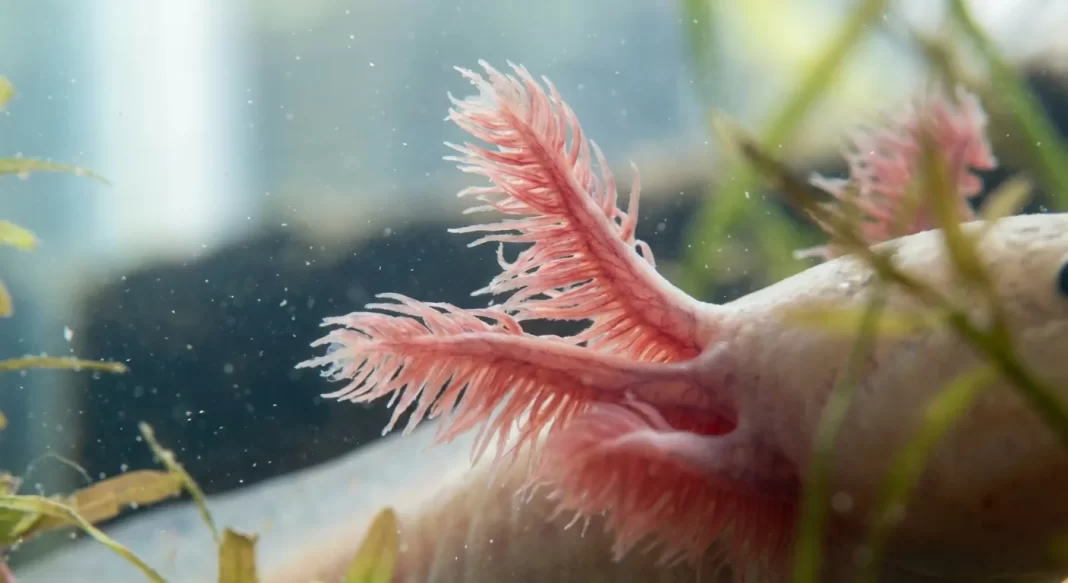
Gill curl direction is the first diagnostic. Forward curl is the most common pattern and per Axolotl.org/health verbatim “Forward-turned gills are typical of an axolotl stressed by flowing water.” Backward curl is rare and usually genetic. Partial curl on one side indicates injury or local infection. Persistent symmetrical curl signals chronic stress. Test water first.
The curl-direction decision tree: forward, backward, partial, or persistent
Gill curl direction is the first diagnostic. Forward curl is the most common pattern and per Axolotl.org/health verbatim “Forward-turned gills are typical of an axolotl stressed by flowing water.” Backward curl is rare and usually a genetic structural trait. Partial curl on one side indicates injury or localized infection. Persistent symmetrical curl despite clean parameters signals chronic stress.
The curl-direction decision tree below maps each curl pattern to its most common cause, severity baseline, and first action. Reading direction before severity or duration gives the fastest route to a useful diagnosis. Most gill curl cases resolve at the home-care level with the right first response. The cases that progress to medical concerns almost always involve persistent symmetrical curl despite clean parameters or partial one-side curl with visible injury or infection signs. The axolotl care guide covers the full husbandry baseline that prevents most stressor conditions before they develop.
| Curl direction | Most common cause | Severity baseline | First action |
|---|---|---|---|
| Forward (most common) | Flow stress per Axolotl.org/health verbatim; chemical irritation (ammonia, nitrite, pH); temperature stress | Mild to moderate | Test water; check filter output |
| Backward (rare) | Genetic abnormality | Low (cosmetic) | Confirm consistency across weeks; no action if stable |
| Partial curl on one side | Physical injury; localized fungal or bacterial infection | Moderate | Inspect for visible damage; observe; vet if worsening |
| Persistent symmetrical curl despite clean parameters | Chronic stress; parasitic gill infection; bacterial gill infection | Moderate to severe | Vet evaluation; gill scraping if available |
Forward curl is the most common pattern
Forward curl is the gill posture that most keepers encounter and the one most often resolved without veterinary intervention. The external gill stalks angle toward the snout, and in moderate to severe cases the tips of the stalks curve inward enough to frame the axolotl’s face. The filaments compress together rather than spreading wide. Per Axolotl.org/health, forward-turned gills are typical of an axolotl stressed by flowing water (source: Axolotl.org health). The mechanism combines mechanical and physiological responses: strong filter output can push filaments forward directly, and chemical irritants in the water trigger a protective reflex that pulls the gills closer to the head to reduce exposed surface area. The axolotl behavior guide covers the broader context for distinguishing normal-vs-abnormal axolotl behavior, including forward gill curl as a stress indicator.
Backward curl is rare and usually genetic
Backward curl means the gill stalks angle away from the head toward the body rather than the standard fanned-outward posture. This pattern is uncommon and usually represents a structural or genetic trait rather than a stress response. An axolotl with consistent backward curl since acquisition, no other stress signs, and normal feeding and activity is showing individual structural variation rather than a problem. No action is required if the curl is stable and the animal is otherwise healthy. The axolotl floating guide covers concurrent stress signs that would change the interpretation if backward curl appears alongside other indicators.
Partial curl on one side indicates injury or local infection
Partial curl affecting only one side of the head, or only one of the three gill pairs, points to a focal cause rather than a systemic stressor. Physical injury from tank mates, sharp decor, or filter intake damage to a single gill stalk is the most common explanation. Localized fungal or bacterial infection affecting one gill stalk is the second most common. The injured or infected gill may show visible damage, redness, swelling, fungal patches, or filament loss. Symmetric water-quality stressors do not produce one-sided curl because they affect both sides equally. The axolotl injury and regeneration guide covers physical injury assessment and recovery. The axolotl fungus guide covers fungal colonization assessment.
Persistent symmetrical curl despite clean parameters signals chronic concern
Persistent forward curl that does not resolve after parameter correction, flow reduction, temperature stabilization, and chemical-contamination ruling-out points to a chronic underlying cause. Possible explanations include parasitic gill infection (gill flukes or other ectoparasites not visible to the naked eye), bacterial gill infection that may not produce visible lesions in early stages, or chronic low-level stress from a source the keeper has not identified (vibration, nearby speaker system, nighttime light exposure, intermittent tank mate harassment). At this point, contact an exotic-animal or aquatic veterinarian. A gill scraping examined under a microscope can identify parasites. Bacterial culture can identify infection.
Normal versus curled gill posture: how to tell the difference
A healthy, relaxed axolotl holds its three pairs of external gill stalks fanned outward and slightly backward from the head. The filaments spread wide, maximizing surface area for oxygen exchange. Forward-curled gills angle toward the snout, and in moderate to severe cases the tips curve inward enough to frame the face. Filaments compress together rather than spreading.
The normal-vs-curl posture comparison below maps each posture to its visual descriptors. The diagnostic value of recognizing the difference is high: a clear baseline of normal posture lets the keeper detect early curl before other stress signs develop. Photographing the axolotl’s gill posture during the first week of ownership provides a reference image for later comparison.
| Posture | Visual descriptors |
|---|---|
| Normal (relaxed) | Three pairs of external gill stalks fanned outward and slightly backward from head; filaments spread wide like open fans or small trees; relaxed rhythmic gill flicking; consistent posture across days |
| Forward curl (stress) | Gill stalks angle toward snout; in moderate-to-severe cases stalk tips curve inward to frame face; filaments compress together rather than spreading; reduced surface area for oxygen exchange |
What relaxed gill posture looks like
In a healthy, relaxed axolotl at rest on the bottom of the tank, the three pairs of external gills extend backward and outward from behind the head, with the feathery filaments spread wide. The posture looks open and flowing rather than tight and clamped. The gills move rhythmically as the axolotl pulls water across the respiratory surface. The same axolotl swimming or chasing food may briefly compress its gills against the head from movement-induced flow, but the gills return to the open posture within seconds of stopping.
What forward-curled posture looks like
In an axolotl experiencing stress from flow, water quality, or temperature, the gill stalks bend toward the front of the head. The angle varies by severity: mild curl shows only the tips of the longest stalks leaning forward, moderate curl shows roughly half the stalk length angled forward, and severe curl shows the stalks folded tightly against the sides of the head with the tips reaching the cheeks. The filaments compress together in all degrees of curl, reducing their effective surface area and forcing the axolotl to flick its gills more frequently to maintain oxygen uptake. The axolotl behavior guide covers the broader context for stress-indicator behaviors.
Structural droop versus stress curl: the distinction
Some axolotls naturally have longer gill stalks that drape forward due to gravity when the animal is stationary. This is a structural trait, not a stress response. The way to distinguish structural droop from stress curl is context. Structural droop is consistent across weeks and months, the filaments remain spread and fluffy rather than compressed, and the axolotl shows no other stress indicators (normal appetite, active at night, responsive to food). Stress curl appears as a change from the animal’s baseline posture, the filaments compress, and it typically accompanies at least one other behavioral shift. Leucistic and golden albino axolotls tend to have longer, more prominent gill stalks where mild curl is easier to spot. Wild-type and melanoid axolotls have darker, sometimes shorter gill stalks where mild curl is harder to detect. The underlying stress response is the same across morphs.
Causes of gill curl by direction: a five-cause matrix
Five causes account for nearly every gill curl case. Excessive water flow physically pushes filaments forward. Chemical irritation from ammonia, nitrite, or pH outside the 6.5 to 8.0 range damages gill tissue and produces curl as a protective reflex. Temperature above the AxolotlCentral comfort ceiling stresses the entire organism. Chemical contamination and structural variation round out the matrix.
The cause-matrix table below maps the five most common causes to direction, mechanism, and contributing factor. Causes can combine: an uncycled tank with elevated ammonia, an overpowered filter creating excessive flow, and summer-month temperature creep could produce gill curl from three causes simultaneously. Working through the matrix systematically narrows the field to the dominant cause and the right first action.
| Cause | Direction | Mechanism | Contributing factor |
|---|---|---|---|
| Excessive water flow | Forward | Strong current pushes filaments forward mechanically; axolotl reflexively tucks gills to reduce drag | Hang-on-back filter with unmodified output; canister filter spray bar; powerheads or wavemakers (which have no place in axolotl tanks) |
| Chemical irritation | Forward | Ammonia, nitrite, or pH outside 6.5-8.0 range irritates gill tissue causing inflammation and protective curl reflex | Uncycled tank; overstocking; missed water changes; pH crash |
| Temperature stress | Forward | Above AxolotlCentral comfort ceiling reduces dissolved oxygen; stress response curls gills as oxygen demand exceeds gill exchange capacity | Summer months without chiller; rooms without air conditioning; equipment heat dump |
| Chemical contamination | Forward (rapid onset) | Chlorine, soap residue, aerosol sprays, medication overdose, or cleaning product residue irritates gill tissue directly | Undechlorinated tap water; aerosol use near tank; cleaning product residue on decor |
| Structural trait | Forward (mild stable) or backward (rare) | Individual morphological variation in gill stalk length and angle; consistent across weeks with no other stress signs | None – inherited; no action needed if stable |
Excessive water flow is the most common cause
Strong current physically pushes gill filaments forward. The axolotl may also reflexively tuck its gills to reduce drag and protect the delicate tissue from mechanical stress. The gills evolved for still water. Even moderate flow that a tropical fish would tolerate easily is excessive for an axolotl. The most common flow sources that cause gill curl are hang-on-back filters with unmodified output, canister filters with spray bars pointed directly at the tank floor, powerheads or wavemakers, and internal filters with uncapped nozzles. Per Axolotl.org/health, forward-turned gills are typical of an axolotl stressed by flowing water (per Axolotl.org health). Hobbyist breeders troubleshooting gill curl in online communities estimate that flow is the root cause in roughly half of all cases. The pattern is consistent: a keeper upgrades their filter for better water quality, the stronger output creates more current, and gill curl appears within days. The fix resolves the curl, confirming the diagnosis. The axolotl current and flow control guide covers every method for reducing filter output without sacrificing biological filtration.
Chemical irritation from ammonia, nitrite, or pH out of range
Ammonia and nitrite are directly toxic to the gill filaments. Per Axolotl.org/health verbatim above-zero framing, any detectable concentration irritates the epithelial cells lining the gills, causing inflammation and tissue swelling. That swelling changes how the gill stalks sit, pushing them forward. The curl from water quality problems looks similar to flow-induced curl, but it tends to develop more gradually and is often accompanied by reddened gill filament tips (chemical irritation) or pale, washed-out filaments (tissue damage). Nitrate above 20 parts per million does not cause acute gill irritation, but chronic elevated nitrate suppresses immune function and contributes to long-term gill health decline. pH outside the 6.5 to 8.0 range also irritates gill tissue. Uncycled tanks are the highest-risk environment for water-quality-driven gill curl. A tank that has not completed the nitrogen cycle will produce ammonia and nitrite spikes that can cause gill curl within hours. The axolotl ammonia burn guide covers ammonia-as-cause tissue damage and recovery. The axolotl water parameters guide covers parameter targets and testing frequency.
Temperature above the safe range stresses the entire organism
Per AxolotlCentral, axolotls are most comfortable kept in water between 12 to 20 degrees Celsius (53.6 to 68 degrees Fahrenheit) (source: AxolotlCentral care guide). Above this comfort band, metabolic rate increases, dissolved oxygen drops, and the axolotl’s stress response activates. Gill curl from temperature stress is usually accompanied by reduced appetite and increased surface gulping (the axolotl swims to the surface to gulp air because dissolved oxygen in warm water is insufficient for gill respiration alone). Per AxolotlCentral, over 22 degrees Celsius (71.6 degrees Fahrenheit) for extended periods will be stressful and suppressing immune response, while over 24 degrees Celsius (75.2 degrees Fahrenheit) can be fatal (per AxolotlCentral care guide). Temperature-driven gill curl tends to appear during summer months or in rooms without air conditioning. If your thermometer reads above the AxolotlCentral comfort ceiling and the axolotl shows gill curl, temperature is likely contributing even if other parameters test clean. The axolotl temperature guide covers cooling strategies. The axolotl heat spike emergency guide covers acute overheating situations. Long-time hobbyist breeders working with axolotls describe a consistent pattern. Filter-upgrade cases that produce gill curl within days are often masked initially because the keeper attributes the change to summer temperature creep, and only systematic isolation of one variable at a time reveals which factor is dominant.
Chemical contamination causes rapid-onset gill curl
Chlorine or chloramine from undechlorinated tap water, soap residue on hands or equipment, aerosol sprays used near the tank, cleaning product residue on decor, and medication overdoses during treatment all irritate gill tissue directly. Chemical-irritant gill curl typically appears suddenly within minutes to hours of exposure and is often accompanied by frantic swimming or thrashing, which distinguishes it from the more gradual onset of flow or water-quality curl. If you suspect chemical contamination, move the axolotl to a clean tub of dechlorinated, temperature-matched water immediately. Do not attempt to treat the tank water. Drain, rinse all surfaces with plain water (no soap), refill with conditioned water, and confirm parameters before returning the axolotl. The axolotl dechlorinator guide covers chlorine and chloramine removal. The axolotl quarantine guide covers tub setup for chemical contamination response.
Structural traits explain stable lifelong curl
Some axolotls have gill architectures where the longest stalks lean slightly forward at rest. This is an inherited structural variation rather than a stress response. The diagnostic is consistency: if the curl has been stable since acquisition, with no worsening, and the animal eats normally, is active at night, and shows no other stress signs, the gills are likely showing individual structural variation. Confirm water parameters and flow are within range, including the AxolotlCentral 12 to 20 degrees Celsius (53.6 to 68 degrees Fahrenheit) comfort band (per AxolotlCentral care guide). If everything checks out and the curl is stable, no intervention is needed. Photograph the gill posture for future baseline comparison.
The diagnostic walkthrough: confirming the cause
Confirm the cause in under 15 minutes. Test water parameters with a liquid kit. Check temperature against the AxolotlCentral 12 to 20 degrees Celsius (53.6 to 68 degrees Fahrenheit) comfort band. Assess filter output by feeling current strength at the axolotl’s resting level. Inspect for visible damage or fungal patches. Observe over 24 hours after correcting one variable.
The diagnostic walkthrough follows a 6-step sequence that systematically isolates the dominant cause. Working through the sequence rather than guessing minimizes wasted intervention and prevents the multi-variable-change confusion that obscures which fix worked.
- Test ammonia, nitrite, nitrate, pH using a liquid reagent kit. Ammonia and nitrite should read zero. Nitrate should be below 20 parts per million. pH should be between 6.5 and 8.0. The axolotl water testing guide covers test cadence and result interpretation. The axolotl water parameters guide covers the canonical parameter targets.
- Check temperature with an aquarium thermometer. Per AxolotlCentral, axolotls are most comfortable kept in water between 12 to 20 degrees Celsius (53.6 to 68 degrees Fahrenheit) (per AxolotlCentral care guide). Above this range, temperature is contributing.
- Assess filter output. Point your hand in front of the filter output and feel the current strength at the axolotl’s resting level. If water pushes your hand noticeably, the flow is probably too strong. The axolotl filtration guide covers filter selection.
- Inspect each gill stalk for visible damage, redness, swelling, fungal patches, or filament loss. Asymmetric damage on one side points to injury or focal infection. Symmetric inflammation points to systemic chemical or thermal stress.
- Review recent history. New tank? Recent filter upgrade? Aerosol use near tank? Cleaning product application? Untreated tap water added? Each recent change is a potential trigger.
- Observe over 24 to 48 hours after correcting one variable. If the gills relax, the corrected variable was the cause. If the gills remain curled, the dominant cause is something else. Move to the next step.
The recovery protocol per cause: one variable at a time
The cardinal rule is to change one variable at a time. Changing multiple things simultaneously may resolve the curl but obscures which change made the difference. Each cause has a specific fix, mapped in the protocol table below.
The recovery-protocol table below maps each cause to its specific recovery action. The protocol is sequenced rather than simultaneous: apply the action that matches the dominant cause, observe over 12 to 48 hours, and move to the next cause only if the curl does not improve.
| Cause | Recovery action | Observation window |
|---|---|---|
| Flow stress | Baffle filter output; add spray bar, baffle plate, or pre-filter sponge; direct output against tank wall | 12 to 24 hours |
| Water quality (ammonia, nitrite, pH out of range) | 30 to 50 percent water change with temperature-matched dechlorinated water; retest after 12 hours; second water change if still detectable | 24 to 48 hours |
| Temperature stress | Float sealed ice bottles to cool gradually no more than 2 degrees per hour; chiller for sustained cooling; target 12 to 20 degrees Celsius (53.6 to 68 degrees Fahrenheit) per AxolotlCentral verbatim | 24 to 48 hours |
| Chemical contamination | Move axolotl to clean tub immediately; drain tank; rinse surfaces with plain water (no soap); refill with conditioned water; run filter 1 hour before return | 24 hours |
Flow stress recovery
If water parameters test clean and temperature is within the comfort band but gill curl persists, flow is the likely cause. Baffle the filter outflow. A pre-filter sponge on the intake reduces suction. A spray bar, baffle plate, or directing the output against the tank wall reduces outflow velocity. If using a hang-on-back filter, attach a filter sponge or water bottle baffle to the output. Confirm the fix by observing the water surface: gentle rippling is acceptable, visible current pushing debris across the tank floor is too strong. Observe gill posture over the next 12 to 24 hours. The axolotl current and flow control guide covers every method for reducing filter output without sacrificing biological filtration. The axolotl filtration guide covers filter selection and setup.
Water quality recovery
If water parameters test above safe limits, perform a 30 to 50 percent water change with temperature-matched, dechlorinated water (per AxolotlCentral care guide). Retest after the water change to confirm improvement. If ammonia or nitrite is still detectable, perform a second water change 12 hours later. Investigate the source: overfeeding, dead tank mate, uncycled filter media replacement, or overstocking. Observe gill posture over the next 24 to 48 hours.
Temperature stress recovery
If temperature reads above the AxolotlCentral comfort ceiling, float sealed ice bottles (frozen water bottles) in the tank to bring the temperature down gradually. Do not add ice directly to the water. Target a reduction rate of no more than 2 degrees per hour to avoid thermal shock. Per AxolotlCentral, axolotls are most comfortable kept in water between 12 to 20 degrees Celsius (53.6 to 68 degrees Fahrenheit) (per AxolotlCentral care guide). If ambient room temperature makes cooling impossible to sustain, a tank chiller is the long-term fix. Observe gill posture as temperature reaches the comfort band. The axolotl temperature guide covers cooling strategies. The axolotl heat spike emergency guide covers acute overheating situations.
Chemical contamination recovery
If chemical contamination is suspected based on sudden onset, recent aerosol use, or recent cleaning, move the axolotl to a clean tub immediately. Drain the tank completely. Rinse all hard surfaces (glass, filter housing, decor) with plain water and no soap. Refill with dechlorinated, temperature-matched water. Run the filter for at least 1 hour before returning the axolotl. Observe gill posture over the next 24 hours. Keeper-community reports on gill regeneration consistently describe one pattern. Even in cases where gill filaments have been damaged by prolonged ammonia exposure or severe flow stress, regrowth begins within days of environmental correction and continues for weeks. The key variable is not whether the gills can recover but whether the keeper identifies and removes the stressor before secondary infection sets in. The axolotl quarantine guide covers tub setup. The axolotl dechlorinator guide covers water conditioning.
The recovery timeline: how long until gills relax
Recovery speed depends on cause and curl duration. Flow-induced curl resolves fastest, often within 4 to 12 hours after baffling, with full return to normal posture within 24 hours. Temperature and water-quality-induced curl take 24 to 72 hours; chemical-irritant curl in a clean tub shows improvement within hours.
The recovery-timeline table below maps each cause to its expected resolution window. Tracking improvement across the expected window distinguishes a successful intervention from a missed cause: if the expected resolution time passes without improvement, the dominant cause is something else, and the diagnostic walkthrough should be repeated.
| Cause | Visible improvement | Full resolution |
|---|---|---|
| Flow stress | 4 to 12 hours after baffling | Within 24 hours |
| Water quality (ammonia, nitrite, pH) | 24 to 48 hours after parameter correction | Up to 72 hours |
| Temperature stress | 24 to 48 hours after stable comfort-band temperature | Within 72 hours |
| Chemical irritant in clean tub | Hours after exposure removed | Days to weeks depending on severity |
Flow-induced curl resolves fastest
Flow-induced gill curl often resolves the fastest. After baffling or redirecting the filter output, many keepers observe the gills beginning to relax within 4 to 12 hours, with full return to normal posture within 24 hours. The mechanism is direct: when the mechanical force pushing the filaments forward is removed, the gills resume their normal fanned posture once the protective reflex relaxes. If 24 hours passes without improvement, the dominant cause is not flow alone, and a parameter test is the next step.
Water-quality-induced curl takes longer
Water-quality-induced gill curl takes longer because the gill tissue needs to recover from chemical irritation. After correcting ammonia or nitrite to zero, expect 24 to 48 hours for visible improvement and up to 72 hours for full resolution. If the axolotl was exposed to elevated ammonia for an extended period (days rather than hours), gill filament damage may take longer to heal, and some filament loss is possible before regrowth occurs. Gill tissue is highly regenerative once the underlying stressor is removed.
Temperature-related curl resolves with stable comfort-band conditions
Temperature-related gill curl resolves as the water cools into the safe range. Once temperature stabilizes within the AxolotlCentral 12 to 20 degrees Celsius (53.6 to 68 degrees Fahrenheit) comfort band (per AxolotlCentral care guide), gill posture typically normalizes within 24 to 48 hours. If cooling is gradual and avoids thermal shock, the recovery is smooth. If cooling is abrupt, the axolotl may show transient stress signs as the body adjusts. The axolotl injury and regeneration guide covers tissue recovery timelines that may apply alongside gill regeneration.
Chemical-irritant curl in a clean tub
Chemical-irritant gill curl in a clean tub usually shows improvement within a few hours as the irritant is no longer present. Full recovery depends on the severity of the exposure. Mild chemical irritation resolves within days. Severe exposure may produce filament damage that takes weeks to regrow. The axolotl fungus guide covers fungal cohort prevention during gill recovery.
When to stop home treatment and see a veterinarian
Four scenarios elevate gill curl to high-urgency veterinary attention. Gill curl combined with curled tail tip indicating prolonged severe stress. Gill curl combined with visible gill deterioration including filament loss, fungal colonization, or red splotches. Gill curl combined with complete appetite loss for more than 72 hours. Gill curl combined with lethargy or unresponsiveness to stimuli.
The when-to-vet escalation table below consolidates the four high-urgency scenarios. Gill curl by itself is a low-to-moderate urgency sign. The combinations below elevate it to high urgency or emergency status. Any one criterion is sufficient. Multiple criteria together strengthen the urgency case but do not change the basic answer: veterinary consultation is warranted.
| Escalation criterion | Description | Urgency |
|---|---|---|
| Gill curl plus curled tail tip | Both gill stalks and tail tip show curl; indicates prolonged severe stress with sustained stress hormone elevation | Within 24 hours |
| Gill curl plus visible gill deterioration | Filaments falling off; white tips suggesting fungal colonization; red splotches suggesting bacterial infection or ammonia burns; shrinking filaments | Within 24 to 48 hours |
| Gill curl plus complete appetite loss 72+ hours | Per Axolotl.org/health verbatim, a common symptom of stress is that animals will go off their food, or eat very little; sustained loss indicates systemic stress | Within 48 hours |
| Gill curl plus lethargy or unresponsiveness | Animal does not react to food presentation, gentle water movement, or careful touch | Immediate |
Gill curl plus curled tail tip
The combination of forward-curled gills and a hooked or spiraled tail tip indicates prolonged, severe stress. Tail curl requires sustained muscular tension from chronic stress hormone elevation. If both signs are present, the axolotl has been stressed for days, not hours, even if you only just noticed. Veterinary consultation within 24 hours is warranted.
Gill curl plus visible gill deterioration
If gill filaments are falling off, turning white at the tips (fungal colonization), developing red splotches (bacterial infection or ammonia burns), or shrinking noticeably, the problem has progressed beyond stress into active tissue damage. Veterinary consultation within 24 to 48 hours is warranted to identify whether infection requires culture and targeted treatment. The axolotl fungus guide covers fungal colonization assessment. The axolotl health red flags guide covers the broader escalation criteria.
Gill curl plus complete appetite loss for 72+ hours
Per Axolotl.org/health, a common symptom of stress is that animals will go off their food, or eat very little (per Axolotl.org health). Refusing food for three or more consecutive days in an axolotl with curled gills suggests systemic stress severe enough to suppress digestive function. This combination warrants veterinary consultation within 48 hours. The axolotl refusing food guide covers the food-refusal diagnostic framework. The axolotl symptoms guide covers the broader A-to-Z symptom-to-diagnosis reference.
Gill curl plus lethargy or unresponsiveness
An axolotl that does not react to food presentation, gentle water movement near its face, or careful touch with a soft net is in a critical state. Combined with gill curl, this suggests the animal is beyond the point where environmental correction alone will resolve the problem. Contact a veterinarian immediately. The axolotl when to see a vet guide covers the vet-escalation decision tree. The axolotl emergency care checklist covers the emergency-response framework.
What NOT to do when treating gill curl
Five practices delay recovery and add risk: manual unfurling, unsupervised medications, tank covering, salt or tea baths as a first step, and antibiotics without a diagnosis. The rationale for each is in the table and section below.
The what-NOT-to-do table below maps each prohibited action to its rationale. Each action is a documented community misconception that delays the correct intervention.
| Do NOT do | Rationale |
|---|---|
| Manual unfurling of the gills | Gill curl is a physiological protective reflex, not mechanical; manual manipulation cannot reverse it and risks tissue damage |
| Chemicals or medications without veterinary diagnosis | Gill curl is a symptom not a disease; medicating an already-stressed axolotl with unnecessary drugs compounds stress |
| Covering the tank to “reduce stress” | Covered tanks reduce dissolved oxygen via reduced surface gas exchange; compounds the oxygen deficit driving gill curl |
| Salt baths or tea baths as first response | Have specific veterinary applications for fungal infections; do not address root cause of gill curl; add a variable to the environment |
| Antibiotics without veterinary diagnosis | Unnecessary antibiotic exposure compounds stress and risks resistance; gill curl is not an infection unless visible signs present |
Rationale for the prohibitions
Each prohibition addresses a documented community misconception. Manual unfurling of the gills is impossible because the curl is a physiological response, not a mechanical position the keeper can reverse. Chemicals or medications without veterinary diagnosis are unhelpful because gill curl is a symptom not a disease; antibiotics, antifungals, and antiparasitics are not indicated unless a secondary infection is visibly present (visible fungal growth, skin lesions, red patches). Covering the tank to “reduce stress” reduces dissolved oxygen via reduced surface gas exchange and compounds the oxygen deficit that often accompanies gill curl. Salt baths and Indian almond leaf (tea) baths are sometimes recommended in online forums as general stress treatment but have specific veterinary applications and do not address the root cause of gill curl. Using them before identifying the cause delays the actual fix. The axolotl medication safety guide covers what is and is not appropriate for home medication. The axolotl when to see a vet guide covers when veterinary diagnosis is appropriate.
Frequently asked questions
Can gill curl happen temporarily after a water change?
Yes. A water change introduces water at a slightly different temperature, pH, or mineral content than the tank water, even when you temperature-match carefully. Some axolotls show mild, transient gill curl for 30 minutes to 2 hours after a water change as they acclimate to the slight parameter shift. This is normal and resolves on its own. If gill curl persists beyond 4 hours after a water change, test the new water parameters to confirm you have not introduced a problem with the source water.
Do certain axolotl morphs show gill curl more visibly?
Leucistic and golden albino axolotls tend to have longer, more prominent gill stalks, which makes curl easier to spot visually. Wild-type and melanoid axolotls have darker, sometimes shorter gill stalks where mild curl can be harder to detect. The underlying stress response is the same across morphs. The visibility difference is purely structural and does not change diagnostic interpretation. A baseline reference photo from the first week of ownership helps with detection regardless of morph.
Can gill curl be caused by overfeeding?
Overfeeding does not cause gill curl directly. However, overfeeding leads to excess waste in the tank, which produces ammonia. If the biological filter cannot process the ammonia load fast enough, ammonia concentration rises and irritates gill tissue, producing curl. The link is indirect: overfeeding causes poor water quality, and poor water quality causes gill curl. Reducing feeding portion and frequency addresses the underlying water-quality issue.
Is tubbing necessary for mild gill curl?
Tubbing or placing the axolotl in a clean container of dechlorinated water outside the tank is not necessary for mild gill curl when you can identify and fix the cause in the tank. Tubbing is appropriate when the tank environment is actively harmful, such as an ammonia spike, chemical contamination, or severe temperature problem, and needs time-consuming correction. For flow-related gill curl, baffling the filter while the axolotl remains in the tank is sufficient.
My axolotl’s gills have been slightly curled since I got it. Is this normal?
If the curl has been consistent since purchase with no worsening and the axolotl eats normally, is active at night, and shows no other stress signs, the gills may be the animal’s natural posture. Some axolotls have gill architectures where the longest stalks lean slightly forward at rest. Confirm water parameters and flow are within range. If everything checks out and the curl is stable, you are likely looking at individual structural variation rather than chronic stress. Photograph the gill posture for future baseline comparison.
- Axolotl care guide: complete husbandry hub for new keepers
- Axolotl behavior guide: broader behavior reference and normal-vs-abnormal classification
- Axolotl floating guide: concurrent stress sign and floating diagnosis
- Axolotl current and flow control: flow management protocol that resolves most forward-curl cases
- Axolotl stress signs: stress symptom catalog
- Axolotl symptoms guide: A-to-Z symptom-to-diagnosis reference
- Axolotl water parameters: ammonia, nitrite, nitrate, pH, and temperature targets
- Axolotl water testing guide: parameter test cadence and how to interpret readings
- Axolotl ammonia burn guide: ammonia-as-cause tissue damage and recovery
- Axolotl temperature guide: comfort band per AxolotlCentral verbatim
- Axolotl tank cycling guide: uncycled tank framing as gill curl trigger
- Axolotl when to see a vet: vet-escalation decision tree
- Axolotl emergency care checklist: broader emergency-response framework
- Axolotl heat spike emergency: heat-driven physiology emergency protocol
- Axolotl dechlorinator guide: chemical contamination prevention
- Axolotl filtration guide: filter selection and setup
- Axolotl injury and regeneration guide: physical injury assessment and recovery
- Axolotl fungus guide: fungal colonization assessment
- Axolotl quarantine guide: tub setup for chemical contamination response
- Axolotl medication safety: what NOT to medicate at home
- Axolotl health red flags: broader escalation criteria
- Axolotl cloudy water fix: water-quality crash recovery
By the ExoPetGuides editorial team (AI-assisted drafting; human-reviewed), reviewed by an exotic-animal veterinarian
Updated 2026-05-20
Primary sources: AxolotlCentral care guide, Axolotl.org health
Disclaimer: This content is for educational purposes only and is not a substitute for professional veterinary advice. Always consult a qualified veterinarian, ideally an exotic-animal specialist, for any health concern about your pet. Care recommendations may vary based on species, individual animal, and local regulations.