


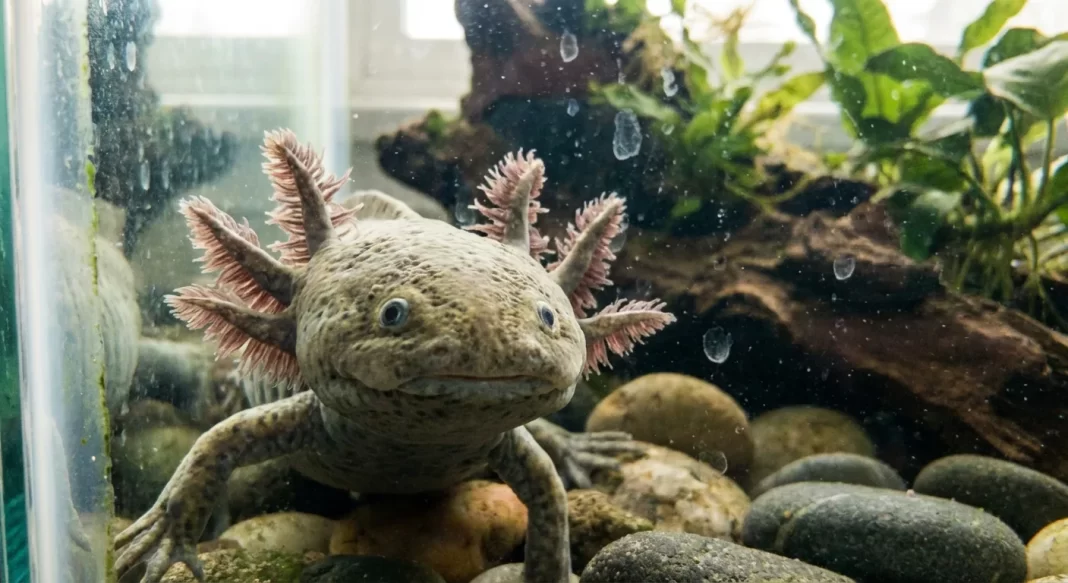
Axolotls should not be handled as part of routine care. They are fully aquatic with permeable skin and cartilaginous skeletons that are easily damaged. When handling is required for tank moves, vet visits, or illness assessment, use the container-transfer method with wet hands and limit any out-of-water time to under 30 seconds. Never grab by tail, limbs, or gills.
Why axolotls should not be handled: the four-factor argument
Four factors make axolotl handling harmful by default. The slime coat is a thin mucus layer disrupted by human skin contact. The skeleton is cartilaginous and easily damaged by firm grip. Human skin is significantly warmer than axolotl tank water and causes thermal shock. Stress from handling is cumulative and suppresses immune function over time.
The why-no-handling table below maps each of the four factors to its mechanism and the practical implication for keepers. The axolotl is a fully-aquatic amphibian, and the can axolotls live out of water guide covers the full physiological context for why removal from water carries immediate welfare cost. The axolotl care guide covers the broader husbandry baseline that makes routine handling unnecessary.
| Factor | Mechanism | Practical implication |
|---|---|---|
| Slime coat disruption | Thin mucus layer is barrier against bacterial and fungal infection; helps osmotic balance; human contact strips portions | Each contact event leaves the axolotl temporarily vulnerable to opportunistic pathogens |
| Cartilaginous skeleton | Bones are largely cartilage especially in limbs and gill stalks; species evolved in water where buoyancy supports body weight | Firm grip that is harmless on a bearded dragon can cause internal bruising or microdamage in an axolotl |
| Thermal differential | Human skin is significantly warmer than axolotl tank water at the AxolotlCentral comfort band; warm dry hands create localized thermal stress | Dry hands cause more damage than wet cool hands by a wide margin |
| Cumulative stress | Single brief contact may not produce visible harm; repeated handling compounds stress and suppresses immune function | The healthiest least-stressed individuals are the ones handled the least |
The slime coat is the first line of defense
The slime coat is a thin mucus layer across the entire axolotl body. This layer functions as a barrier against bacterial and fungal infection, helps regulate osmotic balance between the animal’s body and the surrounding water, and reduces friction during movement through the water column. When a human hand contacts the slime coat, it strips away portions of this protective layer. The damage is not always visible immediately, but it leaves the axolotl temporarily vulnerable to opportunistic pathogens that are always present in aquarium water. The axolotl fungus guide covers fungal colonization risk during the slime-coat regeneration window.
The skeleton is cartilaginous and easily damaged
Axolotls lack the skeletal reinforcement that terrestrial amphibians and reptiles have. Their bones are largely cartilaginous, particularly in the limbs and gill stalks. A firm grip that would be harmless on a bearded dragon or leopard gecko can cause internal bruising or skeletal microdamage in an axolotl. The species evolved in water where buoyancy supports body weight. Lifting an axolotl into air forces its organs and skeleton to bear gravitational loads they are not designed for. The axolotl injury and regeneration guide covers injury assessment and the regeneration framework that handling-related damage typically triggers.
The thermal differential causes localized shock
Human skin at normal body temperature is significantly warmer than the water in a properly maintained axolotl tank. Per AxolotlCentral, axolotls are most comfortable kept in water between 12 to 20 degrees Celsius (53.6 to 68 degrees Fahrenheit) (source: AxolotlCentral care guide), and human skin at 32 to 35 degrees Celsius (90 to 95 degrees Fahrenheit) is roughly 15 to 20 degrees Celsius warmer than the axolotl’s water at the warm end of comfort and 20 to 25 degrees Celsius warmer at the cool end. Dry warm hands strip the slime coat faster and more thoroughly than wet cool hands, and the temperature differential alone creates localized thermal stress on the contact area. Wetting the hands in tank water before contact closes most of the thermal gap and is the single most important precaution for any required handling event.
Stress from handling is cumulative
Stress from handling is cumulative. A single brief contact may not produce visible harm, but repeated handling sessions compound stress, suppress immune function, and can trigger slime-coat shedding events where the animal produces and then sheds excess mucus in response to chronic irritation. Per AxolotlCentral, some behaviors may be indicators of stress or illness including forward curled gills, swimming erratically, writhing, and loss of appetite (per AxolotlCentral care guide), and these are the markers that accumulate in animals handled even moderately on a regular basis. Long-time hobbyist breeders working with axolotl colony intakes report the same trajectory. The healthiest, least-stressed individuals in any multi-animal collection are reliably the ones handled the least, and the animals that receive even moderate handling on a weekly basis show measurably more behavioral stress markers across the population. The axolotl behavior guide covers the broader stress-behavior catalog. The axolotl stress signs guide covers the specific symptom catalog for post-handling monitoring.
When handling is required: the seven-situation matrix
Seven situations require handling. Tank moves and relocations. Emergency tubbing during ammonia spikes or treatments. Veterinary transport. Tank-mate separation during aggression. Illness assessment that cannot be done visually. Photography uses a clear container instead of out-of-water handling. Daily petting or taming is not a valid situation and provides no welfare benefit.
The when-required matrix below maps each situation to its required-handling verdict, preferred method, and maximum out-of-water time. The goal in every case is to minimize direct skin contact and time out of water. Container transfer is the default method that satisfies most situations without any out-of-water exposure.
| Situation | Required handling? | Preferred method | Maximum out-of-water time |
|---|---|---|---|
| Tank move or relocation | YES | Container transfer | Container submerged; no out-of-water time |
| Emergency tubbing (ammonia spike, treatment) | YES | Container transfer | Container submerged; no out-of-water time |
| Vet transport | YES | Sealed transport container with tank water | Container sealed; no out-of-water at endpoints |
| Tank-mate separation (gill biting, aggression) | YES (urgent) | Container or soft net | Under 30 seconds |
| Illness assessment / inspection | Visual through glass first; physical only if needed | Wet-hands direct-contact ≤30 sec | Under 30 seconds |
| Photography | NO (use clear container instead) | Clear container photography through glass | Zero out-of-water time |
| Daily petting or taming | NO (not appropriate) | Feeding conditioning instead | Zero contact |
Tank moves and relocations
Moving to a new tank, upgrading equipment, or relocating the aquarium to a different room all require the axolotl to leave its current water temporarily. The safest approach is always a container transfer rather than lifting the animal by hand. The destination tank should be set up, cycled, and temperature-matched before the move begins so that the axolotl can be transferred directly from one body of water to the next without intermediate handling.
Emergency tubbing
Tubbing is the practice of placing an axolotl in a temporary container with clean conditioned water while the main tank is being treated or cycled. Common reasons include an uncycled tank with dangerous ammonia or nitrite levels, a bacterial bloom that crashed water quality, medication treatment that requires isolation, or a tank leak or equipment failure. During tubbing, the axolotl lives in a small container, typically a 6-quart food-grade plastic tub, and is transferred to a fresh container every 12 to 24 hours. Each transfer is a handling event, so using a clean container or soft net rather than bare hands matters. The axolotl quarantine guide covers the canonical tubbing setup including container choice, water-change cadence, and parameter monitoring.
Veterinary visits
Transporting an axolotl to an exotic-animal veterinarian requires careful containment. The animal needs to travel in a sealed container with tank water, not in air. Secure the container to prevent tipping during transit, maintain temperature by wrapping the container in insulating material, and keep the journey as short as possible. The axolotl when to see a vet guide covers the vet-escalation decision tree and tips for finding an amphibian-experienced veterinarian.
Tank-mate separation
If two axolotls in a shared tank are biting each other’s gills or limbs, immediate separation is necessary. This is not a situation where you can wait for an ideal transfer setup. Use whatever clean container is available, fill it with tank water, and move the aggressor or the injured animal as quickly and calmly as possible. Once separated, set up a proper tubbing arrangement for the displaced individual. The axolotls tank mates guide covers tank-mate compatibility considerations that prevent aggression in the first place.
Illness assessment
For routine health monitoring, no handling is required. The keeper can assess gill condition, body shape, skin color, appetite, and behavior visually through the tank glass. Most health problems produce visible signs before they require physical examination. Direct physical examination by hand should be reserved for veterinary professionals or for inspecting a specific injury that cannot be assessed visually. The axolotl symptoms guide covers the visual health-check protocol. The axolotl emergency care checklist covers the emergency-response framework when handling is needed.
Photography
Photography never requires out-of-water handling. The standard technique is to place the axolotl in a clear container of tank water and photograph through the container wall. This produces clean images without any welfare cost. Out-of-water photography is unnecessary and causes measurable stress without any benefit to either the photographer or the animal.
Daily petting or taming
Daily petting or taming attempts are not appropriate handling situations. Axolotls do not habituate to handling. Repeated contact causes repeated slime-coat damage, repeated stress hormone release, and repeated immune suppression. The only interaction axolotls reliably condition to is food delivery, which requires no physical contact and produces a reliable interactive response through feeding-time approach behavior at the glass.
The safe-handling method: container, soft-net, or wet-hands
Three methods cover all required handling. Container transfer is the preferred method for every situation since it eliminates direct hand contact. Soft-net backup applies when a container cannot reach the axolotl. Wet-hands direct-contact is reserved for emergencies when neither container nor net is available, with hands fully submerged in tank water first.
The safe-method table below maps each method to its use case, equipment requirement, and primary safeguard. The container method is the standard approach recommended across the axolotl keeping community.
| Method | Use case | Equipment | Safeguard |
|---|---|---|---|
| Container transfer | Default for every required handling situation | Clean wide-mouth plastic container or glass jar; second container with destination water | Container stays submerged or container with axolotl + tank water never tilts |
| Soft-net backup | When container cannot reach axolotl (wedged under decor or in narrow corner) | Soft fine-mesh aquarium net | Axolotl spends as little time as possible in the net; transfer to water-filled container immediately |
| Wet-hands direct-contact | Emergency only when neither container nor net is available | Hands submerged in tank water for 10 seconds before contact | Both hands support full body; under 30 seconds total contact time |
Equipment for the container method
The container method requires a clean wide-mouth plastic container or glass jar large enough that the axolotl can fit inside without bending. A soft-mesh aquarium net should be available as backup. A second container filled with destination water (conditioned, temperature-matched, treated with a safe dechlorinator) waits for the axolotl to be transferred into. For ongoing tubbing, two food-grade plastic containers work well. The axolotl water parameters guide covers parameter targets for the destination water.
Step-by-step container transfer
Submerge the container in the tank at an angle, open end facing the axolotl. Slowly guide the axolotl toward the container opening using your other hand as a gentle barrier behind the animal. Do not chase or corner the axolotl aggressively. Patient slow movements produce less stress than quick grabbing motions. Once the axolotl walks or drifts into the container, lift the container straight up with the axolotl and some tank water inside. Move the container to the destination and lower it into the new water, tilting gently to let the axolotl swim out on its own. Per AxolotlCentral, axolotls are most comfortable kept in water between 12 to 20 degrees Celsius (53.6 to 68 degrees Fahrenheit) (per AxolotlCentral care guide), and the destination water should be temperature-matched within 1 to 2 degrees Celsius of the source water to avoid thermal shock. The axolotl temperature guide covers thermal management during transfers.
When a soft net is the only option
If the axolotl is in a position where a container cannot reach it, such as wedged under a decoration or in a narrow corner, a soft-mesh aquarium net is acceptable. Choose a net with fine, soft mesh that will not snag on gill filaments. Scoop gently from below and transfer to a water-filled container immediately. The axolotl should spend as little time in the net as possible. Never leave an axolotl suspended in a net in air for more than a brief moment.
Wet-hands direct-contact: emergency-only protocol
In some emergency situations, direct hand contact is unavoidable. A veterinarian examining the animal, a keeper needing to inspect an injury, or an emergency where no container is within reach all qualify. The wet-hands protocol has four steps. First, submerge both hands in the tank water for at least 10 seconds before touching the axolotl. Per AxolotlCentral, axolotls are most comfortable kept in water between 12 to 20 degrees Celsius (53.6 to 68 degrees Fahrenheit) (per AxolotlCentral care guide), and the tank-water hand-soak closes the thermal gap between human skin and axolotl comfort water before contact begins. Wet cool hands remove significantly less slime coat than dry warm hands, and the water layer between your skin and the axolotl’s skin acts as a lubricating barrier. Second, use both hands to support the full body, placing one hand under the head and torso, the other under the hind body and tail base. Support the animal’s full weight so that no single point bears disproportionate load. Third, hold the animal just above the waterline, not high in the air. If the axolotl squirms and drops, the impact with the water surface or tank bottom is less damaging when the fall is short. Fourth, limit contact to 30 seconds or less.
Special situations: vet transport, photography, tank-mate separation, and illness assessment
Four special situations need protocol distinctions. Vet transport requires a sealed container with tank water plus insulating wrap. Photography uses a clear container to photograph through glass rather than out-of-water posing. Tank-mate separation is urgent but still container-transfer-based. Illness assessment is visual-first through the glass with physical examination only when a veterinarian is present.
The special-situations table below maps each scenario to its specific protocol, equipment requirement, and primary safeguard. The protocols are distinct from routine container transfer because each scenario has its own constraints and risks.
| Situation | Protocol | Equipment | Primary safeguard |
|---|---|---|---|
| Vet transport | Sealed transport container with tank water; insulating wrap; secured against tipping; minimal handling at endpoints | Sealed lidded container; insulating material; vehicle restraint | Temperature stability during transit; no out-of-water at endpoints |
| Photography | Photograph through clear container wall using tank water | Clear plastic or glass container; soft lighting | Zero out-of-water time; no flash directly on animal |
| Tank-mate separation | Container or soft net urgently; whichever is faster; set up proper tubbing once separated | Clean container or soft net; second container with tank water | Speed plus minimum stress; do not chase aggressor longer than necessary |
| Illness assessment | Visual through glass first; physical exam only with veterinarian present | Tank glass viewing; camera for documentation if needed | No physical contact for visual-only assessment |
Vet transport protocol
Transporting an axolotl to a veterinary visit requires a sealed container with tank water sufficient to fully submerge the animal, an insulating wrap to maintain temperature against vehicle climate conditions, and a vehicle restraint to prevent the container from tipping. Keep the journey as short as possible. Bring the parameter log, behavioral notes, and a fresh fecal sample if available. At the clinic, the container should be carried in by hand rather than placed on the floor. Keeper-community accounts triaging vet-visit transports consistently describe one pattern. Animals arriving in well-insulated full-volume sealed containers show measurably less post-transport stress than animals arriving in shallow containers or in containers without insulation, even when the journey time is identical, because the volume buffer reduces parameter swing during transit. The axolotl emergency care checklist covers emergency-response framing.
Photography protocol
Out-of-water photography is never necessary and produces measurable stress without benefit. The standard technique is to place the axolotl in a clear container of tank water, set up soft natural lighting (no direct flash), and photograph through the container wall. This produces clean images that capture the gill posture, body shape, and coloring without any welfare cost. For macro shots of specific features such as gill filaments or external markings, a smaller clear container can be used briefly during the photo session, then the animal returns to the tank.
Tank-mate separation protocol
When tank-mate aggression results in gill biting, limb biting, or other observable injury, separation is urgent. The choice between container transfer and soft net comes down to speed: use whichever is faster to get the aggressor or the injured animal out of the shared tank. Set up a proper tubbing arrangement afterward rather than during the urgent separation. The axolotl quarantine guide covers the canonical tubbing setup for post-separation isolation.
Illness assessment protocol
For routine health monitoring, no handling is required. Visual assessment through the tank glass captures most stress and illness signs early. The axolotl symptoms guide covers the visual health-check protocol that requires no handling. Physical examination by hand should be reserved for veterinary visits or for inspecting a specific injury that cannot be assessed visually. The axolotl floating guide covers concurrent stress signs that may appear during illness, and the axolotl gill curl guide covers gill-posture assessment which is the strongest visual indicator of behavioral and environmental stress.
The brief-window rule: under 30 seconds, never longer
Three time thresholds apply to any out-of-water handling. Under 30 seconds is the practical maximum for any necessary task. Under 15 seconds is the ideal for routine inspection and transfer endpoints. Zero seconds is the answer for petting or taming attempts since these are not required handling situations and provide no welfare benefit.
The brief-window table below maps each time threshold to its appropriate use case and physiological rationale. Every second out of water carries cost, and the keeper’s responsibility is to minimize the total exposure window in every required handling event.
| Time threshold | Appropriate use | Physiological rationale |
|---|---|---|
| Under 30 seconds | Practical maximum for any necessary task: inspection, brief examination, urgent transfer | Beyond 30 seconds gill function declines visibly as filaments collapse without water support; slime coat drying accelerates |
| Under 15 seconds | Ideal for routine inspection, transfer container-to-container, or quick visual check | Minimizes thermal differential exposure and slime coat drying; achievable for most inspection tasks |
| Zero seconds | Petting, taming, or photography | Petting provides no welfare benefit; photography uses clear container instead of out-of-water posing |
Why 30 seconds is the practical maximum
Every second out of water is a second the axolotl cannot breathe efficiently through its gills, a second the slime coat is drying, and a second gravity is stressing the cartilaginous skeleton. The gills begin losing function within seconds of air exposure as the filaments collapse without water support. Slime coat drying begins immediately. Per Axolotl.org/health, a common symptom of stress is that animals will go off their food, or eat very little (source: Axolotl.org health), and post-handling appetite loss in the 24-48 hours after a long exposure is the strongest signal that the 30-second ceiling was crossed too far. The 30-second ceiling reflects the point at which physiological stress becomes measurable in healthy animals; longer exposures compound damage and recovery time. For veterinary examinations that require more time, the vet will use appropriate containment and hydration methods.
When 15 seconds is achievable
Many routine handling tasks can be completed in 15 seconds or less. Container-to-container transfers during tubbing rotations should not require more than 5 to 10 seconds of any out-of-water time. Visual injury inspection can be completed in 10 to 15 seconds if the keeper knows what they are looking for in advance. Brief weight assessment using a kitchen scale can be done in 15 seconds with practiced technique. Aiming for 15 seconds rather than 30 builds in margin for the unexpected. The can axolotls live out of water guide covers the broader physiological context for time-out-of-water.
Why zero seconds applies to petting
Petting and taming attempts have zero appropriate exposure time. Axolotls do not experience contact as pleasant or comforting. The freeze response that some keepers interpret as “calm acceptance” during petting is a stress behavior, not consent. Feeding-based engagement provides reliable interactive response without any out-of-water exposure. Photography through a clear container substitutes cleanly for out-of-water posing. The axolotl stress signs guide covers the freeze response and other handling-induced stress markers.
What NOT to do: the seven cardinal mistakes
Seven cardinal mistakes account for nearly every handling injury. Bare-hand contact without wetting strips slime coat. Grabbing by tail risks tissue tearing. Grabbing by limbs damages cartilaginous joints. Grabbing by gills tears filaments and causes bleeding. Dry hands compound thermal shock. Air exposure beyond 30 seconds drives measurable stress. Soap or lotion residue introduces toxicity to permeable skin.
The what-NOT-to-do table below maps each prohibited action to its consequence and the correct alternative. The prohibitions reflect what actually causes injury in practice.
| Do NOT do | Consequence | Correct alternative |
|---|---|---|
| Bare-hand contact without wetting | Strips slime coat aggressively; introduces dry skin oils | Submerge hands in tank water 10 seconds before contact |
| Grab by tail | Tissue tearing at tail base; cartilage damage; autotomy risk | Scoop from below with both hands or use container |
| Grab by limbs | Cartilaginous joint dislocation or microfracture | Support full body; never lift by a single appendage |
| Grab by gills | Filament ripping; heavy bleeding; bacterial entry route | Never touch gills directly; use container transfer |
| Dry hands | Thermal shock plus aggressive slime stripping | Wet hands 10 seconds in tank water first |
| Extended air exposure | Per AxolotlCentral comfort band guidance, above 22 degrees Celsius (71.6 degrees Fahrenheit) stresses the axolotl; air temperature usually exceeds this; gill collapse and slime drying compound | Under 30 seconds maximum; container transfer to avoid air time entirely |
| Soap or lotion residue on hands | Introduces toxicity to permeable amphibian skin | Wash hands with water-only before contact; rinse thoroughly |
Why never grab by tail, limbs, or gills
Per AxolotlCentral, some behaviors may be indicators of stress or illness including forward curled gills, swimming erratically, writhing, and loss of appetite (per AxolotlCentral care guide), and grab-related handling injury reliably triggers several of these markers within hours. Axolotls can regenerate lost limbs, tail tips, gill stalks, and even portions of their heart, spinal cord, and brain tissue. This regenerative ability is one of the species’ most studied biological features. But regeneration is not a reason to handle these structures carelessly. Regeneration is a stress response, not a painless convenience. When a limb or gill stalk is damaged, the axolotl initiates a complex wound-healing process that takes weeks to months depending on the severity and the animal’s age, nutrition, and water quality. During regeneration, the animal diverts metabolic resources away from growth, immune function, and normal activity. A regenerating axolotl is an axolotl under physiological stress, even if it appears outwardly calm. Grabbing an axolotl by a limb can dislocate or fracture the cartilaginous joint. Grabbing the tail can cause tissue tearing at the base or trigger an autotomy response. Grabbing the gill stalks can rip gill filaments, which are heavily vascularized and bleed freely. None of these outcomes is acceptable husbandry, and the fact that the animal can eventually regenerate the damage does not reduce the welfare harm during recovery. Long-time hobbyist breeders working with axolotl intakes across multiple animals flag the same dynamic. Handling-related gill and limb injuries are among the most preventable welfare problems in the hobby, and the injuries almost always trace back to keepers who grabbed rather than scooped, or to children who were allowed unsupervised access to the tank. The axolotl injury and regeneration guide covers the full injury-assessment and regeneration framework.
Why soap and lotion residue is dangerous
Axolotl skin is permeable. Substances on the keeper’s hands transfer directly to the animal during contact. Soap residue, hand sanitizer residue, lotion, sunscreen, insect repellent, and many household cleaning products are toxic to amphibians at very low concentrations. Wash hands with water only before handling, and rinse thoroughly to remove any trace of soap. Skin lotion and hand sanitizer should be avoided in the hours before handling if possible. The axolotl medication safety guide covers the broader category of what is and is not safe to introduce to axolotl water or skin.
Post-handling monitoring: what to watch for in the next 48 hours
Four indicators warrant monitoring over the next 48 hours. Slime coat shedding shows as thin white film or translucent patches floating off the body. Behavioral stress indicators include forward gill curl, pale coloring, appetite loss, or unusual hiding patterns. Visible injury including torn gill filaments or limb damage. Secondary infection risk during the slime-coat regeneration window.
The post-handling monitoring table below maps each indicator to its appearance window and the action threshold. Most healthy axolotls recover from a single brief handling event without any visible signs within 24 to 48 hours. The monitoring window is the safety net that catches the small percentage of cases where the event triggered a more serious response.
| Indicator | Appearance window | Action threshold |
|---|---|---|
| Slime coat shedding | 6 to 48 hours post-handling | Mild shedding self-resolves in 3-5 days in clean water; persistent shedding past 1 week warrants vet consult |
| Behavioral stress indicators | Immediate to 48 hours | Forward gill curl, pale coloring, appetite loss, hiding past 48 hours warrants water quality check and vet consult |
| Visible injury | Immediate | Any visible wound, torn gill filament, or limb damage warrants tubbing and vet consult for non-trivial injury |
| Secondary infection | 24 hours to 7 days | Any fuzzy white growth, redness around contact area, or visible inflammation warrants vet consult |
Slime coat shedding after handling
A thin white film or patches of translucent material floating off the axolotl’s body indicates the slime coat is regenerating after damage. Mild shedding after a single handling event typically resolves on its own within a few days in clean properly conditioned water within the 12 to 20 degrees Celsius (53.6 to 68 degrees Fahrenheit) AxolotlCentral comfort band per AxolotlCentral verbatim (per AxolotlCentral care guide). Heavier shedding that persists more than a week, or shedding combined with concurrent stress signs, warrants veterinary consultation.
Behavioral stress indicators after handling
Forward gill curl, pallor, appetite loss, glass surfing, or hiding more than usual after handling all indicate stress. These should resolve within 24 to 48 hours if the handling was brief and the water conditions are stable. If stress behaviors persist beyond 48 hours, test water parameters and consult the broader symptom catalog. Per Axolotl.org/health, a common symptom of stress is that animals will go off their food, or eat very little (per Axolotl.org health), and post-handling appetite loss combined with hiding behavior is the strongest signal that the event triggered a stress response beyond normal baseline. The axolotl symptoms guide covers the broader A-to-Z symptom-to-diagnosis reference. The axolotl glass surfing guide covers behavioral pacing signs that can appear after handling stress.
Visible injury after handling
Any visible wound, torn gill filament, or limb damage after handling warrants closer monitoring. Minor gill filament tears in a healthy axolotl with good water quality will regenerate without intervention. Deeper wounds, exposed tissue, or signs of secondary fungal infection require tubbing in clean water and potentially veterinary consultation. The axolotl injury and regeneration guide covers wound assessment and recovery timelines.
Secondary infection after handling
The slime-coat regeneration window is when secondary infection risk is highest. Per Axolotl.org/health, animals tend to lose their appetite and become sluggish, and then become covered in white or grey patches of bacteria (per Axolotl.org health), which is the bacterial Columnaris pattern that can colonize compromised skin during the post-handling recovery window. Watch for fuzzy white growth, redness around the contact area, or visible inflammation. Any of these warrants veterinary consultation rather than home treatment, since misidentifying bacterial Columnaris as fungal can lead to inappropriate home remedies that delay correct treatment. The axolotl fungus guide covers visual differential diagnosis between bacterial and fungal patches.
Children, visitors, and alternatives to handling
Axolotls are appealing to children. Their unusual appearance, external gills, and slow movements invite curiosity and the natural impulse to touch. Managing that impulse is the keeper’s responsibility. The default rule for children and visitors is the same as for daily keeper interaction: this is an observation pet, not a handling pet.
Setting expectations for children
Children should understand from the first interaction that this is an observation pet, not a handling pet. The parallel is fish in an aquarium: you watch, you do not reach in and grab. If a child cannot reliably follow this boundary, the tank should be positioned out of reach or covered. Supervised feeding using long feeding tongs or tweezers eliminates the temptation to touch the axolotl while a hand is submerged. If a child does grab the axolotl, do not panic or yank the child’s hand away abruptly, since this can cause the child to tighten their grip reflexively. Calmly instruct the child to open their hand and lower the axolotl back into the water. Once the axolotl is back in the tank, observe it for the next 24 hours for signs of stress. Per AxolotlCentral, some behaviors may be indicators of stress or illness including forward curled gills, swimming erratically, writhing, and loss of appetite (per AxolotlCentral care guide), and these are the signs to watch for after any unplanned child-contact event. A single brief handling event by a child is unlikely to cause lasting harm if the animal is returned to clean water quickly, but it should not become a pattern. The axolotl tank setup guide covers lid requirements and child-safe tank positioning.
Alternatives to handling: interaction without contact
Keepers who want a closer relationship with their axolotl can build one without physical contact. Feeding conditioning is the strongest interaction tool available. Axolotls develop strong associations between the keeper’s presence and food delivery. Over days and weeks, the axolotl will approach the glass when it detects the keeper, track hand movements, and position itself for feeding. This food-motivated response is reliable, repeatable, and genuinely interactive without any welfare cost. Target training using a colored feeding stick or tong creates a visual cue the axolotl learns to follow. Tank enrichment changes such as rearranging hides or adding new plants provide behavioral stimulation without direct contact. The axolotl as pets guide covers the observation-pet baseline that defines appropriate keeper-axolotl interaction.
Frequently asked questions
Can axolotls get used to being handled if you do it regularly?
No. Axolotls do not habituate to handling the way mammals or some reptiles can. Repeated handling causes repeated slime coat damage, repeated stress hormone release, and repeated immune suppression. An axolotl that appears calm during handling is not comfortable. It is exhibiting a freeze response, which is a stress behavior, not acceptance. The only interaction axolotls reliably condition to is food delivery, and that requires no physical contact. Trying to “tame” an axolotl through repeated handling produces a more stressed animal, not a more comfortable one.
How long can an axolotl survive out of water?
An axolotl can survive briefly out of water because it has functional lungs in addition to gills. However, survival is not the same as safety. The gills begin losing function within seconds of air exposure as the filaments collapse without water support. Slime coat drying begins immediately. Thirty seconds is a practical maximum for any necessary out-of-water handling. Extended air exposure risks gill damage, dehydration, and severe stress even if the animal technically survives. The fully-aquatic biology cross-reference covers the broader physiological context.
Is it safe to pet an axolotl underwater?
Petting an axolotl underwater with wet hands causes less damage than dry handling in air, but it still disrupts the slime coat and provides no benefit to the animal. The axolotl does not experience the contact as pleasant or comforting. The freeze response that looks like acceptance is a stress behavior. If you want to interact, use feeding-based engagement instead. Offering food at the same time and place each session builds a conditioned approach response that the axolotl displays as visible enthusiasm without any welfare cost.
What should I do if my axolotl jumps out of the tank?
Return the axolotl to the water immediately. Wet your hands first if you can do so within a few seconds, but speed matters more than hand preparation in an emergency. Once back in the water, observe for signs of injury or stress over the next 48 hours. Check that the tank has a secure lid with no gaps. Axolotls can and do jump or climb out of uncovered tanks, especially if water quality is poor or the tank is overfilled. Lid requirements and escape prevention are covered in the tank setup guide cross-referenced above.
Do I need to handle my axolotl for health checks?
For routine health monitoring, no. You can assess gill condition, body shape, skin color, appetite, and behavior visually through the tank glass. Most health problems produce visible signs before they require physical examination. Direct physical examination by hand should be reserved for veterinary professionals or for inspecting a specific injury that cannot be assessed visually. The visual health-check protocol covered in the symptoms guide requires no handling.
- Axolotl care guide: complete husbandry hub for new keepers
- Axolotl behavior guide: broader behavior reference and normal-vs-abnormal classification
- Axolotl floating guide: post-handling concurrent stress sign cross-reference
- Axolotl gill curl guide: post-handling concurrent stress sign cross-reference
- Axolotl glass surfing: post-handling behavioral sign cross-reference
- Can axolotls live out of water: fully-aquatic canonical physiological reference
- Axolotl injury and regeneration guide: post-handling injury assessment and regeneration framework
- Axolotl quarantine guide: tubbing setup protocol
- Axolotl stress signs: post-handling stress symptom catalog
- Axolotl symptoms guide: A-to-Z symptom-to-diagnosis reference
- Axolotl fungus guide: post-handling secondary infection differential
- Axolotl when to see a vet: vet visit transport protocol
- Axolotl emergency care checklist: emergency-handling framework
- Axolotls tank mates guide: tank-mate separation context
- Axolotl water parameters: dechlor water for transfer container
- Axolotl dechlorinator guide: dechlor water for transfer container
- Axolotl temperature guide: comfort band for transport water
- Axolotl tank setup guide: secure lid and escape prevention
- Axolotl medication safety: what NOT to introduce to axolotl water or skin
- Axolotl as pets: observation-pet baseline framing
- Axolotl health red flags: escalation criteria reference
By the ExoPetGuides editorial team (AI-assisted drafting; human-reviewed), reviewed by an exotic-animal veterinarian
Updated 2026-05-20
Primary sources: AxolotlCentral care guide, Axolotl.org health
Disclaimer: This content is for educational purposes only and is not a substitute for professional veterinary advice. Always consult a qualified veterinarian, ideally an exotic-animal specialist, for any health concern about your pet. Care recommendations may vary based on species, individual animal, and local regulations.