


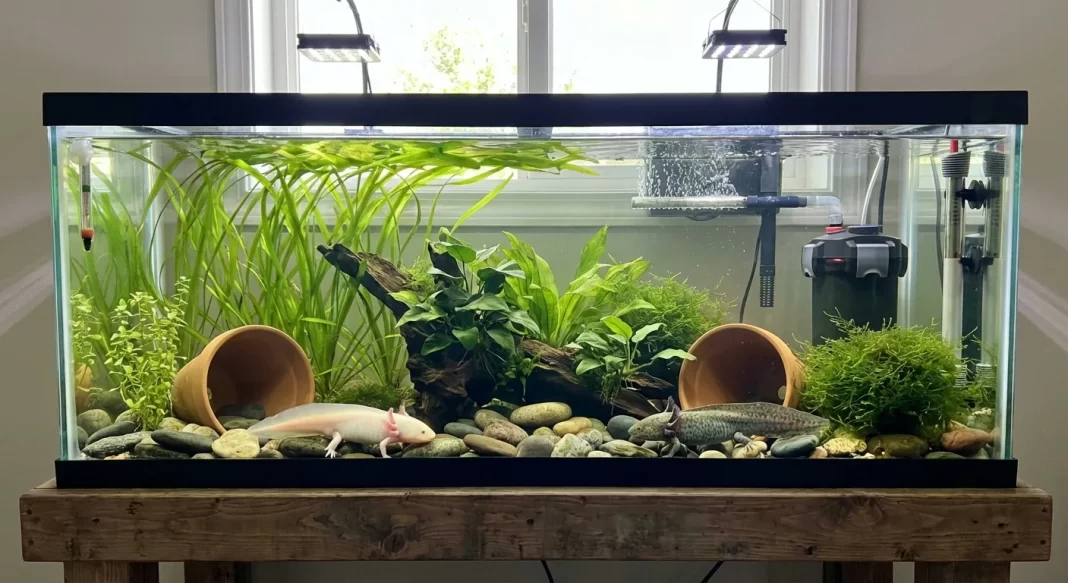
Setting up an axolotl tank correctly before the animal arrives prevents most early health emergencies. A complete setup requires a 20 to 40 gallon long tank, low-flow filtration, dechlorinator, a liquid test kit, fine sand or bare bottom, hides, and a cooling plan. The fishless cycle takes 4 to 8 weeks and cannot be skipped.
What equipment do you need before you start?
A complete axolotl tank setup needs a 20 to 40 gallon long tank, a low-flow sponge or baffled canister filter, dechlorinator, a liquid test kit, sand or bare bottom, a thermometer, at least one hide per animal, and pure ammonia for cycling. A chiller or fan is required if room temperature exceeds 72 Fahrenheit at any point.
Before purchasing an axolotl, you need all of the following assembled, tested, and running. The list addresses the specific biology of the species: cold-water amphibians with sensitive gills, no tolerance for ammonia, and a suction-feeding method that creates impaction risk with the wrong substrate.
Tank: 20-gallon long minimum for one adult axolotl. AxolotlCentral identifies 29 gallons as the practical minimum and recommends a 40-gallon breeder for better outcomes (source: AxolotlCentral care guide). For each additional axolotl, add at least 10 gallons. Floor space matters more than height because axolotls rarely use the upper water column. Full sizing logic is in the tank size guide.
Filter: A sponge filter driven by an air pump is the simplest and safest starting choice. Sponge filters provide biological and mechanical filtration with minimal water current. Canister filters with adjustable flow and a spray bar are the upgrade option for larger tanks. Hang-on-back filters work if the outflow is baffled to reduce current. Axolotl.org notes that excessive water flow will sooner or later lead to disease (source: Axolotl.org captive requirements). The filtration guide covers filter comparison in detail.
Liquid test kit: API Freshwater Master Test Kit or equivalent. Tests ammonia, nitrite, nitrate, and pH. Test strips exist but are less accurate for the narrow tolerances axolotls require. You will use the kit daily during cycling and weekly after the tank is established.
Dechlorinator: Seachem Prime or equivalent water conditioner that neutralises chlorine and chloramine. Every water addition to the tank must be treated, since chlorine and chloramine are directly toxic to amphibian skin and gills (per Axolotl.org).
Thermometer: A digital aquarium thermometer with min/max memory, placed at axolotl level (not near the filter outflow or a window). You need to know the actual temperature the animal experiences.
Hides: At least one hide per axolotl. PVC pipe sections, ceramic aquarium caves, or smooth-edged terracotta pots. Axolotls are nocturnal and light-sensitive, so hides are a welfare requirement, not a decoration. The hides and enrichment guide covers options and placement.
Ammonia source for cycling: Pure ammonia (no surfactants, no fragrances) for fishless cycling. Dr. Tim’s Ammonium Chloride is a commonly used product. You cannot skip cycling.
Optional but strongly recommended: an aquarium chiller or clip-on fan (required if room temperature exceeds 72 degrees Fahrenheit at any point in the year), live cool-water plants (java fern, anubias, elodea), and a mesh lid or glass cover to prevent escape. For breeding-tank setups with rearing-container logistics, see the breeding setup guide.
From a rescue-intake perspective, the cases that surface most often in the first three months trace back to one of three early shortcuts: a tank smaller than 20 gallons, no test kit, or no cooling plan. Buying everything on the non-negotiable list before bringing the animal home prevents the cascade where one missing item leads to a parameter problem that leads to a health problem.
Step 1: Choose the right tank and placement
A 20-gallon long is the floor most keeper resources accept, with AxolotlCentral recommending 29 gallons as the practical minimum and 40 gallons strongly preferred. Floor area matters more than height because axolotls are bottom-dwellers. Place the tank away from direct sunlight, heat sources, and on a surface rated for the ~450 pound weight of a filled 40-gallon.
A 20-gallon long (30 inches by 12 inches by 12 inches) is the absolute minimum for a single adult axolotl. The 40-gallon breeder (36 inches by 18 inches by 16 inches) is the most commonly recommended size in experienced keeper communities because the additional floor space and water volume make temperature stability, waste dilution, and territorial comfort substantially easier to maintain. Adult axolotls reach about 25 centimeters or 10 inches in length (source: Britannica), which makes floor area the binding constraint rather than vertical column space.
Why footprint matters more than volume
Axolotls are benthic animals. They walk along the bottom, rest on the bottom, and feed from the bottom. A 20-gallon tall tank (24 inches by 12 inches by 16 inches) has the same volume as a 20-gallon long but 20 percent less floor space. That difference matters for an animal that almost never swims above the midline. Optimise for footprint when choosing between tank shapes of similar volume.
Placement rules
Place the tank away from direct sunlight, which raises water temperature unpredictably and promotes algae blooms that compete with the nitrogen cycle. Keep it away from heat sources like radiators, space heaters, ovens, and south-facing windows in warm climates. A 20-gallon tank filled with water, substrate, and equipment weighs approximately 225 pounds (102 kilograms), and a 40-gallon breeder weighs approximately 450 pounds (204 kilograms). Standard furniture is not rated for this weight, so use a dedicated aquarium stand or a structurally verified surface.
Place the tank near a power outlet and water source. You will be doing weekly water changes for years, and a tank placed far from a water source turns routine maintenance into an obstacle that leads to skipped changes. Choose a room where you can control temperature: basements and air-conditioned rooms work well, while attic rooms and sunrooms amplify seasonal temperature swings.
Step 2: Substrate selection, safety first and aesthetics second
Safe substrate choices are bare-bottom (the safest option), fine sand under 1 millimeter grain (an alternative for axolotls over 15 centimeters), or rocks individually too large to fit in the axolotl’s mouth. Gravel is never safe at any size: axolotls feed by suction and routinely ingest substrate, and gravel impaction is a surgical or fatal emergency.
Substrate choice is a safety decision with direct veterinary consequences. Axolotls feed by suction, rapidly opening their mouths to create a vacuum that pulls in food along with anything near it. The San Diego Zoo describes axolotls as predators that feed by suction (source: San Diego Zoo), and AxolotlCentral states plainly that axolotls cannot be kept on gravel or rocks because they will draw in everything around them (source: AxolotlCentral substrate guide).
Safe substrate options
Bare bottom is the safest option and the easiest to maintain. There is no impaction risk, waste is visible and easy to remove, and cleaning requires nothing more than a turkey baster or gravel vacuum. Some keepers worry about the animal losing traction on smooth glass, but axolotls adapt to bare glass without documented welfare problems. AxolotlCentral notes that slate or tile cut to fit the tank and glued down with silicone is a safe alternative when traction is a concern (per AxolotlCentral).
Fine sand with a grain size below 1 millimeter is the other safe option. Fine sand passes through the digestive tract if accidentally ingested during feeding. Sand provides more natural footing and allows axolotls to engage in substrate-sifting behavior. Do not use sand for juvenile axolotls under 6 inches (15 centimeters) in length; the impaction risk is higher in smaller animals. The full substrate comparison is in the substrate guide.
What to avoid
Gravel is never safe for axolotls. No gravel size within the standard aquarium gravel range is safe. Pieces large enough to resist suction are still mouthed and occasionally swallowed by adult axolotls during feeding. Gravel impaction requires surgical intervention or causes death in severe cases. Crushed coral, colored gravel, and glass beads carry the same impaction risk as standard gravel plus additional chemical concerns from dyes and coatings. Large river rocks that are individually too big to fit in the axolotl’s mouth (larger than the animal’s head) are acceptable as decorative elements but do not function as a substrate. Ensure no gaps between rocks where a limb could become trapped.
Step 3: Install filtration and understand the nitrogen cycle
Filtration drives biological filtration through the nitrogen cycle, converting toxic ammonia from axolotl waste into nitrite and nitrate. A sponge filter rated for the tank size paired with an adjustable air pump is the default safe choice. Canister filters work with a spray bar baffle, and hang-on-back filters work with a pre-filter sponge.
Filtration is the life-support system for your axolotl. It serves two inseparable purposes: mechanical filtration removes visible debris from the water, and biological filtration converts toxic ammonia into less toxic nitrate. Without biological filtration, ammonia from waste, uneaten food, and gill secretions accumulates to lethal levels within days.
How the nitrogen cycle works
The nitrogen cycle is a bacterial process that happens in every healthy aquarium. Your axolotl produces ammonia through waste, respiration, and gill function, and uneaten food decomposes into ammonia. Beneficial bacteria (Nitrosomonas species) colonise the filter media and convert ammonia into nitrite. A second group (Nitrospira species) convert nitrite into nitrate. Nitrate accumulates in the water at much lower toxicity and is removed through regular partial water changes.
Both ammonia and nitrite are acutely toxic to axolotls at any detectable level. The target for both in a cycled, stable tank is 0 ppm, always. AxolotlCentral’s care reference targets 0 ppm ammonia, 0 ppm nitrite, and 5 to 20 ppm nitrate (per AxolotlCentral care guide).
Choosing a filter type
Sponge filters are the default recommendation for axolotl tanks. They provide excellent biological filtration surface area, produce very gentle water movement, are inexpensive, and are nearly impossible to over-power in a 20 to 40-gallon tank. A sponge filter rated for your tank size paired with an adjustable air pump is the simplest setup that meets the axolotl’s needs.
Canister filters are the upgrade option for tanks of 40 gallons or larger. They must have adjustable flow control, and the return line should use a spray bar positioned along the back wall to diffuse outflow across the water surface rather than creating a directional jet. Without a spray bar or baffle, most canister filters produce too much current.
Hang-on-back filters are a middle option that work if you baffle the outflow with a pre-filter sponge or a water bottle baffle. Unbaffled hang-on-back filters create surface agitation that axolotls find stressful.
Flow control is not optional
Axolotls are sensitive to sustained water current. Their feathery external gills act as drag surfaces, and chronic exposure to directional flow causes gill curl, a condition where the gill filaments fold forward from sustained water pressure (per Axolotl.org). The current and flow control guide covers baffle methods and flow-rate guidelines. Position the filter outflow so that no resting area receives direct current, and place hides in low-flow zones.
Step 4: Cycle the tank before any axolotl enters the water
Fishless cycling takes 4 to 8 weeks of dosing pure ammonia to 1 to 2 parts per million and testing daily. The tank is cycled when it can process 2 ppm of ammonia to 0 ammonia and 0 nitrite within 24 hours. Confirming on two consecutive tests adds a safety margin. Adding an axolotl to an uncycled tank exposes it to lethal ammonia spikes.
The nitrogen cycle must be established before you add your axolotl. This is not a suggestion. Placing an axolotl into an uncycled tank exposes it to ammonia and nitrite spikes that cause gill damage, chemical burns, immune suppression, and organ stress that can kill within days to weeks.
Reviewing axolotl rescue intake records and new-keeper veterinary presentations, the single most common cause of illness in newly acquired axolotls is an uncycled or partially cycled tank. The keeper had the right equipment but skipped the 4-to-8 week wait, and the animal entered a tank that could not yet process its waste.
Fishless cycling step by step
Set up the tank fully with substrate (if using sand), filter running, dechlorinated water, and all equipment positioned as it will remain during operation. Add pure ammonia to reach a concentration of 1 to 2 ppm using Dr. Tim’s Ammonium Chloride or equivalent. AxolotlCentral’s cycling guide recommends 1 drop per gallon as 1 ppm ammonia (source: AxolotlCentral cycling guide). Some keepers cycle at higher doses up to 4 ppm; the 1-to-2 ppm target is the AxolotlCentral guidance and the safer floor for beginners.
Test ammonia, nitrite, and nitrate daily using your liquid test kit and record the results in a log. After several days to two weeks, Nitrosomonas bacteria will colonise the filter media and begin converting ammonia to nitrite, so ammonia declines and nitrite rises. This is expected. Wait for nitrite to drop next. Nitrospira bacteria colonise more slowly, and when nitrite begins to decline, the second stage of the cycle is establishing. Nitrate will begin to appear.
Re-dose ammonia when it drops to 0 ppm. Re-dose to 2 ppm to keep feeding the bacterial colony. You need enough bacteria to handle the ongoing waste load of a live axolotl, not just a one-time pulse.
The tank is cycled when it can process 2 ppm of ammonia to 0 ppm ammonia and 0 ppm nitrite within 24 hours (per AxolotlCentral cycling guide). Confirming on two consecutive tests adds a safety margin. This typically takes 4 to 8 weeks. Some tanks cycle faster with seeded filter media from an established aquarium; others take longer in cool water because bacterial growth rates slow below 20 degrees Celsius (68 degrees Fahrenheit). Background context for the nitrogen cycle and seeded-media acceleration is in the Ethical Axolotls cycling reference.
Do a large water change (50 to 80 percent) to reduce accumulated nitrate before adding the axolotl. Match the replacement water to the tank’s temperature and treat with dechlorinator. The tank cycling guide covers the fishless-cycle process in full detail, including troubleshooting stalls and seeded-media shortcuts.
How to confirm the tank is cycled
Run the confirmation test: dose ammonia to 2 ppm, then test again 24 hours later. If ammonia reads 0 ppm, nitrite reads 0 ppm, and nitrate has increased, the cycle is complete. Run this confirmation test at least twice on consecutive days. A single pass is not reliable because bacterial populations fluctuate during establishment. Do not rely on water clarity as a proxy for cycling. Water can appear perfectly clear while ammonia and nitrite are at toxic levels.
Step 5: Set up a temperature control plan
The safe water temperature range is 60 to 68 Fahrenheit (16-20 Celsius), with 60-64 F (16-18 C) as the ideal midpoint per Axolotl.org. Axolotls do not need heaters. A clip-on fan provides 2 to 4 degrees of evaporative cooling for mild climates; a chiller is required where room temperature regularly exceeds 75 F.
Axolotls are cold-water amphibians. The optimum temperature is between about 16 °C and 18 °C (60 to 64 °F) per Axolotl.org captive requirements, with temperatures above 24 °C causing severe stress and disease (per Axolotl.org). Above 75 degrees Fahrenheit, axolotls experience immune suppression, increased susceptibility to fungal and bacterial infection, and organ damage that can be fatal within days.
A ceramic heat emitter or aquarium heater is not appropriate for this species. The challenge with axolotls is keeping water cool enough, not warm enough. If your room temperature stays between 60 and 68 degrees Fahrenheit year-round, no temperature-control equipment is needed. Most keepers in temperate and warm climates need a cooling plan for at least part of the year.
Cooling options by climate
Mild climates where room temperature occasionally reaches 72 to 75 degrees Fahrenheit in summer can usually be managed with a clip-on aquarium fan positioned to blow across the water surface. The evaporative cooling reduces water temperature by 2 to 4 degrees Fahrenheit. This approach works in dry heat but is less effective in humid conditions where evaporation slows.
Warm climates where room temperature regularly exceeds 75 degrees Fahrenheit require an aquarium chiller. Chillers are the most expensive single piece of axolotl equipment, typically ranging from $150 to $400 USD depending on capacity. Size the chiller to your tank volume and follow the manufacturer’s specifications for flow rate. The chiller guide covers sizing and installation.
For emergency cooling during unexpected heat spikes above 75 degrees Fahrenheit, frozen water bottles (filled with dechlorinated water, sealed, and frozen) can be floated in the tank as a temporary measure. This drops temperature locally but creates uneven cooling and must be refreshed every few hours. The hot weather setup guide covers emergency protocols.
Air conditioning in the room is an effective passive solution if you can maintain the room at 68 degrees Fahrenheit or below. Many experienced keepers in warm climates keep their axolotl tank in a basement or air-conditioned room and consider the air conditioning cost part of the animal’s care budget. The temperature guide covers safe ranges, heat stress signs, and correction methods in depth.
Step 6: Arrange hides, plants, and decor
Place at least one opaque hide per axolotl in a low-flow zone, sized for the animal to fit fully inside. PVC pipe 3 to 4 inches in diameter cut to 6 to 8 inches long is the simplest option. Cool-water plants like java fern and anubias add cover. Lighting stays low on a 12-hour photoperiod.
With the tank cycled and temperature-stable, arrange the interior. Axolotls are nocturnal, light-sensitive animals that spend daylight hours resting in sheltered areas. Tank layout should prioritise cover, low light, and clear sightlines.
Hides
Place at least one hide per axolotl. Hides should be large enough for the axolotl to fit entirely inside without squeezing, smooth-edged with no rough ceramic or sharp rock edges, opaque so they actually exclude light, and positioned in a low-flow zone away from filter outflow. PVC pipe (3-inch or 4-inch diameter, cut to 6 to 8 inches long) is the simplest, cheapest, most cleanable option. Ceramic aquarium caves, terracotta pots (check for drainage holes that could trap a limb), and commercially made resin hides are all acceptable. Avoid painted or coated decorations that could leach chemicals into cool, slightly acidic water over time.
Plants
Live low-light plants that tolerate cool water add cover, surface area for beneficial bacteria, and minor nitrate uptake. Suitable species include java fern (Microsorum pteropus), anubias (Anubias barteri), elodea (Egeria densa), and java moss (Taxiphyllum barbieri). Attach java fern and anubias to driftwood or rocks with fishing line or glue; do not bury the rhizome in substrate. Silk plants are an alternative if you prefer zero plant maintenance. Choose silk over plastic, since hard plastic leaves can abrade gill filaments. The plants guide covers species selection and placement.
Lighting
Axolotls have no eyelids and are photosensitive. Bright overhead lighting causes behavioral stress (glass surfing, hiding refusal, reduced feeding). A low-wattage LED on a timer providing approximately 12 hours of subdued light and 12 hours of darkness is sufficient for plant growth and a consistent day-night cycle. The 12-hour photoperiod is the standard recommendation across keeper references (source: Axolotl Planet lighting guide). Direct sunlight on the tank is not acceptable: it raises water temperature and drives algae overgrowth. The lighting guide covers fixture options.
Step 7: Add the axolotl, acclimation and first-week monitoring
Float the sealed bag in the cycled tank for 15 to 20 minutes to equalise temperature, then drip-mix tank water into the bag every 5 minutes for 20 to 30 minutes before releasing the axolotl. Do not pour bag water into the tank. Test parameters daily for the first two weeks and check temperature twice daily.
The tank is cycled, temperature-stable, equipped, and arranged. Now you can add the animal.
Acclimation procedure
Transport the axolotl in a sealed bag or container with water from its previous environment. Float the sealed bag in your tank for 15 to 20 minutes to equalise temperature. Then, over the next 20 to 30 minutes, gradually add small amounts of your tank water to the bag every 5 minutes to acclimate the animal to your water chemistry. When the bag water is roughly 50 percent your tank water, gently release the axolotl into the tank. Do not dump the bag water into your tank, since it may contain elevated ammonia from transport.
First-week checklist
The first week is a critical monitoring period. The animal is adjusting to new water chemistry, new surroundings, and the stress of transport.
Test water parameters daily for the first two weeks. Ammonia and nitrite should remain at 0 ppm. The bioload from a live axolotl is different from the ammonia doses used during cycling, so monitor for any spike. Check temperature twice daily (morning and evening). Transport stress plus a new thermal environment can coincide with seasonal temperature shifts.
Offer food after 24 to 48 hours. Many axolotls refuse food for the first day or two in a new tank, which is normal stress behavior. Offer a small earthworm segment or a few pellets, and remove uneaten food after a few hours. PetMD’s DVM-reviewed feeding guidance covers normal feeding frequencies once the animal settles (source: PetMD (reviewed by Sean Perry, DVM)).
Observe gill condition. Healthy gills are feathery, erect, and fan outward. Forward-curled gills within the first week may indicate flow stress, so check filter positioning. Pale or shrunken gills may indicate water quality problems, so test immediately. Minimise handling and tank activity: no unnecessary tank rearrangement, no bright overhead lights left on, no tapping on the glass. Do not add a second axolotl during this period; establish the first animal’s baseline before introducing any cohabitant.
Ongoing maintenance: how the setup transitions to daily keeping
Once the axolotl is in the tank, daily, weekly, monthly, and quarterly tasks keep parameters stable for years. Daily checks cover temperature, uneaten food, waste spot-cleaning, and observation. Weekly tasks cover a 20-30 percent water change, parameter testing, and equipment checks. The care SOP has the full schedule.
A properly set up and cycled axolotl tank requires consistent, predictable maintenance. The goal is parameter stability, not perfection in any single measurement. Stable, consistent conditions prevent more health problems than any single piece of equipment.
Weekly water changes of 20 to 30 percent of tank volume, replaced with temperature-matched and dechlorinated water, control nitrate accumulation and replenish minerals. Test ammonia, nitrite, nitrate, and pH weekly. The water testing guide and water parameters guide cover testing technique and safe ranges in depth.
Common setup mistakes and how to avoid them
Experienced keepers in the axolotl rescue and rehoming community see the same preventable mistakes repeatedly: skipping the cycle, using gravel, running an oversized filter without flow control, placing the tank near a window, having no summer cooling plan, and adding the axolotl before cycling completes. Knowing these patterns before you start is more useful than troubleshooting after something goes wrong.
Skipping the cycle is the number-one mistake. A clear-looking tank set up yesterday is not cycled. Bacterial colonies take weeks to establish, and there is no shortcut that eliminates the waiting period entirely, though seeded media from an established tank can reduce it.
Using gravel is the second most common preventable mistake. Gravel impaction is a surgical or fatal emergency. No gravel type, size, or brand is safe. Bare bottom or fine sand only.
Oversized filter without flow control is a frequent issue. A filter rated for 50 gallons on a 20-gallon tank produces current that causes chronic gill stress. Match filter capacity to tank size and always use a flow-control valve, baffle, or spray bar.
Placing the tank near a window raises water temperature and drives algae growth. A tank positioned in a south-facing window can swing 5 to 8 degrees Fahrenheit over a single sunny afternoon.
No cooling plan for summer catches keepers who set up tanks in winter and discover the temperature problem in June. Plan cooling before you need it. A chiller purchased in advance costs less stress than an emergency fan setup while an axolotl is already heat-stressed.
Adding the axolotl too soon ties all the other mistakes together. Cycle first. Acclimate properly. Test daily for the first two weeks. The beginner mistakes guide covers the broader pattern of new-keeper errors and how to prevent them.
Frequently asked questions
Can I use tap water for my axolotl tank?
Yes, but only after treating it with a dechlorinator that neutralises both chlorine and chloramine. Most municipal water supplies use one or both disinfectants, and both are directly toxic to amphibian skin and gills (per Axolotl.org). Seachem Prime and API Tap Water Conditioner are widely used. Never add untreated tap water to the tank, even for small top-offs. Well water does not require dechlorination but should still be tested for pH, hardness, and any contaminants specific to your local geology.
How long does cycling actually take, and what slows it down?
A fishless cycle using pure ammonia typically takes 4 to 8 weeks. The timeline depends on water temperature (bacterial growth is slower in the cool temperatures axolotls need), filter media surface area, and whether you seed the tank with media or bacteria from an established aquarium. Seeded media can reduce cycling time to 2 to 3 weeks in some cases. The cycle is complete when the tank consistently processes 2 ppm ammonia to 0 ppm ammonia and 0 ppm nitrite within 24 hours.
Do axolotls need a heater or a ceramic heat emitter?
No. Axolotls are cold-water animals that need temperatures between 60 and 68 degrees Fahrenheit. A heater or ceramic heat emitter would push water above the safe range and create heat stress. The equipment concern for axolotls is cooling, not heating. If your room temperature drops below 60 degrees Fahrenheit consistently, a low-wattage aquarium heater set to 62 degrees Fahrenheit as a floor could prevent extreme cold, but this situation is uncommon in heated homes.
Can I set up an axolotl tank without a filter?
Technically possible but not recommended for any keeper, especially beginners. Without a filter, the nitrogen cycle has no reliable home for beneficial bacteria, ammonia and nitrite accumulate between water changes, and you would need to perform very large, very frequent water changes (daily or every other day) to keep parameters safe. The cost of a sponge filter and air pump is under $30 and eliminates the single largest ongoing risk to the animal’s health.
What water parameters should I confirm before adding my axolotl?
Before the axolotl enters the water, confirm ammonia at 0 ppm, nitrite at 0 ppm, nitrate below 20 ppm, pH between 6.5 and 8.0 (7.4 to 7.6 is ideal per Axolotl.org), and temperature between 60 and 68 degrees Fahrenheit. Run the cycle confirmation test on two consecutive days before introducing the animal. If any reading is outside these ranges, correct it before adding the axolotl.
Related guides
- Axolotl care guide: complete setup and health reference hub
- Axolotl breeding setup: breeding-specific tank requirements
- Axolotl chiller guide: cooling equipment selection and installation
- Axolotl care SOP: daily, weekly, monthly maintenance schedule
By the ExoPetGuides editorial team (AI-assisted drafting; human-reviewed), reviewed by an exotic-animal veterinarian
Updated 2026-05-17
Primary sources: Axolotl.org captive requirements, AxolotlCentral care guide and substrate guide and cycling guide, PetMD (Sean Perry, DVM), Ethical Axolotls cycling reference, Axolotl Planet lighting guide
Disclaimer: This content is for educational purposes only and is not a substitute for professional veterinary advice. Always consult a qualified veterinarian, ideally an exotic-animal specialist, for any health concern about your pet. Care recommendations may vary based on species, individual animal, and local regulations.