


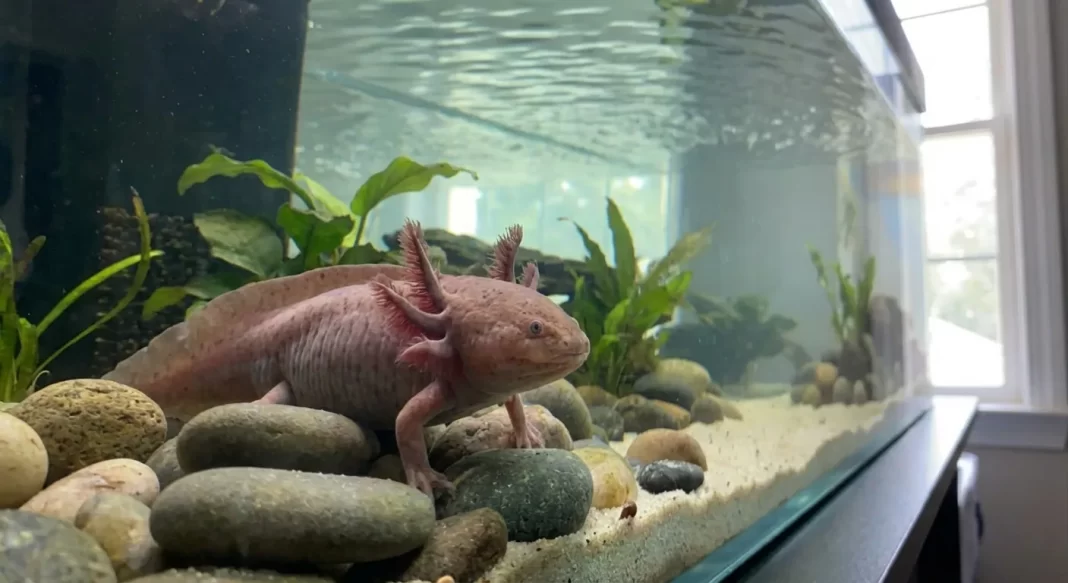
Axolotls evolved in still water and cannot tolerate strong current. Signs of too much flow include forward-curled gills, persistent hiding away from the filter output, and refused food. Reduce flow with a spray bar, sponge baffle, or pre-filter sponge. For tanks under 40 gallons, switching to a sponge filter usually solves the problem entirely. The axolotl care guide covers the broader husbandry framework.
Why are axolotls sensitive to water current?
Output from a filter is one of the most common causes of stress in axolotls (source: Axolotl.org captive requirements). Their gill anatomy and lateral-line biology evolved in the shallow, weedy canals of Lake Xochimilco, where water is essentially still. Strong current compresses the gill filaments, masks prey-detection cues, and creates chronic low-grade stress.
Axolotls are benthic amphibians. They spend most of their time walking on or resting at the bottom. They are not swimmers in any meaningful sense. Their body shape, limb structure, and gill anatomy assume near-zero current. The captive-care page at Axolotl.org records that “Output from a filter can cause significant flow and this is perhaps the most common cause of stress in axolotls. Excessive water flow will, sooner or later, lead to disease” (per Axolotl.org captive requirements). This is the single clearest framing of the problem in the keeper-authority literature.
The external gills are the most vulnerable structure. Each axolotl has three pairs of gill stalks projecting from behind the head. Each stalk is covered in feathery filaments that maximize the surface area exposed to water. This design is efficient for oxygen absorption in still water. It creates a problem in current. Flowing water pushes the filaments backward, compresses them, and reduces the gill surface available for gas exchange. The axolotl cannot retract its gills or protect them from water pressure. Chronic exposure to current forces the animal to work harder to extract oxygen.
Warmer water makes this worse. Warmer water holds less dissolved oxygen (source: USGS Water Science School on dissolved oxygen). Above the safe upper boundary of 68 degrees Fahrenheit, oxygen demand rises just as supply falls. A flow-stressed axolotl in warm water faces a double problem. The temperature guide covers the thermal-tolerance interaction in detail.
Axolotls also have a lateral-line system. This is a series of sensory organs along the body and head that detect water pressure changes and vibrations. Strong current creates constant stimulation of the lateral line, which the animal interprets as environmental threat. This is the same system that detects predator movement in the wild. A tank with strong current essentially simulates a permanent predator-alert state. The animal cannot escape it. Cortisol-driven stress responses elevate. Immune function declines. Secondary problems follow.
Filter sizing is the single biggest variable in this chain. Axolotl.org’s housing guide states that “A large filter is not suitable for a small tank and will usually create far too much water flow in the tank. This is possibly the biggest cause of stress-related disease in axolotls” (source: Axolotl.org filtration and housing). The same source notes that “the actual water turnover through the filter shouldn’t be much beyond what is required” (per Axolotl.org filtration and housing). The filtration guide covers filter equipment selection and sizing at depth.
What are the signs of too much flow in an axolotl tank?
The most reliable signs of too much flow are forward-curled gills symmetric across all six stalks, persistent hiding on the side of the tank farthest from the filter, reduced feeding response, surface gulping, glass surfing on output-opposite walls, and a clamped tail-curled body posture. Two or more signs together strongly indicate flow stress rather than other causes.
Excessive current produces a cluster of behavioral and physical changes that are distinct from other stressors like ammonia exposure or temperature spikes. Recognizing the flow-specific pattern helps keepers diagnose the problem before it causes lasting damage. The table below summarises the six most reliable indicators.
| Sign | Distinguishing feature | What to verify |
|---|---|---|
| Forward-curled gills | All six gill stalks curl symmetrically | Water parameters normal (ammonia 0, nitrite 0) |
| Persistent hiding far from filter | Animal stays pressed against output-opposite wall | Hide on far side is intact and usable |
| Reduced feeding response | Food drifts past unattended | Food sinks within axolotl’s strike range |
| Surface gulping | Repeated trips to the surface for air | Temperature in range, ammonia 0, nitrite 0 |
| Glass surfing on output-opposite walls | Repetition concentrates on one or two walls | Glass surfing is not concentrated at the front, which signals general stress |
| Clamped tail-curled posture | Body flat against substrate, tail folded sideways | Posture changes when flow is briefly reduced |
Forward-curled gills
This is the most specific indicator of flow stress. The gill filaments fold forward toward the head rather than fanning outward. The axolotl is reducing the surface area of its gills to minimize the force of water pushing against them. Flow-related gill curl typically affects all six gill stalks symmetrically. If only one side curls, the cause is more likely localized irritation or infection rather than flow. The health red flags guide covers the full differential diagnosis, including water quality, disease, and genetics. The ammonia burn guide covers chemical-injury gill damage separately.
Persistent hiding on the far side of the tank
Axolotls normally spend time in hides. A flow-stressed axolotl will remain in a hide or pressed against the tank wall on the low-flow side for hours at a time. The animal rarely ventures into open areas. This is avoidance behavior. The axolotl is positioning itself in the area of least current. If your axolotl consistently uses only one end of the tank, and that end is the side farthest from the filter output, flow is the likely cause.
Reduced feeding response
Axolotls hunt by detecting water-pressure disturbances from prey movement through their lateral line. In a tank with strong current, the background water movement masks the subtle pressure changes that trigger the feeding strike. The axolotl may ignore food that passes nearby. It cannot distinguish the food’s movement from the ambient current. Strong flow also physically pushes pellets and worm pieces away from the axolotl before it can strike.
Surface gulping
An axolotl that repeatedly swims to the surface to gulp air may be compensating for reduced gill efficiency caused by flow-compressed filaments. Surface gulping has multiple causes, including low dissolved oxygen and high temperature. When it occurs alongside gill curl and hiding, flow stress is the primary suspect. The water testing guide covers the parameter-test sequence that rules out water-quality causes.
Glass surfing concentrated on the output-opposite walls
Repeated swimming along the tank glass, especially on the side opposite the filter output, can indicate the animal is trying to escape the current zone. Glass surfing from flow stress tends to concentrate on the walls farthest from the filter rather than being distributed across all four walls. Generalized glass surfing across all walls usually signals broader environmental stress, not flow specifically.
Tail curling and clamped posture
An axolotl held in current may curl its tail to one side and press its body flat against the substrate. This reduces its profile against the water flow. It is an energy-conservation posture. In still water, the same axolotl would rest with its tail extended naturally and its body slightly arched.
Across axolotl-keeper rescue networks reviewing flow-stressed animals brought in by new keepers, the consistent pattern is that gill curl reverses fast when the underlying cause is flow rather than water quality or disease. Keepers who reduce flow with a spray bar or sponge baffle often report visible fanning-out of gill filaments within hours, not days. Feeding response usually returns within a single day. When 48 to 72 hours of reduced flow does not produce visible relaxation, the cause is something other than flow alone. The tank cycling guide covers the parameter-stability prerequisite that lets you isolate flow as the variable.
How do you test water flow in an axolotl tank?
The simplest flow test drops a floating piece of leaf or styrofoam near the filter output and watches how it moves across the surface. Safe flow takes more than 30 seconds to cross the tank. A turkey-baster puff at the tank floor checks current at the axolotl’s resting zone. A Java moss strand near the floor works as a permanent indicator.
The table below structures the three testing methods, the threshold for axolotl-safe flow on each, and the frequency at which to apply each.
| Test | Method | Axolotl-safe threshold | Frequency |
|---|---|---|---|
| Floating debris surface test | Drop dried leaf or styrofoam near filter output | More than 30 seconds to cross tank surface | After every filter change or reduction |
| Turkey-baster floor-level puff | Release small puff horizontally near substrate | Cloud dissipates roughly in place | After every filter change or reduction |
| Java moss permanent indicator | Anchor moss strand near substrate | Remains essentially still | Continuous; check at every feeding |
The floating debris method
Drop a small piece of floating material onto the water surface near the filter output. A piece of dried leaf, a tiny fragment of styrofoam, or even a pinch of fish flake works. Watch how the debris moves across the surface over 30 to 60 seconds. Safe flow has the debris drifting slowly across the surface, taking 30 seconds or more to travel from the filter-output side to the opposite wall. The movement is barely perceptible. At the tank floor, there should be no visible movement of fine substrate particles or lightweight decorations. Borderline flow moves the debris noticeably across the surface within 10 to 20 seconds. There may be slight movement of lightweight objects at the substrate. This level may be tolerable for a healthy adult axolotl but is too strong for juveniles or any axolotl showing stress signs. Excessive flow crosses the tank surface in under 10 seconds or follows a clear circular pattern. Any visible movement of substrate particles is too much.
The floor-level puff test
The surface test measures current at the top of the water column. Because axolotls live at the bottom, you also need to check floor-level flow. Hold a turkey baster or pipette near the tank floor. Release a small puff of tank water horizontally. Watch how quickly the cloud of disturbed water dissipates versus how far it travels. In a properly flow-controlled tank, the puff should dissipate roughly in place. If it stretches visibly across the tank floor, the current at floor level is too strong.
Using a flow-indicator plant
Java moss or a strand of Java fern attached to a weight near the tank floor serves as a permanent flow indicator. In safe flow conditions, the plant remains essentially still with only the slightest occasional movement. If the plant is pushed consistently to one side or waves continuously, the floor-level current needs further reduction. The hides and enrichment guide covers plant species that tolerate the cool water axolotls require.
How do spray bars reduce flow for axolotls?
A spray bar is a perforated tube on a canister filter output that distributes water across many small holes rather than one concentrated jet. The reduced velocity per hole brings effective current to axolotl-safe levels. Position the spray bar along the back glass aimed at the wall or angled slightly upward toward the surface, never horizontally across the tank length.
How a spray bar works
A standard canister filter output hose concentrates the entire flow volume through one opening, typically 12 to 16 millimeters in diameter. The velocity at the exit point is high enough to create a jet that extends across the tank. A spray bar with 10 to 20 holes distributes the same volume of water across a much wider area. Each individual hole produces a fraction of the velocity. The streams interact and slow each other down as they enter the tank.
Axolotl.org’s housing guide documents a setup where a keeper reduced an Eheim Ecco 2231 canister filter from its rated 300 liters per hour to approximately 150 liters per hour of effective output. The reduced output was then dispersed through a spray bar to bring the effective current to axolotl-safe levels (per Axolotl.org filtration and housing). That combination of inline flow reduction plus spray bar distribution is the standard approach for canister filters on axolotl tanks.
Spray bar positioning for axolotl tanks
Position the spray bar along the back wall of the tank, near the water surface. Point the holes toward the back glass or angle them slightly upward toward the surface. This achieves two things. The water stream hits the glass and loses most of its velocity before entering the main tank volume. The surface agitation promotes gas exchange for oxygenation without creating current at the tank floor.
Never point a spray bar horizontally across the tank length. This creates a current channel from the output side to the opposite wall that the axolotl cannot avoid. Never point it downward toward the tank floor. The goal is to keep the strongest water movement at the surface and near the back wall, away from the axolotl’s resting zone.
Drilling additional holes
If the stock spray bar does not reduce velocity enough, drill additional holes using a 2 to 3 millimeter drill bit. More holes means less pressure per hole, which means lower velocity at each exit point. Some keepers drill the holes slightly larger as well, though this is less precise. After drilling, run the filter. Check flow at the tank floor using the debris test described above.
How do baffles reduce filter output for axolotls?
A baffle is a physical barrier that breaks up filter output. The simplest baffle wedges a piece of coarse aquarium filter sponge into a HOB filter output slot. A cut plastic water bottle attached to the HOB output redirects the waterfall stream along the glass. For canister filters, driftwood or rock placed in front of the spray bar absorbs residual current.
Baffles are the primary tool for making hang-on-back filters usable on axolotl tanks. They also serve as a secondary flow-reduction method for canister filters when spray bars alone are not sufficient. Axolotl.org notes that filter outflow can be dispersed “by means of a spray bar, or the careful placement of aquarium decor to interrupt the flow of water” (per Axolotl.org filtration and housing). The decor-placement framing is the source for the physical-baffle approach.
DIY sponge baffle for HOB filters
The simplest and most effective baffle for HOB filters is a piece of coarse aquarium filter sponge wedged into the output slot. The waterfall stream is forced through the sponge pores, which breaks the concentrated flow into hundreds of tiny trickles. The sponge must be coarse enough to allow water through without causing the HOB to back up and overflow. Fine sponge will restrict flow too much and can cause the filter to overflow from the intake side. Cut the sponge to fit snugly in the output slot. It should be thick enough to meaningfully slow the water, at least 2 centimeters, but not so thick that it blocks flow entirely. Check the water level inside the HOB unit after installing the sponge. If the water rises to within a centimeter of the top of the unit, the sponge is too dense. Switch to a coarser grade.
Water bottle baffle
A plastic water bottle cut to shape and attached over the HOB output redirects the waterfall stream against the tank glass or upward toward the surface. The water no longer drops straight down into the tank. Cut the bottom off a small plastic bottle. Then cut the bottle lengthwise so it opens into a curved ramp. Attach it to the HOB output with suction cups or aquarium-safe silicone. The water slides down the curved surface and enters the tank along the glass rather than as a free-falling stream. This method is visually less clean than a sponge baffle but can be more effective at eliminating the downward impact of HOB waterfall output. Some keepers combine both methods, using a sponge inside the output slot and a bottle ramp over the outside.
Baffle for canister filter output
If a canister filter spray bar is not reducing flow enough, a secondary baffle can be placed in the tank in front of the spray bar output. A large piece of driftwood, a tall rock, or a dense clump of aquarium-safe plants between the spray bar and the main tank volume absorbs remaining current before it reaches the axolotl’s zone. This approach also creates a visual barrier that serves as enrichment. The hides and enrichment guide covers placement strategies for tank furniture that doubles as flow disruption.
How do pre-filter sponges help with flow control?
A pre-filter sponge is a foam sleeve over the filter intake strainer. It protects the axolotl’s gills and limbs from being pulled against the intake. It also passively reduces total flow volume by adding intake resistance. The sponge colonizes with nitrifying bacteria, which provides bonus biological filtration. Squeeze it in old tank water during every water change.
Flow reduction effect
The sponge creates resistance at the intake. This reduces the total volume of water moving through the filter per unit time. A canister filter rated at 300 liters per hour may effectively move 200 to 250 liters per hour with a pre-filter sponge installed, depending on the sponge’s density and cleanliness. This is a passive flow reduction that requires no adjustment. As the sponge accumulates debris between cleanings, the flow reduction increases slightly.
Safety function
Without a pre-filter sponge, the intake strainer of a canister filter can trap an axolotl’s gill filaments or toes against the grate. The suction is not strong enough to injure a healthy adult in most cases. It can damage gill filaments and cause stress if the axolotl cannot pull free quickly. For juveniles, the risk is higher. Their smaller gill filaments can slip through standard strainer openings. Experienced axolotl keepers treat the pre-filter sponge as mandatory, not optional, on any filter with a powered intake.
Additional biological filtration
The pre-filter sponge colonizes with nitrifying bacteria just like any other filter media. This provides a bonus pocket of biological filtration that operates independently of the main filter body. If the main filter is removed for cleaning or fails temporarily, the bacterial colony on the pre-filter sponge continues processing ammonia. That is a meaningful safety margin. The tank cycling guide covers the nitrifying bacteria role in detail.
Maintenance
Squeeze the pre-filter sponge in a bucket of old tank water during every water change. Do not rinse it under tap water. Chlorine kills the nitrifying bacteria colonizing the foam. If the sponge becomes so clogged that it severely restricts intake flow, it needs a more thorough squeeze. You will notice reduced output from the spray bar or filter return. Replace the sponge only when it is physically disintegrating. The cleaning routine guide covers the squeeze-in-old-tank-water rule within the broader filter maintenance schedule.
Why are sponge filters the gentlest option for axolotls?
Sponge filters produce the lowest flow output of any powered filtration. An air pump pushes bubbles through a lift tube, drawing water through the sponge and back into the tank. At the tank floor, a properly sized sponge filter produces essentially zero horizontal current. Sponge filters are the default recommendation for single-axolotl tanks up to 40 gallons.
How sponge filter flow works
An air pump pushes air through airline tubing into the sponge filter’s lift tube. Air bubbles rise through the tube. They create a low-pressure zone that draws water through the sponge and up the tube. The water exits at the top of the lift tube and falls back onto the surface or flows gently sideways. Because the driving force is air buoyancy rather than an electric impeller, the total volume of water moved per hour is much lower than a canister or HOB filter of comparable physical size.
This is why sponge filters are the default recommendation for single-axolotl tanks up to 40 gallons in keeper-community consensus. For flow control specifically, sponge filters require almost no modification to be axolotl-safe. The filtration guide covers the full comparison of sponge, canister, and HOB filter types at depth.
Controlling sponge filter airflow
Even though sponge filters are gentle, an oversized air pump can push too many bubbles through the lift tube. The bubbles create turbulence at the surface that propagates downward. If the surface above the sponge filter is visibly churning, or if bubbles disrupt the area around the sponge at floor level, reduce the air pump output. Most air pumps include a dial for this purpose. If yours does not, add an inline airline valve between the pump and the sponge filter. These valves cost under two dollars and allow precise control over the bubble rate.
The correct airflow produces a steady, gentle stream of bubbles rising through the lift tube. You should be able to see individual bubbles rather than a continuous rush of air. Experienced keepers who have run sponge filters on axolotl tanks for years tend to err toward less airflow rather than more. They accept slightly lower filtration throughput in exchange for near-zero current at the tank floor.
How do you reduce canister filter flow for axolotl tanks?
Canister filters provide the strongest filtration capacity but produce the strongest output current. Making a canister axolotl-safe layers three techniques in sequence. Close the inline valve to 50 to 60 percent of rated output. Attach a spray bar along the back glass. Place a physical baffle of driftwood or rock between the spray bar and the main tank volume.
The 3-step layered procedure below covers the canonical canister flow reduction for axolotl tanks.
Step 1: Close the inline valve to 50 to 60 percent of rated output. Partially close the ball valve or flow-adjustment knob on the canister’s output hose. Reduce the flow to roughly 50 to 60 percent of the filter’s rated output. Do not close it more than 50 percent. Severely restricted flow can cause the motor to overheat. It also reduces biological filtration throughput below useful levels.
Step 2: Attach a spray bar along the back glass. Connect a spray bar to the output hose. Position it along the back wall of the tank near the water surface. Point the holes toward the back glass or angle them slightly upward toward the surface. Never point the spray bar horizontally across the tank length, and never point it downward at the substrate.
Step 3: Place a physical baffle between the spray bar and the main tank volume. Position a piece of driftwood, a tall hide, or a dense plant cluster between the spray bar output and the open tank floor. This absorbs whatever residual current passes the spray bar before it reaches the axolotl’s zone. Then verify the result. Run the floating debris test at both the surface and the tank floor. If debris at the floor level still moves visibly, tighten the inline valve further or add additional physical obstructions.
Canister intake protection
Every canister filter on an axolotl tank must have a pre-filter sponge on the intake strainer. This serves the dual purpose of protecting the axolotl from suction injury and passively reducing total flow volume. Without the intake sponge, the filter operates at full rated intake, which means full rated output. That is almost always too strong for axolotls even with a spray bar in place.
Can you use a HOB filter on an axolotl tank?
Hang-on-back filters are the least suitable type for axolotls. The waterfall return creates a concentrated downward stream that is difficult to diffuse. A sponge baffle wedged in the output slot plus a water-bottle ramp redirecting the stream along the glass makes a HOB marginally usable. For tanks under 40 gallons, replacing the HOB with a sponge filter is the most cost-effective fix.
Mandatory modifications
A sponge baffle or water-bottle baffle on the output is not optional. Without one, the waterfall impact creates a current zone that extends across at least a third of the tank in most setups under 40 gallons. The baffle section above covers construction details for both options. Set the HOB to its lowest flow setting if adjustable. Position the output end against the back glass so the water runs down the glass rather than falling into open water. Add a pre-filter sponge on the intake tube for both flow reduction and axolotl safety.
When to replace the HOB
If your axolotl shows gill curl, persistent hiding on the far side of the tank, or reduced feeding response after installing baffles and reducing flow to minimum, the HOB is still producing too much current for your tank. A sponge filter for a 20-gallon tank costs between 8 and 15 dollars and eliminates the flow problem entirely. For tanks under 40 gallons with a single axolotl, switching from a HOB to a sponge filter is the most cost-effective welfare improvement available. The tank size guide covers the tank-volume thresholds that interact with filter type selection.
How does tank layout affect flow distribution?
Tank layout breaks up current loops. A bare tank lets water circulate from the filter output to the opposite wall and back. Objects placed perpendicular to current create flow shadows where the axolotl can rest without fighting flow. Tall plants between the spray bar and the substrate absorb current energy. Mid-tank obstructions break long-axis flow channels.
Creating dead zones intentionally
In most aquarium contexts, dead zones are areas of stagnant water that keepers try to eliminate. The reason is that they accumulate debris and develop low oxygen. In axolotl tanks, small dead zones are desirable. The axolotl needs areas of near-zero flow where it can rest without fighting current. Place hides, rocks, or driftwood perpendicular to the direction of current. This creates flow shadows behind each object. Position the axolotl’s primary hide in one of these flow shadows.
Plant placement for flow absorption
Live or artificial plants positioned between the filter output and the main tank floor absorb current energy. Dense, tall plants like Java fern clusters, Anubias on driftwood, or silk artificial plants placed vertically between the spray bar and the axolotl’s zone function as biological baffles (per Axolotl.org filtration and housing). The hides and enrichment guide covers which live plant species are safe for axolotl tanks at axolotl-cool water temperatures. The tank setup guide covers tank layout from the base setup phase.
Avoid long-axis flow channels
If the filter output is on one short end of a rectangular tank and nothing interrupts the current along the long axis, the water creates a fast channel that runs the length of the tank. Break this channel with at least one obstruction placed roughly midway along the tank length. Even a single large rock or a mid-tank hide is enough to disrupt the channel pattern.
What flow level is safe for axolotl juveniles versus adults?
Juveniles under 10 centimeters need zero detectable floor-level current. A sponge filter on low airflow is the safest choice. For grow-out canisters, reduce output to 30 to 40 percent of rated flow rather than the 50 to 60 percent acceptable for adults. Healthy adults tolerate slight ambient flow only if gill filaments move from breathing alone.
Juvenile flow requirements
For axolotls under 10 centimeters in body length, the tank should have no detectable current at floor level. A sponge filter on low airflow is the safest choice. If a canister filter is used on a grow-out tank, reduce the output to 30 to 40 percent of rated flow rather than the 50 to 60 percent acceptable for adults. Verify with the floor-level debris test that no movement is visible. Juvenile axolotls that are kept in containers or tubs during grow-out often do best with no powered filtration at all. They rely instead on daily water changes. This eliminates flow stress entirely during the most vulnerable growth period. Once the juvenile reaches 10 centimeters and is moved to a permanent tank, a gentle sponge filter is the standard first filter. The breeding setup guide covers grow-out conditions in detail. The water change schedule covers the no-powered-filtration grow-out water-change cadence.
Adult flow tolerance
Healthy adult axolotls tolerate very slight ambient flow without stress. Slight means essentially invisible without a debris test. If you can see the current by watching the axolotl’s gill filaments sway consistently in one direction, the flow is at the upper edge of tolerable. In tanks maintained by experienced keepers, the standard is to reduce flow until the gill filaments move only from the axolotl’s own breathing and occasional body movement, not from ambient current.
How do you troubleshoot persistent flow problems?
Persistent flow problems usually trace to one of three causes. The filter is oversized for the tank, which no baffle combination can fix. The return and intake create a vortex pattern through the tank. Multiple flow sources compound when a canister and sponge run simultaneously. Test each source independently using the floating-debris method.
Some tanks remain too high-flow despite spray bars, baffles, and valve adjustments. These cases typically involve one of three underlying issues.
Filter is oversized for the tank
A canister filter rated for 75 gallons on a 20-gallon tank produces more flow than any reasonable combination of baffles can absorb. The solution is to replace the filter with one rated closer to the tank volume, or switch to a sponge filter. Axolotl.org notes that “a large filter is not suitable for a small tank and will usually create far too much water flow in the tank” and identifies this mismatch as “possibly the biggest cause of stress-related disease in axolotls” (per Axolotl.org filtration and housing).
Return flow creates a vortex
In smaller tanks under 30 gallons, the filter return and intake can create a circular current pattern. Water flows from the output across the tank, down the far wall, along the floor, and back to the intake. This vortex is difficult to break with baffles alone because the flow is self-reinforcing. The fix is to reposition the output and intake to break the circular path. Pointing the output toward the back glass instead of across the tank disrupts the vortex. Moving the intake to the same side as the output also disrupts the pattern.
Multiple flow sources compound
Running a sponge filter and a canister filter simultaneously can produce acceptable flow from each source individually but excessive combined flow. Test each source separately. Turn off one filter at a time and run the debris test. If either source alone produces borderline flow, reduce the stronger one further. The combined flow from both sources running simultaneously should pass the debris test at floor level. If the chiller-return line on a temperature-controlled tank adds a third flow source, the axolotl chiller guide covers chiller-return diffusion using the same spray-bar and wall-direction techniques.
Among keepers seeking help on chronic axolotl flow stress, the single most common underlying cause is a filter rated for two to three times the tank’s water volume. The keeper bought based on the marketing claim that more filtration is always better, then layered baffles to bring the flow down. Baffles cannot fully reduce a fundamentally oversized filter to axolotl-safe levels. The cleaner fix is to replace the filter with one rated closer to the tank volume, or move the existing filter to a larger tank and run a sponge filter on the axolotl tank instead. If gill curl or stress signs persist despite parameter checks and flow reduction, locate an exotic-animal vet through the ARAV Find-A-Vet directory (source: ARAV Find-A-Vet directory).
Common axolotl flow-control mistakes
The most common flow-control mistakes share patterns. Pointing the spray bar horizontally across the tank length creates an unavoidable current channel. Drilling spray bar holes too large defeats velocity reduction. Wedging the sponge baffle too dense overflows the HOB. Skipping the pre-filter sponge leaves the gills vulnerable. Leaving the inline valve fully open undermines the rest of the reduction strategy.
Pointing the spray bar horizontally across the tank length
This creates a current channel from the output side to the opposite wall that the axolotl cannot avoid. The spray bar should always point at the back glass or angle slightly upward toward the surface, never across the tank.
Drilling spray bar holes too large
Larger holes mean less velocity reduction per hole. The point of drilling extra holes is to lower velocity at each exit point. Going to a 5 millimeter bit rather than a 2 to 3 millimeter bit defeats this. Start with 2 millimeter holes and add more rather than enlarging existing ones.
Wedging the sponge baffle too dense
A fine sponge or a thick block wedged into the HOB output slot can restrict flow enough to overflow the HOB from the intake side. The water level inside the HOB unit should not rise to within a centimeter of the top after installing the sponge. If it does, switch to a coarser grade or trim the baffle.
Skipping the pre-filter sponge on the intake
This leaves the gills and limbs of the axolotl vulnerable to being pulled against the intake grate. The pre-filter sponge is mandatory on any filter with a powered intake. The cost is under 10 dollars. The axolotls as pets guide covers the equipment-readiness commitment that includes the pre-filter sponge as a non-negotiable item.
Leaving the inline valve fully open
The layered canister reduction depends on the inline valve closing to 50 to 60 percent rated output. Leaving the valve at 100 percent means the spray bar and physical baffle alone are absorbing the full rated flow, which is rarely enough. The inline valve does the bulk of the work.
Running canister and sponge simultaneously without testing the combined flow
Each source alone may pass the debris test. Together they can produce excessive combined flow. Always test combined flow with the floating-debris method after adding a second flow source.
Ignoring juvenile-specific zero-current requirements
Juveniles under 10 centimeters need essentially zero floor-level current. Using adult-tolerance settings on a grow-out tank is one of the more common preventable mistakes. The axolotl care SOP covers the routine differences between juvenile and adult husbandry.
Frequently asked questions
These are the questions keepers most often ask when diagnosing or fixing flow problems. The answers assume a fully cycled tank with stable water chemistry. For broader stress-sign biology, water-quality differential, and the daily monitoring routine that surrounds flow diagnosis, see the linked sub-guides above.
How do I know if my axolotl’s gill curl is from flow or water quality?
Flow-related gill curl typically affects all six gill stalks symmetrically and occurs even when ammonia, nitrite, and pH are within safe ranges. Water-quality gill curl often appears alongside other symptoms like mucus overproduction, reddened skin, or loss of gill filament color. Test your water parameters first using a liquid test kit. If parameters are normal and the curl developed after a filter change or flow adjustment, flow is the more likely cause. Reducing flow and observing for 48 to 72 hours is a safe diagnostic step. If gill curl persists with normal parameters and reduced flow, escalate to an exotic-animal vet.
Can too little flow harm an axolotl?
Low current alone does not hurt axolotls. They evolved in still water. The risk is not from low flow itself. It is from inadequate biological filtration, which is a separate issue. A sponge filter on low airflow still processes ammonia effectively because biological filtration depends on bacterial surface area, not water velocity. Insufficient filtration throughput can allow ammonia to accumulate, which is harmful. Ensure your filter media has sufficient surface area for bacterial colonization. Test ammonia weekly. Low flow with adequate biological filtration is the target.
Will adding live plants reduce the need for flow-control modifications?
Live plants absorb some current energy and create flow shadows, but they are not a substitute for proper mechanical flow reduction. A dense planting can make borderline flow tolerable. It cannot reduce a fundamentally overpowered filter output to safe levels. Use plants as a supplementary flow-reduction tool, not the primary one. If your floor-level debris test still shows movement after dense planting, the underlying equipment is still too strong and needs a spray bar, baffle, valve reduction, or a filter swap.
Does water temperature affect how much flow an axolotl tolerates?
Warmer water holds less dissolved oxygen, which makes gill efficiency more important. At temperatures above 20 degrees Celsius, an axolotl with flow-compressed gills is at higher risk of oxygen deprivation than the same axolotl at 16 degrees Celsius. In warm conditions, reducing flow becomes more critical because the axolotl needs maximum gill surface area to extract adequate oxygen. The temperature guide covers safe temperature ranges and heat-stress corrections. A chiller-cooled tank at 64 degrees Fahrenheit is more forgiving of borderline flow than the same tank at 72 degrees.
How long does it take for gill curl to reverse after fixing flow?
Mild gill curl from short-term flow exposure of days to a few weeks typically begins reversing within 3 to 7 days of flow reduction. The filaments gradually relax and fan outward as the stimulus is removed. Severe curl from months of chronic flow exposure may take 2 to 4 weeks to fully reverse. In some cases, permanent structural changes to the gill filaments prevent complete recovery. Early correction produces faster and more complete reversal. If the curl does not begin reversing within a week of confirmed flow reduction, water quality or disease is the more likely cause.
Related guides
- Axolotl care guide: complete husbandry hub for new keepers
- Axolotl breeding setup: conditioning-phase low-flow protocols for breeding tanks
- Axolotl chiller guide: chiller-return diffusion using the same spray-bar and wall-direction techniques
- Axolotl filtration guide: filter equipment selection and sizing standards
- Axolotl tank setup guide: base tank layout including flow-disruption decor placement
- Axolotl tank size guide: tank-volume thresholds that interact with filter type selection
- Axolotl temperature guide: thermal-tolerance and dissolved-oxygen interaction
- Axolotl water parameters: parameter targets including dissolved oxygen context
- Axolotl water testing guide: parameter-test sequence to rule out water-quality causes
- Axolotl water change schedule: no-powered-filtration grow-out water-change cadence
- Axolotl cleaning routine: pre-filter sponge maintenance and old-tank-water squeeze
- Axolotl health red flags: full differential diagnosis for gill curl, hiding, and feeding-response changes
- Axolotl ammonia burn guide: chemical-injury gill damage as separate from flow-related curl
- Axolotl tank cycling guide: parameter-stability prerequisite for isolating flow as the variable
- Axolotl hides and enrichment: low-flow zone hide placement and flow-absorbing plants
- Axolotls as pets: equipment-readiness commitment including pre-filter sponge
By the ExoPetGuides editorial team (AI-assisted drafting; human-reviewed), reviewed by an exotic-animal veterinarian
Updated 2026-05-19
Primary sources: Axolotl.org filtration and housing, Axolotl.org captive requirements, USGS Water Science School on dissolved oxygen, ARAV Find-A-Vet directory
Disclaimer: This content is for educational purposes only and is not a substitute for professional veterinary advice. Always consult a qualified veterinarian, ideally an exotic-animal specialist, for any health concern about your pet. Care recommendations may vary based on species, individual animal, and local regulations.