


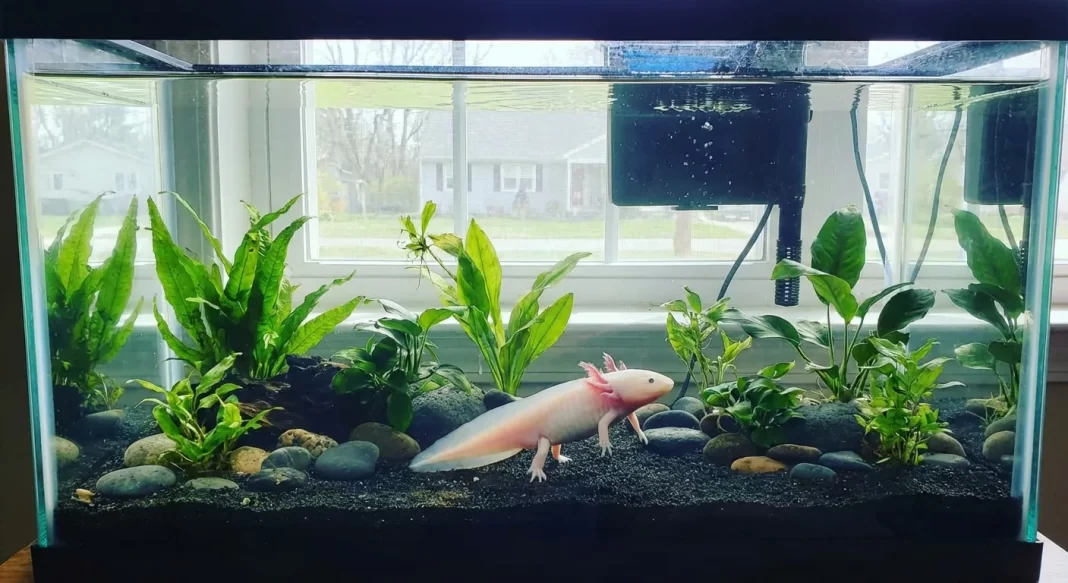
Cycling an axolotl tank grows the bacterial colony that converts the animal’s toxic ammonia waste into nitrate before the axolotl ever enters the water. The fishless method takes four to ten weeks. Axolotls live in clean tubs with daily water changes during the wait. Cycling-in is never acceptable because external gills burn too fast.
What is the nitrogen cycle in an axolotl tank?
The nitrogen cycle is the biological process where naturally occurring bacteria convert ammonia into nitrite and then into nitrate inside an aquarium. In a cycled tank, this conversion happens continuously and keeps ammonia and nitrite at zero parts per million.
Axolotls produce ammonia as their main waste product. It comes out through the gills and, to a lesser extent, through urine. Uneaten food and dead plant material also break down into ammonia. In a tank without established bacterial colonies, this ammonia has nowhere to go. It builds up in the water and poisons the animal. Axolotls are fully aquatic (source: PetMD (reviewed by Sean Perry, DVM)). They have external feathery gills (source: San Diego Zoo), large surface areas of thin tissue that sit in direct contact with the water column. That anatomy makes axolotls especially vulnerable to dissolved waste.
The cycle operates in two stages, each powered by a different group of bacteria.
Stage 1: Ammonia to nitrite
Bacteria in the genus Nitrosomonas colonize filter media, sponge surfaces, and tank walls. They oxidize ammonia (NH3 / NH4+) into nitrite (NO2-). This reaction uses oxygen and produces hydrogen ions as a byproduct, which gradually lowers pH over time. During cycling, you will see ammonia levels decline as this colony establishes, followed by a rise in nitrite readings. Ethical Axolotls’ cycling guide describes the first-stage organism as Nitrosomona and the second-stage as Nitrobacter in keeper-community shorthand (source: Ethical Axolotls cycling guide).
Stage 2: Nitrite to nitrate
A second group of bacteria converts nitrite into nitrate (NO3-). Modern freshwater research points to Nitrospira as the main nitrite oxidizer in most aquarium settings. Older literature commonly attributes this role to Nitrobacter. The two names are often used interchangeably in hobby sources. Nitrate is far less toxic than ammonia or nitrite. It is removed through regular water changes and, to a lesser degree, by live plants that take it up as a nutrient. During cycling, nitrite rises after ammonia begins to fall. Then nitrite itself declines as this second colony matures. Nitrate builds up steadily throughout.
Where the bacteria live
Nitrifying bacteria are not free-floating. They colonize surfaces with high water flow and oxygen. Cool freshwater holds more dissolved oxygen than warm freshwater, and oxygen availability is one of the limiting inputs for the colony’s metabolism (source: USGS dissolved oxygen and water). The main colonization sites are filter media (sponge, ceramic rings, bio-balls). Tank walls, substrate surfaces, and porous decorations also host smaller populations. This is why filter maintenance matters so much after cycling. Replacing all filter media at once removes the bacterial colony and can crash the cycle. The filtration guide covers media care that protects the colony. The hub axolotl care guide covers the broader husbandry context. The water parameters guide covers per-parameter targets, including the cycle-readiness criteria (0 ppm ammonia, 0 ppm nitrite, under 40 ppm nitrate).
Why must you cycle the tank before adding an axolotl?
Placing an axolotl in an uncycled tank exposes it to rising ammonia and nitrite with no bacterial population to process the waste. This is called new tank syndrome. It is one of the most common causes of axolotl illness and death among new keepers. In an uncycled tank, ammonia can reach 0.5 to 1 ppm within 24 to 48 hours in a moderately sized tank, and ammonia at any concentration above zero damages gill tissue.
The axolotl begins producing ammonia immediately after entering the tank. Within hours, the concentration starts rising. Axolotl.org’s health page notes that ammonia or nitrite buildup from inadequate biological filtration can be fatal in a matter of days if left unchecked (source: Axolotl.org health). Ammonia is a strong cell poison that damages gill epithelium on contact. Concentrations of 1 ppm or higher can kill an axolotl within days.
Axolotls are more vulnerable to ammonia than most aquarium fish because of their permeable skin and exposed external gills. The gill filaments have an enormous surface area of thin tissue in constant, direct contact with the water. Ammonia burns present as reddened, curled, or eroded gill filaments. Even if the axolotl survives the initial exposure, the immune suppression from ammonia damage opens the door to secondary fungal and bacterial infections that can be fatal weeks later. The ammonia burn guide covers identification and treatment of ammonia-related gill damage in clinical depth.
New tank syndrome follows a predictable and dangerous pattern. Ammonia rises first. The keeper performs emergency water changes to bring it down. Then nitrite spikes as the first bacterial colony partially establishes but the second colony has not yet formed. The axolotl endures weeks of fluctuating toxic exposure instead of entering a stable, fully cycled environment. Fishless cycling eliminates this entirely by completing the bacterial colonization process before the animal is ever at risk. Axolotl.org’s captive requirements page reinforces the underlying mandate by instructing keepers to treat tap water for chlorine and chloramines every time water is changed, including the water that establishes the cycle (source: Axolotl.org captive requirements). The cloudy water fix guide covers the bacterial-bloom diagnostic that often accompanies cycle disruption.
What equipment and supplies do you need?
Fishless cycling needs a tank and filter fully assembled and running. You also need a dechlorinator that removes chlorine and chloramine, a pure-ammonia source (Dr Tim’s Ammonium Chloride or Fritz Fishless Fuel), and a liquid drop test kit for ammonia, nitrite, nitrate, and pH. A thermometer and a notebook complete the setup. Household cleaning ammonia is unsafe because surfactants kill the bacteria.
Before starting a fishless cycle, the tank and filter must be fully assembled and running. Cycling needs water flow, oxygen, and surfaces for bacterial colonization. The tank setup guide covers the one-time setup steps that precede cycling.
| Item | Purpose | Notes |
|---|---|---|
| Tank (29-gallon minimum, 40-gallon preferred) | Provides water volume and surface area | AxolotlCentral lists 29-gallon minimum for one adult; larger tanks cycle more stably (source: AxolotlCentral care guide) |
| Filter (sponge, hang-on-back, or canister) | Provides primary bacterial colonization surface | Must run 24/7 during cycling and afterward |
| Dechlorinator | Removes chlorine and chloramine from tap water | Seachem Prime removes chlorine and chloramine and detoxifies ammonia (source: Seachem Prime) |
| Pure ammonia source | Feeds the bacterial colony during cycling | Dr Tim’s Ammonium Chloride or Fritz Fishless Fuel |
| Liquid test kit | Measures ammonia, nitrite, nitrate, and pH | API Freshwater Master Test Kit (strip tests are not accurate enough for cycling) |
| Thermometer | Monitors water temperature | Digital or glass; accuracy matters more than format |
| Notebook or log sheet | Tracks daily test results | Essential for spotting trends |
Choosing an ammonia source
Use reagent-grade ammonium chloride designed for aquarium cycling. Dr Tim’s Ammonium Chloride and Fritz Zyme Fishless Fuel are the two most widely available options and produce predictable, measurable results. Dr Tim’s Aquatics specifies a target initial concentration of 2 to 3 mg/L (ppm). About 4 drops of solution per gallon yields 2 ppm (source: Dr Tim’s Aquatics fishless cycling). Do not use household cleaning ammonia. Many cleaning products contain surfactants, fragrances, or other additives that are toxic to aquatic life and can kill the bacteria you are trying to grow. If you shake a bottle of ammonia and it foams, it contains surfactants and must not be used.
Some guides suggest using raw shrimp or fish food as an ammonia source. These do produce ammonia as they decompose, but the dosing is unpredictable, the water becomes cloudy and foul-smelling, and the decomposition process produces other compounds that complicate water chemistry. Pure ammonium chloride gives you control over the exact concentration in the tank. The dechlorinator guide covers the chlorine and chloramine product-selection details that apply to every step of cycling.
How do you fishless cycle an axolotl tank step by step?
The fishless cycle is a repeating process of dosing ammonia, testing water parameters daily, and waiting for bacterial colonies to establish. Ethical Axolotls’ cycling guide places the full process at 4 to 10 weeks (per Ethical Axolotls cycling guide). The seven steps follow a predictable sequence.
Step 1: Set up the tank and dechlorinate the water
Assemble the tank, filter, and any decorations or hides. Fill with tap water treated with a dechlorinator that removes both chlorine and chloramine. Both chemicals kill nitrifying bacteria on contact and will prevent the cycle from starting. Run the filter for 24 hours to circulate and stabilize the water. Test baseline pH, ammonia, nitrite, and nitrate before dosing ammonia. Some tap water already contains low levels of ammonia or nitrate, and you need to know your starting point.
Step 2: Dose ammonia to 2 ppm
Add ammonium chloride to bring the tank’s ammonia concentration to 2 ppm. AxolotlCentral’s cycling guide notes that 1 drop of Dr Tim’s Ammonium Chloride per gallon yields 1 ppm ammonia. So 2 drops per gallon yields 2 ppm (source: AxolotlCentral cycling guide). Wait one hour after dosing, then test ammonia with your liquid kit to confirm you reached the target. If the reading is too low, add more. If too high (above 4 ppm), perform a partial water change to bring it down. Ammonia concentrations above 5 ppm can inhibit bacterial growth rather than accelerate it.
Step 3: Test daily and wait for ammonia to decline
Starting the day after your initial dose, test ammonia, nitrite, and pH every 24 hours. Record every result. For the first 1 to 2 weeks, ammonia will sit at or near your initial dosing level. This is normal. The ammonia-oxidizing bacteria are colonizing the filter media, but their population is too small to process the ammonia faster than you can measure the decline.
You will eventually see ammonia begin to drop. This is the first sign that Nitrosomonas have established in meaningful numbers. Around the same time, nitrite will start to appear on your test kit. This is expected and confirms the first stage of the cycle is working.
Step 4: Re-dose ammonia when it drops below 1 ppm
Whenever your ammonia test reads below 1 ppm, add enough ammonium chloride to bring it back up to 1 to 2 ppm (per AxolotlCentral cycling guide). The bacterial colony needs a continuous food source to grow. If you let ammonia drop to zero and leave it there for days, the colony will shrink. Consistent re-dosing keeps the colony expanding.
Rescue-network keepers who troubleshoot cycling stalls consistently report that the most common mistake at the re-dose stage is impatience. Keepers see ammonia sitting at the same level for 10 to 14 days and assume something is wrong. In most cases, the bacteria are colonizing but their population is too small to process the ammonia faster than the test kit’s detection threshold can register. Patience and consistent re-dosing are the correct response to a slow start.
Step 5: Watch for nitrite to spike and then decline
As the Nitrosomonas colony grows and processes ammonia faster, nitrite production rises. Nitrite often spikes to very high levels during cycling, sometimes reaching 5 ppm or higher on a liquid test kit. This is the most challenging phase because high nitrite can actually slow the growth of the second-stage bacterial colony, creating a feedback loop that extends the cycle.
If nitrite exceeds 5 ppm, reduce your ammonia dose to 1 ppm instead of 2 ppm. This slows nitrite production while still feeding the ammonia-oxidizing colony. High nitrite is one of the most common causes of extended cycling times. The second stage of the cycle is complete when the nitrite-oxidizing colony has established in sufficient numbers to convert nitrite to nitrate as fast as it is produced. You will see nitrite gradually decline from its peak while nitrate accumulates. This phase often takes 2 to 4 weeks after nitrite first appeared.
Step 6: Run the completion test
The cycle is complete when the tank can process 2 ppm of ammonia into 0 ppm ammonia and 0 ppm nitrite within 24 hours (per AxolotlCentral cycling guide). To confirm: dose ammonia to 2 ppm, wait exactly 24 hours, test ammonia and nitrite and nitrate. Ammonia must read 0 ppm. Nitrite must read 0 ppm. Nitrate should read above 5 ppm (which confirms bacterial activity produced it through the full two-stage conversion).
If ammonia or nitrite is still detectable after 24 hours, the cycle is not complete. Continue daily dosing and testing. Run the completion test again in 3 to 5 days.
Step 7: Final water change and add the axolotl
Perform a large water change (50 to 80 percent) with dechlorinated, temperature-matched water before adding the axolotl. This removes the nitrate that built up during cycling, giving the axolotl a clean starting point. Do not re-dose ammonia after this water change. The axolotl’s own waste will now feed the bacterial colony. Continue testing ammonia, nitrite, and nitrate every 2 to 3 days for the first month. The biological load from a living animal differs slightly from pure ammonia dosing, and you need to confirm the colony adjusts.
What does the daily testing schedule look like?
Test ammonia, nitrite, pH, and (once nitrite appears) nitrate every 24 hours from day one through cycle completion. The four phases (initial-plateau, nitrite-spike, nitrite-decline, completion-test) follow a predictable order. Track every result in a notebook. Strip tests are not accurate enough for cycling. Liquid drop kits like the API Freshwater Master Test Kit are the standard.
Consistent testing is the only way to know where your cycle stands. The phase-mapped schedule below helps diagnose where the cycle currently sits.
| Cycle phase | Approximate duration | Test frequency | What to test |
|---|---|---|---|
| Initial dosing | Days 1-14 | Every 24 hours | Ammonia, nitrite, pH |
| Ammonia decline begins | Days 14-28 | Every 24 hours | Ammonia, nitrite, nitrate |
| Nitrite spike | Days 21-42 | Every 24 hours | Ammonia, nitrite, nitrate |
| Nitrite decline | Days 28-56 | Every 24 hours | Ammonia, nitrite, nitrate |
| Completion test | Day varies (around week 4-10) | Test at 24-hour mark after dosing | Ammonia, nitrite, nitrate |
pH monitoring during cycling
pH must stay above 6.5 throughout the cycling process. The ammonia-to-nitrite conversion produces hydrogen ions (acid) as a byproduct, which gradually lowers pH. Sustained drops below pH 6.0 stall the cycle because bacterial activity slows to a near halt. If pH drops below 6.5 during cycling, perform a 20 to 25 percent water change with dechlorinated tap water to bring it back up. The pH, GH, and KH guide covers carbonate hardness (KH) supplementation that prevents this kind of cycling-driven pH decline.
Temperature during cycling
Nitrifying bacteria grow faster in warmer water. AxolotlCentral’s cycling guide notes that a warmer water temperature may help stimulate bacteria growth (per AxolotlCentral cycling guide). Some keepers install a temporary heater during cycling to speed bacterial growth, setting it to approximately 75 to 80 degrees Fahrenheit (24 to 27 degrees Celsius). This is safe because there is no axolotl in the tank during fishless cycling.
If you use a heater during cycling, you must remove it and let the water cool to the axolotl-safe range before adding the animal. That range is 60 to 68 degrees Fahrenheit (16 to 20 degrees Celsius). Allow at least 24 hours for the temperature to stabilize at the lower range. Then run one final completion test at the cooler temperature to confirm the bacterial colony still processes ammonia adequately. Bacterial activity slows at lower temperatures, so a colony that processed 2 ppm in 12 hours at 80 degrees Fahrenheit may take a full 24 hours at 64 degrees Fahrenheit. This is normal and still indicates a healthy cycle. The temperature guide covers the cooling steps and ongoing temperature management.
When and how should you tub the axolotl during cycling?
Axolotls should not do fish-in cycling. If you already have the axolotl and the tank is not cycled, tub the animal in a clean 5-to-10-gallon plastic container with dechlorinated temperature-matched water and a hide. Change 100 percent of the water daily. The axolotl can live safely in a tubbing setup for the full cycling duration as long as daily changes are not skipped.
Tubbing is the practice of housing an axolotl in a clean container of dechlorinated water, changed daily, as a temporary measure when the main tank is unsafe. It is not a substitute for a cycled tank, but it is the standard emergency tool used by rescue organizations and experienced keeper communities.
When to tub
Tub your axolotl right away if any of these conditions apply:
- The main tank is not cycled and you already have the axolotl
- Ammonia or nitrite reads above 0 ppm in the main tank and water changes are not resolving the problem
- The cycle has crashed (often after medication use, filter failure, or full filter media replacement)
- You need to restart the cycling process from scratch
How to tub correctly
Use a plastic tub or container large enough for the axolotl to turn around comfortably. A 5-to-10-gallon storage container works for most juvenile and adult axolotls. Fill with dechlorinated water at the correct temperature (60 to 68 degrees Fahrenheit). Change 100 percent of the water daily. Dechlorinate each batch first. Keep the tub in a cool, quiet location with a lid. Axolotls can jump. Add a hide for the animal to rest under.
Tubbing works because daily full water changes prevent ammonia and nitrite from building up. The axolotl lives in clean water while the main tank finishes cycling. Tubbing is labor-intensive but effective.
Tubbing timeline
An axolotl can live safely in a tubbing setup for the entire duration of a fishless cycle (4 to 10 weeks or longer) as long as water changes are performed daily without exception. The main tank cycles independently using the fishless ammonia-dosing method described above. Once the tank passes the completion test, acclimate the axolotl gradually by floating the tub container in the tank for 15 to 20 minutes to equalize temperature, then release.
Vet-tech teams at axolotl rescues consistently document the same outcome from keepers who try to cycle the tank with the axolotl already in it. They rely on daily large water changes to control ammonia. The animals usually survive the cycling window. But many emerge with permanently curled or shortened gill filaments. The axolotl carries this damage for the rest of its life. Ammonia spikes between changes injured tissue that does not fully regrow. This is why fish-in cycling is not acceptable for axolotls, no matter how vigilant the keeper is. Keepers facing severe gill damage during a cycle crash should consult an exotic-animal veterinarian; the ARAV Find-a-Vet directory locates qualified clinicians (source: ARAV Find-a-Vet). The stress signs guide covers the broader behavioral indicators that show up during chronic toxic exposure.
How do you know the cycle is complete?
The cycle is complete when the tank can process 2 parts per million of ammonia to 0 ppm ammonia and 0 ppm nitrite within 24 hours, while nitrate is detectable (above 5 ppm). All three criteria must be met at the same time. If you cycled with a heater, re-run the completion test at the axolotl-safe temperature (60 to 68 degrees Fahrenheit) before adding the animal.
This is sometimes called the 0/0/under-40 test in keeper shorthand. Zero ammonia, zero nitrite, nitrate present but below the 40 ppm safety ceiling. The 2 ppm processed in 24 hours definition is the standard across both AxolotlCentral and Ethical Axolotls cycling references (per AxolotlCentral cycling guide; Ethical Axolotls also defines a completed cycle as 2 ppm processed in 24 hours).
Common mistakes when declaring the cycle complete
Testing too soon after a water change. A large water change dilutes ammonia and nitrite, producing artificially low readings. The completion test must follow a full ammonia dose with no water changes in between.
Confusing ammonia drop with cycle completion. Ammonia declining from 3 ppm to 0.5 ppm indicates progress but not completion. The ammonia-oxidizing colony is growing, but the cycle is not done until both ammonia and nitrite reach zero at the same time.
Ignoring nitrite. A tank can process ammonia to zero while nitrite stays elevated. This means the first bacterial colony is mature but the second is still establishing. The cycle is not complete until both reach zero.
Not running the test at axolotl-safe temperature. If you cycled with a heater, the final completion test must be done at the temperature the axolotl will actually live in (60 to 68 degrees Fahrenheit). Bacterial processing slows at lower temperatures, and you need to confirm the colony can still handle the bioload at operating temperature. The water testing guide covers the routine post-cycling testing schedule and what to do if readings fluctuate during the transition.
What does a typical fishless cycle log look like day-by-day?
A typical fishless cycle follows a predictable shape. Ammonia drops first as Nitrosomonas establish during week one. Nitrite spikes in week two as the slower second-stage bacteria catch up. Both readings return to zero with rising nitrate around weeks four to five, signalling cycle completion. The day-by-day log below is illustrative, not a prescription.
| Day | Ammonia (ppm) | Nitrite (ppm) | Nitrate (ppm) | Stage | Action |
|---|---|---|---|---|---|
| 1 | 2.0 | 0 | 0 | Initial dose | Add ammonium chloride to 2 ppm; record baseline pH and temperature |
| 4 | 2.0 | 0 | 0 | Lag phase | Test daily; unchanged readings are normal in week one |
| 7 | 1.5 | 0.25 | 5 | Nitrosomonas establishing | First nitrite appears; do not water-change |
| 10 | 0.5 | 1.0 | 10 | Ammonia processing | Redose ammonia back to 2 ppm |
| 14 | 0.25 | 3.0 | 15 | Nitrite climbing | Nitrospira slow to catch up; readings normal |
| 18 | 0.25 | 5.0 | 20 | Nitrite peak | Some setups peak above 5 ppm; still within normal range |
| 22 | 0 | 2.0 | 30 | Nitrite dropping | Cycle nearing completion |
| 26 | 0 | 0.5 | 35 | Both colonies mature | Redose ammonia to 2 ppm to begin readiness test |
| 27 | 1.0 | 0.25 | 35 | 24-hour test in progress | Wait full 24 hours before re-testing |
| 28 | 0 | 0 | 40 | Readiness test PASSED | Cycle complete; begin water-change protocol |
This timeline is a representative example, not a guarantee. Cooler tanks running at the axolotl-safe range (60 to 68 degrees Fahrenheit, 16 to 20 Celsius) cycle slower than warmer tanks because nitrifying bacteria grow faster in warmer water (per AxolotlCentral cycling guide). The underlying biology is well established: Britannica describes nitrification as a process carried out by nitrifying bacteria that transforms ammonia into nitrate (source: Britannica nitrogen cycle); the aquarium-scale version splits that conversion into the ammonia-to-nitrite and nitrite-to-nitrate stages the keeper observes in the daily log above. Some keepers run cycling at 75 to 80 Fahrenheit (24 to 27 Celsius) and cool the tank before introducing the axolotl. Larger tanks and heavier dosing also lengthen the timeline. Common variations include a longer lag phase (1 to 3 weeks before first nitrite), a higher nitrite peak (up to 5 ppm in some setups), and a slower tail to completion (4 to 6 weeks rather than the textbook 4 weeks). Ethical Axolotls’ cycling guide places the full process at 4 to 10 weeks (per Ethical Axolotls cycling guide). Test daily, log your readings, and follow the readiness criterion (2 ppm processed in 24 hours), not the calendar.
How do you preserve the cycle and recover from a crash?
Preserve the cycle by following four rules. Never rinse filter media in tap water. Never replace all media at the same time. Never run antibiotics without tubbing the axolotl during treatment. Never leave the filter off longer than about four hours. A crash shows up as ammonia or nitrite reappearing after weeks of stable readings. Recovery means tubbing the animal and rebuilding the colony.
Cycle-preservation rules
AxolotlCentral’s cycling guide specifies that when filter media gets dirty, you may rinse it in old tank water only. Both the chlorine in tap water and the sudden temperature change will kill your bacteria (per AxolotlCentral cycling guide). Tap-water rinses are the single most common cause of accidental cycle damage in otherwise well-managed tanks. Old tank water in a clean container is the only safe rinse medium.
AxolotlCentral also specifies that you should never replace all of your filter media at a given time (per AxolotlCentral cycling guide). The bacterial colony lives on the media. Removing everything at once leaves the tank effectively uncycled overnight. Replace no more than half the media at a time and leave the rest in place for 2 to 4 weeks while bacteria colonize the new media. The filtration guide covers the cartridge-replacement trap (manufacturers commonly instruct monthly cartridge replacement, which crashes cycles) in fuller depth.
Antibiotic and antifungal medications kill nitrifying bacteria along with the targeted pathogen. If you need to medicate, either move the axolotl to a tub for the treatment period or accept that the cycle will need rebuilding afterward. Prolonged filter shutdown is also dangerous because the bacteria need continuous water flow and oxygen. A few hours of shutdown is usually recoverable; overnight shutdown often kills enough of the colony to require partial recycling.
Cycle crash diagnosis
A crash shows up as ammonia or nitrite reappearing on your test kit after weeks of stable 0/0 readings. The causes are predictable. Full filter media replacement removes the colony. Tap-water rinse kills the colony with chlorine. Antibiotic medication kills the colony along with the pathogen. Prolonged filter shutdown (more than about four hours) starves the colony of oxygen. Sudden temperature spike or drop also stresses the colony.
Cycle crash recovery
If you can identify the cause, address it first. If you replaced all the media, move the axolotl to a tub immediately. Run a fresh fishless cycle on the tank. Or run a recovery cycle if you can transfer seeded media from another cycled tank. If you tap-water rinsed, tub the axolotl and run the recovery cycle. Monitor whether the partial colony recovers. If you medicated, tub during treatment and rebuild the cycle after. If you had a filter shutdown beyond 4 hours, tub the axolotl, restart the filter, and watch test results for the next 5 to 7 days.
A bottled bacteria product can speed up recovery. Dr Tim’s One and Only or Fritz TurboStart 700 contain live nitrifying bacteria and can reduce recovery time when used with proper ammonia dosing. Confirm cycle status with the 2 ppm processed in 24 hours test before returning the axolotl to the tank.
Common axolotl cycling mistakes
The five most common cycling mistakes follow recognizable patterns. Dosing ammonia above 5 ppm inhibits bacterial growth instead of speeding it. Skipping dechlorinator at any step kills the colony. Fish-in cycling damages axolotl gills permanently in many cases. Declaring the cycle complete based on a bottled-bacteria label without running the 2-ppm-in-24-hours test fails. Replacing all filter media after the cycle establishes restarts the process.
Over-dosing ammonia is the most common starter mistake. Concentrations above 5 ppm inhibit bacterial growth rather than accelerating it. If you accidentally dose above 4 ppm, perform a partial water change to bring it down before continuing.
Skipping dechlorinator at any step is the most common cycle-disrupting mistake. Chlorine and chloramine kill nitrifying bacteria on contact. Every batch of water added to the tank during cycling and afterward must be dechlorinated. The same rule applies to media rinses. Use treated tank water, not untreated tap water.
Fish-in cycling with the axolotl already in the tank is the most damaging mistake. Even with daily large water changes to control ammonia, the animal experiences ammonia spikes between changes that injure gill tissue. The injury often becomes permanent. Tub instead.
Declaring the cycle complete based on a bottled-bacteria product label rather than the 2-ppm-in-24-hours test is the most over-confident mistake. Bottled bacteria can significantly reduce cycling time, but the completion test is the only reliable signal that the colony can handle the bioload. Always run the test.
Replacing all filter media after the cycle is established is the most common post-cycling crash trigger. The colony lives on the media. Half-at-a-time replacement with a 2-to-4-week wait between replacements is the safe protocol. The care SOP covers the routine maintenance schedule that prevents this kind of accidental crash.
Frequently asked questions
Can you use bottled bacteria to skip the cycling process?
Bottled bacteria products like Fritz TurboStart 700 or Dr Tim’s One and Only contain live nitrifying bacteria. They can significantly reduce cycling time. Results vary by product freshness, storage temperature, and tank conditions. Bacteria are living organisms that die in extreme heat or cold. Do not consider the cycle complete based on using a bottled product alone. Always run the 2-ppm-in-24-hours completion test to confirm the colony is established and self-sustaining. The bottled product is a head-start tool, not a replacement for the test.
What ammonia concentration should you dose to?
Target 1 to 2 ppm for the initial dose and all re-doses in axolotl-keeping practice. AxolotlCentral specifies 1-2 ppm; Dr Tim’s protocol pushes 2-3 ppm. The conservative 1-2 ppm starter range is the dominant axolotl-keeper community choice because it provides enough food for bacterial growth without inhibiting it. Concentrations above 5 ppm slow bacterial colonization rather than speeding it. If you accidentally over-dose, perform a water change to bring ammonia back below 4 ppm before continuing.
Why is the cycle taking longer than 8 weeks?
Extended cycling times usually come from one of four factors: cycling at cool axolotl-safe temperatures (60-68 degrees Fahrenheit slows bacterial reproduction), pH below 6.5 (stalls bacterial activity), over-dosing ammonia above 5 ppm (inhibits bacteria), or chlorine in the water (kills bacteria). Check all four. Cool temperature is the most common culprit. If you are cycling at 64 degrees Fahrenheit without a temporary heater, 8 to 12 weeks is a realistic timeline. Verify your dechlorinator dose and confirm pH is above 6.5 before assuming a deeper problem.
Do you need a substrate during cycling?
No. You can cycle a bare-bottom tank without issue. The bacteria colonize filter media, not substrate. However, if you plan to use a substrate with the axolotl, adding it before cycling lets you confirm it does not leach harmful chemicals or shift pH outside the safe range. Sand and bare-bottom are the two safe substrate choices for adult axolotls; the substrate guide covers the choice in detail. Adding substrate during cycling has no downside.
Can you cycle a tank with the filter off at night?
No. The filter must run 24 hours a day, 7 days a week during cycling and at all times afterward. Nitrifying bacteria need continuous water flow and oxygen. Turning the filter off for even a few hours lets oxygen levels in the media drop, which can kill portions of the colony. A single overnight shutdown can set the cycle back by days or weeks. The same rule applies to power outages. If a long outage seems likely, run a battery-powered air pump to maintain water movement and oxygen.
Related guides
- Axolotl care guide: complete husbandry hub for new keepers
- Axolotl ammonia burn guide: acute clinical injury protocol when ammonia spikes on the animal
- Axolotl cloudy water fix: diagnostic for bacterial bloom when biofilter is disrupted
- Axolotl dechlorinator guide: chloramine biology and product selection
- Axolotl filtration guide: filter selection, sizing, and bacterial-colony preservation
- Axolotl pH, GH, and KH guide: water-chemistry parameter targets and safe adjustment
By the ExoPetGuides editorial team (AI-assisted drafting; human-reviewed), reviewed by an exotic-animal veterinarian
Updated 2026-05-18
Primary sources: AxolotlCentral cycling guide and care guide, Ethical Axolotls cycling guide, Dr Tim’s Aquatics fishless cycling protocol, Axolotl.org captive requirements and health page, Seachem Prime product page, PetMD axolotl reference reviewed by Sean Perry DVM, San Diego Zoo Animals and Plants, Britannica, Animal Diversity Web, ARAV Find a Vet directory
Disclaimer: This content is for educational purposes only and is not a substitute for professional veterinary advice. Always consult a qualified veterinarian, ideally an exotic-animal specialist, for any health concern about your pet. Care recommendations may vary based on species, individual animal, and local regulations.