


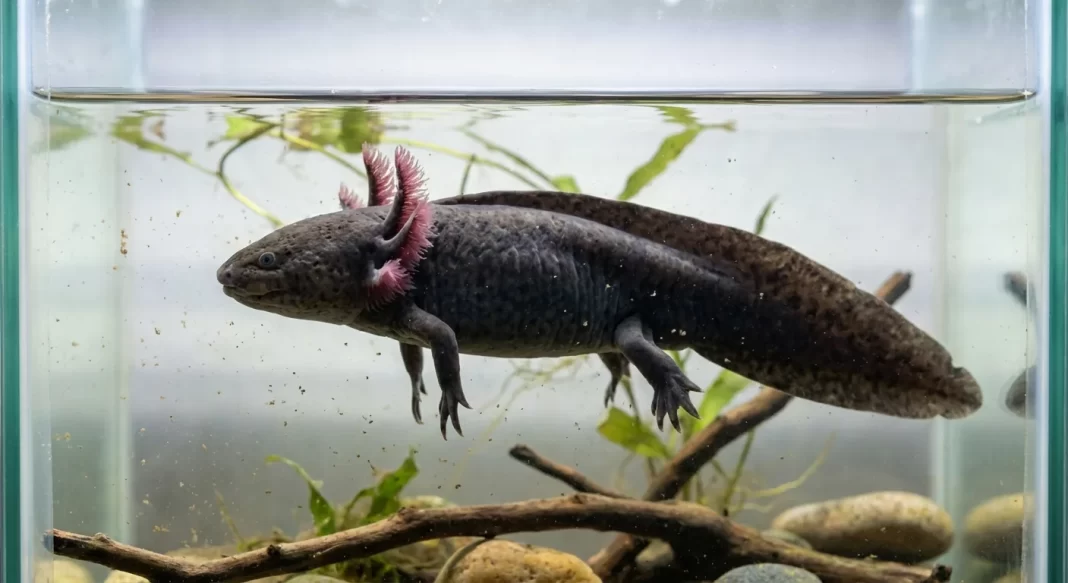
Axolotls need pH between 6.5 and 8.0, GH between 7 and 14 degrees (general hardness), and KH between 3 and 7 degrees (carbonate hardness). Stable readings matter more than chasing ideal numbers. Low KH causes pH crashes. Low GH starves the slime coat. Crushed coral or commercial buffers raise both safely.
What pH do axolotls need?
Axolotls tolerate a pH between 6.5 and 8.0. The ideal target is 7.4 to 7.6. A tank that holds steady at 7.8 is healthier than one that fluctuates between 7.0 and 7.6 across the week. Stability matters more than the exact number within the safe band. Higher pH increases ammonia toxicity at any given ammonia reading.
pH measures the concentration of hydrogen ions in water on a scale from 0 (most acidic) to 14 (most alkaline), with 7.0 as neutral. The scale is logarithmic. Each whole-number change represents a tenfold difference in hydrogen ion concentration. A drop from 7.0 to 6.0 means the water is ten times more acidic. This matters for axolotls because their feathery external gills (source: San Diego Zoo) and permeable skin sit in constant contact with the surrounding water, an established amphibian-physiology feature documented across exotic-vet references. Small numerical shifts create large chemical changes at the tissue level.
Axolotl.org’s captive requirements page specifies a pH range of 6.5 to 8.0 with an ideal target of 7.4 to 7.6 (source: Axolotl.org captive requirements). AxolotlCentral’s care guide gives a slightly broader operational band of 7.2 to 8.4, reflecting that healthy adult axolotls hold up well at the higher end of the safe range as long as ammonia stays at zero (source: AxolotlCentral care guide). Most municipal tap water falls between pH 7.0 and 8.0, which is already within the acceptable range. The hub axolotl care guide covers the broader husbandry context, and the water parameters guide covers per-parameter targets including ammonia and nitrite alongside pH.
Why pH stability matters more than the exact number
The single most important concept in axolotl water chemistry is that stable parameters are safer than ideal parameters achieved through constant adjustment. A tank that sits at pH 7.8 every week, with no swings, is a healthier environment than a tank where a keeper uses chemical additives to push pH down to 7.4 and then watches it climb back to 7.8 between doses.
pH instability causes three simultaneous problems. First, the axolotl’s gill tissue and skin must constantly readjust to changing hydrogen ion concentrations, which stresses the mucus membrane. Second, the helpful bacteria that power the nitrogen cycle function most efficiently between pH 7.0 and 8.0 and slow down below pH 6.5. Sustained drops below 6.0 can stall the cycle entirely. Third, pH swings that push the water more alkaline temporarily raise ammonia toxicity during the upswing, then drop it during the downswing, creating an unpredictable toxic load.
Keepers who work with axolotl rescue groups consistently report that their longest-lived animals are in tanks where water chemistry barely changes from week to week. The keepers who chase a perfect pH by adding chemicals after every test are the ones who end up dealing with cycle crashes and stress symptoms. The stress signs guide covers the broader behavioral indicators of an axolotl in chemistry-related distress.
How pH interacts with ammonia toxicity
Ammonia exists in water in two forms. Toxic unionized ammonia (NH3) and the less toxic ammonium ion (NH4+). The fraction that exists as toxic NH3 rises with higher pH and higher water temperature. At pH 7.0, only a small fraction of total ammonia nitrogen exists as toxic NH3. At pH 8.0, that fraction is roughly ten times higher. This means a tank with even a small ammonia reading is more dangerous at pH 8.0 than at pH 7.0.
This relationship creates a practical trade-off. Keepers whose tap water runs at pH 7.8 or 8.0 need to be especially careful about keeping ammonia at zero, because any ammonia present is more toxic than it would be at lower pH. But that is not a reason to lower the pH artificially. A stable pH of 7.8 with zero ammonia is far safer than a pH that bounces between 7.0 and 7.8 while you fight with chemical additives. The correct response to higher pH is tighter ammonia control. The ammonia burn guide covers the acute clinical injury when this control fails, and the cloudy water fix guide covers the bacterial bloom diagnostic when the biofilter is disrupted.
What GH do axolotls need?
General hardness (GH) should be 7 to 14 degrees (dGH), with an ideal target of 8 to 12 dGH. GH below 4 dGH is an emergency threshold. GH measures dissolved calcium and magnesium. Calcium supports the slime coat, gill tissue, and skeletal structure. Soft water thins the protective slime layer over weeks. Hard water above 14 dGH is tolerated well.
GH measures the concentration of dissolved calcium and magnesium ions in the water, expressed in degrees where 1 dGH equals 17.8 mg/L of calcium carbonate equivalent. AxolotlCentral’s care guide states the ideal GH for axolotls is 7 to 14 dGH (125.3 to 250.6 ppm), which places the species in the moderately hard to hard range (per AxolotlCentral care guide). Ethical Axolotls’ parameters page is more conservative, stating that GH must not be allowed to fall below 6 dGH and should remain above 8 dGH (source: Ethical Axolotls parameters). The U.S. Geological Survey classifies fresh water above 121 mg/L of dissolved calcium carbonate equivalent as hard, which corresponds to about 7 dGH and aligns with the lower end of the axolotl ideal range (source: USGS hardness of water). These are not decorative numbers on a test strip. Calcium and magnesium are biologically active minerals that axolotls take in through their permeable skin and gill tissue.
Why calcium and magnesium matter for axolotl health
Calcium plays a direct role in three systems. The skeletal structure (axolotls are vertebrates with a cartilaginous skeleton that relies on calcium for rigidity), the mucus membrane that protects skin and gill tissue, and neuromuscular function (calcium ions are required for nerve signaling and muscle contraction). Magnesium supports enzymatic processes, energy metabolism, and works alongside calcium in maintaining cell membrane stability.
Axolotl.org’s captive requirements page notes that axolotls prefer somewhat hard water and that animals kept in soft water often suffer from temporary anaemia (per Axolotl.org captive requirements). The same page describes the species as adapted to mineral-content water, which is consistent with the moderately hard 7 to 14 dGH band. Persistent soft-water conditions reduce slime coat integrity over time and make the axolotl more vulnerable to fungal infection and ammonia-related gill damage.
What happens when GH is too low
When GH drops below 4 dGH, the water lacks the dissolved minerals the axolotl needs for normal physiological function. The effects are gradual rather than acute. The slime coat thins because there is not enough calcium to maintain the mucopolysaccharide matrix that forms the protective layer over skin and gills. Gill filaments become more fragile and more susceptible to damage from minor irritants. Particulate matter and mild ammonia exposure that a healthy slime coat would buffer can now cause visible erosion. Osmotic stress also increases because the mineral gradient between the axolotl’s body fluids and the surrounding water widens. The animal’s cells work harder to keep electrolyte balance.
Long-term skeletal development may be affected in juveniles. Calcium-deficient water during growth phases can result in skeletal abnormalities, though this is hard to diagnose in practice because the effects are slow and cumulative. The PetMD axolotl reference, reviewed by Sean Perry, DVM, notes that axolotls are fully aquatic and rely on their water environment for nearly every physiological function (source: PetMD (reviewed by Sean Perry, DVM)). That dependence makes water-mineral content a continuous health input, not an occasional one.
From working with axolotl keepers in regions with naturally soft water, the most common symptom that leads keepers to test GH is persistent gill pallor that does not respond to water changes alone. Once GH is raised to the 8 to 12 dGH range through remineralization, gill color and filament fullness typically improve within two to three weeks.
What happens when GH is too high
GH above 14 dGH is less problematic than low GH. Axolotls tolerate hard water better than soft water. Some municipal water supplies deliver GH readings of 16 to 20 dGH with no observable ill effects. Very hard water above 20 dGH can leave mineral deposits on equipment and may interact with medications in ways that reduce their effectiveness. The native habitat at Lake Xochimilco near Mexico City sits at approximately 2,274 meters elevation (source: Animal Diversity Web), which is consistent with the species’ tolerance for hard water rather than soft. Britannica places Lake Xochimilco within Mexico City as the species’ surviving habitat (source: Britannica).
What KH do axolotls need?
Carbonate hardness (KH) should be 3 to 7 degrees (dKH), with an ideal target of 4 to 6 dKH. KH below 2 dKH is an emergency threshold. KH measures the water’s buffering capacity. A tank with adequate KH absorbs the acid byproduct of the nitrogen cycle and holds pH stable. A tank with low KH can experience a sudden pH crash when the buffer runs out.
KH measures the concentration of carbonate and bicarbonate ions in the water. Unlike GH, which directly supplies minerals the axolotl needs, KH matters primarily because it buffers pH. AxolotlCentral’s care guide lists the ideal KH for axolotls at 3 to 7 dKH (53.7 to 125.3 ppm) (per AxolotlCentral care guide). Most experienced axolotl keepers narrow that to a 4 to 6 dKH target.
How KH prevents pH crashes
The nitrogen cycle produces acid as a byproduct. When the helpful bacteria convert ammonia to nitrite and nitrite to nitrate, hydrogen ions are released into the water. In a tank with adequate KH, these hydrogen ions are absorbed by the carbonate buffer system, neutralized, and pH stays stable.
In a tank with KH below 3 dKH, the buffer runs thin. The hydrogen ions produced by the nitrogen cycle gradually consume the available carbonates. When the buffer is exhausted, there is nothing left to absorb the acid. pH then drops suddenly. This is a pH crash. A rapid fall in pH, sometimes by a full point or more within hours, that happens without warning once the buffer is gone.
A pH crash triggers a cascade. The sudden acidity stresses the axolotl’s gill tissue and skin. The nitrogen-cycle bacteria slow or stall because they work poorly below pH 6.5. If the cycle stalls, ammonia begins building up. The axolotl is now facing acid stress and rising ammonia at the same time. If the situation is not caught quickly, it can escalate into a veterinary emergency. The ARAV Find-a-Vet directory locates exotic-animal clinicians qualified to assess amphibian acid-and-ammonia injury (source: ARAV Find-a-Vet).
Vet-tech teams at axolotl rescues note that pH crashes are one of the most common causes of sudden, unexplained axolotl distress in tanks that were previously stable. The tank looked stable because the keeper was only testing pH (which reads normal as long as the buffer holds) and not testing KH (which was declining silently). The tank cycling guide covers the full nitrogen-cycle protocol and the maintenance rules that protect the bacterial colony from a parallel crash.
What happens when KH is too high
KH above 7 dKH is generally not harmful. Higher KH provides a stronger pH buffer, which is protective. The main practical concern is that very high KH (above 12 dKH) tends to push pH upward and hold it there. That increases ammonia toxicity at any given ammonia reading. If your tap water has KH above 10 dKH and your pH consistently reads above 7.8, focus on keeping ammonia at absolute zero rather than trying to lower KH.
How do you raise GH safely?
Raise GH by adding crushed coral or limestone to the filter (slow and self-regulating), dosing Seachem Equilibrium to replacement water (precise control), or placing cuttlebone in the tank (gentle calcium release). Crushed coral also raises KH at the same time, which is helpful in most soft-water situations. Raise no more than 2 dGH per day to avoid shocking the axolotl.
Crushed coral or limestone in the filter
Place a mesh bag of crushed coral or natural limestone chips in the filter compartment or in a media bag in the tank. The material dissolves slowly, releasing calcium and magnesium ions. This method is self-regulating because dissolution slows as mineral content rises. Start with about one tablespoon per 10 gallons, test GH weekly, and adjust the quantity. Crushed coral also raises KH at the same time, which is a benefit in most soft-water situations because low GH and low KH usually appear together. The filtration guide covers media-bag placement options that fit inside common filter types.
Seachem Equilibrium for precise GH control
Seachem Equilibrium is a commercial remineralizer designed to add calcium, magnesium, potassium, and iron in controlled doses. The manufacturer’s dosing rate is 16 grams (about 1 tablespoon) per 80 liters (20 US gallons) of water, which raises general hardness by approximately 1 meq/L or 3 dGH (source: Seachem Equilibrium). The product is well suited for reverse osmosis or deionized water, which carries no minerals and must be remineralized before it enters the tank. Follow the manufacturer’s dosing instructions, add to replacement water before adding it to the tank (never dose directly into the tank), and test GH after each water change until you establish a consistent routine.
Cuttlebone for gentle calcium release
A piece of cuttlebone placed in the tank dissolves slowly and releases calcium carbonate. It raises both GH and KH. The dissolution rate is slow, making it a gentle option for tanks that need only a modest increase. Cuttlebone is the same product sold for pet birds and is widely available. Replace the piece when it stops contributing to GH readings (usually 4 to 6 months).
All three methods should be introduced gradually. Raise GH by no more than 2 dGH per day. Larger jumps stress the axolotl by shifting the osmotic gradient too fast.
How to lower GH
Lowering GH is rarely necessary because axolotls tolerate hard water well. If GH exceeds 20 dGH and you want to bring it down, the safest method is diluting tank water with reverse osmosis (RO) or distilled water during water changes. Mix RO water with your tap water in a bucket before adding it to the tank, and test GH after mixing to confirm the blend hits the target range. Never add pure RO or distilled water directly to the tank because it carries zero mineral content and can cause osmotic stress.
How do you raise KH safely?
Raise KH with crushed coral in the filter (long-term solution that also raises GH), Seachem Alkaline Buffer dosed to replacement water (controlled commercial option), or baking soda for emergencies when KH drops below 2 dKH. Use no more than 1 teaspoon of baking soda per 5 gallons in a 24-hour period. Never use commercial pH-down or KH-down products.
Crushed coral in the filter
Crushed coral is the most commonly recommended long-term solution in the axolotl keeping community because it addresses KH and GH at the same time, dissolves slowly, and is self-regulating. Place 1 to 2 tablespoons per 10 gallons in a mesh bag in the filter. Test KH weekly and adjust the amount. As KH rises toward the target, dissolution slows naturally. This is the same setup described in the GH section because crushed coral is dual-action.
Seachem Alkaline Buffer for controlled KH
Seachem Alkaline Buffer is a non-phosphate buffer designed to raise pH and alkalinity (KH). The manufacturer’s dosing rate is 1 teaspoon (6 grams) per 80 liters (20 US gallons) daily until the desired pH is reached, and the product buffers between pH 7.2 and 8.5 (source: Seachem Alkaline Buffer). Follow the product instructions and add to replacement water before adding it to the tank. This is the controlled commercial option for keepers who want precision without waiting for crushed coral to dissolve.
Baking soda for KH emergencies
For emergency KH correction when KH has dropped below 2 dKH, dissolve 1 teaspoon of pure baking soda (sodium bicarbonate) per 5 gallons in a separate container of tank water, then add the solution to the tank slowly. This raises KH quickly but does not raise GH (it adds bicarbonate but no calcium or magnesium). Test KH and pH 2 hours after dosing. Do not add more than 1 teaspoon per 5 gallons in a single 24-hour period. Baking soda is a temporary fix. If your source water is consistently low in KH, install crushed coral for long-term stability.
How to lower KH
Lowering KH is rarely necessary and is generally inadvisable for axolotl tanks because higher KH provides more pH stability, which is the goal. If KH exceeds 12 dKH and you have a specific reason to lower it (such as very high pH above 8.0 combined with borderline ammonia readings), dilute with RO water during water changes. Do not use commercial pH-down or KH-down products. These introduce acids that consume the buffer temporarily and create rebound instability.
Can Indian almond leaves lower pH for axolotls?
Indian almond leaves (Terminalia catappa) release tannins that gradually lower pH and add antifungal properties to the water. They are sometimes recommended in aquarium forums as a natural pH-lowering method. In an axolotl tank, they can be used cautiously, but they are rarely necessary.
If your tap water produces a stable pH above 7.8 and you want to bring it down slightly, one or two Indian almond leaves in a 40-gallon tank will release tannins that lower pH by 0.1 to 0.3 over several days. The effect is gentle and self-limiting because the leaves stop releasing tannins as they decompose. The tannins also have mild antifungal properties, which can help axolotls recovering from minor skin or gill irritation.
The practical concerns with Indian almond leaves are three. They tint the water brown, which some keepers find cosmetically undesirable. They decompose and add organic load that the filter must process. And they can lower pH below the safe range in tanks with low KH. If your KH is below 4 dKH, do not add Indian almond leaves without first raising KH, because the tannin acids will further deplete your already thin buffer.
Indian almond leaves are a tool for specific situations, not a routine addition. If your pH is stable between 6.5 and 8.0, you do not need them.
How often should you test pH, GH, and KH?
Test pH, GH, and KH weekly in the first three months after cycling. Test monthly in established tanks with stable readings. Retest within 24 to 48 hours of any change to substrate, decorations, filter media, or source water. Use a liquid drop test kit (API GH and KH Test Kit, API pH Test Kit) for accuracy. Strip tests are screening tools only.
New tanks (first 3 months after cycling)
Test pH weekly. Test KH weekly. Test GH at setup, after any addition of crushed coral or remineralizer, and at least every two weeks. New tanks are still establishing chemical equilibrium, and KH can decline faster than expected as the nitrogen cycle consumes buffer. Catching KH decline early prevents pH crashes.
Established tanks (3+ months with stable readings)
Test pH monthly. Test KH monthly. Test GH monthly or quarterly if your source water is consistent. If all three readings have been stable for three months in a row and you have not changed anything in the tank (substrate, filter media, decorations), you can extend testing to every 6 to 8 weeks. But resume weekly testing after any change.
After any change to the tank
Adding crushed coral, changing the substrate, adding driftwood (which releases tannins and acids), performing a water change larger than 50 percent with soft source water, or dosing any chemical (including dechlorinator in unusual amounts) all warrant testing pH, GH, and KH within 24 to 48 hours. The water testing guide covers test kit selection and result interpretation across parameters.
What test kits to use
Liquid drop test kits (API GH and KH Test Kit, API pH Test Kit) are more accurate than strip tests for these parameters. GH and KH strips give approximate readings, but the titration-based liquid kits provide dGH and dKH values precise enough to track trends over time. pH strips are adequate for routine monitoring if you cross-check with a liquid kit periodically. Axolotl.org instructs keepers to treat tap water for chlorine and chloramines before every water change (per Axolotl.org captive requirements), and the Ethical Axolotls parameters page recommends Seachem Prime or Aqueon as the dechlorinator of choice (per Ethical Axolotls parameters), so any test of source water should be done after dechlorination if you want to mirror what the tank actually sees.
Common pH, GH, and KH mistakes
The four most common axolotl water-chemistry mistakes share a pattern. Using pH-adjusting chemicals creates instability worse than the original problem. Making rapid changes exceeds axolotl acclimation. Chasing ideal numbers at the expense of stability stresses the animal. Ignoring KH while monitoring only pH allows silent buffer depletion that ends in a sudden crash.
Do not use pH-adjusting chemicals
Commercial pH-up and pH-down products are the single most common cause of preventable water-chemistry problems in axolotl tanks. These products work by adding acids or bases to shift pH directly. The shift is temporary because the product does not change the underlying buffering system. Within hours or days, pH drifts back toward its natural equilibrium, and the keeper doses again. This creates exactly the kind of pH instability that damages gill tissue and disrupts the nitrogen cycle.
pH-down products are particularly dangerous because they consume KH as they lower pH. Each dose depletes the carbonate buffer, making the tank more vulnerable to a pH crash later. A keeper who uses pH-down to bring pH from 7.8 to 7.2 has not fixed a pH problem. They have created a KH problem that will eventually cause a worse pH problem.
Do not make rapid changes
Any water-chemistry change that happens faster than the axolotl can acclimate to causes stress. The general safety threshold for pH changes is no more than 0.5 units per day. The same principle applies to GH and KH. When adjusting any parameter, work slowly. Add crushed coral and wait a week before testing. Add remineralizer to replacement water at half the recommended dose and increase gradually. Never dump adjustment chemicals directly into the tank. The temperature guide covers the parallel acclimation rules for temperature changes, which follow the same gradual-shift principle.
Do not chase numbers at the expense of stability
If your tap water produces a stable pH of 7.8, GH of 10 dGH, and KH of 6 dKH, your water is within range and does not need adjustment. The fact that 7.4 to 7.6 is the ideal pH does not mean you should spend money and effort trying to push 7.8 down to 7.5. The difference between 7.5 and 7.8 is trivial compared to the difference between stable and unstable.
Do not ignore KH while monitoring pH
Testing pH without testing KH gives an incomplete picture. pH can read 7.4 for weeks while KH silently declines. By the time pH starts dropping, the buffer may already be nearly depleted, and a crash can happen within hours. Test KH at least monthly in established tanks, and weekly in new tanks or tanks with soft source water.
Quick reference: pH, GH, KH at a glance
| Parameter | Safe range | Ideal target | Emergency threshold | What it measures |
|---|---|---|---|---|
| pH | 6.5-8.0 | 7.4-7.6 | Below 6.0 or above 8.5 | Hydrogen ion concentration |
| GH | 7-14 dGH (125.3-250.6 ppm) | 8-12 dGH | Below 4 dGH | Dissolved calcium and magnesium |
| KH | 3-7 dKH (53.7-125.3 ppm) | 4-6 dKH | Below 2 dKH | Carbonate buffering capacity |
| Problem | Symptoms | Fix | Avoid |
|---|---|---|---|
| pH too low (below 6.5) | Excess mucus, lethargy, gill irritation | Water change; add crushed coral or baking soda gradually | pH-up chemicals |
| pH too high (above 8.0) | Increased ammonia toxicity risk | Leave stable if within 8.0-8.2; dilute with RO water if above 8.5 | pH-down chemicals |
| GH too low (below 7 dGH) | Gill pallor, thin slime coat, fragile filaments | Crushed coral, Seachem Equilibrium, or cuttlebone | Pure RO or distilled water without remineralizing |
| KH too low (below 3 dKH) | pH instability, risk of sudden crash | Crushed coral; emergency baking soda if below 2 dKH | Ignoring KH while only testing pH |
| pH crash (sudden drop) | Lethargy, gill clamping, cycle stall | Immediate water change with buffered replacement water; baking soda slowly | Large rapid corrections; investigate KH cause |
Frequently asked questions
Is it better to have slightly high pH or slightly low pH for axolotls?
Slightly high pH (7.6 to 8.0) is safer than slightly low pH (6.5 to 6.8) for two reasons. Higher pH supports more efficient nitrogen-cycle bacterial activity, which keeps ammonia and nitrite at zero. And moderately alkaline water is less likely to erode the protective slime coat than moderately acidic water. The trade-off is that higher pH increases ammonia toxicity if any ammonia is present, so keepers with pH above 7.5 should be especially careful about maintaining zero ammonia readings on every test.
Can I use distilled or RO water for my axolotl tank?
Never use pure distilled or RO water without remineralizing it first. Pure RO water has zero GH and zero KH, which means it provides no minerals and no pH buffering. Filling a tank with pure RO water will create osmotic stress, mineral deficiency, and pH instability. If you need to use RO water (because your tap water is extremely hard or contains contaminants), always remineralize it to at least 7 dGH and 3 dKH before adding it to the tank. Seachem Equilibrium is the standard commercial option for this.
My tap water has high KH (above 10 dKH). Is that a problem?
High KH is generally protective, not harmful. It provides a strong pH buffer that prevents crashes. The only concern is that very high KH tends to hold pH at the upper end of the range (7.8 to 8.2), which increases ammonia toxicity at any given ammonia reading. If your pH stays below 8.2 and your ammonia is consistently zero, high KH is a benefit. Do not try to lower it unless you have a specific veterinary reason to do so.
How do I know if my source water is too soft for axolotls?
Test your tap water for GH and KH before it enters the tank. If GH is below 6 dGH or KH is below 3 dKH, your water is too soft for axolotls without supplementation. Common indicators of soft source water include the absence of mineral deposits on faucets and showerheads, water that lathers easily with soap, and geographic regions with granite bedrock or rainwater-fed reservoirs. Parts of the Pacific Northwest, parts of New England, and much of the UK fall into this category. If your source water is soft, crushed coral in the filter is the simplest permanent solution.
Does driftwood affect pH, GH, or KH?
Driftwood releases tannins and humic acids that gradually lower pH and consume KH. In a tank with adequate KH (4 to 6 dKH), a small piece of driftwood will have minimal effect. In a tank with KH below 3 dKH, driftwood can speed up KH depletion and trigger a pH crash. If you use driftwood in an axolotl tank, monitor KH more often and be ready to supplement with crushed coral if KH trends downward. This is the same caution that applies to Indian almond leaves and other tannin-releasing additions.
Related guides
- Axolotl care guide: complete husbandry hub for new keepers
- Axolotl ammonia burn guide: acute clinical injury protocol when ammonia spikes on the animal
- Axolotl cloudy water fix: diagnostic for bacterial bloom when biofilter is disrupted
- Axolotl water parameters: per-parameter target reference including ammonia, nitrite, nitrate, chlorine
- Axolotl tank cycling guide: nitrogen cycle setup and bacterial colony preservation
By the ExoPetGuides editorial team (AI-assisted drafting; human-reviewed), reviewed by an exotic-animal veterinarian
Updated 2026-05-18
Primary sources: Axolotl.org captive requirements, AxolotlCentral care guide, Ethical Axolotls parameters, Seachem Equilibrium and Alkaline Buffer product pages, PetMD axolotl reference reviewed by Sean Perry DVM, San Diego Zoo Animals and Plants, Britannica, Animal Diversity Web
Disclaimer: This content is for educational purposes only and is not a substitute for professional veterinary advice. Always consult a qualified veterinarian, ideally an exotic-animal specialist, for any health concern about your pet. Care recommendations may vary based on species, individual animal, and local regulations.