


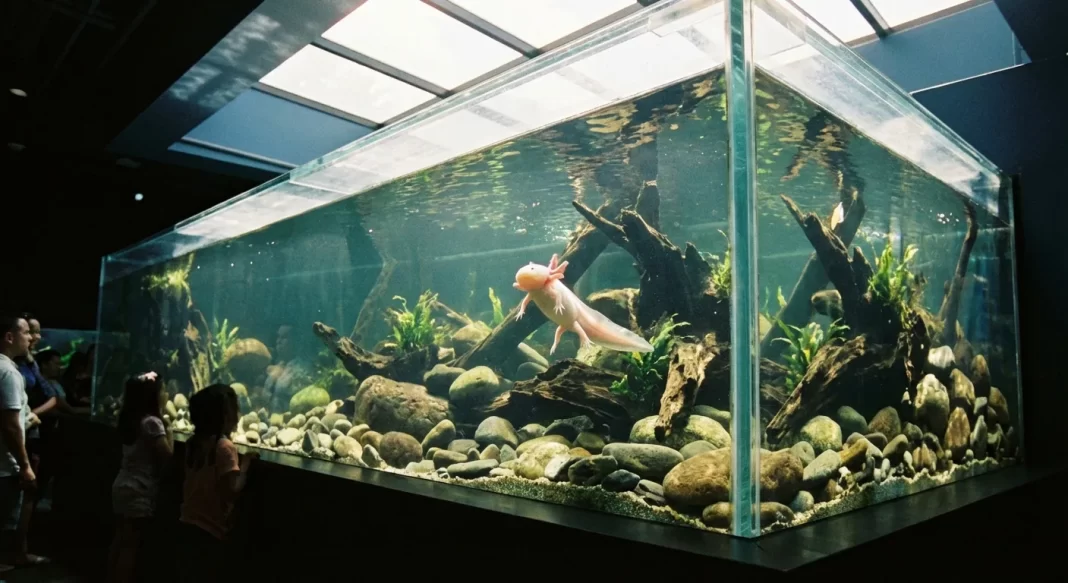
A single adult axolotl needs a minimum of 20 gallons, with AxolotlCentral identifying 29 gallons as the bare minimum and a 40-gallon breeder at 36 by 18 inches as the standard recommendation. Floor space matters more than water depth. Each additional axolotl adds at least 10 gallons of volume and a separate hide and territorial zone.
What is the minimum tank size for one axolotl?
A single adult axolotl needs a minimum of 20 gallons with at least 360 square inches of floor area. AxolotlCentral identifies 29 gallons (30 by 12 by 18 inches) as the bare minimum and a 40-gallon breeder (36 by 18 by 16 inches) as the strongly preferred standard. Floor area is the binding constraint, not column height.
A healthy adult axolotl reaches about 20 to 30 centimeters or 8 to 12 inches in total length, with average weight 60 to 110 grams (source: Animal Diversity Web). Britannica describes the species as reaching about 25 centimeters or 10 inches (source: Britannica). In a 20-gallon long tank with a 30-by-12-inch footprint, a 10-inch animal occupies roughly one-third of the tank’s length when resting. That leaves limited room for a hide, a feeding area, and enough open floor for the animal to walk without constantly meeting the glass. The tank functions, but there is no margin for error. Any equipment malfunction, missed water change, or temperature fluctuation hits harder in 20 gallons than in 40 because the smaller water volume amplifies every variable.
AxolotlCentral’s current recommendation goes further than the older 20-gallon floor: it specifies 110 liters or 29 gallons (30 by 12 by 18 inches) as the absolute bare minimum and the 180-liter or 40-gallon breeder style (36 by 18 by 16 inches) as the much more suitable minimum tank size for a single axolotl (source: AxolotlCentral care guide). Ethical Axolotls reaches a similar conclusion through a different route: their dimensional recommendation for one adult axolotl is 36 by 18 by 18 inches (source: Ethical Axolotls enclosures), which matches the 40-gallon breeder footprint.
Why 20 gallons is the floor, not the goal
A 29-gallon tank shares the same 30-by-12-inch footprint as a 20-gallon long but adds 45 percent more water volume. That extra volume buffers ammonia spikes, slows temperature rises during summer afternoons, and provides a larger biological filtration capacity. The 40-gallon breeder goes further with its 36-by-18-inch footprint, which gives the axolotl 50 percent more floor space than the 20-gallon long while approximately doubling the water volume.
Ethical Axolotls’ calculation method backs this with a dimensional formula based on snout-to-vent measurement, recommending tank width of approximately six times body length (per Ethical Axolotls enclosures), which for a typical adult yields the same 36-inch length the 40-gallon breeder provides. The cost difference between a 20-gallon long and a 29-gallon is roughly $10 to $20. For that price, the temperature and chemistry buffering substantially reduces the consequences of any single error in maintenance.
What about a 20-gallon tall?
A 20-gallon tall tank (24 by 12 by 16 inches) has the same water volume as a 20-gallon long but a smaller footprint of 288 square inches. This is the wrong tank for an axolotl. Axolotls are obligate bottom dwellers that walk along the substrate, rest on the substrate, and feed from the substrate (per San Diego Zoo). They rarely swim above the midline of the water column. A tall tank wastes vertical space the animal does not use while reducing the floor area it needs. AxolotlCentral states that wide-and-low aquariums are preferable to tall tanks for this reason (per AxolotlCentral care guide). Always choose long or breeder tank formats over tall or standard formats of the same volume.
How much additional space does each extra axolotl need?
Each additional axolotl requires at least 10 gallons of additional water volume and a separate hide with its own territorial zone. Ethical Axolotls recommends 20 gallons per axolotl in cohousing setups: 40 gallons for two adults, 60 for three, 80 for four. Both animals must be confirmed same-sex and within 3 inches of body length.
Axolotls are not social animals. They tolerate cohabitation under specific conditions, but they do not benefit from it. AxolotlCentral states plainly that axolotls generally do not do well with tank mates and that there are no benefits to cohabiting axolotls (per AxolotlCentral care guide). Ethical Axolotls outlines the requirements explicitly: two axolotls must be of the same size or within 3 inches of each other in body length, their heads should be around the same size, and they must be the same confirmed sex (per Ethical Axolotls enclosures). Unsexed sub-adult and juvenile axolotls should not be cohabitated. The full cohabitation risk assessment is in the tank mates guide.
Tank size table by number of axolotls
| Number of axolotls | Minimum tank size | Recommended tank size | Minimum floor area |
|---|---|---|---|
| 1 (adult) | 20-gallon long (29 preferred) | 40-gallon breeder | 360 sq in (30 x 12 in) |
| 2 (adult, same-sex same-size) | 40 gallons | 55 gallons | 540 sq in (36 x 15 in) |
| 3 (adult) | 55 gallons | 75 gallons | 624 sq in (48 x 13 in) |
| 4 (adult) | 75 gallons | 90+ gallons | 768 sq in (48 x 16 in) |
These figures assume adult axolotls of 9 to 12 inches in length. Larger morphs, breeding pairs, or groups housed for production rather than companionship may require additional space beyond these minimums. Breeding tanks have additional requirements covered in the breeding setup guide.
Why volume rules need behavioral context
The +10-gallons-per-additional-axolotl rule addresses water volume only. Volume determines how quickly waste rises and how much thermal mass the tank has, but it does not solve the territorial and physical-space problems of cohousing. Two axolotls in a 30-gallon tall have enough volume but not enough floor space to establish separate resting areas. Two in a 40-gallon breeder with a 36-by-18-inch footprint have both.
Size-matched pairs or groups in appropriately sized tanks with multiple hides and visual barriers are the standard for safe cohabitation. A 12-inch adult housed with a 5-inch juvenile creates a predation risk regardless of tank size, since axolotls will attempt to suction-feed on anything that fits in their mouth.
Why does floor space matter more than tank height?
Axolotls are benthic animals that walk along the bottom, rest flat against the substrate, and ambush-feed from there. The upper water column serves no behavioral function for a healthy axolotl. A tank for axolotls should maximize horizontal floor area, not vertical depth. AxolotlCentral specifies wide-and-low aquariums as preferable to tall formats for this reason.
Surface gulping occurs occasionally for air intake from the rudimentary lungs that axolotls retain alongside their feathery external gills, but it takes seconds, not sustained swimming. The San Diego Zoo notes that axolotls are predators that feed by suction along the substrate (source: San Diego Zoo), which keeps the animal anchored to the bottom for almost all functional activity. The DVM-reviewed PetMD feeding guidance confirms that axolotls feed by vacuum-style suction and swallow prey whole (source: PetMD (reviewed by Sean Perry, DVM)).
The floor-space-per-animal calculation
A useful way to evaluate tank suitability is floor area per axolotl rather than gallons alone. A single adult axolotl at 10 inches in length needs a minimum of approximately 300 square inches of unobstructed floor space to walk, turn, and rest without constant contact with hides or glass walls. That number comes from the animal’s resting body dimensions (roughly 10 inches by 2 inches) plus the turning radius needed for normal locomotion, plus space for at least one hide and one open feeding zone.
In a 20-gallon long (30 by 12 inches, 360 square inches total floor), approximately 60 square inches is occupied by a standard hide, leaving 300 square inches of open floor. That is enough for one axolotl with no margin. In a 40-gallon breeder (36 by 18 inches, 648 square inches total floor), the same hide leaves 588 square inches of open floor, which is enough for two appropriately matched axolotls with comfortable separation.
Long tanks versus tall tanks: a direct comparison
| Tank | Gallons | Dimensions (L x W x H) | Floor area | Axolotl suitability |
|---|---|---|---|---|
| 20-gallon long | 20 | 30 x 12 x 12 in | 360 sq in | Minimum for 1 adult |
| 20-gallon tall | 20 | 24 x 12 x 16 in | 288 sq in | Too small floor for 1 adult |
| 29-gallon | 29 | 30 x 12 x 18 in | 360 sq in | Good for 1, tight for 2 |
| 40-gallon breeder | 40 | 36 x 18 x 16 in | 648 sq in | Good for 1-2 adults |
| 55-gallon | 55 | 48 x 13 x 20 in | 624 sq in | Good for 2-3 adults |
| 75-gallon | 75 | 48 x 18 x 20 in | 864 sq in | Good for 3-4 adults |
The 55-gallon tank has more water volume than the 40-gallon breeder but only slightly more floor area. For a single axolotl, the 40-gallon breeder with its wider footprint is a better layout than the 55-gallon with its narrower 13-inch width. This is why choosing by floor dimensions, not just gallons, produces better outcomes.
What is bioload and how does it determine stocking density?
Bioload is the total biological waste an animal produces: ammonia from respiration, solid waste from digestion, and mucus from skin and gills. Axolotls produce a disproportionately heavy bioload because of their carnivorous diet and gill-based respiration that releases ammonia directly into water. Larger tanks dilute the same waste across more volume, extending the safety margin between water changes.
The nitrogen cycle converts ammonia to nitrite and then to nitrate through colonies of beneficial bacteria living primarily in the filter media. Bacteria can only process ammonia at a finite rate, and AxolotlCentral’s cycling reference notes that the filter colony grows in proportion to the available ammonia and the surface area you provide (source: AxolotlCentral cycling guide). When bioload exceeds biological filtration capacity, ammonia accumulates between water changes. In a larger tank, the same bioload is diluted across more water volume, which means ammonia concentration rises more slowly. This gives the bacterial colony more time to process waste and gives the keeper more margin if a water change is delayed by a day. The water parameters guide covers safe ranges and testing.
Bioload math, concretely
In a 20-gallon tank with one adult axolotl, a single missed weekly water change can push ammonia from 0 ppm to detectable levels within 48 to 72 hours. In a 40-gallon tank with the same animal and filter, the same missed change produces a slower ammonia rise because waste is diluted across twice the water volume.
The math is straightforward. If one adult axolotl produces X waste per day, in 20 gallons the concentration equals X divided by 20; in 40 gallons it equals X divided by 40. After 7 days, the 20-gallon tank’s concentration is exactly double. This does not mean larger tanks need fewer water changes; it means larger tanks are more forgiving when life intervenes. The water change schedule guide covers maintenance frequencies by tank size.
Stocking density limits
The practical stocking limit for axolotls is approximately one adult per 10 to 15 gallons of actual water volume (after accounting for substrate, equipment, and decor displacement), combined with at least 300 square inches of floor space per animal. Exceeding this density creates three compounding problems:
Ammonia accumulation outpaces filtration. Two adult axolotls in a 20-gallon tank produce enough ammonia that even a well-maintained sponge filter struggles to keep ammonia at 0 ppm between weekly water changes. The keeper is forced into more frequent water changes, which increases stress from parameter fluctuations and accelerates dechlorinator and conditioner consumption.
Territorial overlap causes chronic stress. Axolotls housed too closely engage in gill nipping, tail biting, and displacement behavior where one animal consistently occupies the preferred resting area while the other is pushed into open water or against the glass. This stress suppresses immune function and increases susceptibility to bacterial and fungal infections. Axolotl.org’s health reference identifies stress, including from overstocking, as one of the most common precipitants of disease in captive axolotls (source: Axolotl.org health). Treatment of the resulting infections is covered in the fungus guide.
Temperature management becomes harder. More animals produce more metabolic heat. In a borderline-temperature room, the additional thermal output from two or three axolotls in a small tank can push water temperature 1 to 2 degrees Fahrenheit above what the room temperature alone would produce. In a larger tank, this metabolic contribution is diluted below measurable impact. The temperature guide covers heat-stress thresholds.
Reviewing rescue-intake records across keeper communities, overstocked tanks are the second most common preventable welfare issue after uncycled tanks. The pattern is consistent: a keeper starts with one axolotl in a 20-gallon, adds a second without upsizing, and presents to the community or a vet within three to six months with ammonia burns, gill deterioration, or chronic fungal issues on one or both animals.
How should you size a tank for juvenile axolotls?
Juveniles under 4 inches can be temporarily housed in a 10-gallon grow-out tank with bare-bottom substrate and twice-weekly water changes. Plan to transition to a 20-gallon or larger tank within 4 to 5 months. AxolotlCentral specifies that sand is not safe for axolotls under 15 centimeters, so bare-bottom is required for juveniles.
A juvenile axolotl grows approximately 1 inch per month for the first 6 to 8 months of life. A 3-inch juvenile purchased from a breeder will reach 8 to 9 inches within 5 to 6 months. Planning tank size for the adult, not the juvenile, prevents the common and expensive mistake of buying a small tank, outgrowing it, and buying a second tank.
Juvenile housing guidelines
A juvenile axolotl under 4 inches can be housed in a 10-gallon tank during grow-out, provided the tank is fully cycled before the juvenile enters, water changes happen at least twice per week (juveniles are more sensitive to ammonia than adults because their gills are proportionally larger and their immune systems still developing), the substrate is bare bottom (sand is not safe for juveniles under 15 centimeters because impaction risk is higher in smaller animals with narrower digestive tracts: source: AxolotlCentral substrate post), and a 20-gallon-or-larger tank is ready for transition at 5 to 6 inches.
A 10-gallon is acceptable as a temporary grow-out enclosure. It is not acceptable as a permanent home for any axolotl at any age. The distinction matters because some online guides present 10 gallons as fine for one axolotl without specifying that this applies only to juveniles for a limited period.
Why the 10-gallon starter advice persists and why it is wrong
The 10-gallon recommendation for one adult axolotl appears in older care sheets, some pet-store care cards, and a few online guides that have not been updated. The advice originates from a period when axolotl husbandry knowledge was less developed. The recommendation was based on the minimum volume in which an axolotl could physically fit and survive, not the minimum for long-term health.
A 10-gallon tank (20 by 10 by 12 inches) has 200 square inches of floor space. An adult axolotl at 10 inches occupies half the tank’s length when resting. Water volume is insufficient to buffer ammonia between weekly water changes, temperature swings are amplified because 10 gallons gains and loses heat faster than 20 or 40, and there is no room for a proper hide, feeding area, and open walking space simultaneously.
From working with axolotl rescue intakes, the animals housed long-term in 10-gallon tanks consistently arrive with stunted gill development, glass-surfing behavior, and chronic stress markers that are not present in animals from properly sized setups. The 10-gallon advice was never wrong because of one missing variable; it was wrong because every variable was working against the animal at once. The current consensus across veterinary references, experienced keepers, and rescue organizations is a 20-gallon long minimum with 29 to 40 gallons strongly recommended.
How does tank size affect water parameters and maintenance?
Tank size directly determines how stable water parameters remain between maintenance events. The critical axolotl parameters are ammonia 0 ppm, nitrite 0 ppm, nitrate below 20 ppm, pH 6.5 to 8.0 (7.4 to 7.6 ideal per Axolotl.org), and temperature 60 to 68 degrees Fahrenheit. Every one is easier to maintain in a larger water volume.
Axolotl.org specifies the parameter ranges that frame the relationship between water volume and parameter stability (source: Axolotl.org captive requirements). Ethical Axolotls’ parameter reference adds that a properly sized aquarium reduces maintenance to a 50 percent weekly water change rather than the daily changes an undersized tank may require (source: Ethical Axolotls parameters). The full parameter ranges and testing protocols are in the water parameters guide linked above.
Temperature stability by tank size
Water has a high specific heat capacity, which means larger volumes resist temperature changes more effectively than smaller volumes. A 10-gallon tank in a room that rises from 68 to 76 degrees Fahrenheit over an afternoon can see water temperature climb 4 to 6 degrees in the same period. A 40-gallon tank in the same room gains temperature roughly half as fast because of the larger thermal mass. For an animal whose safe temperature range spans only 8 degrees (60 to 68 degrees Fahrenheit), that buffering effect is the difference between stable conditions and daily thermal stress.
This is particularly relevant during summer months. A room that stays at 72 degrees Fahrenheit with air conditioning produces a water temperature that hovers at the upper boundary of the safe range. A sudden AC failure in a small tank can push water above 72 degrees within hours, triggering heat stress. In a larger tank, the same failure gives the keeper more time to intervene with cooling measures. The hot weather setup guide covers emergency cooling protocols.
Ammonia dilution and water change frequency
In a properly cycled 40-gallon tank with one adult axolotl, a standard 20 to 25 percent weekly water change is typically sufficient to keep nitrate below 20 ppm. In a 20-gallon tank with the same animal and feeding schedule, nitrate rises faster, and some keepers find they need water changes every 5 days rather than every 7 to maintain the same parameter stability. The maintenance load does not double, but it increases enough to matter for keepers who travel or have inconsistent schedules. Detailed water change schedules by tank size and stocking level are covered in the water testing guide alongside testing technique.
How do you choose between common tank sizes?
The right tank depends on three factors: how many axolotls you plan to keep across two years, whether your room stays below 72 °F year-round without intervention, and how much maintenance flexibility you want. The 40-gallon breeder is the most commonly recommended single-axolotl tank for warm climates or inconsistent schedules. Smaller tanks work in temperate climates.
One axolotl, controlled room temperature, consistent maintenance
The 20-gallon long works if your room stays at or below 68 degrees Fahrenheit year-round and you commit to weekly water changes without exception. If either condition is uncertain, the 29-gallon is a low-cost upgrade that provides meaningful temperature and chemistry buffering for roughly $10 to $20 more at most retailers.
One axolotl, warm climate or inconsistent schedule
The 40-gallon breeder is the right choice. The 36-by-18-inch footprint gives the axolotl ample floor space, and the 40-gallon volume provides enough thermal mass and waste dilution to tolerate a delayed water change or a warm afternoon without immediately compromising water quality. This is the tank that experienced keepers most often recommend as the set-it-and-stop-worrying option for a single axolotl. The tank setup guide covers the full procedural sequence for assembling and cycling this tank.
Two axolotls
Start at 40 gallons minimum, with 55 gallons strongly recommended. Two axolotls in a 40-gallon breeder have adequate floor space at 648 square inches (roughly 324 per animal), but the bioload of two adults stretches the filtration and water-change capacity of 40 gallons during warm months. A 55-gallon tank provides the additional volume buffer that keeps two-axolotl tanks from becoming high-maintenance setups. Ensure both animals have their own hides placed at opposite ends of the tank with a visual barrier between them. The hides and enrichment guide covers placement.
Three or more axolotls
A 75-gallon tank is the practical minimum for three adults. At this stocking level, filtration capacity becomes a limiting factor. A single sponge filter is likely insufficient for three adult axolotls in 75 gallons. Most keepers at this scale run either dual sponge filters or a canister filter rated for the tank volume, paired with a sponge filter for redundancy. The filtration guide covers filter sizing for multi-axolotl setups.
Housing four or more axolotls in a single tank is uncommon outside of breeding operations and rescue organizations. At that density, even a 75-gallon tank requires aggressive maintenance schedules, oversized filtration, and careful monitoring. Most keepers with four or more axolotls use multiple tanks rather than one large one, which allows quarantine separation and reduces the cascading-failure risk of a single system.
What tank features matter beyond size?
Tank size sets the baseline, but lid, material, and stand weight capacity affect whether the tank functions across the axolotl’s 10-to-15-year captive lifespan. A filled 40-gallon weighs about 450 pounds and needs a dedicated stand. Glass and acrylic both work. Mesh lids prevent escape during feeding lunges.
Axolotls reach the upper end of the 10-to-15-year captive lifespan only in stable, properly equipped setups (source: PBS Nature axolotl fact sheet). Each of the features below contributes to that stability.
Lid or cover
Axolotls occasionally lunge at the surface during feeding and can exit an uncovered tank. A mesh screen or glass lid with ventilation gaps prevents escape and reduces evaporation. The lid also blocks the direct overhead lighting that axolotls find stressful given their photosensitive eyes (source: Axolotl Planet lighting guide). Avoid tight-fitting lids that trap heat, especially in warm climates. An airtight cover on a warm day acts as a greenhouse, raising water temperature faster than an uncovered tank would.
Tank material: glass versus acrylic
Glass tanks are heavier but scratch-resistant and chemically inert. Acrylic tanks are lighter, offer clearer viewing, and resist impact better, but they scratch easily and some acrylic formulations can leach chemicals at elevated temperatures. For axolotls, either material works. Glass is more common and less expensive at standard aquarium sizes. Acrylic becomes relevant at large custom sizes (100+ gallons) where glass weight becomes a structural concern.
Stand and weight capacity
A filled aquarium weighs approximately 10 to 11 pounds per gallon of capacity (water weight plus tank, substrate, and equipment). A 20-gallon tank weighs roughly 225 pounds filled. A 40-gallon breeder weighs roughly 450 pounds. A 75-gallon tank exceeds 850 pounds. Standard household furniture is not rated for these loads. Use a dedicated aquarium stand or verify the structural capacity of the surface. Placing a heavy tank on an inadequate surface risks catastrophic failure, and a collapsed tank is a lethal event for the animal and a significant property-damage event for the keeper.
Common tank-size mistakes and how to avoid them
Recurring preventable tank-size mistakes are starting in a 10-gallon for an adult, adding a second axolotl without upsizing, choosing a tall tank over a long, placing a heavy tank on standard furniture, and assuming juvenile housing is permanent adult housing. Each comes from optimizing for cost rather than floor area and volume.
Starting in a 10-gallon for an adult is the most common preventable mistake. A 10-gallon is grow-out housing only, not permanent housing. Adding a second axolotl without upsizing produces the overstocking cascade described above within months. Choosing a tall tank over a long compresses floor space for an animal that rarely uses the vertical column: a 20-gallon tall has 25 percent less floor area than a 20-gallon long.
Placing a heavy tank on standard furniture risks structural failure. A typical dresser, bookshelf, or coffee table is not rated for 450 pounds concentrated in a small footprint. Use a dedicated aquarium stand for any tank 20 gallons or larger. Assuming juvenile housing is also permanent housing leads keepers to buy a 10-gallon for a 3-inch juvenile and face a $200-plus upgrade within six months. Plan the adult tank from the beginning.
The beginner mistakes guide covers the broader pattern of new-keeper errors, the care SOP integrates maintenance with the chosen tank size, the axolotl care guide hub orients the dimensional decision within the broader husbandry framework, and the chiller guide covers cooling for warm-room setups.
Frequently asked questions
Can I keep an axolotl in a plastic storage bin instead of a glass aquarium permanently?
Food-grade, opaque, uncolored plastic storage bins are used as temporary housing during tank cycling, emergencies, and quarantine. They are not ideal as permanent enclosures because they do not allow visual monitoring from the side, they lack structural rigidity for mounting filters and thermometers, and opaque walls prevent the keeper from spotting early signs of health problems without physically looking down into the bin. For permanent housing, a standard glass or acrylic aquarium is strongly preferred. Bins also lack the secure lid options of standard aquariums.
Should I get a 29-gallon or a 40-gallon for a single axolotl if I am undecided?
The 40-gallon breeder is the better choice if you have the room. The 36-by-18-inch footprint provides 80 percent more floor area than the 30-by-12-inch footprint of the 29-gallon, and the additional 11 gallons of volume buffer parameter swings more effectively. The price difference is typically $50 to $80, and the 40-gallon needs about 6 inches more length and 6 inches more width in your room. Maintenance is a 4 to 6 gallon weekly water change for the 29-gallon and an 8 to 12 gallon change for the 40-gallon. If those numbers fit your space and routine, choose the 40-gallon.
How big should a hospital or quarantine tub be?
A 5 to 10 gallon food-safe plastic tub with dechlorinated, parameter-matched water and a sponge filter or air stone is sufficient for short-term hospital or quarantine use. Hospital tubbing is typically 1 to 4 weeks during a specific medical situation, after which the axolotl returns to its main tank. Match the tub water temperature to the main tank within 2 degrees Fahrenheit. Keep the tub in a low-light area to reduce stress, and perform daily 50 to 100 percent water changes if no filter is running. Do not house an axolotl in a tub long-term.
Can I keep an axolotl outdoors in a pond?
Pond housing is only viable in temperate climates where pond water stays below 22 degrees Celsius (72 degrees Fahrenheit) year-round, including summer. Most populated regions cannot meet this requirement without active cooling, which defeats the purpose of pond keeping. Pond housing also introduces predator risks (cats, raccoons, herons, large fish if cohabiting), escape risks during heavy rain that raises water levels, and substantially reduced ability to observe the animal for early health signs. Pond keeping is not recommended for first-time keepers and is rarely the best choice even for experienced ones.
What is the largest tank a single axolotl can be kept in?
There is no upper limit on tank size for a single axolotl, but practical considerations make tanks deeper than 16 inches harder to maintain because reaching the substrate for waste removal and decor adjustment becomes difficult. Very large tanks (100+ gallons) require stronger biological filtration without proportionally higher water flow, since axolotls remain sensitive to current regardless of tank size. Lighting also becomes more challenging in deep tanks, since the substrate level receives less light than in standard depths. For one axolotl, a 40 to 75 gallon breeder is the practical sweet spot.
Related guides
- Axolotl care guide: complete husbandry hub for new keepers
- Axolotl breeding setup: breeding-specific tank requirements and rearing logistics
- Axolotl chiller guide: cooling equipment selection and installation
- Axolotl tank setup guide: step-by-step procedure from empty tank to cycled habitat
By the ExoPetGuides editorial team (AI-assisted drafting; human-reviewed), reviewed by an exotic-animal veterinarian
Updated 2026-05-17
Primary sources: AxolotlCentral care guide and substrate post, Ethical Axolotls enclosures, Axolotl.org captive requirements, Britannica axolotl entry, San Diego Zoo Animals and Plants
Disclaimer: This content is for educational purposes only and is not a substitute for professional veterinary advice. Always consult a qualified veterinarian, ideally an exotic-animal specialist, for any health concern about your pet. Care recommendations may vary based on species, individual animal, and local regulations.