


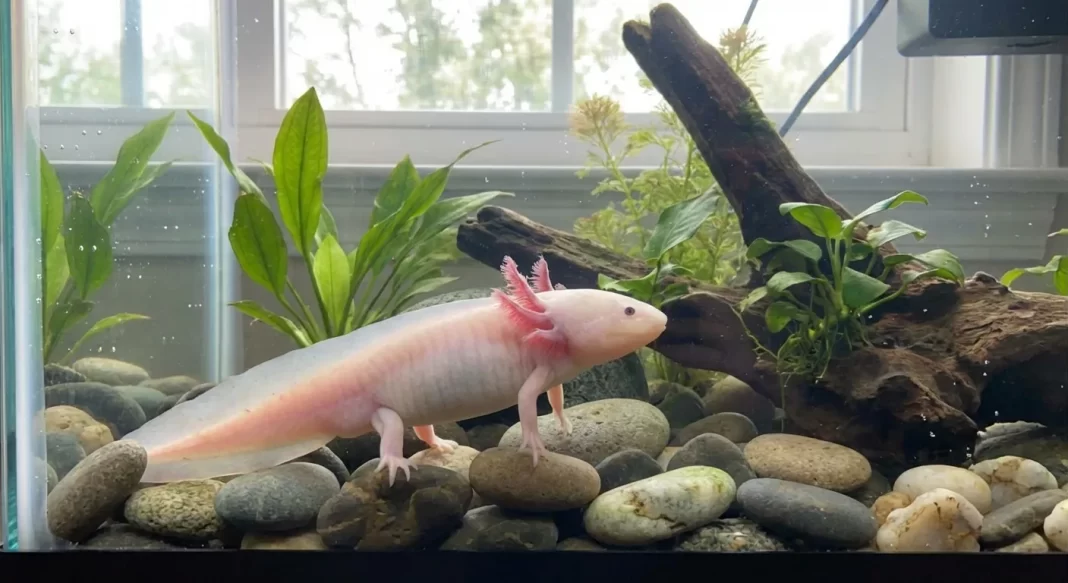
Axolotl water testing requires a liquid drop test kit (the API Freshwater Master Test Kit is the standard) plus a separate API GH and KH Test Kit. Test ammonia, nitrite, nitrate, and pH every day during cycling, every 2 to 3 days for the first month with the axolotl, weekly once stable, and daily when anything looks wrong.
What parameters should you test in an axolotl tank?
Test seven parameters in an axolotl tank: ammonia (safe at 0 ppm), nitrite (safe at 0 ppm), nitrate (safe below 40 ppm, ideal below 20 ppm), pH (safe 6.5-8.0, ideal 7.4-7.6), temperature (safe 60-68°F), GH (safe 7-14 dGH), and KH (safe 3-7 dKH). All seven must stay in range simultaneously for the animal to remain healthy.
These ranges are consistent across keeper-authority and primary sources. AxolotlCentral’s care guide carries pH 7.2-8.4, GH 7-14 dGH (125.3-250.6 ppm), and KH 3-7 dKH (53.7-125.3 ppm) (source: AxolotlCentral care guide). Axolotl.org’s captive requirements page specifies the pH band of 6.5-8.0 with an ideal of 7.4-7.6 and advises that “a periodic ammonia test is advisable” along with regular nitrite testing (source: Axolotl.org captive requirements). The Liberty Land Axolotl Rescue water-quality page reinforces the safe-zero rule on ammonia and nitrite plus the 10-40 ppm nitrate band (source: Liberty Land Axolotl Rescue water quality).
The seven-parameter safe-range matrix is the per-test reference. The water parameters guide covers the biological mechanisms behind each safe range in detail. This article focuses on what each test reveals and what action a reading triggers.
| Parameter | Safe range | Ideal target | Action threshold |
|---|---|---|---|
| Ammonia (NH3/NH4+) | 0 ppm | 0 ppm | Any reading above 0 ppm |
| Nitrite (NO2-) | 0 ppm | 0 ppm | Any reading above 0 ppm |
| Nitrate (NO3-) | Below 40 ppm | Below 20 ppm | Above 40 ppm |
| pH | 6.5-8.0 | 7.4-7.6 | Below 6.0 or above 8.5 |
| Temperature | 60-68°F (16-20°C) | 60-64°F (16-18°C) | Above 72°F (22°C) or below 50°F (10°C) |
| General hardness (GH) | 7-14 dGH | 8-12 dGH | Below 4 dGH |
| Carbonate hardness (KH) | 3-7 dKH | 4-6 dKH | Below 2 dKH |
Ammonia
Ammonia is the most dangerous parameter in an axolotl tank. Any detectable reading means the water is actively harming the animal. Ammonia is excreted through the gills and accumulates from uneaten food, waste, and decomposing organic matter. A reading of 0.25 ppm already warrants an immediate water change. At 1 ppm, gill burns become visible within 24 to 48 hours. The ammonia burn guide covers the clinical injury depth.
Liquid test kits measure total ammonia nitrogen (TAN), which includes both the ionized form (ammonium, NH4+) and the toxic un-ionized form (ammonia, NH3). The proportion of toxic NH3 increases with higher pH and higher temperature. At pH 7.0 and 64°F, only a small fraction of TAN is toxic NH3. At pH 8.0 and 72°F, the toxic fraction is roughly ten times higher. This interaction is why testing pH alongside ammonia is essential, and why a tank running at higher pH needs tighter ammonia control even at the same reading.
Nitrite
Nitrite is the intermediate product of the nitrogen cycle, produced when ammonia-oxidizing bacteria convert ammonia but before nitrite-oxidizing bacteria convert it to nitrate. Like ammonia, the only safe reading is 0 ppm. Nitrite causes methemoglobinemia, a condition where nitrite binds to hemoglobin and prevents oxygen transport. Symptoms include lethargy, pale or darkened coloration, and gill clamping. Nitrite readings above zero in an established tank indicate a problem with the biological filter. Common causes include filter media replacement, medication use that killed beneficial bacteria, an extended power outage, or a sudden increase in bioload (overfeeding, adding a second axolotl). The cloudy water fix guide covers the biofilter-crash diagnostic.
Nitrate
Nitrate is the end product of bacterial conversion and is far less toxic than ammonia or nitrite. It accumulates between water changes and is removed primarily through partial water changes (and slightly through live plants). Readings below 20 ppm are ideal. Readings between 20 and 40 ppm are acceptable but indicate water changes should be more frequent. Readings above 40 ppm require an immediate large water change. Chronic exposure above 40 ppm suppresses immune function and contributes to long-term health decline even though the axolotl may not show obvious acute symptoms. The within-pair sibling water change schedule guide covers the cadence and percentages that maintain the below-20-ppm target.
pH
pH measures the acidity or alkalinity of the water. Axolotls tolerate a range of 6.5 to 8.0, with 7.4 to 7.6 being ideal. Stability matters more than hitting a specific number. A tank that sits at pH 7.8 consistently is safer than one swinging between 7.0 and 7.6. Sudden pH swings stress the axolotl and can crash the nitrogen cycle if pH drops below 6.0, because nitrifying bacteria slow at low pH. Testing pH weekly catches slow drifts before they become dangerous. The pH GH KH guide covers the chase-numbers-not-stability framing and adjustment protocols.
Temperature
Temperature is not a chemical test, but it belongs in every testing routine because it directly affects every other parameter. Warmer water holds less dissolved oxygen, increases ammonia toxicity (more un-ionized NH3 at higher temperatures), and stresses axolotl metabolism. A basic digital aquarium thermometer provides continuous readings. Check and record it at the same time you test water chemistry. Any reading above 72°F (22°C) is an emergency. The temperature guide covers the thermal-tolerance biology in detail.
GH (general hardness)
General hardness measures dissolved calcium and magnesium concentrations. Axolotls need moderately hard water in the range of 7 to 14 dGH. Calcium is essential for bone development, gill function, and slime coat integrity. AxolotlCentral’s care guide places the ideal GH at 7 to 14 dGH (125.3 to 250.6 ppm) (source: AxolotlCentral GH range). Axolotl.org’s captive requirements page notes that axolotls prefer somewhat hard water and that soft water can cause temporary anaemia (source: Axolotl.org hardness preference). GH below 4 dGH warrants supplementation with a mineral additive or crushed coral. Experienced axolotl keepers test GH monthly in established tanks and more frequently when using RO or distilled water for top-offs.
KH (carbonate hardness)
Carbonate hardness measures the buffering capacity of the water, its ability to resist pH changes. KH in the range of 3 to 7 dKH provides adequate buffering. Below 2 dKH, the water loses its ability to absorb acid produced by the nitrogen cycle, and pH can crash overnight. A KH crash is one of the most common causes of sudden pH drops in established axolotl tanks, which is why testing KH matters even when pH looks stable. The tank cycling guide explains how low KH stalls the nitrogen cycle during setup.
Which test kit should you use?
The API Freshwater Master Test Kit is the standard for axolotl keepers. It tests ammonia, nitrite, nitrate, pH, and high-range pH using liquid reagents. Buy the separate API GH and KH Test Kit for hardness. Test strips are a fast secondary screening tool, not a primary kit. Digital probes work for advanced multi-tank operators. The kit you use determines whether your readings are accurate enough to act on.
There are three categories of aquarium test equipment. Liquid reagent kits, test strips, and digital probes. Each has a place, but they are not interchangeable for axolotl keeping.
API Freshwater Master Test Kit (liquid reagent, gold standard)
The API Freshwater Master Test Kit is the canonical recommendation across axolotl breeder, rescue, and veterinary communities. The kit covers pH, high-range pH, ammonia, nitrite, and nitrate using liquid reagents and color-comparison cards. The package includes seven test solutions, four test tubes, a holding tray, and a computer-calibrated laminated color card (source: API Freshwater Master Test Kit). API recommends weekly testing for routine maintenance. Liquid reagent tests are more accurate than strips because the color development reaction is controlled. You add a precise number of drops to a precise volume of water, shake for a defined time, wait a defined period, then compare against a standardized color card.
Ethical Axolotls’ parameters page directly recommends this approach: invest in a KH/GH test kit in addition to the necessary liquid master test kit (per Ethical Axolotls parameters). The Liberty Land Axolotl Rescue page reinforces the rule: use a liquid test kit like API’s Freshwater Master Test Kit, not strips, because liquid kits are more accurate (source: Liberty Land Rescue liquid-vs-strips).
API GH and KH Test Kit (separate purchase)
The API Freshwater Master Test Kit does not include GH or KH tests. You need the separate API GH and KH Test Kit. The kit uses a titration method. You add drops of reagent one at a time to a water sample until a color change occurs. The number of drops to reach the color change equals the degree of hardness (1 drop equals 1 dGH or 1 dKH). This titration method is straightforward and produces accurate results. For an axolotl tank with stable readings, monthly testing of GH and KH is the standard cadence. The pH GH KH guide covers the parameter-adjustment protocols if GH or KH falls outside the safe band.
Test strips (secondary, not primary)
Dip-and-read test strips provide a quick snapshot but are less precise than liquid reagents. Color pads on strips can be affected by humidity exposure (if the container is not sealed tightly), user interpretation differences (the color blocks cover broad ranges), and manufacturing variation between batches. Strips are useful as a fast secondary check between liquid tests or when traveling with an axolotl (emergency tubbing situations where speed matters), but they should not be the sole testing method for regular maintenance.
Strips that test ammonia, nitrite, nitrate, pH, GH, and KH in a single dip exist, but each pad reads a broader range than a liquid reagent test. A strip might show 0 ppm for ammonia when the actual concentration is 0.15 ppm, below the strip’s detection resolution but above the safe threshold for axolotl gills. This resolution gap is the core reason liquid tests are the primary method for axolotl keepers.
Digital probes and meters
Digital pH meters and TDS (total dissolved solids) meters provide instant numerical readings and are useful for experienced keepers maintaining multiple tanks. They require calibration with buffer solutions and periodic electrode replacement. A digital thermometer is standard equipment for any axolotl tank. Digital ammonia or nitrite probes exist but are prohibitively expensive for hobbyist use and unnecessary when liquid test kits provide the same accuracy at a fraction of the cost.
Kit-by-purpose comparison
| Kit type | Best for | Limitation | Cost tier |
|---|---|---|---|
| API Freshwater Master (liquid) | Primary weekly testing of ammonia, nitrite, nitrate, pH | Does not include GH or KH | Low (one-time + reagent replacement) |
| API GH and KH (liquid titration) | Monthly hardness testing | Separate purchase from the Master kit | Low |
| Multi-parameter test strips | Quick screening between liquid tests, emergency tubbing | Broad-range color blocks, resolution gap below safe ammonia threshold | Very low |
| Digital pH meter | Multi-tank operations, continuous monitoring | Requires calibration with buffer solutions | Medium |
| Digital ammonia/nitrite probes | Lab-grade research | Prohibitively expensive for hobbyist use | High |
How do you test ammonia correctly with the API kit?
Test ammonia with the API kit in six steps. Fill the test tube to the 5-milliliter line with tank water. Add 8 drops of Ammonia Test Solution 1. Add 8 drops of Solution 2. Cap and shake for 5 seconds. Wait 5 minutes. Compare the color against the card in natural daylight. The wait time and daylight reading both matter for accuracy.
The step-by-step procedure below follows the printed instructions shipped with the API kit. Drop counts may vary slightly with kit revisions; verify against the leaflet that ships in your specific kit if you see a discrepancy.
Step 1: Fill the test tube to 5 mL with tank water
Use one of the test tubes from the kit. Submerge the tube in the tank water (not at the surface, where floating film can skew the sample) and fill to the 5-milliliter line marked on the tube. Pull out, cap if you want, and transfer to a stable surface for the drop-counting steps. The 5-mL fill matters because the reagent concentration is calibrated to this volume.
Step 2: Add 8 drops of Ammonia Test Solution 1
Hold Bottle 1 vertically over the open test tube. Squeeze gently to release drops one at a time. Count to 8. Holding the bottle vertically matters because tilted bottles release larger or smaller drops than the calibrated drop size. If you accidentally over-dose, start over with a fresh tube and fresh water rather than trying to correct the dose mid-test.
Step 3: Add 8 drops of Ammonia Test Solution 2
Repeat with Bottle 2 using the same vertical-bottle protocol. Both bottles must reach the test tube for the reagent reaction to develop.
Step 4: Cap the tube and shake vigorously for 5 seconds
Cap the tube tightly. Shake vigorously for a full 5 seconds. Insufficient shaking is a common cause of color-development inconsistency.
Step 5: Wait 5 minutes
Set a timer. The color development reaction requires the full 5 minutes to reach equilibrium. Reading early produces a false-low result because the color has not fully developed. Reading after 10 or more minutes can produce false-high results because evaporation concentrates the sample.
Step 6: Read against the color card in natural daylight
Hold the test tube against the white area of the color card, not against a colored background or aquarium glass. View in natural daylight or under a daylight-balanced light (5000-6500K). Aquarium lighting, especially blue-spectrum LED fixtures, shifts perceived color and makes ammonia readings appear lighter (lower) than they actually are. If a reading falls between two color blocks on the card, record the higher value and treat accordingly. The same procedure framework (5-mL fill, calibrated drop count, defined shake and wait, daylight read) applies to the nitrite and nitrate tests with their own reagent bottles and wait times.
How often should you test axolotl water?
Test ammonia, nitrite, and pH every day during cycling. Test every 2 to 3 days during the first month with the axolotl. Test weekly once the tank is stable, with monthly GH and KH. Test 2 to 4 hours after every water change. Test daily during any illness or emergency. Undertesting misses dangerous changes; overtesting wastes reagents without improving outcomes.
The schedule below balances safety with practicality. The Liberty Land Axolotl Rescue page recommends the same cadence framework: daily during cycling, weekly once stable, and anytime stress signs appear (source: Liberty Land Rescue testing cadence).
Testing-frequency-by-tank-stage matrix
| Tank stage | Ammonia | Nitrite | Nitrate | pH | GH | KH | Temperature |
|---|---|---|---|---|---|---|---|
| Cycling (no axolotl) | Daily | Daily | Every 2-3 days | Daily | Baseline + as needed | Baseline + as needed | Daily |
| First month with axolotl | Every 2-3 days | Every 2-3 days | Every 2-3 days | Weekly | Baseline + as needed | Baseline + as needed | Daily |
| Established (stable) | Weekly | Weekly | Weekly | Weekly | Monthly | Monthly | Daily |
| After water change | 2-4 hours post | 2-4 hours post | Optional | 2-4 hours post | Not needed | Not needed | Check match |
| Emergency / illness | Daily | Daily | Daily | Daily | If suspected | If suspected | Multiple daily |
During the nitrogen cycle (no axolotl)
Test ammonia, nitrite, and pH every 24 hours. Test nitrate every 2 to 3 days. This daily schedule is non-negotiable during cycling because the entire purpose of cycling is to track when the bacterial colonies have fully established. The tank cycling guide covers the day-by-day testing protocol, ammonia dosing targets, and completion criteria. GH and KH need only a baseline test at the start plus a recheck if pH drifts unexpectedly.
First month after adding the axolotl
Test ammonia, nitrite, and nitrate every 2 to 3 days. Test pH once per week. The transition from pure ammonia dosing to a live axolotl changes the bioload pattern, and the bacterial colony needs time to adjust. Readings that were zero during cycling may spike briefly as the colony recalibrates to the organic waste pattern of a living animal rather than pure ammonium chloride. Testing every 2 to 3 days catches this transition spike before it causes harm.
Established tank (cycled, stable, axolotl healthy)
Test ammonia, nitrite, nitrate, and pH once per week. Test GH and KH once per month. Weekly testing catches slow parameter drift (rising nitrate between water changes, gradual pH decline from KH depletion, filter performance changes) while monthly GH and KH checks confirm mineral stability. Most long-term axolotl keepers settle into a routine of testing on the same day they do their weekly partial water change, testing before the change to see current conditions and then changing the water.
After water changes
Test ammonia, nitrite, and pH approximately 2 to 4 hours after completing a water change. This post-change test confirms two things. The dechlorinator worked (ammonia did not spike from chloramine in the tap water), and the fresh water did not shift pH dramatically. The within-pair sibling water change schedule guide covers the post-change-test checklist and why the 2-4 hour wait matters.
During illness, emergencies, or suspected problems
Test ammonia, nitrite, nitrate, and pH daily until the problem resolves. Common triggers that require daily testing include visible gill damage, refused food for more than 3 days, cloudy water, unusual lethargy, a dead tank mate, a filter malfunction, a power outage lasting more than 2 hours, or any medication being added to the tank. When keepers in axolotl rescue communities report a sick animal, the first question is always what are your water parameters? The answer needs to be from a test done that same day, not last week.
When should you test outside the regular schedule?
Test outside the regular schedule whenever you add a new decoration or substrate, when power restores after an outage of 2 or more hours, after any medication course completes, after a temperature spike above 72°F, or after a tankmate dies. Each of these events can shift parameters within hours, which the weekly schedule alone cannot catch.
The off-schedule trigger list below covers the situations that warrant immediate testing.
After adding anything to the tank
New decorations, substrate, or live plants can alter pH, GH, or KH. New food items decompose and produce ammonia. Even a new hide made from a material that was not properly cleaned can leach contaminants. Test ammonia and pH within 24 hours of adding any new item.
After a power outage
A power outage shuts down the filter, which stops water flow through the bacterial colony. Nitrifying bacteria require continuous oxygen and flow. An outage lasting 2 hours or more can begin to kill portions of the colony. Test ammonia and nitrite within 1 to 2 hours of power restoration and continue daily testing for 5 to 7 days to confirm the colony recovers.
After medicating
Many aquarium medications (antibiotics, antifungals) kill or inhibit nitrifying bacteria as a side effect. Any medication use should be followed by daily ammonia and nitrite testing for at least one week after the treatment course ends. The nitrogen cycle can partially or fully crash during treatment, especially with antibiotics. The within-pair sibling water change schedule guide covers the post-medication 30-50 percent change that pairs with this testing schedule.
After a temperature spike
A heat wave, heater malfunction, or air conditioning failure that pushes water above 72°F stresses both the axolotl and the bacterial colony. Test ammonia immediately. Bacterial processing rates change with temperature, and a rapid temperature swing can temporarily disrupt the cycle. Temperature spikes also increase ammonia toxicity because the proportion of un-ionized NH3 rises with temperature.
After a tankmate death
A dead organism decomposes rapidly and produces a large ammonia spike. If a tankmate (snail, shrimp, or second axolotl) dies and is not removed promptly, ammonia can reach dangerous levels within 12 to 24 hours in a small tank. Remove the body, test ammonia immediately, and perform a water change if any ammonia is detected.
How do you read and interpret test results?
Read test colors against the white background of the card in natural daylight, never under aquarium lighting. Round borderline readings up to the worse value. The single most common cause of falsely-low nitrate readings is failing to shake API Bottle 2 vigorously for 30 seconds before each test. Wrong-time reads also produce false-low results. The accuracy of your readings depends on following the test procedure exactly.
Reading the color card
Hold the test tube against the white area of the color card, not against a colored background or aquarium glass. View in natural daylight or under a daylight-balanced light (5000-6500K). Aquarium lighting, especially blue-spectrum LED fixtures, shifts perceived color and makes ammonia readings appear lighter (lower) than they actually are. If a reading falls between two color blocks on the card, record the higher value and treat accordingly. Keepers who work with axolotl rescue groups consistently note that the safer interpretation of borderline readings is always the worse one. The cost of treating a 0.1 ppm ammonia reading as 0.25 ppm is a precautionary water change. The cost of treating a 0.25 ppm reading as 0 ppm is gill damage.
Common testing errors
Four errors account for the bulk of “my test says X but my axolotl says Y” reports in axolotl-keeper forums. Each one has a specific procedural fix.
The first is the nitrate Bottle 2 not being shaken. The nitrate test reagent (API Bottle 2) contains a suspension that settles between uses. If the bottle is not shaken vigorously for a full 30 seconds before dispensing, the reagent is too dilute and produces artificially low nitrate readings. From helping axolotl keepers troubleshoot inconsistent test results, the nitrate Bottle 2 shaking step is by far the most frequently skipped instruction, and it produces readings that underreport nitrate by 50 percent or more. If your established tank shows 0 ppm nitrate despite a cycled filter and an axolotl producing waste, shake Bottle 2 vigorously and retest.
The second is reading at the wrong time. Each test has a defined waiting period (5 minutes for ammonia, nitrite, and nitrate per the API protocol). Reading early produces a false low because the color reaction has not fully developed. Reading after 10 or more minutes can produce a false high because evaporation concentrates the sample. Set a timer.
The third is contaminated test tubes. Residue from a previous test affects the next test. Rinse each tube with tank water before use, then fill to the 5 mL line. Never use tap water to rinse (chlorine residue reacts with ammonia reagent). Dedicated tubes for each test prevent cross-contamination if you test frequently.
The fourth is reading under aquarium lighting. Blue-spectrum LED fixtures shift perceived color and produce false readings. Always read in natural daylight or under a daylight-balanced bulb (5000-6500K).
How do you keep a testing log?
A testing log records date, time, ammonia, nitrite, nitrate, pH, temperature, GH, KH, and notes (water change performed, feeding skipped, medication added, new item introduced). A paper notebook works. A spreadsheet works better because it allows graphing trends over time. Several aquarium apps add structured logging with parameter tracking and alerts. The first-year log becomes your tank’s baseline.
Recording test results creates a history that reveals trends invisible in individual readings. A slow nitrate climb over six weeks signals that the water change schedule needs adjustment. A gradual pH decline over three months indicates KH depletion. These patterns only become visible with consistent logging.
A sample log entry looks like this: “2026-05-18, 7 PM. Ammonia 0, Nitrite 0, Nitrate 15, pH 7.6, Temp 64°F. GH and KH skipped (monthly). Did 20% water change after testing. Fed two earthworm chunks.” That entry captures the parameters, the maintenance action, and the feeding context. Six weeks of similar entries reveal whether your weekly 20% change holds nitrate at 15 ppm, whether nitrate is creeping upward, or whether feeding adjustments correlate with nitrate trends.
Keepers who track results through the first full year of a tank’s life build an understanding of how their specific water source, filter setup, and feeding schedule interact. No two tanks behave identically. A log from the first year becomes a baseline for recognizing when something changes. AxolotlCentral’s care guide frames the underlying principle: the only real way to know if your axolotl is stressed is by always knowing your water parameters (source: AxolotlCentral parameter-knowledge framing). A log makes “always knowing” sustainable.
What does each test result mean?
An ammonia reading of 0 ppm is safe. 0.25 ppm warrants an immediate 25 percent water change. 0.5 ppm or higher is an emergency requiring a 50 percent change plus Seachem Prime at 5x. Nitrite above 0 in an established tank is an emergency. Nitrate above 40 ppm requires an immediate large change. pH below 6.5 means KH is depleted; pH above 8.0 in an established tank is unusual and warrants checking for new mineral-leaching additions.
The per-parameter interpretation table below maps each reading to its action. The Seachem Prime 5x emergency dose framing comes from the manufacturer’s product page (source: Seachem Prime). The PetMD axolotl reference, reviewed by Sean Perry DVM, reinforces the fully-aquatic framing that makes any out-of-range parameter a continuous welfare input (source: PetMD (reviewed by Sean Perry, DVM)).
| Parameter reading | Verdict | Action |
|---|---|---|
| Ammonia 0 ppm | Safe | No action; biological filter is processing all waste |
| Ammonia 0.25 ppm | Warning | 25% water change immediately; retest in 4-6 hours; investigate cause |
| Ammonia 0.5 ppm or higher | Emergency | 50% water change; Seachem Prime at 5x to detoxify; retest every 4-6 hours; tub if elevated after two changes |
| Nitrite 0 ppm | Safe | Full nitrogen cycle is functioning |
| Nitrite above 0 ppm (established tank) | Emergency | 50% water change; salt at 1 tsp per gallon as short-term toxicity reducer; retest daily |
| Nitrate below 20 ppm | Ideal | Water change schedule is appropriate |
| Nitrate 20-40 ppm | Acceptable, approaching threshold | Consider increasing water change frequency or volume |
| Nitrate above 40 ppm | Emergency | 50% change; if above 80 ppm, graduated 30% daily until below 20 ppm |
| pH below 6.5 | Warning | Test KH immediately; add crushed coral or buffer with sodium bicarbonate; raise pH no more than 0.5 units per day |
| pH above 8.0 (established tank) | Unusual | Check for new mineral-leaching additions; avoid pH-down chemicals |
Compound situations
A reading of 0.25 ppm ammonia at pH 8.0 and 70°F is more dangerous than the same reading at pH 7.0 and 64°F because the toxic NH3 fraction rises with both pH and temperature. The response is the same (immediate 25% water change), but the urgency is higher. Similarly, a pH of 6.4 with KH below 2 dKH is a developing pH crash situation. The pH reading and the KH reading together tell you the tank is approaching a cycle stall. The pH GH KH guide covers compound-situation troubleshooting in detail. The ammonia burn guide covers the clinical-injury timeline that ammonia readings predict.
How do reagents expire and when should you replace them?
API reagents carry an expiration date printed on the box. Stored sealed, upright, at room temperature, away from sunlight, they remain accurate for several years. Expired reagents typically read low. If your ammonia test consistently shows 0 while your axolotl shows gill redness, refused food, or other ammonia-exposure symptoms, replace the kit and retest before assuming the tank is safe.
Reagent expiration is one of the under-appreciated failure modes in axolotl water testing. A keeper who has used the same kit for three or four years can be confident in their test procedure and still get false readings because the reagent chemistry has degraded. The symptom-doesn’t-match-reading pattern (animal looks sick, water tests perfect) is the most common signal that expired reagents may be the cause.
Storage conditions matter. Reagent bottles should sit upright (so the dropper stem stays primed), in a cool location (room temperature, not next to a heating vent), away from direct sunlight (UV degrades some reagents), and tightly capped between uses. The Bottle 2 nitrate reagent specifically benefits from being kept in a dark cupboard rather than on an open shelf. If the kit has lived in a hot garage or a sun-exposed cabinet for a year, replace it regardless of the printed expiration date.
A practical replacement signal is consistency of result. If your tank has been stable at 10-15 ppm nitrate for months and the reading suddenly drops to 0, either something major changed in the tank (which other tests should also reflect) or the reagent is failing. Cross-check with a freshly opened kit, with a friend’s kit, or with an aquarium-shop water-test service before assuming the tank is the problem.
Common axolotl water-testing errors
The five most common water-testing errors share a pattern. Failing to shake API Bottle 2 produces false-low nitrate readings. Reading the color before the 5-minute wait completes produces false lows. Contaminated test tubes carry residue from previous tests. Reading under aquarium lighting shifts perceived color. Using test strips as the primary method misses sub-threshold readings.
Bottle 2 not shaken
The single most common cause of “my established tank shows 0 nitrate” reports in axolotl-keeper forums is failing to shake the API nitrate Bottle 2 reagent for 30 seconds before dispensing. The reagent contains a suspension that settles between uses, and the dispensed dose is too dilute if the suspension is not fully redistributed. If your established tank shows 0 ppm nitrate despite a cycled filter and an axolotl producing waste, shake Bottle 2 vigorously and retest.
Wrong-time reads
Each color reaction needs the full wait time to reach equilibrium (5 minutes for ammonia, nitrite, and nitrate). Reading at 2 or 3 minutes produces a false-low result because the color development is incomplete. Reading at 10 or 15 minutes can produce a false-high result because evaporation has concentrated the sample. Set a timer. Set the timer immediately after the shake step, not after stowing the tube on the rack.
Contaminated test tubes
Residue from previous tests cross-contaminates the next test. Rinse each tube with tank water (never tap water, which carries chlorine that reacts with the ammonia reagent) before each test. Dedicated tubes for each test (one for ammonia, one for nitrite, one for nitrate) prevent cross-contamination if you test multiple parameters frequently.
Reading under aquarium lighting
Blue-spectrum LED aquarium lighting shifts perceived color. The same ammonia color that reads as 0 ppm under aquarium light may read as 0.25 ppm under daylight. Always read in natural daylight or under a daylight-balanced bulb (5000-6500K). Sitting near a window during the daytime works. So does a desk lamp with a 5000K LED bulb.
Using test strips as the primary method
Strips read in broad color blocks. A strip showing 0 ppm ammonia may actually mean anywhere from 0 to 0.25 ppm because the color pads cannot resolve below that threshold. For axolotl-safe ammonia (strictly 0 ppm), that resolution gap is the difference between safe and active gill damage. Strips are a fast secondary screening tool; they are not a replacement for a liquid kit.
Frequently asked questions
Do you need to test water if the tank has been stable for years?
Yes. Weekly testing remains necessary even in mature tanks. Filter media degrades over time, tap water chemistry changes seasonally (some municipal water supplies have higher chloramine in summer), and biological loads shift with feeding changes or aging equipment. A tank that has been perfect for two years can develop a slow KH decline that drops pH below 6.0 over a few months if no one tests for it. The pH GH KH guide covers the silent-KH-decline-then-pH-crash pattern. Testing is cheap insurance against invisible problems.
Can you rely on test strips instead of liquid test kits?
Test strips provide a quick estimate but lack the precision needed for axolotl-critical parameters. A strip showing ammonia at 0 ppm may actually indicate anywhere from 0 to 0.25 ppm because the color pads resolve in broad ranges. For an axolotl, whose safe ammonia threshold is strictly 0 ppm, that resolution gap can mean the difference between safe and active gill damage. Use strips as a secondary quick-check tool between weekly liquid tests, not as your primary method. Travel with strips if you tub the axolotl, but test with liquid reagents when you return home.
How long do liquid test kit reagents last?
API reagents carry an expiration date printed on the box. Stored sealed, upright, at room temperature, away from sunlight, they typically remain accurate for several years. Expired reagents produce unreliable results, usually reading low. The diagnostic flow when reagents are suspected expired: cross-check with a freshly opened kit, a friend’s kit, or an aquarium-shop water-test service. If your ammonia test consistently shows 0 ppm while your axolotl shows symptoms of ammonia exposure (gill redness, curling, appetite loss), replace the kit before assuming the tank is fine.
What if ammonia and nitrite are both zero but the axolotl still looks sick?
Zero ammonia and zero nitrite rule out the most common water quality causes of illness, but they do not rule out all water-related problems. Keepers who work with axolotl rescue groups report that the symptomatic-axolotl-with-in-range-water-readings pattern is the moment to look beyond the standard aquarium-test panel. Copper from plumbing, aerosols from cooking sprays, or residue from cleaning products near the tank are common invisible contaminants that liquid test kits do not detect. Check temperature, pH, GH, and KH. Test for chlorine if you recently changed water. If water parameters are all within range and the axolotl remains symptomatic, consult an exotic-animal veterinarian via the ARAV Find-a-Vet directory (source: ARAV Find-a-Vet).
Should you test the tap water before using it in the tank?
Yes. Testing your tap water establishes a baseline for what you are adding during water changes. Some municipal water contains low levels of ammonia (from chloramine treatment), elevated nitrate (from agricultural runoff in the watershed), or pH values that differ significantly from your tank. Knowing your tap water parameters helps you predict how a water change will affect the tank and whether you need additional conditioning beyond standard dechlorination. The within-pair sibling water change schedule guide covers the high-nitrate-tap-water scenario specifically. Test tap water once when you first set up the tank, then recheck seasonally.
Related guides
- Axolotl care guide: complete husbandry hub for new keepers
- Axolotl ammonia burn guide: acute clinical injury protocol when ammonia spikes on the animal
- Axolotl cloudy water fix: diagnostic for bacterial bloom when biofilter is disrupted
- Axolotl water change schedule: cadence, percentages, emergency triggers, and step-by-step procedure
- Axolotl tank cycling guide: nitrogen cycle setup and bacterial colony preservation
- Axolotl pH GH KH guide: pH-GH-KH parameter targets and safe-adjustment protocols
- Axolotl water parameters: per-parameter target reference including ammonia, nitrite, nitrate, chlorine
By the ExoPetGuides editorial team (AI-assisted drafting; human-reviewed), reviewed by an exotic-animal veterinarian
Updated 2026-05-18
Primary sources: API Freshwater Master Test Kit (Apifishcare), Axolotl.org captive requirements, AxolotlCentral care guide, Ethical Axolotls parameters, Liberty Land Axolotl Rescue water quality, Seachem Prime product page, PetMD axolotl reference reviewed by Sean Perry DVM, ARAV Find-a-Vet
Disclaimer: This content is for educational purposes only and is not a substitute for professional veterinary advice. Always consult a qualified veterinarian, ideally an exotic-animal specialist, for any health concern about your pet. Care recommendations may vary based on species, individual animal, and local regulations.