


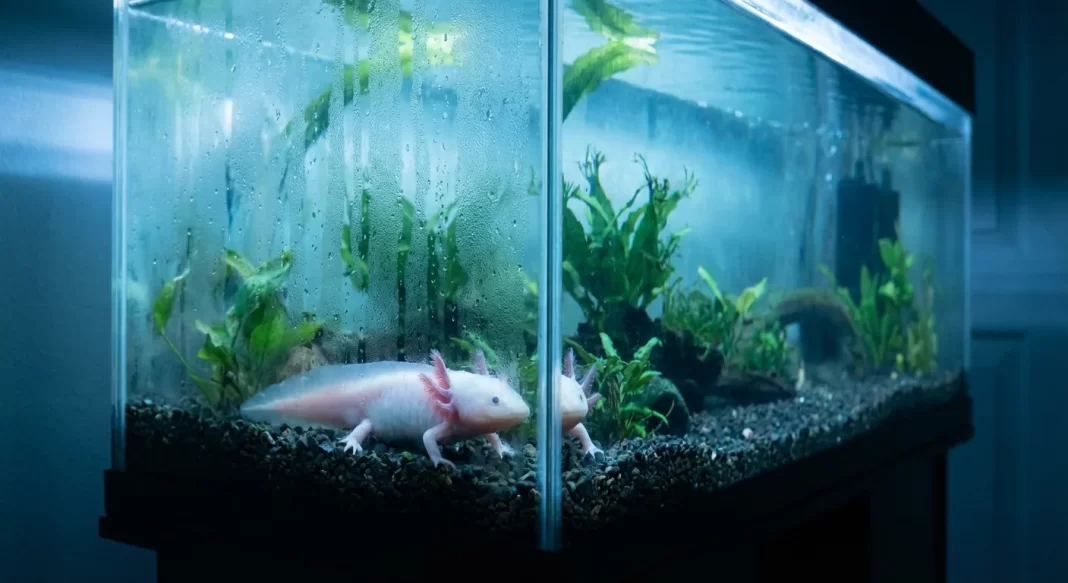
Heat is the most dangerous routine event for captive axolotls. If your tank climbs past 70 degrees Fahrenheit, start an evaporative fan, float a frozen 2L bottle of dechlorinated water, and close the blinds. Call an exotic-animal vet if food refusal lasts past 48 hours or gill or skin color shifts. The axolotl care guide covers the broader husbandry framework.
Why are axolotls so vulnerable to warm water?
Axolotls are cold-water ectotherms with no internal mechanism to regulate body temperature. Their immune response, organ function, and oxygen demand are controlled by the surrounding water. Above the 16 to 18 degree Celsius optimal range, multiple damaging processes start at once. Warmer water also holds less dissolved oxygen, so demand rises as supply falls.
Axolotls evolved in the spring-fed canals of Lake Xochimilco at high elevation, where summer water temperatures stayed cool year-round. The optimal captive range is 16 to 18 degrees Celsius (source: Axolotl.org captive requirements), and AxolotlCentral records that axolotls are most comfortable kept between 12 and 20 degrees Celsius, with 12 to 20 degrees Celsius spanning the broader tolerance window (source: AxolotlCentral care guide). Above this band, biological processes accelerate beyond what the animal can sustain.
The dissolved oxygen interaction is the most-overlooked part of the problem. Water holds less dissolved oxygen as temperature rises (source: USGS Water Science School on dissolved oxygen). At 16 degrees Celsius, fresh water can hold about 10 milligrams of dissolved oxygen per liter. At 25 degrees Celsius, the same water holds only about 8 milligrams per liter. Meanwhile, the axolotl’s metabolic demand rises sharply as an ectotherm warms. The animal needs more oxygen at the moment less is available.
The external gills make this worse. Each axolotl has three pairs of gill stalks covered in feathery filaments. The design maximizes surface area for oxygen absorption in still water. In warm water with reduced dissolved oxygen, the gills must work harder to extract what is available. The current and flow control guide covers the gas-exchange mechanism in more detail.
Above 22 degrees Celsius, immune suppression begins. The protective slime coat thins. Bacterial and fungal pathogens reproduce faster in warmer water. The animal’s ability to fight infection declines. This is why fungal outbreaks cluster in summer months even in tanks with otherwise good water quality. Above 24 degrees Celsius, organ stress accumulates. The axolotl’s liver, kidneys, and gill tissue are not built for warm-water operation. Sustained exposure at these temperatures can trigger disease and anorexia (per AxolotlCentral care guide) and can be fatal within days, not weeks.
Ammonia toxicity also amplifies. The proportion of un-ionized ammonia, which is the toxic form, increases with both temperature and pH. A tank reading at safe ammonia levels at 18 degrees Celsius may carry significantly higher effective toxicity at 26 degrees Celsius even with the same parts-per-million number. The temperature guide covers the full thermal biology framework. The water parameters guide covers ammonia targets and testing intervals.
Keepers who have managed axolotl collections through multiple summers consistently describe the 22-degree Celsius threshold as the line where proactive cooling becomes mandatory rather than optional. The tank cycling guide covers the parameter-stability baseline that any heat response builds on top of.
What is the heat-emergency decision tree by tank temperature?
Read your tank temperature against three tiers. Between 21 and 22 degrees Celsius, run a sustained evaporative fan and cut feeding. Between 22 and 24 degrees Celsius, add frozen-bottle rotation and a 20-percent partial water change with cooler dechlorinated water. Above 24 degrees Celsius, tub the axolotl at 4 degrees Fahrenheit per hour and call an exotic-animal vet.
Speed matters during a heat event, but so does matching the intervention to the temperature. Over-correcting with cold water causes thermal shock that can be worse than the original heat exposure. The table below structures the three response tiers, the specific actions for each, and the monitoring cadence.
| Tier | Tank temperature | Actions | Monitoring cadence |
|---|---|---|---|
| Mild | 21 to 22 degrees Celsius (70 to 72 degrees Fahrenheit) | Sustained evaporative fan, reduce feeding by half, close blinds and curtains, turn off tank light | Every 2 hours |
| Moderate | 22 to 24 degrees Celsius (72 to 76 degrees Fahrenheit) | Add frozen-bottle rotation, run 20-percent partial water change with cooler dechlorinated water, tank light off, room air conditioning if available | Every 30 minutes |
| Severe | Above 24 degrees Celsius (above 76 degrees Fahrenheit) | Tub the axolotl in 5+ gallons of cool dechlorinated water at no more than 4 degrees Fahrenheit per hour acclimation, contact exotic-animal vet, continue tank cooling in parallel | Every 15 minutes |
Mild tier (21 to 22 degrees Celsius)
A tank climbing into the 21 to 22 degree Celsius range is at the upper edge of tolerable but not in immediate danger. Start a clip-on evaporative fan blowing across the water surface. Reduce feeding by half because warmer water accelerates metabolic waste production. Close blinds and curtains on any window the tank can see, and turn off the dedicated tank light if you use one. Check temperature every two hours. If the trend is downward, hold the routine until the tank returns to 20 degrees Celsius. If the trend is flat or upward, move to the moderate tier without waiting.
Moderate tier (22 to 24 degrees Celsius)
At 22 to 24 degrees Celsius, the axolotl is in active heat stress. Add frozen 2-liter bottles of dechlorinated water to the tank and rotate them every 2 to 4 hours. Run a 20-percent partial water change with dechlorinated water that is 3 to 5 degrees Fahrenheit cooler than the current tank temperature, never colder than that gradient. Switch off the tank light entirely. If you have room air conditioning, drop the setpoint to maintain ambient room temperature below 22 degrees Celsius. Check temperature every 30 minutes and log readings on a sheet of paper near the tank. The water change schedule covers the emergency partial-change cadence. The dechlorinator guide covers dechlor dosing for both replacement water and frozen-bottle preparation.
Severe tier (above 24 degrees Celsius)
Above 24 degrees Celsius, the axolotl needs to leave the main tank. Tub the animal in a clean, food-safe plastic container of at least 5 gallons filled with cool dechlorinated water. The acclimation rate is critical. Do not drop the axolotl’s water temperature by more than 4 degrees Fahrenheit per hour. If the tank is at 27 degrees Celsius and your target tub temperature is 18 degrees Celsius, that is a 16-degree Fahrenheit drop, which requires at least 4 hours of staged transitions. Contact an exotic-animal vet through the ARAV directory (source: ARAV Find-A-Vet directory) while you work on cooling. The health red flags guide covers heat-stress symptoms that need vet documentation.
How do you verify your chiller is working during a heatwave?
A chiller that runs fine in mild weather can underperform during a heatwave. Check three things. Confirm the return-line temperature matches the setpoint with a separate thermometer. Inspect the condenser coil for dust buildup that blocks heat exchange. Ensure the room has enough ventilation that the chiller’s exhaust heat does not raise ambient temperature and feed back into the tank.
A chiller pulls heat from the tank water and exhausts it into the surrounding air through a refrigerant cycle. The mechanism depends on the chiller being able to actually reject heat to a cooler ambient environment. When the room itself heats up, chiller efficiency drops sharply. The axolotl chiller guide covers chiller sizing and equipment selection in more depth.
Check the return-line temperature
Place a separate digital thermometer at the chiller’s return inlet, the point where cooled water re-enters the tank. The reading should match the setpoint within 1 degree Celsius. If you set the chiller to 18 degrees Celsius and the return line reads 22 degrees Celsius, the chiller is not delivering rated cooling capacity. The cause is usually either a clogged condenser coil or insufficient room ventilation, both addressed below. A return-line temperature that matches the setpoint confirms the chiller itself is working, even if the tank average is climbing because of heat load elsewhere.
Inspect the condenser coil for dust
Most chillers have a finned heat-exchange coil that releases heat to the room air. Over months, dust accumulates on these fins and reduces airflow through the coil, which directly reduces heat rejection. Unplug the chiller. Vacuum the coil with a soft brush attachment. Severe buildup may need compressed air or a coil cleaning brush. Restore power. The chiller should now cycle less often to hold the setpoint, which is the signal that heat rejection has improved.
Verify room ventilation
The chiller’s exhaust heat goes into the room. In a closed bedroom or closet during a heatwave, that exhaust heat raises ambient temperature, which forces the chiller to work harder, which exhausts more heat. The feedback loop can defeat any chiller. Open a door to the rest of the home. Run a separate household fan in the room to circulate air. If the chiller sits inside an enclosed cabinet, open the cabinet door for the duration of the heat event. The tank setup guide covers the broader equipment-placement framework that includes chiller ventilation.
Across axolotl-keeper rescue networks reviewing heat-related cases where the chiller was running but the tank still climbed, the consistent pattern is that the room hosting the chiller was poorly ventilated. The chiller exhausts heat into the surrounding air. In a closed bedroom or closet during a heatwave, the exhaust heat raises ambient temperature, which makes the chiller work harder and exhaust more heat, which raises ambient further. Opening a door, running a separate fan in the room, or relocating the chiller to a basement breaks the feedback loop within hours.
How do evaporative fans cool an axolotl tank?
A clip-on aquarium fan blows air across the water surface. As water evaporates, it carries heat away from the remaining water and lowers the temperature by 2 to 5 degrees Fahrenheit in most dry conditions. The mechanism requires open evaporation, so the tank needs an open or mesh lid. In humid climates above 60-percent relative humidity, the effect drops sharply.
Evaporative cooling is the most accessible without-chiller method during a heat event. The equipment costs 15 to 40 dollars, plugs into a standard outlet, and clips to the tank rim. The mechanism is physics rather than active refrigeration.
How evaporation cools the tank
Every gram of water that evaporates from the tank surface carries with it approximately 580 calories of heat (the latent heat of vaporization at room temperature). The fan accelerates evaporation by moving humid air away from the surface and replacing it with drier room air. In dry conditions below 50-percent relative humidity, a single clip-on fan can hold a 40-gallon tank 3 to 5 degrees Fahrenheit below room temperature. In moderate conditions around 55 to 60 percent humidity, the effect drops to 2 to 3 degrees. Above 65-percent humidity, the effect is minimal.
Fan placement and lid configuration
Position the fan so airflow runs across the water surface, not down into the water column. Mount it at the tank rim, angled across the open top. The lid configuration matters as much as the fan placement. A sealed glass or acrylic lid traps humid air above the water surface and blocks evaporation. Use a mesh lid or remove the solid lid entirely while the fan is running. A lid of some form is required because axolotls have been known to leap from open tanks, often fatally (source: Axolotl.org filtration and housing). A mesh lid with gaps under 6 millimeters is the safest compromise.
Humidity-climate limitations
Evaporative fans work best in dry-heat climates. In humid coastal or tropical regions where summer humidity routinely exceeds 60 percent, fans alone are unlikely to provide sufficient cooling. In these conditions, the fan can still be used as a supplementary tool alongside frozen-bottle rotation or room air conditioning. A single fan will not move a tank from 24 degrees Celsius back to 20 degrees Celsius in 80-percent humidity. Plan for multiple cooling tools layered together in humid climates. The temperature guide covers the climate-specific equipment calculation. Evaporation also increases water level loss, so a tank running a fan continuously can lose 1 to 2 inches of water per week. Top off with dechlorinated water and remember that evaporation concentrates dissolved solids in the remaining volume.
How do frozen water bottles work for emergency cooling?
A sealed 2-liter bottle of dechlorinated water frozen solid absorbs heat as it melts. Each bottle provides 1 to 3 degrees Fahrenheit of cooling for 2 to 4 hours. Rotate bottles so a fully frozen one is always ready. Use dechlorinated water in case of a leak. Never put tap-water ice cubes in the tank.
Frozen bottles are the emergency cooling tool of choice when a chiller is not available. The technique is documented as a standard cool-down method (source: Axolotl.org care FAQ). They cost nothing beyond the bottles themselves, deploy in minutes, and produce predictable cooling.
Preparing dechlorinated 2L bottles
Fill empty 2-liter plastic bottles with water that has been treated with dechlorinator at the dose printed on the bottle label (per Axolotl.org filtration and housing, water added to an axolotl system must be dechlorinated). Cap them tightly. Place them in a freezer at standard household setting. Allow 24 to 36 hours for complete solid freezing. Keep at least 4 bottles in the freezer rotation during the warm months of the year. The 2-liter size is the right balance between thermal mass and freezer time. Smaller 500-milliliter bottles melt too quickly. Larger bottles take too long to freeze and may not refreeze fully between rotations.
Rotation cadence every 2 to 4 hours
Float one or two bottles in the tank when the temperature climbs above 21 degrees Celsius. The bottles will melt over 2 to 4 hours depending on tank water temperature and ambient room conditions. As one bottle becomes mostly water, remove it and replace with a fully frozen bottle from the freezer. Continue the rotation until the heat event passes. The rotation must continue overnight during sustained heat. Set a phone alarm if needed. The dechlorinator guide covers dechlorinator product selection and dose calculations for bottle preparation.
Why never tap-water ice cubes
Loose ice cubes from a household freezer are made with untreated tap water that contains chlorine or chloramine. Both are acutely toxic to axolotls. Even if you make ice from dechlorinated water, loose cubes melt rapidly and create localized cold zones near the axolotl that can cause thermal shock. Sealed frozen bottles are safer because they melt slowly, do not release any water into the tank, and can be removed and refrozen for reuse. The sealed-bottle method also lets you control which part of the tank the cold mass occupies. Float the bottle near the filter return or away from the axolotl’s resting zone to distribute cooling without creating a cold spot at the animal.
What emergency cooling works when you have neither chiller nor fan?
When neither chiller nor fan is available, drape a wet towel over the tank side and aim a household fan across the towel for evaporative cooling. For sustained heat above 26 degrees Celsius room temperature, move the tank to a basement or cooler interior room. Reusable ice packs in sealed plastic bags can float near the filter return.
These methods are improvisations for keepers caught without dedicated aquarium cooling equipment during an unexpected heat event. They work, but they require more attention than chiller or fan cooling.
Wet-towel-over-tank-side with household fan
Place a clean cotton towel soaked in cool tap water against the outside glass of the tank, draped over the rim or held in place with binder clips. Aim a household oscillating fan across the wet towel. Evaporation from the towel cools the glass, which transfers heat away from the tank water through the glass wall. The effect is 1 to 3 degrees Fahrenheit in dry conditions, less in humid weather. Rewet the towel every 30 to 60 minutes. The method works best for short emergency periods rather than sustained 24-hour cooling.
Basement or interior-room relocation
If room temperature climbs above 26 degrees Celsius and no other cooling is available, relocating the tank to a basement or interior room is the most reliable single intervention. Basements are typically 4 to 8 degrees Fahrenheit cooler than upstairs rooms in summer. The procedure is logistically demanding. Catch the axolotl in a soft net or a deep cup, transfer to a transport tub of original tank water, and cover the tub to reduce light stress. Move the tank empty after draining most of the water. Move the equipment and hardscape separately. Refill the relocated tank with the original water plus dechlorinated top-off. Reintroduce the axolotl when the tub temperature and the new tank temperature differ by no more than 4 degrees Fahrenheit.
Among keepers reporting heat-event injuries to axolotl rescue networks, the single most violated rule during panic-response is the 2-to-4 degrees per hour acclimation limit. A keeper moves the axolotl from 27-degree Celsius tank water directly to 16-degree Celsius tub water within a few minutes. The cold-shock injury is often worse than the original heat exposure. The acclimation step takes 6 to 9 hours when done correctly but prevents the secondary thermal injury that compounds the heat damage.
Reusable ice packs in sealed plastic bags
Standard freezer ice packs sold for camping coolers can supplement frozen-bottle rotation. Seal each pack inside a heavy-duty resealable plastic bag in case the pack itself leaks chemical gel into the tank. Float the bagged pack near the filter return or any high-flow zone so the cold water disperses rather than pooling. Each pack provides 1 to 2 degrees Fahrenheit of cooling for 3 to 6 hours depending on size. Rotate at least 2 packs so one is always frozen. The filtration guide covers filter return positioning that helps distribute cooling evenly.
What is the emergency tubbing protocol when nothing else is working?
Emergency tubbing moves the axolotl to a 5-plus-gallon food-safe container of cool dechlorinated water when the main tank stays above 24 degrees Celsius. Drop temperature no more than 4 degrees Fahrenheit per hour to avoid cold shock. Place the tub in the coolest room. Change tub water every 8 to 12 hours because the small volume lacks biological filtration.
Tubbing is the last-resort intervention when other cooling methods have failed to bring the main tank into safe range. The five-step protocol below is the canonical procedure.
Step 1: Confirm tank temperature with a second thermometer. A failing thermometer can trigger a false alarm. Use a second digital thermometer to verify the reading. If both thermometers agree that the tank is above 24 degrees Celsius and rising, proceed.
Step 2: Close blinds and turn off the tank light. Reduce all external heat inputs immediately. Close blinds, curtains, and shades on any window the tank can see. Turn off the dedicated tank light. Turn off room overhead lights that contribute warmth. Run any room air conditioning at its lowest setpoint.
Step 3: Set up an evaporative clip-on fan across the water surface with the lid open or mesh. If a fan is available, install it now. Remove the solid lid or replace with a mesh cover. Position the fan so airflow runs across the surface. The fan does not need to fully cool the tank by itself. It contributes to the parallel cooling effort while you prepare the tub.
Step 4: Float a frozen 2L bottle of dechlorinated water and rotate every 2 to 4 hours. Add one or two frozen 2-liter bottles to the tank. Float them away from the axolotl’s resting zone. Rotate with fully frozen bottles from the freezer as they melt.
Step 5: If temperature still climbs above 24 degrees Celsius, tub the axolotl in 5+ gallons of cool dechlorinated water at no more than 4 degrees Fahrenheit per hour acclimation rate. Prepare a 5-gallon or larger food-safe plastic container. Fill with dechlorinated water at a temperature no more than 4 degrees Fahrenheit cooler than the current tank temperature. Net or cup the axolotl gently and place in the tub. Over the next several hours, gradually replace tub water with progressively cooler dechlorinated water until the tub reaches 18 degrees Celsius. Place the tub in the coolest room available, away from windows. Change tub water every 8 to 12 hours because the small volume has no biological filtration and ammonia will accumulate. Continue tank cooling in parallel. The water testing guide covers the parameter-monitoring routine for the tub during extended use.
What heat-stress symptoms require a vet?
Call an exotic-animal vet when any of six symptoms appears. Refused food past 48 hours. Persistent gill curl after temperature is restored. Pale patches or white mucus tufts on skin or gills. Lethargy plateau where the animal stops responding to feeding. Surface gulping that does not resolve when water is cooled. Fungal growth during or after a heat event.
The table below structures the six escalation thresholds, what to document for the vet call, and the urgency flag.
| Symptom | Threshold | What to document | Vet-call flag |
|---|---|---|---|
| Refused food | More than 48 hours during the event | Last successful feeding date, food offered, temperature timeline | Yes if continues past 72 hours |
| Gill curl | Persists after temperature is restored to under 20 degrees Celsius | Photo of gills, temperature timeline, flow status | Yes if curl persists 72+ hours after temp restored |
| Pale patches or white mucus tufts | Any visible patch on skin or gills | Photo with date, body location, temperature peak | Yes immediately |
| Lethargy plateau | No response to feeding or movement near tank for 6+ hours | Last responsive behavior, temperature timeline | Yes if combined with any other symptom |
| Surface gulping unresponsive to cooling | Continues after temperature returns to under 22 degrees Celsius | Frequency of gulping per hour, dissolved oxygen test result | Yes if continues 24+ hours post-cooling |
| Fungal growth | Cotton-like white tufts on body, gills, or limbs | Photo, body location, days since heat event | Yes immediately |
Refused food past 48 hours
Appetite loss during a heat event is normal. Sustained refusal past 48 hours indicates the metabolic suppression has reached a level that needs medical attention. Document the last successful feeding date, what food was offered, and the temperature timeline. The vet will use this to assess whether secondary infection or organ damage is contributing.
Persistent gill curl after temperature restored
Flow-related gill curl typically reverses within hours of flow reduction. Heat-related gill curl may take days. Curl that persists more than 72 hours after temperature returns to under 20 degrees Celsius suggests structural damage to gill tissue rather than transient stress. The current and flow control guide covers the flow-stress differential. A vet exam differentiates heat damage from flow stress and other causes.
Pale patches or white mucus tufts
Any visible patch of unusual coloration or excess mucus on the skin or gills is an immediate vet flag. Pale patches indicate slime-coat breakdown under thermal stress. White mucus tufts can be the early stage of fungal infection that took hold during heat-induced immune suppression. Photograph the patches with a clear date stamp.
Lethargy plateau
Axolotls reduce activity in warm water as a natural response to thermal stress. A lethargy plateau is when the animal stops responding to feeding stimuli or movement near the tank entirely for 6 or more hours. This is past normal reduced activity into clinical distress. Combined with any other symptom on this list, it is an immediate vet call.
Surface gulping unresponsive to cooling
Surface gulping during a heat event is expected because dissolved oxygen is reduced. Surface gulping that continues after the tank has cooled to under 22 degrees Celsius indicates ongoing oxygen exchange problems, possibly from gill damage. Locate an exotic-animal vet through the ARAV directory (per ARAV Find-A-Vet directory). The health red flags guide covers the full differential diagnosis for surface gulping.
Fungal growth during or after the event
Heat-induced immune suppression sets up secondary fungal infection. Cotton-like white tufts on the body, gills, or limbs that appear during the event or in the first 1 to 2 weeks afterward should be photographed and sent to the vet immediately. The fungus itself may need anti-fungal treatment.
What is the recovery cadence after the heat event passes?
After the heat event passes, monitor water parameters daily for at least 7 days. Reintroduce feeding at half-normal portion for 3 days, then return to full. Avoid rearranging decor or hides for 14 days to reduce additional stress. Watch for secondary fungal growth that often follows heat events because the immune system was suppressed during the warm period.
The recovery period is when keepers most often miss the secondary complications that turn a heat event into a chronic problem.
Daily water testing for 7+ days
The cycle can be disrupted by the partial water changes performed during the heat event and by the metabolic spike that accelerated waste production. Test ammonia, nitrite, nitrate, and pH daily for at least 7 days after the event. Any ammonia or nitrite reading above zero needs an immediate partial water change. The water testing guide covers the test-kit protocol.
Half-portion feeding for 3 days
The animal’s appetite returns gradually. Offer half the normal portion for the first 3 days after temperature stabilizes. Remove any uneaten food within 2 hours. By day 4, return to the normal portion size if the animal is eating reliably. If appetite has not returned by day 4, escalate to a vet. The care guide covers the broader feeding framework.
No decor rearrangement for 14 days
Rearranging the tank during the recovery window adds environmental stress on top of the residual thermal stress. Hold all decor and hide positions stable for 14 days after the event. Resume the normal rearrangement cadence after the animal is feeding reliably and showing normal behavior. The cleaning routine guide covers the routine schedule that resumes after recovery.
Secondary fungal infection watch
The immune suppression during the heat event can take days to weeks to reverse. Cotton-like white tufts, redness around gill bases, or any unusual mucus accumulation should be documented and photographed. If fungus appears, contact a vet for anti-fungal treatment. The fungus is opportunistic and takes hold when the slime coat has thinned during heat stress. Summer heat also disrupts breeding-cycle conditioning by overriding the cold-phase trigger that spawning requires; the axolotl breeding setup guide covers the cold-phase trigger that summer overshoots can disrupt.
What should you NEVER do during an axolotl heat emergency?
Never add household tap-water ice cubes directly to the tank: chlorine kills nitrifying bacteria and cold shock injures gill tissue. Never swap the full tank volume in one go because parameter and temperature shock can be worse than the original heat. Never place the axolotl in a refrigerator or freezer. Never use commercial chemical cooling products for tropical fish.
The mistakes below are common during panic response. They make a heat event worse rather than better.
No tap-water ice cubes directly in the tank
Tap-water ice cubes carry chlorine or chloramine and cause localized cold shock at the melt point. Use dechlorinated frozen 2-liter bottles instead.
No full-volume water swap in one go
Replacing the entire tank volume in a single change causes parameter shock (pH, hardness, mineral content all shift abruptly) and temperature shock. A 20 to 30 percent partial water change is the maximum for emergency cooling. Repeat partial changes spaced 4 to 6 hours apart if more total replacement is needed.
No fridge or freezer placement
Refrigerators and freezers will drop the axolotl far below the cold tolerance of the species in minutes. The cold shock will be lethal. Use a basement, interior room, or cool tub instead.
No commercial chemical cooling products
Many products marketed as tank coolers or water chillers for tropical fish use evaporation enhancers or chemical reactions that are not safe for amphibians. Some contain compounds that disrupt the slime coat. None are tested for axolotl safety. Use mechanical methods only.
No chiller setpoint below 16 degrees Celsius
A chiller setpoint below 16 degrees Celsius is colder than necessary, slows biological filtration without benefit, and increases chiller wear from longer runtime. Set chillers between 16 and 18 degrees Celsius (per Axolotl.org captive requirements; AxolotlCentral records 12 to 20 degrees Celsius as the broader comfort range, per AxolotlCentral care guide). The 64 to 65 degree Fahrenheit setpoint is the standard.
Common axolotl hot-weather mistakes
The most common axolotl hot-weather mistakes share patterns. Assuming the room air conditioning is sufficient without measuring tank temperature. Running a fan with a sealed tank lid that blocks evaporation. Waiting until the tank reaches 26 degrees Celsius before deploying any cooling. Skipping dechlorinator on an emergency partial water change. Feeding a normal portion during the heat event.
Assuming the room AC is sufficient without measuring tank temperature
Room air conditioning sets ambient air temperature but cannot guarantee tank water temperature. A tank near a window, sharing a room with heat-generating appliances, or sitting on a sun-warmed surface can be 4 to 8 degrees Fahrenheit warmer than the room average. Always read the in-tank thermometer rather than assuming the room thermostat reading.
Running a fan with a sealed tank lid
A fan blowing on a sealed glass or acrylic lid produces no cooling because evaporation is blocked. Remove the solid lid or replace with mesh while the fan is running.
Waiting until the tank reaches 26 degrees Celsius
Cooling interventions are far more effective applied at 21 degrees Celsius than at 26 degrees Celsius. The thermal mass of the tank water resists rapid cooling. Starting at the mild tier as soon as the tank crosses 21 degrees Celsius is the difference between a minor inconvenience and an emergency.
Skipping dechlorinator on emergency partial water change
Even in a panic, the replacement water added during a partial change must be dechlorinated before it enters the tank. Chlorine kills nitrifying bacteria and damages gill tissue. The 2 minutes required to dechlorinate is non-negotiable.
Feeding normal portion during the heat event
Warmer water accelerates metabolic waste production and uneaten food decomposition. Continuing normal feeding compounds the water-quality decline during the event. Reduce feeding by half during mild and moderate tiers. Skip feeding entirely if the animal is refusing food.
Frequently asked questions
These are the questions keepers most often ask during or after a heat event. The answers assume a fully cycled tank with stable water chemistry. For broader temperature-management depth and the daily monitoring routine that surrounds heat response, see the linked sub-guides above.
Can I use ice cubes from a household freezer to cool my axolotl tank?
No. Ice cubes from a household freezer are made with untreated tap water that contains chlorine or chloramine, both of which are acutely toxic to axolotls and kill the nitrifying bacteria in your filter. Even ice made from dechlorinated water creates localized cold zones near the axolotl as it melts, which causes thermal shock to gill tissue. Sealed frozen 2-liter bottles of dechlorinated water are the safer alternative because they melt slowly, release no water into the tank, and can be rotated and refrozen.
How quickly can heat actually kill an axolotl?
At temperatures above 26 degrees Celsius, organ damage can begin within hours. Sustained exposure above 27 degrees Celsius is often fatal within 24 to 48 hours, depending on the individual animal’s health, age, and prior thermal history. Lower but still dangerous temperatures in the 22 to 24 degree Celsius range cause cumulative damage. Immune suppression and chronic stress shorten lifespan and increase disease susceptibility even if the animal survives each individual heat event without obvious signs.
Do axolotl tanks need a lid during summer when using a fan?
Fans require open-top or mesh-top access to work. A solid glass or acrylic lid traps humid air above the water surface and blocks evaporation, which is the entire mechanism the fan depends on. Use a mesh screen with gaps under 6 millimeters or remove the solid lid entirely while the fan is running. An open top increases evaporation and requires more frequent top-offs with dechlorinated water. If you use a mesh cover, ensure the gaps are small enough to prevent the axolotl from escaping during surface lunges at feeding time.
Should I feed my axolotl less during a heat event?
Yes. Warmer water accelerates metabolic waste production, and uneaten food decomposes faster, both of which degrade water quality at the worst possible time. Reduce feeding frequency by 25 to 50 percent during heat events, and remove any uneaten food within two hours. If your axolotl is refusing food entirely during a heat event, do not force-feed. Appetite loss is a stress response, and the animal will resume eating once temperatures return to the safe range. Reintroduce feeding at half-portion for the first 3 days of recovery.
What temperature should I set my chiller to during a heatwave?
Set the chiller setpoint to 18 degrees Celsius (64 degrees Fahrenheit). This places the tank in the middle of the 16 to 18 degree Celsius optimal range (per Axolotl.org captive requirements) and provides a buffer before reaching the 20 degree Celsius upper edge of the tolerance window (per AxolotlCentral care guide). Some keepers set it to 19 degrees Celsius (66 degrees Fahrenheit) to reduce runtime and electricity cost while maintaining a safe margin. Do not set below 16 degrees Celsius because unnecessarily cold water slows biological filtration without benefiting the animal and increases chiller wear from longer runtime.
Related guides
- Axolotl care guide: complete husbandry hub for new keepers
- Axolotl breeding setup: conditioning-phase temperature management for breeding tanks
- Axolotl chiller guide: chiller equipment selection and sizing standards
- Axolotl temperature guide: thermal-tolerance baseline and seasonal management
- Axolotl current and flow control: dissolved oxygen and flow-stress interactions under heat
- Axolotl water change schedule: emergency partial-change cadence during a heat event
- Axolotl water testing guide: post-event parameter monitoring
- Axolotl dechlorinator guide: dechlor for emergency partial change and frozen-bottle preparation
- Axolotl health red flags: heat-stress symptom catalog and vet escalation
- Axolotl tank setup guide: base tank layout and equipment placement
- Axolotl water parameters: ammonia targets and the temperature-toxicity interaction
- Axolotl filtration guide: filter return positioning that distributes cooling evenly
- Axolotl tank cycling guide: parameter-stability prerequisite for emergency response
- Axolotl cleaning routine: routine schedule that resumes after recovery window
By the ExoPetGuides editorial team (AI-assisted drafting; human-reviewed), reviewed by an exotic-animal veterinarian
Updated 2026-05-20
Primary sources: Axolotl.org captive requirements, Axolotl.org filtration and housing, Axolotl.org care FAQ, AxolotlCentral care guide, USGS Water Science School on dissolved oxygen, ARAV Find-A-Vet directory
Disclaimer: This content is for educational purposes only and is not a substitute for professional veterinary advice. Always consult a qualified veterinarian, ideally an exotic-animal specialist, for any health concern about your pet. Care recommendations may vary based on species, individual animal, and local regulations.