


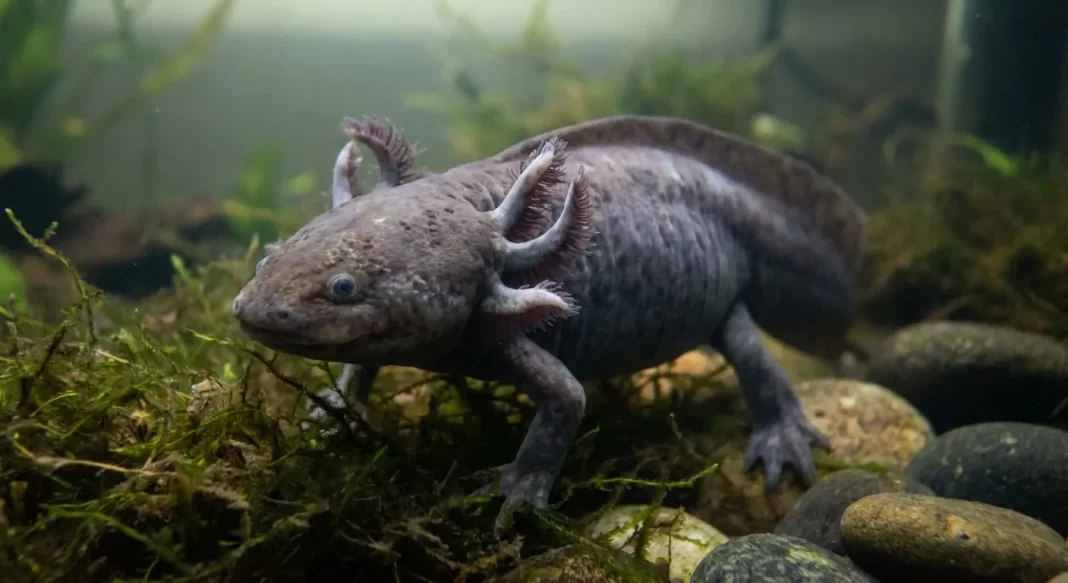
Every visible axolotl stress sign maps to an environmental cause. Water quality is the number-one cause in the majority of cases. Test ammonia, nitrite, nitrate, pH, and temperature before assuming illness. Correct the cause, and most signs resolve within 48 hours. Signs that persist after parameter correction require vet escalation via the ARAV directory.
What are the most common axolotl stress signs?
Axolotls do not vocalize or display mammalian distress signals. Every stress signal is physical: gill posture, skin color, slime, or appetite change. Earliest physical signs include forward gill curl, color paling, and slime overproduction. The most serious physical signs include curled tail tip combined with gill curl, sustained surface gulping, and visible body lesions that appear alongside other signs.
The physical signs catalog below lists each indicator roughly in order of how early it tends to appear, from the first subtle shifts a new keeper might miss to the overt distress signs that demand immediate action. The axolotl care guide covers the broader husbandry framework that prevents most situations where these signs would appear. The axolotl emergency care checklist covers the broader emergency-response sequence for severe combinations.
Forward gill curl
Forward-curled gills are among the earliest and most frequently reported stress indicators. In a relaxed, healthy animal, the external gill stalks fan outward and slightly backward, with the feathery filaments spread wide for maximum oxygen exchange. When an axolotl is stressed, the gill tips angle forward toward the snout, sometimes curling tightly enough to frame the face. The mechanism is partly protective and partly reflexive. Strong water current pushes filaments forward mechanically, and the axolotl tucks them to reduce drag. Chemical irritation from ammonia or nitrite causes inflammation that changes how the gills sit. Per Axolotl.org/health, water quality is probably the most important consideration when it comes to an axolotl’s health, and ammonia or nitrite build-up from inadequate biological filtration can be fatal in a matter of days if left unchecked (source: Axolotl.org health).
Pale or washed-out color
A healthy axolotl’s skin should look vivid and consistent with its morph. Wild-type axolotls show deep olive-brown with iridophore speckling. Leucistic axolotls are pale but with bright pink or red gills. Golden albinos are warm yellow. When any morph looks noticeably paler, duller, or more washed out than its baseline, something is wrong. Color paling happens because chromatophores, the pigment-containing cells in axolotl skin, contract in response to stress hormones. Cortisol release during acute stress causes rapid blanching visible within minutes. Chronic low-level stress produces a more gradual dullness that is easy to miss without baseline photographs for comparison.
Color darkening or blotchy
Some axolotls show the opposite response: darkening. Wild-type and melanoid axolotls may develop noticeably darker pigmentation under chronic stress, particularly in response to persistently dim conditions or elevated stress hormones. The skin can also develop a blotchy uneven appearance where some areas darken while others remain normal. Rapid blanching and rapid darkening can both occur in the same animal depending on the type and duration of stress. Acute stress tends to produce blanching. Chronic environmental stress tends to produce darkening. Compare current coloring to earlier photos. Review the lighting schedule for consistency.
Slime overproduction
A visible mucus film or stringy slime sloughing off the body indicates acute chemical or physical irritation. The slime coat is the axolotl’s first line of defense, and the animal increases mucus production in response to dissolved chemicals or physical contact damage. Slime overproduction often appears within hours of a water-quality crash, an undechlorinated water addition, or contact with a chemical irritant including soap residue on hands. The axolotl symptoms guide covers slime-coat changes alongside the broader symptom-to-diagnosis framework.
Curled tail tip
A curled tail tip, where the very end of the tail curls into a hook or spiral, is one of the more serious stress indicators. While gill curl is common and often resolves quickly with water corrections, a curled tail tip typically indicates more severe or prolonged stress. The physiological mechanism is muscular tension. Chronic stress causes sustained contraction of the tail musculature, pulling the tip into a curl. When combined with forward-curled gills, the combination strongly suggests the axolotl has been stressed for a significant period, not just minutes or hours. A tail curl combined with gill curl, appetite loss, and lethargy is a veterinary-level concern.
Sustained surface gulping
Healthy axolotls visit the surface occasionally to take a breath of air, then return to the bottom. Sustained surface gulping where the axolotl repeatedly returns to the surface to gulp air indicates dissolved-oxygen deficit from warm water or gill damage from chronic stressors. Warm water holds less dissolved oxygen and forces the axolotl to gulp atmospheric air to compensate. Per Axolotl.org/health, lower temperatures of 5 to 15 degrees Celsius are described as a general panacea for axolotls (per Axolotl.org health), which makes temperature reduction the standard first response when warm water is driving the surface gulping.
What behavioral stress signs do axolotls show?
Behavioral stress signs include glass surfing (repetitive wall pacing), sustained hiding over 48 hours when the axolotl normally emerges, refused food beyond two consecutive feeding days, frantic swimming or thrashing, and sustained lethargy beyond morning baseline. Each behavioral sign maps to a specific cause category and a first-response action.
The behavioral signs catalog complements the physical signs catalog. A keeper who sees only physical signs may miss a stress event that the axolotl is expressing through behavior change, and vice versa. The axolotl symptoms guide covers the broader symptom-to-diagnosis framework that includes both physical and behavioral indicators in a single triage reference.
Glass surfing
Glass surfing describes the behavior where an axolotl swims back and forth along the tank walls in a repetitive, pacing pattern. In fish keeping, the same behavior is called pacing and is widely recognized as a stress response. In axolotls, it carries the same meaning: the animal is trying to escape an environment it finds uncomfortable. Glass surfing is distinct from normal exploratory swimming that some axolotls do at night. The pacing version is repetitive, patterned, and direction-changing at the same point. Exploratory swimming is varied, curious, and often involves the axolotl pausing at decor or examining substrate.
Sustained hiding over 48 hours
Axolotls are naturally reclusive during daylight hours, so hiding alone is not a stress sign. The distinction is a change from the individual animal’s baseline. An axolotl that normally comes out at feeding time, explores during dusk, and rests in the open occasionally but now refuses to leave its hide for 48 or more consecutive hours is showing avoidance behavior. The most common causes are recent tank disturbance, aggressive tank-mate presence, excessive ambient light, or vibration from nearby foot traffic or appliances. The axolotl tank mates guide covers the cohabitation-stress framework for the tank-mate trigger.
Refused food beyond two feeding days
Axolotls are opportunistic feeders that typically strike at food the moment it is presented. A healthy axolotl that suddenly ignores bloodworms, pellets, or nightcrawlers is telling you something is wrong. Appetite loss is one of the earliest stress indicators because the stress response suppresses digestive function before more dramatic behavioral changes appear. The most likely causes are water temperature above the comfort band, ammonia or nitrite exposure, recent handling or tank disturbance, aggressive tank mates, or impaction.
Frantic swimming and thrashing
Frantic swimming is the most alarming stress behavior to witness. The axolotl darts around the tank in short rapid bursts, crashing into walls and decor, sometimes barrel-rolling or thrashing its body. Unlike glass surfing, which is repetitive and patterned, frantic swimming is chaotic and looks panicked. This behavior almost always indicates acute chemical or thermal distress. The axolotl is in pain or extreme discomfort and is attempting to flee something it cannot escape. The first response is to prepare a tub of clean dechlorinated temperature-matched water immediately and move the axolotl into it while the tank water is tested.
Sustained lethargy beyond morning baseline
Axolotls have a daily activity rhythm with reduced activity during peak daylight and increased activity at dusk and overnight. Sustained lethargy that extends through the normal active periods indicates suppressed metabolic function from cold-water-extreme, illness, or post-stress recovery. An axolotl that is normally responsive to a hand near the glass and now does not react warrants water testing and observation for other concurrent signs.
How severe is each stress sign? The severity-tier triage matrix
Stress signs fall into three tiers. MONITOR signs may resolve with environmental correction within 48 hours and require observation only. ACT signs require parameter testing and corrective action within 24 hours but rarely need vet escalation if caught early. EMERGENCY VET signs require contacting an exotic-amphibian vet within hours, including frantic-swimming-continues-after-correction and combination-of-three concurrent signs.
The triage matrix below consolidates the physical and behavioral signs catalogs into a single quick-reference table. Use it after reading the detailed sections above to map the specific sign you are observing to its likely cause, first action, and severity tier. The matrix is the operational tool for the de-stress protocol that follows.
| Sign observed | Most likely cause | First action | Severity tier |
|---|---|---|---|
| Forward gill curl | Flow stress, ammonia or nitrite, pH swing | Test water, baffle filter outflow, redirect current | MONITOR if isolated; ACT if persistent or concurrent |
| Pale or washed-out color | Acute disturbance, chronic water quality, illness | Test water, review recent changes, reduce light | MONITOR if transient; ACT if persistent over 48h |
| Color darkening or blotchy | Chronic stress, photoperiod disruption, sustained temperature stress | Test water, stabilize light cycle, photo-track baseline | MONITOR; ACT if concurrent with other signs |
| Slime overproduction | Acute chemical or physical irritation | Tub in clean water, identify and remove irritant source | ACT |
| Curled tail tip | Prolonged chronic stress, systemic illness | Test water, evaluate combination signs, vet consult | ACT; EMERGENCY VET if combined with gill curl plus appetite loss |
| Sustained surface gulping | Low dissolved oxygen from warm water, gill damage | Reduce temperature, add air stone placed away from rest area, test water | ACT |
| Glass surfing | Poor water quality, excessive flow, no hides, tank too small | Test water, baffle flow, add hides, evaluate tank size | ACT |
| Sustained hiding over 48 hours | Recent disturbance, tank-mate aggression, light or vibration | Test water, review lighting and traffic, observe tank mates | MONITOR; ACT if concurrent with appetite loss |
| Frantic swimming and thrashing | Ammonia spike, chlorine, chemical contamination, medication overdose | Emergency tub in clean dechlorinated water, immediate parameter test | EMERGENCY VET if persists after correction |
| Refused food beyond 48 hours | Temperature above 68 F, ammonia, infection, recent disturbance | Test water, check temperature, try different food | ACT |
What causes axolotl stress? The root-cause matrix
Five root causes produce the vast majority of axolotl stress: water quality (number one in most cases), temperature outside the 12 to 20 degrees Celsius comfort band, excessive water flow forcing constant swimming, cohabitation issues from tank-mate aggression or chronic-presence stress, and recent handling or transport. The de-stress protocol targets each cause in sequence.
The root-cause matrix below maps each cause to the signs it typically produces and the relevant deeper-protocol cross-link. Many signs are produced by multiple causes, so identifying the correct root cause requires both observing the sign pattern and testing water parameters as the first diagnostic step. A pale axolotl with forward gill curl in a tank reading 0.5 ppm ammonia points to water quality. The same pale axolotl in a tank with parameters reading clean but at 23 degrees Celsius points to temperature. Test before assuming.
| Root cause | Typical signs produced | Cross-link for deeper detail |
|---|---|---|
| Water quality (number one cause) | Forward gill curl, pale color, slime overproduction, frantic swimming, glass surfing, refused food, surface gulping | axolotl water testing guide + ammonia burn guide |
| Temperature outside 12 to 20 C | Refused food, sustained surface gulping, lethargy or hyperactivity, immune-suppression onset | temperature guide + hot weather setup |
| Excessive water flow | Forward gill curl, sustained swimming, exhaustion-related lethargy, glass surfing | current and flow control |
| Tank-mate aggression or presence | Hiding, refused food, gill nips, bite injuries, glass surfing | axolotls tank mates guide |
| Recent handling, transport, or disturbance | Pale color, slime overproduction, transient hiding, transient refused food | Acclimation 48 to 72 hours typically resolves; monitor for parameters |
How does water quality cause stress? (root cause number one)
Poor water quality causes more axolotl stress than all other factors combined. The water-quality-first principle states that ammonia, nitrite, nitrate, pH, and temperature must be tested before any other intervention. No amount of medication, tubbing, or environmental adjustment will resolve a stress sign if the underlying water is still poisoning the animal.
Ammonia is the most acutely toxic parameter. Even 0.25 ppm ammonia irritates gill tissue, suppresses appetite, and triggers gill curl. Keeper-community thresholds widely treat 1 ppm and above as the band where ammonia produces chemical burns on the gills and skin, frantic swimming, and rapid deterioration if uncorrected. Per Axolotl.org/health, ammonia and nitrite build-up from inadequate biological filtration can be fatal in a matter of days if left unchecked. Nitrite is similarly toxic at low concentrations because it binds to hemoglobin and reduces the blood’s oxygen-carrying capacity. Nitrate is less acutely dangerous but causes chronic stress and immunosuppression above 20 ppm.
Ammonia and nitrite gill-tissue irritation
Dissolved ammonia attacks gill filaments directly because the same large vascular surface that absorbs oxygen also absorbs the toxin. The result is inflammation that the axolotl signals through forward gill curl, then through slime overproduction, then through frantic swimming as the irritation intensifies. Nitrite produces a brownish-pale gill color rather than the normal deep red because nitrite-bound hemoglobin (methemoglobin) cannot carry oxygen efficiently. Both compounds require an immediate partial water change of 30 to 50 percent with temperature-matched dechlorinated water as the first response. The axolotl ammonia burn guide covers the broader ammonia-burn first-response protocol.
Nitrate chronic-stress suppression
Nitrate is the final product of nitrification and is the least acutely toxic of the three nitrogen compounds. Above 20 ppm in the main tank, however, nitrate causes chronic stress that suppresses immune function and increases secondary-infection susceptibility. Routine partial water changes are the primary tool for keeping nitrate below 20 ppm. The axolotl cloudy water fix covers the broader water-quality remediation framework.
pH swings outside 6.5 to 8.0
Most keeper-community pH guidance places the axolotl comfort range between 6.5 and 8.0 with 7.4 to 7.6 ideal. A pH that drops sharply during a water change or rises slowly through hardness depletion stresses the axolotl by changing the ionic balance of the water. Stable pH within the comfort range is more important than chasing a specific number.
Keepers who track daily gill posture alongside water-test logs consistently catch parameter problems 6 to 12 hours before the same problems register on a liquid test kit. Forward gill curl appears as the body’s early-warning indicator of dissolved chemical irritation while the readings themselves are still in the borderline-but-not-yet-flagged range. Logging both observations together turns a daily 30-second visual check into a cycle-instability detection system.
How does temperature cause stress? (root cause number two)
Per the AxolotlCentral care guide, axolotls are most comfortable kept in water between 12 and 20 degrees Celsius; over 22°C suppresses immune response and over 24°C can be fatal (source: AxolotlCentral care guide). Temperature stress produces appetite loss, gill deterioration, increased infection susceptibility, and in acute spikes the frantic swimming associated with thermal distress.
Temperature is the second most common root cause of axolotl stress after water quality. Unlike water quality, temperature problems develop slowly through summer warming or sudden through cooling failure, and the signs may not appear until the temperature has been elevated for days. Many keepers underestimate how much summer room warming raises tank temperature, particularly in apartments without air conditioning.
Above 68 F: metabolic stress begins
At water temperatures above 20 degrees Celsius (68 degrees Fahrenheit), the axolotl’s metabolic rate begins increasing faster than the animal can compensate. Dissolved oxygen drops because warm water holds less oxygen. Bacterial growth in the water accelerates. Appetite typically declines first, followed by surface gulping as the dissolved oxygen drops below the comfortable threshold. The axolotl hot weather setup covers prevention protocols for warm-weather seasons.
Above 22 C: immune suppression onset
Per AxolotlCentral, sustained exposure over 22 degrees Celsius (71.6 degrees Fahrenheit) is stressful and suppresses immune response (per AxolotlCentral care guide). This is the threshold where chronic temperature stress crosses into immune-compromised territory and infection susceptibility climbs sharply. Fungal infections including Saprolegnia frequently establish in axolotls held at sustained warm temperatures because the immune suppression and the pathogen advantage happen simultaneously. The axolotl fungus guide covers the stress-to-secondary-infection detail for Saprolegnia in temperature-compromised axolotls.
Below 50 F: slow-metabolism baseline
The cool end of the comfort band is therapeutic and is not stressful for healthy axolotls. Per Axolotl.org/health, lower temperatures of 5 to 15 degrees Celsius are described as a general panacea for axolotls and the keeper-community standard for tubbing recovery is the cool end of the comfort band (per Axolotl.org health). Slow metabolism at lower temperatures means reduced feeding intake which is physiologically appropriate, not pathological. The axolotl heat spike emergency covers emergency cooling protocols for the rare acute heat events that push tank temperature into the danger range.
How do flow and cohabitation cause stress?
Axolotls evolved in slow-moving water and have no adaptation for sustained current. Even filters rated appropriately for tank volume can produce too much flow if outflow is not baffled. Aggressive tank mates produce chronic stress through bite injuries and visual disturbance. Even the mere presence of fast-moving fish in the tank can stress an axolotl through lateral-line pressure detection.
Flow and cohabitation are the third and fourth most common root causes after water quality and temperature. Both share the property that they create chronic low-grade stress rather than acute crises, which makes them harder to detect because the signs appear gradually rather than suddenly.
Flow forces sustained swimming and gill displacement
Strong current forces axolotls to swim constantly, which exhausts them, and mechanically pushes gill filaments forward. Even a filter rated appropriate for the tank volume can produce too much flow if the outflow is not baffled or redirected. The forward gill curl that develops in a high-flow tank is partly a drag-reduction reflex and partly the result of sustained physical pressure on the filaments. The axolotl current and flow control guide explains how to reduce flow without sacrificing filtration through spray bars, sponge pre-filters, and outflow redirection.
Cohabitation: chronic anxiety vs visible aggression
Aggressive or nippy tank mates create chronic stress through direct physical harassment. Fish species like guppies, tetras, and barbs will nip axolotl gills and tails. Even other axolotls can be problematic if there is a significant size difference, as larger axolotls may bite smaller ones. The stress from tank-mate aggression produces hiding, appetite loss, and gill damage that mimics water quality problems. But the more subtle form of cohabitation stress is the chronic anxiety produced by fast-moving tank mates that never actually attack. The lateral line system detects pressure waves in the water and the constant presence of active fish triggers sustained defensive alertness even when no biting occurs. The axolotls tank mates guide covers the broader cohabitation framework including the recommended species-not-to-cohabit list.
Recent handling and transport
Handling causes acute stress through removal from water, slime-coat damage from skin contact, and the disorientation of being moved to a new container. Transport from a breeder or pet store can cause stress signs that last 48 to 72 hours into the new home. These are typically self-resolving if the new tank parameters are clean and stable. Minimize disturbance during this acclimation window. The axolotl quarantine guide covers the 30-day new-arrival protocol that monitors for stress resolution alongside parasite and disease screening.
What is the de-stress protocol when you spot a stress sign?
The universal 5-step de-stress protocol applies when any stress sign appears. Test ammonia, nitrite, nitrate, pH, and temperature first. Correct any out-of-range parameter via partial water change with dechlorinated temperature-matched water. Drop temperature to the cool end of the comfort band if temperature is the cause. Tank rest day with no further disturbance. Retest after 24 to 48 hours.
The protocol exists because skipping these steps is the most common path to harm. Testing water first eliminates the largest single cause. Correcting the parameter resolves the majority of stress signs without further intervention. The temperature drop and rest day support recovery for cases where stress has already accumulated. Retesting after 24 to 48 hours confirms whether the correction is working or whether escalation is needed.
Step 1: Test water parameters
Test ammonia, nitrite, nitrate, pH, and temperature with a liquid-reagent test kit. The majority of axolotl stress signs trace to water quality, not exotic conditions. If any parameter is out of range, the parameter correction in Step 2 is the priority. The axolotl water testing guide covers the full test cadence including how to interpret borderline readings.
Step 2: Correct any out-of-range parameter
Perform a 30 to 50 percent water change with temperature-matched dechlorinated water using a conditioner like Seachem Prime. For ammonia or nitrite spikes, the partial water change reduces the toxic concentration immediately. For nitrate creep above 20 ppm, the partial water change resets the baseline. For pH out of range, identify whether the cause is acidic buildup (more common) or hardness depletion. The axolotl water parameters guide covers the safe ranges and correction protocols for each compound.
Step 3: Drop temperature to cool end of comfort band if temperature is the cause
If the water test shows clean parameters but the temperature reads above 20 degrees Celsius, the stress is likely temperature-driven. Drop temperature gradually to 15 to 17 degrees Celsius through frozen-water-bottle floats, room cooling, or chiller activation if equipment is available. Per Axolotl.org/health, the cool-water range is therapeutic for stress recovery, with lower temperatures of 5 to 15 degrees Celsius described as a general panacea (per Axolotl.org health). The axolotl temperature guide covers the broader temperature framework.
Step 4: Tank rest day with no further disturbance
After parameter correction and temperature drop, give the axolotl 24 to 48 hours of rest with no further disturbance. Reduce light levels. Skip a feeding to reduce digestive load and waste production. Do not perform additional water changes during the rest day unless parameters cross back into out-of-range territory. The rest day allows the axolotl’s stress response to subside and the gill tissue and slime coat to recover. The axolotl quarantine guide covers the sick-tub protocol for cases where the main tank cannot be made stress-free for the rest period.
Step 5: Retest parameters and observe after 24 to 48 hours
Retest ammonia, nitrite, nitrate, pH, and temperature after the rest day. If parameters are now in range and the stress signs are improving, continue normal husbandry with closer-than-usual monitoring for the next week. If parameters are in range but the stress signs persist or have worsened, the stress is not water-quality-driven and requires escalation to vet consultation. The axolotl emergency care checklist covers the broader emergency-response framework for cases that do not resolve with the de-stress protocol.
Vet-tech teams working with amphibian patients report that the most common owner mistake after stress signs appear is waiting too long, assuming the animal will recover on its own. Axolotls mask illness until they are severely compromised, and by the time visible lesions or extreme lethargy appear, the underlying problem has often been developing for days. Early intervention, starting from the first stress sign, produces significantly better outcomes than waiting to see what happens.
When does stress become a medical emergency? Vet escalation thresholds
Not every stress sign requires a vet. Most resolve with environmental correction. But some combinations and durations cross into medical territory where an exotic-amphibian veterinarian needs to intervene. The Association of Reptile and Amphibian Veterinarians (ARAV) maintains a searchable directory of qualified exotic vets (source: ARAV Find-A-Vet directory). Identify an amphibian-experienced vet before an emergency.
Five thresholds escalate stress to a medical emergency. The table below consolidates the thresholds with the specific sign-combinations or durations that trigger each. Apply the table after the 5-step de-stress protocol has been followed and the 24 to 48 hour observation window has elapsed. The axolotl symptoms guide covers the broader symptom-to-diagnosis reference that complements this stress-specific escalation matrix.
| Threshold | Specific trigger | Action |
|---|---|---|
| Single sign persists past 48 hours after parameter correction | Gill curl, pale color, refused food, glass surfing, or hiding does not resolve within 48 hours of confirmed clean water | Contact ARAV vet (per ARAV Find-A-Vet directory) |
| Two or more concurrent stress signs | Two or more signs appear in the same animal at the same time | ACT level; contact vet if not resolving in 24 hours |
| Frantic swimming continues after correction | Frantic swimming persists after the axolotl has been moved to a tub of clean dechlorinated water for 30 minutes | EMERGENCY VET |
| Combination: curled tail plus gill curl plus appetite loss for 72 hours | Three-sign combination persists three days | EMERGENCY VET |
| Unresponsiveness | Axolotl does not react to food, gentle water movement, or careful prodding | EMERGENCY VET |
Per Axolotl.org/health, in all cases of disease or stress, isolation of the affected animal is strongly recommended (per Axolotl.org health). Tub the axolotl in clean dechlorinated water at the cool end of the comfort band while contacting the vet. The axolotl medication safety guide covers the do-not-medicate-without-diagnosis principle that applies whenever vet consultation is pending.
Frequently asked questions
Can an axolotl be stressed by lighting alone?
Yes. Axolotls lack eyelids and are highly sensitive to bright light. Overhead tank lights that are too intense or left on for extended periods cause photostress, which manifests as persistent hiding, appetite suppression, and in some cases glass surfing to escape the light. The solution is to keep lighting dim, provide multiple shaded hides, and maintain a consistent 12-hour on and 12-hour off photoperiod. LED lights with dimmable settings give the most control. Keepers running lights brighter than ambient room light or for periods longer than 12 hours commonly produce photostress without realizing it.
How quickly should stress signs resolve after fixing the cause?
Gill curl from flow issues can resolve within hours of baffling the filter outflow. Appetite typically returns within 24 to 48 hours of correcting water quality or temperature. Color changes from acute stress (pale or dark shifts) usually normalize within 24 to 72 hours. Glass surfing driven by water quality problems often stops within 12 to 24 hours of a water change. If any sign persists beyond 72 hours after confirmed correction of the suspected cause, treat it as a possible medical issue rather than simple environmental stress and consult an exotic vet.
Is it normal for a new axolotl to show stress signs after being brought home?
Relocation stress is expected. A new axolotl may show gill curl, appetite loss, excessive hiding, and pale coloring for the first 48 to 72 hours in a new tank. This is a normal acclimation response, provided the tank is fully cycled and parameters are within safe ranges. Do not attempt to force-feed or constantly check on the animal during this period. Minimize disturbance, keep lights dim, and offer food once daily without removing uneaten food for at least 12 hours. Most healthy axolotls begin eating and exploring within 3 to 5 days of arrival.
Can tank mates cause stress even without visible aggression?
Yes. The mere presence of fast-moving fish in the tank can produce chronic low-level stress in axolotls through constant visual stimulation and pressure-wave disturbance detected by the lateral line. An axolotl does not need to be bitten to be stressed by a tank mate. Persistent proximity of active fish, especially at night when the axolotl is most active, triggers defensive alertness that suppresses normal resting and feeding behavior. Remove active fish from the tank even if no bites or chasing have been observed if the axolotl shows hiding or appetite suppression.
My axolotl’s gills look fine but the tail tip is curled. Should I be worried?
A curled tail tip without gill curl is less common and warrants careful investigation. Check all water parameters, verify temperature is within range, especially at night when room heating may cycle differently, and inspect for any tank-mate injuries. The tail tip can also curl from physical damage to the tail itself. If water is clean, temperature is stable, and there are no tank mates, monitor closely for 48 hours. If the curl persists or other signs appear, consult an exotic veterinarian via the ARAV directory. The combination of tail curl plus gill curl plus appetite loss for 72 hours is an emergency vet trigger.
- Axolotl care guide: complete husbandry hub for new keepers
- Axolotl emergency care checklist: broader emergency-response framework and triage matrix
- Axolotl fungus guide: stress-to-secondary-infection cross-link and protocol detail
- Axolotl symptoms guide: A-to-Z symptom-to-diagnosis reference
- Axolotl ammonia burn guide: water-quality first-cause first-response
- Axolotl water testing guide: parameter diagnosis and test cadence
- Axolotl temperature guide: temperature-stress framing and comfort band
- Axolotl current and flow control: flow-stress remediation
- Axolotls tank mates guide: cohabitation-stress framework
- Axolotl hot weather setup: heat-stress prevention
- Axolotl heat spike emergency: acute heat stress response
- Axolotl medication safety: do-not-medicate-without-diagnosis
- Axolotl quarantine guide: sick-tub recovery protocol
- Axolotl injury and regeneration guide: physical-trauma stress
- Axolotl impaction guide: impaction-stress cross-protocol
- Axolotl water parameters: parameter targets reference
- Axolotl cloudy water fix: water-quality remediation
- Axolotl health red flags: chronic-symptom catalog
By the ExoPetGuides editorial team (AI-assisted drafting; human-reviewed), reviewed by an exotic-animal veterinarian
Updated 2026-05-20
Primary sources: Axolotl.org health, AxolotlCentral care guide, ARAV Find-A-Vet directory
Disclaimer: This content is for educational purposes only and is not a substitute for professional veterinary advice. Always consult a qualified veterinarian, ideally an exotic-animal specialist, for any health concern about your pet. Care recommendations may vary based on species, individual animal, and local regulations.