


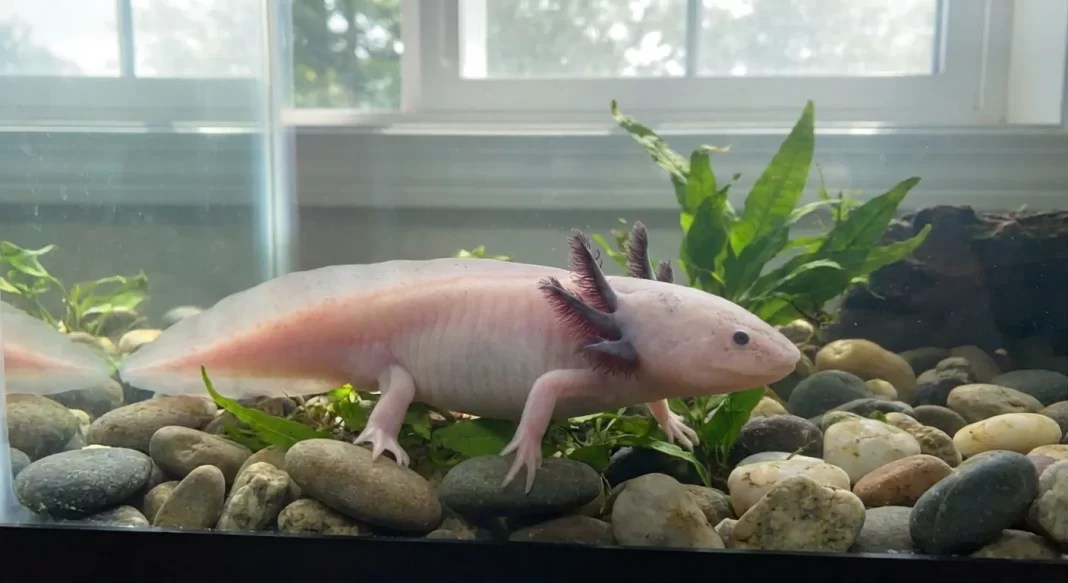
A heat spike that pushes axolotl tank water above 22 degrees Celsius needs immediate cooling within the first 30 minutes. Turn off the light and any heater. Deploy a frozen sealed dechlor water bottle. Position a fan across the surface. Target a 1-degree-Celsius drop per hour. Tub at 24 degrees Celsius. Vet contact if no improvement after 2 hours.
What counts as a heat-spike emergency and what does it look like in your axolotl?
A heat-spike emergency triggers when tank water reads above 22 degrees Celsius or when room ambient reaches 25 degrees Celsius and is climbing toward the tank within 4 to 12 hours. The fatal threshold is 24 degrees Celsius. Heat suppresses the immune system, reduces dissolved oxygen, and accelerates pathogen growth.
Per Axolotl.org, the optimum temperature for axolotls is between about 16 and 18 degrees Celsius (source: Axolotl.org captive requirements), with a 12-to-20-degree comfort band per AxolotlCentral (source: AxolotlCentral care guide). Above 22 degrees Celsius extended exposure suppresses immune response per AxolotlCentral (per AxolotlCentral). Above 24 degrees Celsius per Axolotl.org is very stressful, and the stress resulting from more than a day or two will quickly lead to disease and death (per Axolotl.org captive requirements). The axolotl care guide covers the broader husbandry framework that prevents most heat events. The temperature guide covers the full operating range and threshold biology.
| Stage | Sign | Severity | First response |
|---|---|---|---|
| Stage 1 (early stress) | Rapid gill movement (faster than normal flicking) | Mild | Confirm temperature; deploy first cooling |
| Stage 2 (active distress) | Repeated surface gulping (more time at surface than substrate) | Moderate | Continue cooling; verify dissolved oxygen |
| Stage 3 (metabolic accumulation) | Lethargy plus appetite loss | Moderate | Continue cooling; document onset |
| Stage 4 (tissue compromise) | Pale mucus patches developing on skin | Severe | Tub in cool dechlor; prepare vet contact |
| Stage 5 (secondary colonization) | Fungal bloom (Saprolegnia) on gills or body | Severe | Tub; cross-reference fungus guide; vet contact |
| Stage 6 (late-stage stress) | Forward-curled gills with floating, tail curling | Critical | Tub immediately; vet emergency |
Rapid gill movement
Healthy axolotl gills fan gently and rhythmically. When water temperature rises, dissolved oxygen concentration drops because warm water holds less dissolved gas than cold water (source: USGS Water Science School on dissolved oxygen). The axolotl compensates by increasing its gill flick rate to pull more oxygen from the water column. Rapid gill movement at normal temperatures can also indicate ammonia exposure, so always cross-reference with a temperature reading and a water parameter test. The water testing guide covers the parameter test protocol.
Surface gulping
Axolotls are primarily gill breathers but retain functional lungs. When dissolved oxygen drops far enough that gill respiration alone cannot sustain the animal, the axolotl rises to the surface and gulps air. Occasional surface visits are normal. Repeated, frequent gulping where the axolotl is spending more time near the surface than at the bottom is an active distress signal during a heat event. The current and flow control guide covers surface agitation methodology that supports dissolved oxygen.
Lethargy and loss of appetite
An axolotl that was eating normally yesterday and refuses food today, combined with water temperature above 22 degrees Celsius, is almost certainly experiencing heat stress. Lethargy presents as the axolotl resting in one position for long periods without responding to food or stimulation. This is distinct from normal resting behavior because a healthy axolotl at appropriate temperatures still responds when food is introduced.
Pale mucus patches and fungal bloom
As heat stress progresses, pale patches of mucus-like material can develop on the skin. These result from the mucous layer breaking down under thermal stress and creating an environment where opportunistic pathogens colonize. When water temperature stays elevated for more than 24 hours, fungal organisms (particularly Saprolegnia species) can colonize damaged skin and gill tissue. Per Axolotl.org, Saprolegnia is the most common true fungus found in freshwater and is rarely fatal if treated early (source: Axolotl.org health). The axolotl fungus guide covers identification, salt-bath protocols, and treatment timing. This is a critical cross-reference because post-heat fungal-bloom is the most common follow-up emergency.
Forward-curled gills and late-stage stress
Per Axolotl.org/health, forward-turned gills are typical of an axolotl stressed by flowing water, but during a sustained heat event the same forward-curl pattern appears as a general acute-stress indicator (per Axolotl.org health). Combined with floating behavior or tail curling, forward-curled gills indicate the animal is in acute late-stage distress and needs immediate intervention. The health red flags guide covers the broader symptom catalog distinguishing acute from chronic presentations.
What is the time-window response framework?
Five response windows structure the emergency. The first 30 minutes establish temperature confirmation and deploy initial cooling. The first 60 minutes execute the bottle rotation and prep tubbing. The first 4 hours assess trajectory and decide tubbing. The first 24 hours stabilize and test parameters. The 48-hour monitoring catches secondary infection.
The time-window framework matters because each window has its own primary actions and its own decision points. Treating a heat spike as a single response misses the structure: the early windows are about deploying cooling correctly, the middle windows are about assessment and tubbing decisions, the later windows are about stabilization and secondary-infection prevention. The emergency care checklist covers the broader 4-type emergency framework (water-quality + heat + injury + disease) that routes the heat-emergency subprotocol to this article.
| Time window | Primary actions | Decision point |
|---|---|---|
| First 30 minutes | Confirm temperature with digital probe; turn off lights and any heater; deploy first frozen sealed dechlor bottle; position fan across surface; lower room temperature | If temperature dropping at 1°C/hour, continue to 60-min window. If still climbing, escalate prep tubbing immediately. |
| First 60 minutes | Rotate frozen bottles swapping thawed for fresh; prep tubbing supplies and pre-cooled dechlor water; prep chiller commissioning if available; monitor every 10-15 minutes | If tank reaches 16-20°C range, continue to 4-hour assessment. If above 24°C and still climbing, tub immediately. |
| First 4 hours | Tub at 24°C threshold if cooling not achieved; assess recovery trajectory by gill rate slowing, surface gulping reducing, color returning; vet contact if no improvement | If symptoms improving, continue to 24-hour window. If non-responsive or worsening, vet emergency. |
| First 24 hours | Stable temperature maintained 6-12+ hours; water test all parameters; partial 20-30% water change; gradual feeding reintroduction; document the event | If parameters stable and behavior recovered, transition to 48-hour monitoring window. |
| 48-hour secondary-infection monitoring | Inspect gills/body/tail twice daily for fungal growth; monitor appetite recovery within 24-48 hours; test ammonia/nitrite daily 5-7 days; behavioral observation | If fungal tufts appear, escalate to fungus-guide protocol. If cycle disruption, 20-30% partial change. |
What do you do in the first 30 minutes of a heat spike?
Within 30 minutes confirm tank temperature with a digital probe thermometer not a stick-on strip. Turn off the tank light and any submersible heater immediately. Deploy the first frozen sealed dechlorinated water bottle into the tank. Position a clip-on or desk fan across the surface for evaporative cooling. Lower the room ambient.
The first 30 minutes determine whether the cooling response stays ahead of the temperature climb or falls behind it. Speed matters but procedure matters more. Each step removes a heat source or adds a cooling source without introducing thermal-shock risk.
Keepers who lose animals to summer heat are not typically the ones who lacked equipment. They are the ones who lacked a prepared frozen-bottle rotation in the freezer at the start of the season. Preparation is the decisive variable. The intervention that prevents the most heat-event mortality is having three to four bottles already frozen by the first week of June, not buying or refilling them after the temperature is climbing.
Step 1: Confirm the temperature (minute 0 to 2)
Read the tank thermometer. If only a stick-on thermometer is available, submerge a separate digital probe thermometer to get an accurate reading. Stick-on models measure the glass surface, not the water, and can read several degrees lower than actual water temperature. Write down the reading and the time. The starting point becomes critical for tracking the cooling rate.
Step 2: Turn off heat-producing equipment (minute 2 to 5)
Turn off the tank light immediately. Aquarium lighting, especially incandescent or halogen fixtures, adds heat to the water. LED lights produce less heat but still contribute. If a submersible heater is installed (some keepers use one during winter), confirm it is off and unplugged. Check that the room does not have a space heater or heating vent directed at the tank. Close blinds or curtains if direct sunlight hits the tank.
Step 3: Deploy first frozen water bottle (minute 5 to 10)
Float one frozen sealed dechlorinated water bottle in the tank. Per Axolotl.org, the bottle is filled to between 80 and 90 percent capacity and then frozen solid (per Axolotl.org captive requirements). Do not add loose ice cubes or ice directly to the water. Loose ice introduces chlorinated tap water into the tank as it melts and creates extreme localized cold spots that can thermally shock an axolotl that swims into contact with it. The dechlorinator guide covers Prime dosing for the bottle-fill water preparation.
For tanks smaller than 20 gallons, use a 500-milliliter bottle rather than a full liter to avoid dropping the temperature too fast. For a standard 40-gallon breeder tank, one liter bottle is appropriate.
Step 4: Position the fan across the water surface (minute 5 to 10)
Place a clip-on aquarium fan or a small desk fan so it blows across the water surface. Evaporation cools water. This method alone typically drops water temperature by 2 to 5 degrees Fahrenheit depending on ambient humidity. In high-humidity environments above 70 percent relative humidity, evaporative cooling is less effective. In dry environments, a surface fan is one of the most effective low-cost cooling methods available. If the tank has a solid glass lid, remove it or prop it open. A closed lid traps humid air and blocks evaporation entirely.
Step 5: Lower room ambient temperature (minute 5 to 15)
If air conditioning is available, set it to the coolest comfortable temperature and direct airflow toward the tank room. If no AC, close the room to direct sunlight, draw curtains, and consider moving a portable evaporative cooler or additional fans into the room. Room ambient sets the floor for tank water temperature. No amount of frozen bottles and surface fans will maintain 64-degree-Fahrenheit water in a room sitting at 90 degrees Fahrenheit.
Step 6: Document the starting state (minute 15 onward)
Write down the starting temperature, the time the response began, the equipment turned off, and the cooling deployed. This documentation supports vet escalation if needed and helps assess whether the response is succeeding at the 60-minute mark.
What do you do in the first 60 minutes?
Within 60 minutes rotate the frozen bottles swapping each thawed bottle for a fresh one. Prep tubbing supplies including a 6-to-12-quart food-grade container and pre-cooled 60-to-64-degree-Fahrenheit dechlorinated water. Prep chiller commissioning if equipment is owned. Monitor every 10 to 15 minutes targeting a maximum of 1 degree Celsius drop per hour.
Per Axolotl.org/requirements, the temperature change should not take place in less than 30 to 60 minutes (per Axolotl.org captive requirements). The 1-degree-Celsius-per-hour cooling rate is the upper safe limit. Faster cooling causes thermal shock as harmful as the heat itself. The 60-minute window is when the bottle rotation must be sustainable and the tubbing supplies must be ready.
Steps 1 through 5 cover the first 30 minutes (above). Steps 6 and 7 cover minutes 30 to 60.
Step 1: Confirm the temperature with a digital probe thermometer. Document the starting reading and time.
Step 2: Turn off the tank light and any submersible heater. Identify other heat sources including room AC, sunlight through curtains, and space heaters.
Step 3: Deploy the first frozen sealed dechlorinated water bottle. Do not add loose ice cubes. Per Axolotl.org/requirements, the bottle is filled to between 80 and 90 percent capacity and then frozen solid (per Axolotl.org captive requirements). Per AxolotlCentral, frozen water bottles can be used temporarily but are best used for emergencies (per AxolotlCentral care guide).
Step 4: Position a clip-on or desk fan across the water surface for evaporative cooling. Open or remove the tank lid to prevent humid-air trap.
Step 5: Lower the room ambient temperature. Use AC, blinds, portable fans, or relocation to a cooler room if available.
Step 6: Monitor every 10 to 15 minutes targeting a 1-degree-Celsius drop per hour maximum. Per Axolotl.org/requirements, the temperature change should not take place in less than 30 to 60 minutes (per Axolotl.org captive requirements). If dropping faster, remove one bottle. If not dropping after 30 minutes, add a second bottle and increase fan coverage.
Step 7: Rotate frozen bottles swapping each thawed bottle for a fresh frozen one until temperature reaches the 16-to-20-degree-Celsius range. Keep at least 2 to 3 spare bottles in the freezer. Top off evaporation losses with dechlorinated water as needed.
Prep tubbing supplies in parallel
While the bottle rotation runs, prep a clean 6-to-12-quart food-grade container with fresh dechlorinated water at 60 to 64 degrees Fahrenheit (15.5 to 17.8 degrees Celsius). If the main tank temperature does not drop below 24 degrees Celsius within 60 minutes, tubbing in the prepared container becomes the next intervention.
Prep chiller commissioning if equipment is owned
If a chiller is owned but not currently deployed, commission it now. The chiller commissioning checklist is covered in detail in the chiller commissioning section below. The chiller guide covers sizing and installation. The hot weather setup covers the broader prevention layer that minimizes the need for emergency commissioning.
What do you do in the first 4 hours?
Within 4 hours if tank water has not dropped below 24 degrees Celsius tub the axolotl in pre-cooled dechlorinated water. Assess recovery trajectory by watching gill rate slow, surface gulping reduce, and color return to normal tone. Contact a vet if no symptomatic improvement after 2 hours of in-tank cooling.
The first-4-hour window is where the tubbing-vs-main-tank-cooling decision becomes definitive. If the bottle rotation plus fan plus room cooling has not brought temperature below 24 degrees Celsius by minute 60 to 90, the main tank is exceeding the response capacity and the axolotl needs to move to a controllable separate container.
Tubbing decision at the 24°C threshold
Move the axolotl to the prepared 6-to-12-quart food-grade container with fresh dechlorinated water at 60 to 64 degrees Fahrenheit. Use a separate digital thermometer to verify tub water temperature before transferring. Gently scoop with a soft mesh net or with wet hands. Place the axolotl into the tub. Per Axolotl.org/health, a few weeks in cool water is often helpful to speed recovery during and after treatment (per Axolotl.org health), so the tub becomes both the immediate response and the recovery environment.
Recovery trajectory assessment
In the 4-hour window after tubbing or after the tank reaches safe range, watch three indicators. Gill rate should slow from the rapid flicking back toward gentle rhythmic motion. Surface gulping should reduce from repeated visits back toward occasional or none. Color should return from pale washed-out tones back toward normal pigmentation. If all three are improving by hour 2 to 3, the recovery trajectory is positive.
Vet contact at 2-hour no-improvement threshold
If no symptomatic improvement after 2 hours of in-tank cooling, or after 1 hour post-tubbing, contact an exotic vet. The emergency care checklist covers the broader 5-step immediate-response protocol that maps the heat-emergency sub-protocol against the other emergency types. Per the ARAV directory, qualified exotic vets are located via the searchable member-directory access (source: ARAV Find-A-Vet directory).
Document parameter readings every 30 minutes
Continue documenting temperature readings every 30 minutes during the 4-hour window. Photograph the axolotl from above and from the side every hour. If escalating to vet, this documentation becomes critical diagnostic data.
What do you do in the first 24 hours?
Within 24 hours after the tank water reaches the safe 16-to-20-degree-Celsius range and holds without intervention for 6 to 12 hours, run a full parameter test. Perform a partial 20 to 30 percent water change with dechlorinated temperature-matched water. Reintroduce feeding gradually with a small portion only.
The first-24-hour window stabilizes the situation and begins recovery monitoring. Three actions matter: confirming temperature stability without intervention, testing all parameters because heat can disrupt the nitrogen cycle, and reintroducing feeding gradually if the axolotl shows behavioral recovery.
Confirm temperature stability without intervention
After 6 to 12 hours of stable temperature in the 16-to-20-degree-Celsius range without any frozen-bottle rotation or fan-assisted cooling, the immediate emergency has resolved. If the room temperature is still elevated, this may require a deployed chiller or sustained air conditioning. Without confirmed stability, the heat spike has not actually resolved; it has paused.
Test all parameters
Heat spikes can disrupt the nitrogen cycle. Beneficial bacteria in the biological filter (Nitrosomonas and Nitrobacter) function most efficiently between 60 and 80 degrees Fahrenheit but extreme temperature swings can stress the bacterial colony and cause temporary processing slowdown. Test ammonia, nitrite, nitrate, and pH using a liquid-reagent kit. The water testing guide covers the daily-testing protocol.
Partial 20 to 30 percent water change
If ammonia or nitrite reads above 0 ppm, perform a 20 to 30 percent water change with dechlorinated temperature-matched water. The water change schedule covers the partial-change procedure. The water parameters guide covers the target ranges. Re-test after the change. Continue 20 to 30 percent partial changes daily for 5 to 7 days if parameters remain unstable.
Gradual feeding reintroduction
A healthy axolotl should resume eating within 24 to 48 hours of the temperature returning to normal. Offer food 24 hours after temperature stability is confirmed. Start with a small portion of the axolotl’s preferred food (typically earthworm). If the axolotl accepts food, that is a positive sign of recovery. If it refuses food for more than 48 hours after the temperature has been corrected, the animal may have developed a secondary condition needing veterinary attention. The feeding schedule by age covers feeding cadence during recovery.
What should you monitor during the 48-hour secondary-infection window?
Within 48 hours after temperature stabilization the keeper monitors for secondary infection. Inspect gills body and tail twice daily for white cotton-like growths most likely on gill filaments. Watch appetite return within 24 to 48 hours of stable temperature. Test ammonia and nitrite daily for 5 to 7 days because heat can disrupt the nitrogen cycle.
The 48-hour secondary-infection window is the post-acute period where heat-event recovery is at highest risk for fungal-bloom and bacterial-bloom complications. Heat compromises the immune system and the mucus coat, both of which take time to recover even after the temperature normalizes.
Keeper-community intake data consistently shows that the post-heat fungal-bloom is the most common follow-up emergency among keepers who otherwise managed the cooling correctly. Heat compromises the mucus coat for 48 to 72 hours after the temperature normalizes, and Saprolegnia colonization in that window is far more common than a primary fungal infection in a cool stable tank. The axolotl fungus guide covers identification and treatment.
| Day range | Checks | Decision point |
|---|---|---|
| Day 0-1 (acute recovery) | Twice-daily gill inspection; appetite test at 24h mark; ammonia + nitrite test every 12 hours | If fungal tufts visible, start salt-bath protocol per fungus guide. If parameters spiking, 20-30% change. |
| Day 2-3 (early monitoring) | Twice-daily gill inspection; once-daily feeding test; ammonia + nitrite daily; behavioral observation | If fungal-bloom appears, escalate to fungus-guide protocol. If behavior normal, continue. |
| Day 4-7 (stabilization) | Once-daily gill inspection; normal feeding cadence resumed; ammonia + nitrite every 2-3 days | If parameters stable 7 days, transition to routine cadence. If reinfection, full investigation. |
Watch for new fungal growth
Inspect the axolotl’s gills body and tail twice daily for 48 hours after a heat event. Saprolegnia appears as white or gray cotton-like tufts often starting on gill filaments where tissue damage from heat stress is most common. If new tufts appear after temperature has corrected, the axolotl developed the infection during the heat spike and it is now manifesting. The fungus guide covers identification, severity tiers, salt-bath protocol per Axolotl.org/health, and treatment timing.
Monitor appetite recovery
Appetite return within 24 to 48 hours of stable temperature is a positive recovery sign. Continued food refusal beyond 48 hours after temperature correction may indicate secondary condition needing veterinary evaluation. The differential includes ammonia accumulation from nitrogen-cycle disruption, persistent stress, fungal-bloom interfering with gill function, or undiagnosed organ damage from acute heat exposure.
Test water parameters daily
Test ammonia and nitrite daily for 5 to 7 days after a heat event because heat disrupts the nitrogen cycle. If either reads above 0 ppm, perform a 20 to 30 percent water change with dechlorinated temperature-matched water. The tank cycling guide covers nitrogen-cycle disruption and recovery.
Check for behavioral recovery
Normal post-recovery behavior looks like the axolotl returning to its usual pattern. Resting on the substrate during the day. Showing interest in food. Gills returning to normal color and movement rate. No persistent surface gulping. If the axolotl remains lethargic, continues floating, or shows gill curl after the temperature has been stable for 48 hours, treat it as a vet-call situation. The health red flags guide covers the broader threshold framework.
When should you tub the axolotl versus cooling the main tank?
Tub when tank water exceeds 24 degrees Celsius and cooling interventions are not bringing it down within 30 minutes. Tub when fungal or mucus patches develop during the event. Tub when the axolotl is non-responsive. Keep the tub in the coolest room, change water daily, and return only when main-tank parameters and temperature are stable.
The tubbing-vs-main-tank decision is a routing question. Main-tank cooling preserves the biological filter and reduces handling stress. Tubbing provides full control over temperature and water quality at the cost of handling stress and biological-filter disruption. The decision depends on the trajectory of the cooling response.
| Condition | First response | Rationale |
|---|---|---|
| Temperature 22-24°C, trending down with intervention, axolotl alert | Continue main-tank cooling | Bottle rotation plus fan plus room cooling adequate; tubbing adds handling stress unnecessarily |
| Temperature above 24°C and rising despite 30-minute intervention | Tub in 60-64°F dechlor | Main tank exceeds response capacity; controllable container needed |
| Visible fungal or mucus patches during event regardless of temperature | Tub in 60-64°F dechlor | Skin compromise active; clean cool water becomes treatment |
| Axolotl non-responsive or in late-stage stress signs | Tub in 60-64°F dechlor | Immediate environmental control needed; vet contact concurrent |
| Temperature back in 16-20°C range stable 12+ hours | Continue main-tank recovery | Return to routine husbandry; monitor 48-hour secondary-infection window |
Tubbing protocol
Move the axolotl to a clean 6-to-12-quart food-grade container with fresh dechlorinated water at 60 to 64 degrees Fahrenheit. Per Axolotl.org/health, lower temperatures in the 5-to-15-degree-Celsius range serve as a general panacea for axolotls (per Axolotl.org health). Change tub water daily using dechlorinated temperature-matched water. The tub has no biological filter so ammonia accumulates. Add a hide such as a clean ceramic mug on its side. Place the tub in the coolest room available away from direct sunlight. Cover with mesh to prevent the axolotl from climbing out.
When to return to main tank
The main tank must meet three conditions before the axolotl returns. Water temperature is stable between 16 and 20 degrees Celsius for at least 12 hours without intervention. Ammonia and nitrite both read 0 ppm. The cooling solution (chiller, fans, AC, or seasonal temperature drop) is reliable enough that the heat spike will not recur within days.
What should you NOT do during a heat-spike emergency?
Four actions cause more harm than help. Loose ice cubes in tank water leach chlorinated tap water and create thermal-shock cold spots. Cooling faster than 1 degree Celsius per hour causes thermal shock as harmful as the heat itself. Full-volume water swap disrupts biological filter further. Feeding during heat or first 12 hours after recovery compounds metabolic stress.
The never-do framework is calibrated to common compounding errors observed in keeper-community discussion of heat events. Each entry below represents a well-intentioned response that produces worse outcomes than the no-action baseline.
| Action | Why it is dangerous | Correct alternative |
|---|---|---|
| Adding loose ice cubes directly to tank water | Chlorinated tap water leaches as ice melts plus localized cold spots cause thermal shock | Float sealed frozen dechlorinated water bottles for gradual cooling |
| Cooling faster than 1°C per hour | Thermal shock from rapid temperature drop is as harmful as the heat being treated; can trigger fatal stress response | Target 1°C per hour drop max as editorial guidance derived from the Axolotl.org/requirements 30-to-60-minute window |
| Full-volume main-tank water swap during heat | Disrupts biological filter further; chlorinated replacement water adds stress; high volume change shocks axolotl | Partial 20-30% changes only after temperature stabilizes; full tub change only in dedicated tub |
| Feeding during heat or first 12 hours after recovery | Elevated metabolism + reduced biological-filter DO + waste accumulation compounds emergency | Wait until temperature stable 12+ hours; start with small portion |
| Closing tank lid while running fans | Traps humid air above water surface blocks evaporative cooling | Remove lid or prop open during fan-assisted cooling phase |
No loose ice cubes
Ice cubes added directly to tank water cause two problems. Ice made from tap water introduces chlorine and chloramine into the tank as it melts. Even ice made from dechlorinated water creates extreme localized cold zones at the cube surface. An axolotl swimming into contact with a melting ice cube experiences a sudden temperature drop at the skin surface that can trigger thermal shock. Frozen sealed water bottles avoid both problems: chlorinated water stays inside the bottle, and the bottle creates a gradual cooling zone.
No cooling faster than 1°C per hour
Per Axolotl.org/requirements, the temperature change should not take place in less than 30 to 60 minutes (per Axolotl.org captive requirements). Cooling faster than 1 degree Celsius per hour causes thermal shock as harmful as the heat being treated. If the temperature is dropping faster than that during the cooling response, remove one of the frozen bottles to slow the rate. The goal is steady controlled descent, not maximum-speed descent.
No full-volume main-tank water swap during heat
Full water changes during an active heat event do more harm than good. Removing 50 to 100 percent of tank water during the heat event disrupts the biological filter, the chlorinated replacement water adds chemical stress on top of thermal stress, and the high-volume change itself stresses the axolotl. Partial 20-to-30-percent changes during the 24-hour stabilization window are appropriate. Full changes belong only in a dedicated tub. The water change schedule covers partial-change procedure.
No feeding during heat or first 12 hours after recovery
Elevated temperature increases metabolic rate which means the axolotl produces more waste. Simultaneously the biological filter may struggle because the dissolved oxygen levels in warm water are lower, reducing bacterial processing capacity. Adding food waste to a system already under stress worsens water quality. Wait until temperature is stable within the safe range for at least 12 hours. Start with a small portion. Observe whether the axolotl accepts before returning to normal feeding schedule.
No closing tank lid during fan cooling
A closed tank lid traps humid air above the water surface and blocks evaporative cooling. Remove the lid or prop it open during the fan-assisted cooling phase. A mesh screen cover can replace a glass lid if a cover is needed to prevent the axolotl from jumping. Note that evaporative cooling increases the rate of water loss; top off with dechlorinated water as needed during extended cooling.
How do you commission an emergency chiller you already own?
Five steps commission an emergency chiller you already own. Plug in and verify the thermostat set point matches the target temperature. Confirm flow rate matches tank size. Connect inline with the filter return path. Run for 30 to 60 minutes before measuring outflow temperature. Maintain secondary monitoring while the chiller stabilizes.
Many keepers own chillers but have not had them deployed during the current season. The transition from off-shelf to in-line operation requires a brief commissioning sequence. The 5 steps below cover the standard emergency commissioning protocol.
Step 1: Plug in and verify thermostat set point
Plug the chiller into a dedicated outlet. Most chillers draw 2 to 4 amps continuous, well within standard household circuit capacity but plug into an outlet not shared with high-draw appliances. Verify the thermostat set point matches the target temperature (typically 18 degrees Celsius for axolotl operation, 16 degrees Celsius for more aggressive cooling).
Step 2: Confirm flow rate matches tank size
Most aquarium chillers list a flow-rate range on the unit. Verify the flow rate falls within the recommended range for the tank size. Too low a flow rate causes inefficient heat exchange. Too high a flow rate stresses the chiller compressor and shortens its operating life.
Step 3: Connect inline with filter return path
The chiller installs in the filter return line. The flow path is: filter intake → filter → chiller → return to tank. Verify all tube connections are leak-tight before powering on. The chiller guide covers the broader installation and sizing framework.
Step 4: Run for 30 to 60 minutes before measuring outflow
After power-on, the chiller compressor takes several minutes to reach operating temperature. Allow 30 to 60 minutes of continuous operation before measuring outflow temperature with a digital probe thermometer. The outflow should be 2 to 4 degrees Celsius cooler than the tank water during initial operation; the tank water temperature will gradually decline toward the set point over the next 1 to 3 hours depending on tank volume and ambient conditions.
Step 5: Maintain secondary monitoring while chiller stabilizes
Continue frozen-bottle rotation and fan-assisted cooling during the chiller stabilization period. Once tank water reaches the set point and holds for 1 to 2 hours, the chiller has assumed primary cooling and secondary measures can wind down. Keep frozen bottles ready in case of chiller failure or power outage during the heat event. The hot weather setup covers backup cooling plans for power outages and equipment failure.
When should you call an exotic veterinarian?
Vet escalation thresholds for heat events include sustained exposure above 74 degrees Fahrenheit for more than 24 hours, visible fungal growth spreading despite cooling correction, non-responsive axolotl after temperature returns to safe range, and floating with abdomen distension. ARAV’s directory locates qualified exotic vets.
The vet-escalation framework for heat emergencies parallels the broader emergency-care framework but with heat-specific thresholds. The earlier the contact during a problematic event, the better the outcome.
Temperature above 74°F for more than 24 hours (conservative early-escalation trigger)
Call the vet at sustained 74 degrees Fahrenheit (approximately 23 degrees Celsius) as a conservative one-degree-Celsius cushion before reaching the 75-degree-Fahrenheit (24 degrees Celsius) threshold that Axolotl.org/requirements identifies as very stressful. Per Axolotl.org/requirements, temperatures above 24 degrees Celsius are very stressful and the stress resulting from more than a day or two of exposure will quickly lead to disease and death (per Axolotl.org captive requirements). Setting the vet-call trigger at 74°F (23°C) rather than 75°F (24°C) builds in a response window so that vet contact is established before the animal enters the source-confirmed fatal zone. A vet can assess whether the axolotl has developed internal complications not visible externally.
Visible fungal growth spreading
If fungal growth appears during or after the heat event and is spreading across multiple gill stalks, covering significant body surface area, or appearing on the face, the infection has outpaced what salt baths alone can manage. The fungus guide covers identification, severity tiers, and the salt-bath plus methylene blue framework. Vet escalation enters at the severe-tier threshold.
Non-responsive axolotl after temperature corrected
An axolotl that does not respond to food, touch, or water movement after the temperature has been brought back to safe range is showing signs of systemic compromise. Healthy axolotls, even stressed ones, react when touched or when water moves around them. Complete non-responsiveness after a heat event suggests potential organ damage, neurological compromise, or advanced septicemia.
Floating with abdomen distension
Persistent floating combined with visible abdomen distension during the post-heat recovery window suggests gas accumulation from metabolic disruption or organ inflammation. Vet evaluation is appropriate to differentiate buoyancy disorders from acute fluid accumulation conditions.
Finding an exotic vet
If you do not yet have an exotic vet, the Association of Reptile and Amphibian Veterinarians maintains a searchable directory (per ARAV Find-A-Vet directory). Not every general-practice veterinarian has experience with amphibians. An axolotl requires a vet who specifically treats exotic species or amphibians. The emergency care checklist covers the broader vet-visit preparation framework including water sample, parameter log, photos, feeding history, and medication history.
How do you prevent heat spikes from happening?
Prevention beats emergency response on every axis. Install a dedicated aquarium chiller for climates where room temperature regularly exceeds 72 degrees Fahrenheit. Use clip-on fans for mild-climate evaporative cooling. Maintain room air conditioning during summer. Install a digital temperature alarm triggered at 21 degrees Celsius. Plan seasonal cooling capacity before summer arrives.
The prevention framework reduces heat-spike frequency through equipment plus seasonal planning. Every heat spike that does not happen is a recovery cycle the axolotl does not need.
Aquarium chiller
A dedicated aquarium chiller is the most reliable cooling method for climates where room temperature regularly exceeds 72 degrees Fahrenheit during summer. Chillers maintain temperature within 1 to 2 degrees of the set point regardless of room temperature. Upfront cost (typically $150 to $400 for units sized for 20-to-40-gallon tanks) pays for itself by eliminating heat-related illness frequency. The chiller guide covers sizing, installation, and maintenance.
Clip-on fans and evaporative cooling
For keepers in mild climates where room temperature only occasionally exceeds safe range, clip-on aquarium fans mounted to blow across the water surface provide 2 to 5 degrees of cooling. This is enough in many temperate climates to keep water below 68 degrees Fahrenheit during summer peaks. Fans are inexpensive ($15 to $30) and easy to install. They are not sufficient in tropical or subtropical climates where both temperature and humidity are consistently high.
Room air conditioning
The simplest approach for many keepers is running room AC during summer months to keep ambient temperature below 72 degrees Fahrenheit. If the room stays cool, the tank water stays cool without specialized aquarium equipment. This works well for tanks in climate-controlled rooms. Less practical for tanks in garages, basements without AC, or rooms with poor insulation.
Temperature alerts and monitoring
A digital thermometer with a high-temperature alarm provides early warning before the axolotl is in danger. Set the alarm to trigger at 70 to 72 degrees Fahrenheit (21 degrees Celsius), which gives time to intervene before the water reaches the danger zone. WiFi-connected aquarium monitors can send alerts to a phone. Cost of a temperature alarm ($15 to $40) is trivial compared to vet visit cost or losing the animal.
Seasonal planning
Before summer arrives, assess cooling capacity. If room temperature exceeded 75 degrees Fahrenheit at any point last summer and the response relied on frozen bottles only, that is the signal to install a chiller or upgrade AC before the next heat season. Plan for the worst-case scenario, not the average day. A single power outage on the hottest day of the year can push water temperature from safe to dangerous in hours. The hot weather setup covers the full seasonal preparation checklist including backup cooling plans for power outages. The cleaning routine covers the routine husbandry that minimizes pre-existing stress before heat season.
Frequently asked questions
These are the questions keepers most often ask about axolotl heat-spike emergencies. The answers assume the time-window response framework, the gradual-cooling 1-degree-Celsius-per-hour guidance (editorial derivation from the Axolotl.org/requirements 30-to-60-minute window), and the broader temperature framework covered above.
Can loose ice cubes cool an axolotl tank in an emergency?
Adding loose ice cubes directly to water is not recommended. Ice made from tap water introduces chlorine and chloramine into the tank as it melts, which damages axolotl gills and skin. Even ice made from dechlorinated water creates extreme localized cold zones in the water. An axolotl swimming into contact with a melting ice cube experiences a sudden temperature drop at the skin surface that can cause thermal shock. Frozen water bottles sealed with caps avoid both problems: the dechlorinated water stays inside the bottle, and the bottle creates a gradual cooling zone rather than a point-source cold spot.
How quickly can heat kill an axolotl?
There is no single number because it depends on starting temperature, rate of rise, and individual animal condition. Per Axolotl.org/requirements, exposure to temperatures above 24 degrees Celsius for more than a day or two will quickly lead to disease and death. In practice, an axolotl at 80 degrees Fahrenheit with no cooling intervention can develop life-threatening complications within 24 to 48 hours. Younger, smaller, or already-stressed animals are at higher risk and may deteriorate faster. The danger is not just the heat itself but the cascade of secondary effects: immune suppression, oxygen deprivation, fungal colonization, and bacterial septicemia.
Should you feed an axolotl during a heat event?
No. Do not feed while water temperature is above 22 degrees Celsius. Elevated temperature increases metabolic rate which means the axolotl produces more waste, while the biological filter may be struggling because dissolved oxygen in warm water is lower, reducing bacterial processing capacity. Adding food waste to a system already under stress worsens water quality. Wait until temperature is stable within the safe range for at least 12 hours before offering food. Start with a small portion and observe whether the axolotl accepts before returning to the normal feeding schedule.
What is the difference between heat-event tubbing and fungus-treatment fridging?
Three protocols use cool water but with different parameters. Heat-event tubbing uses a tub at 60 to 64 degrees Fahrenheit (15.5 to 17.8 degrees Celsius) for the duration of the emergency. Fungus-treatment fridging uses a tub at 5 to 15 degrees Celsius per Axolotl.org/health for 7 to 14 days during salt-bath treatment. Impaction fridging uses actual refrigerator-cold water at 5 to 8 degrees Celsius for several days specifically to slow gut motility. The axolotl fungus guide covers fungus-fridging vs impaction-fridging distinctions in detail.
Do axolotls recover fully from heat stress?
Most axolotls recover fully from a single heat spike if the temperature is corrected within a few hours and no secondary infection develops. The immune system rebounds once water returns to safe range, and appetite typically returns within 24 to 48 hours. Prolonged heat exposure (multiple days above 24 degrees Celsius) or repeated heat spikes cause cumulative damage that may shorten lifespan even if the animal survives the acute event. Prevention is always better than recovery.
Related guides
- Axolotl care guide: complete husbandry hub for new keepers
- Axolotl emergency care checklist: broader 4-type emergency framework with 5-step immediate-response protocol
- Axolotl fungus guide: 48-hour post-heat secondary fungal-bloom identification and treatment
- Axolotl temperature guide: 16-to-20-degree Celsius operating range and threshold biology
- Axolotl chiller guide: chiller selection, sizing, and installation framework
- Axolotl hot weather setup: prevention layer for warm climates plus backup cooling plans
- Axolotl water testing guide: post-event parameter testing cadence
- Axolotl water parameters: target ranges during recovery
- Axolotl dechlorinator guide: Prime dosing for pre-dechlor water storage
- Axolotl current and flow control: surface agitation and dissolved oxygen context
- Axolotl health red flags: chronic-vs-acute symptom differential
- Axolotl water change schedule: post-event partial 20-30% change procedure
- Axolotl tank cycling guide: nitrogen cycle disruption recovery
- Axolotl feeding schedule by age: feeding cadence during post-heat recovery
- Axolotl cleaning routine: weekly maintenance preventing pre-existing stress
- Axolotl care SOP: proactive husbandry framework
By the ExoPetGuides editorial team (AI-assisted drafting; human-reviewed), reviewed by an exotic-animal veterinarian
Updated 2026-05-20
Primary sources: Axolotl.org captive requirements, Axolotl.org health, AxolotlCentral care guide, ARAV Find-A-Vet directory, USGS Water Science School on dissolved oxygen
Disclaimer: This content is for educational purposes only and is not a substitute for professional veterinary advice. Always consult a qualified veterinarian, ideally an exotic-animal specialist, for any health concern about your pet. Care recommendations may vary based on species, individual animal, and local regulations.