


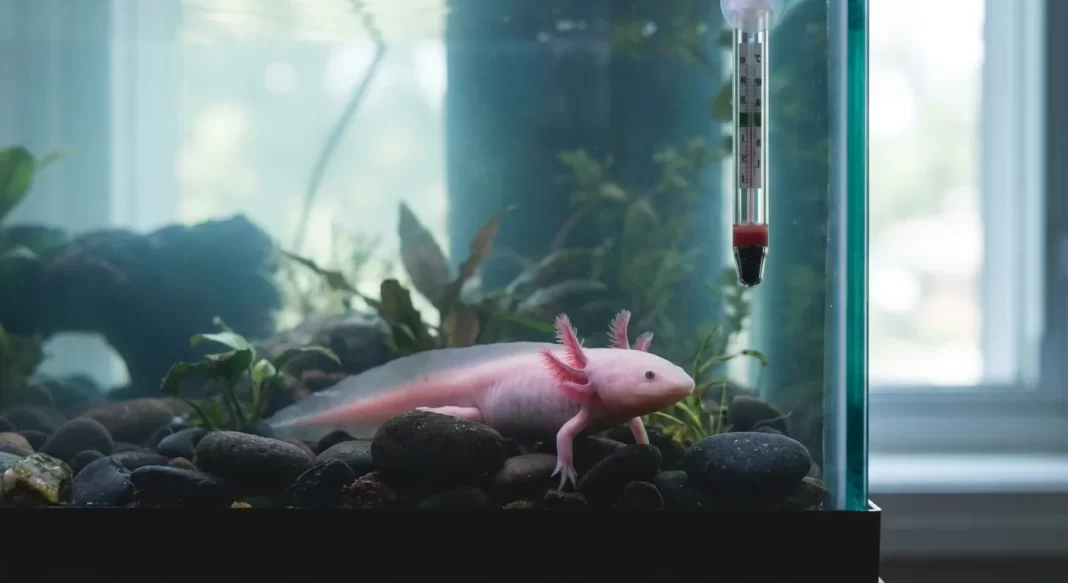
The ideal water temperature for axolotls is 60 to 64 degrees Fahrenheit (16 to 18 degrees Celsius) per Axolotl.org, with a tolerable range up to 68 degrees Fahrenheit (20 degrees Celsius). Above 72 degrees Fahrenheit causes immune suppression; above 75 degrees Fahrenheit is potentially lethal within days. Cooling, not heating, is the equipment problem keepers solve.
What is the safe temperature range for axolotls?
The ideal water temperature for axolotls is 60 to 64 °F (16 to 18 °C) per Axolotl.org, with the broader safe range extending to 68 °F (20 °C). AxolotlCentral places the wider tolerable range at 12 to 20 °C, with above 20 degrees the boundary where stress signs begin and above 24 °C fatal within days.
Temperature is the single most critical environmental parameter in axolotl keeping. Axolotls are cold-water amphibians native to the high-altitude lake system of Xochimilco in central Mexico, where water temperatures historically stayed between 14 and 20 degrees Celsius year-round (source: Britannica). The Animal Diversity Web entry adds that the native lakes sit at approximately 2,274 meters elevation, which produces consistently cool water year-round (source: Animal Diversity Web). In captivity, maintaining water temperature within the safe range directly determines gill health, immune function, dissolved oxygen availability, metabolic stability, and long-term survival. The full husbandry context is in the axolotl care guide.
Axolotl.org specifies that the optimum temperature is between about 16 and 18 degrees Celsius (60 to 64 degrees Fahrenheit), with temperatures above 24 degrees Celsius (75 degrees Fahrenheit) very stressful (source: Axolotl.org captive requirements). AxolotlCentral gives a slightly wider tolerable range of 12 to 20 degrees Celsius (53.6 to 68 degrees Fahrenheit) and confirms that temperatures above 20 degrees cause stress and disease while temperatures above 24 degrees can be fatal (source: AxolotlCentral care guide).
Understanding the temperature zones
Breaking the full range into zones clarifies what each temperature window means for the animal.
50 to 58 degrees Fahrenheit (10 to 14 degrees Celsius): Cold but survivable. Axolotls become sluggish, eat less frequently, and show reduced activity. Metabolism slows substantially. Biological filtration in the tank also slows at these temperatures because the beneficial bacteria responsible for the nitrogen cycle grow more slowly in cool water (per AxolotlCentral cycling guidance: source: AxolotlCentral cycling guide). This range is tolerable for short periods but not ideal for long-term housing. Some outdoor pond-kept axolotls in mild climates do survive winter temperatures in this range; indoor aquarium keepers should aim higher.
60 to 68 degrees Fahrenheit (16 to 20 degrees Celsius): The target zone. Axolotls eat well, show normal gill coloration, remain active during their typical dawn and dusk periods, and maintain healthy immune function. Dissolved oxygen levels are adequate for gill respiration. Growth proceeds at a healthy, steady rate rather than the accelerated pace seen at warmer temperatures.
68 to 72 degrees Fahrenheit (20 to 22 degrees Celsius): The caution zone. Axolotls remain alive and may appear normal superficially, but stress indicators begin to appear with sustained exposure. The immune system becomes progressively less effective at fighting bacterial and fungal infections. Dissolved oxygen in the water drops measurably at these temperatures, which forces the axolotl to rely more on gulping air at the surface rather than absorbing oxygen through the gills. Many fungal infections that keepers see in axolotl communities begin during sustained periods in this range. Photoperiod also matters at the upper end of this zone, since light intensity tends to track outdoor temperatures and adds to the stress load; the standard 12-hour low-light photoperiod is covered in the Axolotl Planet lighting reference (source: Axolotl Planet lighting guide).
72 to 75 degrees Fahrenheit (22 to 24 degrees Celsius): The danger zone. Axolotl.org warns that temperatures above 24 degrees Celsius are very stressful and that extended exposure quickly leads to disease and death (per Axolotl.org). Immune suppression becomes significant. Fungal growth on gills and skin accelerates because warm water supports pathogen reproduction while simultaneously weakening the axolotl’s defenses. The first visible sign is often refusal of food, followed by pale patches of mucus-like material on the skin.
Above 75 degrees Fahrenheit (above 24 degrees Celsius): Lethal territory. Organ stress, severe oxygen deprivation at the gill level, rapid pathogen colonization, and systemic failure follow within days if temperature is not corrected. No axolotl should be housed at this temperature under any circumstance. Acute clinical signs from heat exposure are covered in the health red flags guide.
Why do axolotls need cold water?
Cold water is a biological requirement, not a preference. Three mechanisms tie temperature to axolotl health: dissolved oxygen drops as water warms while metabolic oxygen demand climbs, the immune system loses pace with pathogen growth at warmer temperatures, and sustained warmth forces organs to operate above evolved parameters. Wound healing is also paradoxically faster in cooler water per Axolotl.org.
Dissolved oxygen and gill respiration
Axolotls are neotenic salamanders that retain their larval gills throughout life. Those feathery external gills are the primary site of gas exchange. Unlike fish, axolotls can also gulp air at the surface using rudimentary lungs (per San Diego Zoo: source: San Diego Zoo), but gill respiration is the dominant mechanism for oxygen uptake in healthy animals.
Cold freshwater holds significantly more dissolved oxygen than warm freshwater, a well-established property of aquatic biology. Standard dissolved-oxygen-saturation tables show approximately 9.9 milligrams per liter at 16 degrees Celsius and around 8.4 milligrams per liter at 24 degrees Celsius at sea level. That 15 percent reduction sounds modest in absolute terms, but the axolotl’s oxygen demand simultaneously increases at higher temperatures because its metabolic rate climbs. The animal needs more oxygen at the exact moment less is available. Keepers who observe their axolotls gulping air at the surface more frequently during warm weather are watching this oxygen deficit play out in real time.
Metabolic rate and immune function
Axolotls are ectotherms. Their metabolic rate scales directly with water temperature. Warmer water means faster metabolism, faster waste production, higher food demand, and faster cellular turnover. The DVM-reviewed PetMD feeding reference notes that adult axolotl feeding frequency naturally varies with temperature and life stage (source: PetMD (reviewed by Sean Perry, DVM)), which is one symptom of the temperature-driven metabolic shift. In isolation, a faster metabolism is not harmful. The problem is that the axolotl’s immune system does not scale upward at the same rate. At elevated temperatures, pathogens (particularly the fungi and bacteria that colonize gill tissue) reproduce faster, but the immune cells responsible for combating those pathogens become less effective. The result is a widening gap between pathogen growth rate and immune response, which is why warm-water axolotl tanks so reliably produce fungal infections.
Wound healing in axolotls also responds counterintuitively to temperature. Axolotl.org notes that wound healing seems to occur more rapidly at lower than normal temperatures, with lower temperatures (5 to 15 degrees Celsius) beneficial for recovery (source: Axolotl.org health). This finding aligns with the reduced pathogen activity in cold water: wounds close in a cleaner environment where bacterial colonization is slower.
Long-term organ stress
Sustained elevated temperatures force axolotl organs to operate above their evolved parameters. The heart rate increases, the kidneys process waste faster, and the liver works harder to manage metabolic byproducts. Over weeks and months, this chronic elevation contributes to reduced lifespan. PBS Nature’s axolotl fact sheet notes the species reaches 10 to 15 years in captivity when conditions are stable (source: PBS Nature axolotl fact sheet); unstable temperatures are one of the most common reasons captive axolotls fall short of this lifespan. From reviewing axolotl keeper health logs across different temperature setups, the animals consistently kept at 60 to 64 degrees Fahrenheit show fewer veterinary issues, better gill coloration, and longer lives than those kept at the upper boundary of the safe range, even when every other parameter is identical. Temperature is not the most exciting variable to optimize, but it is the one that produces the biggest difference in long-term welfare.
How do you cool an axolotl tank?
Cooling methods rank by reliability: room air conditioning (best passive), aquarium chiller (best active, $150 to $500), clip-on evaporative fan (2 to 5 °F reduction), frozen water bottles (emergency stopgap), and basement placement (only if it stays below 68 °F). Ice cubes are dangerous. A chiller is the only consistent thermostat-controlled option.
Cooling an axolotl tank is the single biggest practical challenge for keepers in warm climates or homes without central air conditioning. Several methods exist, each with specific capabilities and limitations.
Room air conditioning
The simplest and most effective passive cooling method is keeping the room where the tank is located air-conditioned to 68 degrees Fahrenheit (20 degrees Celsius) or below. If the ambient room temperature stays below the tank’s target range, the water temperature will equilibrate naturally without any aquarium-specific equipment. This works well in homes with central air conditioning that runs consistently, but it becomes expensive in hot climates where the AC would need to run continuously for the tank. A room air conditioner set to 65 degrees Fahrenheit (18 degrees Celsius) in a well-insulated room with a 40-gallon tank typically maintains tank water between 64 and 68 degrees Fahrenheit without any additional cooling.
Aquarium clip-on fans
Clip-on cooling fans mount to the tank rim and blow air across the water surface. They work by accelerating evaporation: as water evaporates from the surface, it absorbs heat energy from the remaining water, lowering tank temperature. In practice, clip-on fans reduce water temperature by 2 to 5 degrees Fahrenheit (1 to 3 degrees Celsius) below ambient room temperature. This reduction is meaningful if the room sits at 73 to 75 degrees Fahrenheit and the fan brings the tank down to 70 to 72 degrees Fahrenheit, but it cannot bring a tank from 80 degrees Fahrenheit into the safe range on its own.
Fans increase the evaporation rate substantially, which means the water level drops faster than normal. Keepers using fans need to top off the tank more frequently with dechlorinated, temperature-matched water. The water parameters guide covers target mineral ranges. Evaporation also concentrates dissolved minerals in the remaining water, which makes regular water changes per the water change schedule guide more important.
Frozen water bottles
Freezing sealed bottles of dechlorinated water and floating them in the tank is a widely used emergency cooling technique. A 1-liter frozen bottle in a 40-gallon tank drops the temperature by roughly 1 to 3 degrees Fahrenheit over an hour, depending on starting temperature. The effect is temporary. Once the ice melts, the water begins warming again immediately.
Frozen bottles are a stopgap, not a permanent solution. They require manual rotation every few hours during a heat wave, and tank temperature fluctuates as each bottle melts and is replaced. Rapid temperature swings are themselves stressful. Axolotl.org cautions specifically that repeated rapid temperature changes from ice bottles can stress the axolotl to the extreme (per Axolotl.org). If you use frozen bottles, limit temperature change to no more than 2 degrees Fahrenheit per hour and monitor continuously. Never add loose ice directly to the tank.
Aquarium chiller (the permanent solution)
An aquarium chiller is the only equipment that provides consistent, thermostat-controlled cooling regardless of ambient room temperature. Chillers work by circulating tank water through a refrigeration unit that removes heat, then returning the cooled water to the tank. A thermostat maintains the set temperature within 1 to 2 degrees Fahrenheit.
Two types exist. Refrigerated (compressor-based) chillers use the same refrigeration cycle as a household refrigerator and are effective for tanks of any size, though they produce heat and noise from the compressor unit. Thermoelectric (Peltier) chillers use a solid-state cooling element and are quieter, but they are only effective for tanks up to about 10 gallons. Any standard-size axolotl tank requires a compressor-based chiller.
For a 40-gallon tank in a room that reaches 80 °F, a chiller rated for 1/10 horsepower is typically sufficient to hold the tank at 64 °F. Oversizing slightly (1/5 HP for a 40-gallon) reduces how hard the compressor works. The chiller guide covers sizing and product recommendations. Chillers cost $150 to $500 but eliminate the daily management burden of fans and frozen bottles.
What does not work
Positioning the tank in a basement helps only if that room actually stays below 68 °F year-round. Many basements in warm climates reach 75 °F or higher in summer. Moving the tank to a basement that reaches 74 °F accomplishes nothing if the cooling target is 64 °F.
Adding ice cubes directly to the tank is dangerous. The rapid local temperature change near the ice can shock the axolotl, the ice melts quickly with negligible overall effect, and the ice itself introduces contaminants if made from untreated tap water (chlorine, chloramine, heavy metals). Sealed frozen bottles solve the contamination issue but still carry the temperature fluctuation risk.
How should you set up a thermometer for an axolotl tank?
A digital aquarium thermometer with min/max memory, a submersible probe, and an external display is the standard for axolotl temperature monitoring. The min/max function records overnight lows and afternoon highs without continuous watching. Place the probe at mid-depth, away from filter outflow and chiller return, on the opposite side from any cooling source.
A thermometer is not optional equipment. Without continuous temperature monitoring, a keeper cannot detect gradual warming trends, overnight temperature drops from heating system failures, or the early stages of a heat spike before the axolotl shows clinical signs.
Thermometer type
A digital thermometer with a submersible probe and a display unit that sits outside the tank is the best option. The critical feature is min/max memory: the thermometer records the highest and lowest temperatures reached since the last reset. This lets you check the overnight low and afternoon high each day without watching the tank continuously. If the max temperature crept to 71 degrees Fahrenheit overnight while the room AC cycled off, you would see it in the morning and know the cooling system needs adjustment.
Analog stick-on strip thermometers are inexpensive but imprecise. They read the glass temperature rather than the water temperature, which can differ by 2 to 4 degrees Fahrenheit depending on room conditions and tank placement. They also lack min/max memory. Strip thermometers are better than nothing but should not be the primary monitoring tool.
Glass alcohol thermometers (the traditional floating or suction-cup type) are reasonably accurate but fragile. A broken glass thermometer inside an axolotl tank introduces glass shards and alcohol into the water. If you use one, mount it securely with a suction cup away from areas where the axolotl swims or rests. Routine monitoring fits into the broader maintenance cadence covered in the care SOP.
Probe placement
Place the temperature probe in the main body of the tank water at mid-depth, away from the filter output, any heater, the chiller return line, or any localized heat or cold source. Temperature stratification occurs in aquariums: water near the surface can be 1 to 2 °F warmer than water near the substrate if the tank has weak circulation. The probe should read the temperature where the axolotl actually spends its time, which for most axolotls is the bottom third of the tank. Secure the probe with a suction cup so it does not drift.
If you run a chiller, place the temperature probe on the opposite side of the tank from the chiller return line. This gives you the warmest reading rather than the coolest, which is the more useful measurement for safety. You want to know the highest temperature the axolotl is experiencing, not the lowest.
How do you manage temperature across seasons?
Summer is when most axolotl temperature emergencies occur, as room temperatures rise and AC may be insufficient. Winter requires monitoring for cold drops below 58 °F and rapid swings from heating-system cycling. Spring and fall produce the widest daily oscillations. The core principle: indoor air temperature drives tank water temperature.
Summer (the dangerous season)
Summer is when most axolotl temperature emergencies occur. Room temperatures rise, AC systems may be insufficient or absent, and power outages during storms can eliminate cooling for hours. Keepers in warm climates (areas where indoor temperatures regularly exceed 72 degrees Fahrenheit between May and September) should have a cooling plan in place before summer begins, not after the first heat spike.
Veterinary teams and rescue-community keepers consistently report that fungal gill infections cluster in June through September, correlating directly with elevated tank temperatures during the warmest months of the year. Warm-water fungal infections in axolotls are almost entirely preventable infrastructure failures, not bad luck or weak animals. Specific signs of stress and infection are catalogued in the stress signs guide.
Preparation for summer includes confirming the chiller (if installed) is operational and properly sized, keeping frozen bottles prepared in the freezer as a backup for chiller failures or power outages, ensuring the room AC can maintain target temperature under peak outdoor heat, and reviewing the hot weather setup guide for proactive infrastructure adjustments. Ethical Axolotls’ parameters reference adds that water temperature must be maintained below 68 °F at all times, with a stronger recommendation to keep below 65 °F for long-term welfare (source: Ethical Axolotls parameters). The heat spike emergency guide covers the acute response protocol in detail.
Winter
Winter is generally safer for axolotl keeping because ambient temperatures naturally fall within or below the target range in most homes. The risk shifts from overheating to overcooling or rapid temperature swings from heating system cycles. A home heating system that cycles on and off can cause room temperature to swing by 5 to 8 degrees Fahrenheit between heating cycles, which translates to slower but measurable tank temperature fluctuations.
If the tank is in a room that drops below 58 degrees Fahrenheit (14 degrees Celsius) overnight in winter, the axolotl will survive but become sluggish, eat less, and the biological filter will slow. A small aquarium heater set to 60 degrees Fahrenheit (16 degrees Celsius) provides a temperature floor without warming the water above the safe range. Set the heater thermostat conservatively and verify with your digital thermometer that it does not overshoot.
Transitional seasons (spring and fall)
Spring and fall produce the widest daily temperature swings in most homes. A sunny afternoon in April can heat a room to 76 °F while the same room drops to 62 °F overnight. This daily oscillation stresses the axolotl more than a steady temperature at either end of the range. A chiller with a thermostat handles this automatically. Without a chiller, close blinds during sunny afternoons, run fans as needed, and monitor the min/max thermometer daily. Axolotl.org emphasizes that any temperature acclimation should occur over 30 to 60 minutes minimum (per Axolotl.org).
What should you do during a heat spike emergency?
A heat spike is any situation where tank temperature rises above 72 °F and continues climbing or holds at that level. The active cooling protocol uses frozen bottles, an evaporative fan, a partial water change with cooler water, ambient room cooling, and last-resort tubbing, applied in order with continuous monitoring to limit drops to under 2 °F per hour.
The response protocol depends on how high the temperature has reached and how quickly it is changing. Persistent floating, food refusal, and pale gill coloration during a heat spike are red-flag signs covered in the health red flags guide linked above; if those appear, the response shifts from cooling alone to cooling plus veterinary consultation per the when to see vet guide.
Immediate assessment (first 5 minutes)
Check the current tank temperature. Check the thermometer’s max reading to see how high the temperature reached before you noticed. Observe the axolotl for stress signs: floating at the surface, rapid gill movement, refusal to eat, pale patches on the skin, or excessive mucus production. If the temperature is above 75 degrees Fahrenheit or the axolotl is showing clinical signs, treat this as a medical emergency and act within the hour.
Active cooling protocol
Step 1: Place 1 to 2 frozen bottles of dechlorinated water in the tank immediately. Monitor the temperature drop. Target a reduction rate of no more than 2 degrees Fahrenheit per hour to avoid thermal shock from rapid cooling.
Step 2: If you have a clip-on fan, turn it on at maximum speed aimed at the water surface. This accelerates evaporative cooling and supplements the frozen bottles.
Step 3: Perform a 20 to 30 percent water change using cooler (60 to 64 degrees Fahrenheit), dechlorinated water. This provides the fastest safe temperature reduction for the largest volume of water.
Step 4: Reduce the ambient room temperature if possible. Turn on room AC, close blinds, turn off any heat-producing equipment near the tank (lights, electronics, other aquarium heaters in the room).
Step 5: If the temperature will not come below 72 degrees Fahrenheit with the above measures, prepare a temporary tubbing container. Fill a clean, food-safe plastic tub with 5 to 10 gallons of dechlorinated water at 60 to 64 degrees Fahrenheit. Transfer the axolotl to the tub. This is a last-resort emergency measure while you address the root cause (chiller failure, AC outage, equipment malfunction). The temporary tub needs an air stone or small sponge filter for oxygenation, and the water must be replaced or cooled as it warms.
After the emergency
Once tank temperature is back below 68 degrees Fahrenheit, monitor the axolotl closely for 48 to 72 hours. Heat stress suppresses the immune system, and fungal or bacterial infections may appear 24 to 72 hours after the spike even if temperature has been corrected. Watch for cotton-like growths on the gills, white patches on the skin, food refusal, or lethargy. If any of these appear, consult an exotic-animal veterinarian. Do not attempt to treat suspected infections with over-the-counter remedies without professional guidance, as many fish medications are not safe for amphibians at standard dosing. Fungal infection treatment specifically is covered in the fungus guide.
When should you contact a veterinarian about temperature stress?
Contact an exotic-animal vet after a heat spike if the axolotl was exposed above 75 °F for more than four hours, if fungal growths or white patches appear within 72 hours, if food refusal continues past 48 hours after temperature is corrected, or if persistent floating develops. Heat stress suppresses immune function for days after the spike resolves.
The vet visit criteria after a temperature emergency are specific. Contact an exotic-animal vet if the axolotl was exposed to temperatures above 75 degrees Fahrenheit for more than 4 hours, if fungal growths or white patches appear on the gills or body after the spike, if the axolotl refuses food for more than 48 hours after temperature has been corrected, if the axolotl floats persistently and cannot maintain position on the substrate, or if any combination of these signs appears. The Association of Reptile and Amphibian Veterinarians maintains a public Find-a-Vet directory of practitioners with reptile and amphibian credentials (source: ARAV Find a Vet); call ahead to confirm amphibian experience before traveling. The broader vet-finding workflow is in the when-to-see-vet guide linked above.
The breeding setup guide also covers temperature considerations specific to spawning conditions, where the temperature target shifts seasonally to trigger breeding behavior; if you suspect a temperature event has affected a breeding pair, the considerations differ from a non-breeding adult.
Common temperature management mistakes
Recurring preventable temperature mistakes are no thermometer with min/max memory, no cooling plan before summer, a heater set to a tropical-fish default instead of a 60 °F floor, ice cubes added directly to the tank, and assuming a basement provides cool conditions without verification. Each comes from treating temperature as set-and-forget.
No thermometer with min/max memory is the first preventable mistake. A standard digital thermometer with min/max function costs $10 to $20 and surfaces overnight lows and afternoon highs the keeper would otherwise miss. Without it, the first warning is the axolotl’s stress signs, which surface days after the temperature drift began.
No cooling plan before summer arrives catches keepers who set up tanks in winter and discover the temperature problem in June. Chillers, fans, and contingency planning should be in place before the first warm month.
A heater set to a tropical-fish default at 78 degrees Fahrenheit is one of the most dangerous single-point failures in an axolotl setup. If you use a heater for a 60 °F floor in a cold room, verify the thermostat with a digital thermometer and check min/max daily.
Adding ice cubes directly to the tank produces the dangerous rapid local temperature change discussed above. Sealed frozen bottles, used carefully, are the only acceptable form of in-tank ice cooling.
Assuming a basement provides cool conditions without verification leads to surprised keepers in July. Test basement temperatures across all seasons before relying on placement alone. The beginner mistakes guide covers the broader pattern of new-keeper temperature errors. The tank setup guide integrates temperature planning into the broader setup procedure, and the tank size guide covers how larger water volumes buffer temperature swings. Cycling-related considerations for cool-water tanks are in the tank cycling guide.
Frequently asked questions
Does water temperature affect the nitrogen cycle in the tank?
Yes. The beneficial bacteria that convert ammonia to nitrite and nitrite to nitrate (Nitrosomonas and Nitrospira species) are temperature-sensitive. Their activity slows below 60 degrees Fahrenheit (16 degrees Celsius) and drops significantly below 50 degrees Fahrenheit (10 degrees Celsius). AxolotlCentral notes that warmer water stimulates bacterial growth, which is why cycling a tank at the upper end of the safe range (66 to 68 degrees Fahrenheit) is faster than cycling at the optimum 60 to 64 degrees. The Ethical Axolotls cycling reference provides the underlying nitrogen-cycle chemistry showing how each ppm of ammonia processes to nitrite and nitrate (source: Ethical Axolotls cycling guide). Axolotl tank cycling typically takes longer than tropical-tank cycling for this reason.
Is it safe to use a heater in an axolotl tank?
A heater set to 60 degrees Fahrenheit (16 degrees Celsius) as a temperature floor in a cold room is safe and sometimes necessary during winter. The risk is misconfiguration. A heater set to 78 degrees Fahrenheit (a common default for tropical fish) will cook the tank to lethal temperatures. If you use a heater, set it to 60 degrees Fahrenheit, verify the thermostat accuracy with your digital thermometer, and check the min/max readings daily. A stuck thermostat on a heater is one of the most dangerous single-point failures in an axolotl setup.
What happens if the temperature drops too low for too long?
Axolotls tolerate cold water well and survive temperatures down to 50 degrees Fahrenheit (10 degrees Celsius) without physical harm, though they become sluggish and eat less. Prolonged exposure below 40 degrees Fahrenheit (4 degrees Celsius) for more than 20 days can become dangerous. Freezing temperatures (32 degrees Fahrenheit, 0 degrees Celsius) are fatal because ice crystal formation damages the animal’s cells. In practice, indoor aquariums almost never reach these extremes unless kept in unheated garages or sheds during winter.
Can axolotls be kept outdoors in ponds?
Pond housing is only viable in temperate climates where pond water stays below 22 degrees Celsius (72 degrees Fahrenheit) year-round, including summer. Most populated regions cannot meet this requirement without active cooling. Pond housing also introduces predator risks (raccoons, herons, large fish if cohabiting), escape risks during heavy rain that raises water levels, and substantially reduced ability to observe the animal for early health signs. Pond keeping is not recommended for first-time keepers, regardless of climate.
How long can an axolotl survive at warm temperatures before damage occurs?
The damage timeline depends on how warm the water is. At 80 degrees Fahrenheit, minutes to a few hours produces acute heat-stress signs and immune compromise. At 75 degrees Fahrenheit, hours to a day produces severe stress and food refusal. At 72 degrees Fahrenheit, days of sustained exposure produce chronic stress, gradual immune decline, and increased fungal susceptibility. Even at 70 degrees Fahrenheit, weeks of exposure shorten lifespan measurably. There is no warm-temperature window that is harmless if extended long enough.
Related guides
- Axolotl care guide: complete husbandry hub for new keepers
- Axolotl breeding setup: breeding-tank temperature considerations
- Axolotl chiller guide: cooling equipment selection and installation
- Axolotl hot weather setup: proactive summer infrastructure
- Axolotl heat spike emergency: acute first-60-minute protocol
By the ExoPetGuides editorial team (AI-assisted drafting; human-reviewed), reviewed by an exotic-animal veterinarian
Updated 2026-05-17
Primary sources: Axolotl.org captive requirements and health page, AxolotlCentral care guide and cycling guide, Britannica axolotl entry, San Diego Zoo Animals and Plants
Disclaimer: This content is for educational purposes only and is not a substitute for professional veterinary advice. Always consult a qualified veterinarian, ideally an exotic-animal specialist, for any health concern about your pet. Care recommendations may vary based on species, individual animal, and local regulations.