


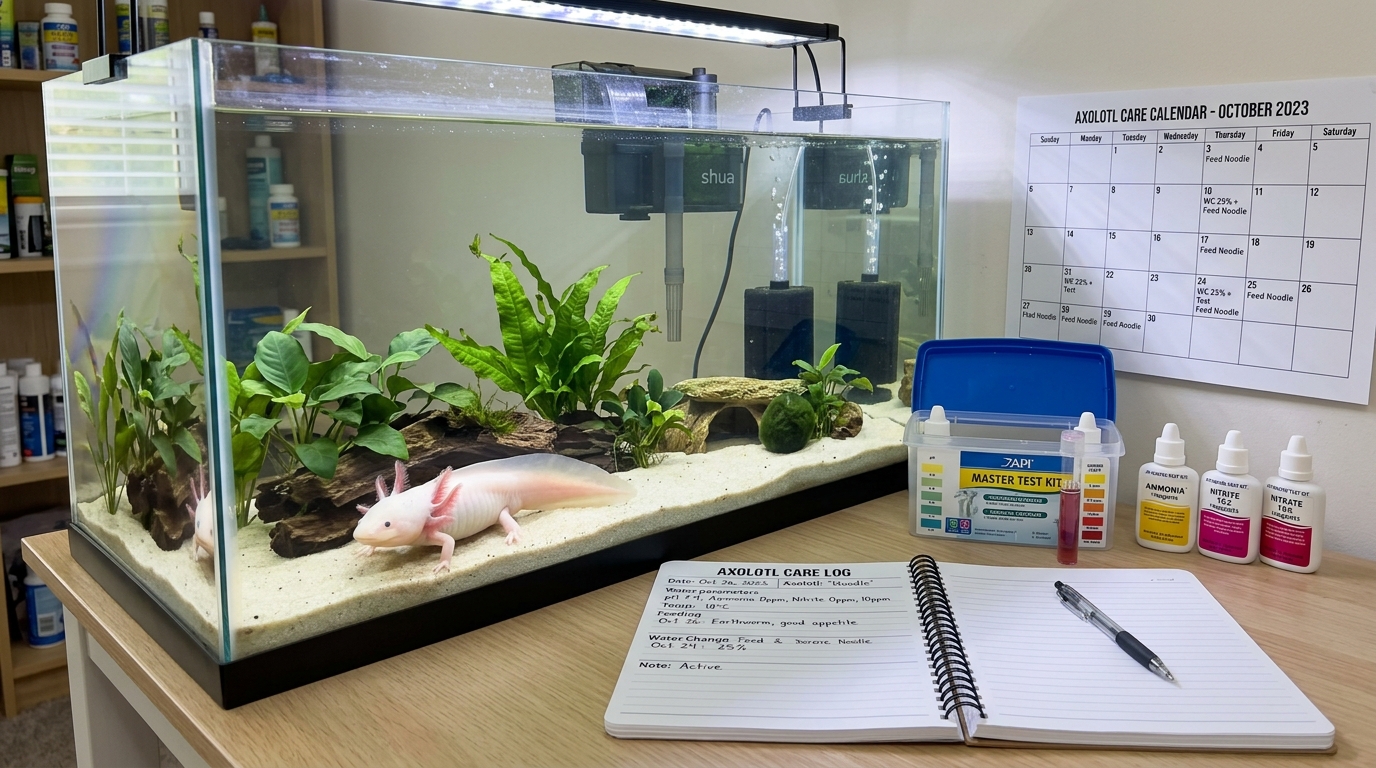
Keeping written records of your axolotl’s environment and health turns scattered observations into a reliable dataset that catches problems before they become emergencies. A record-keeping system tracks daily water temperature, feeding responses, weekly test-kit results for ammonia, nitrite, nitrate, and pH, monthly weight measurements and gill condition assessments, medication and treatment history, breeding events if applicable, and equipment maintenance intervals. This guide provides ready-to-use templates in printable, spreadsheet, and app-friendly formats, with sample filled-in entries showing what consistent logging looks like in practice.
Keepers who maintain logs for axolotl communities we collaborate with consistently report the same outcome: the first time the log catches a slow nitrate climb or a gradual weight drop that visual observation missed, the practice pays for itself permanently. Record-keeping is not administrative busywork. It is the mechanism that separates reactive crisis management from proactive husbandry.
Why records matter more than memory for axolotl care
Consistent record-keeping transforms axolotl husbandry from guesswork into evidence-based practice. The three core benefits are early problem detection, veterinary preparation, and long-term pattern recognition. Each of these addresses a specific failure mode that memory alone cannot prevent.
Early problem detection. Axolotl health problems rarely appear suddenly. Ammonia does not spike from zero to lethal in a single day in a cycled tank. Instead, a filter begins losing capacity over weeks, nitrate readings drift upward by 2 to 3 ppm per test, and the axolotl’s gill filaments shorten incrementally. Without a written record, each individual reading looks acceptable. With a log, you see the trend line. A keeper reviewing four consecutive weekly nitrate readings of 8, 11, 14, and 18 ppm recognizes that the trajectory will breach the 20 ppm action threshold within one more cycle and can increase water change volume before the animal shows stress. A keeper relying on memory sees "under 20" each week and does nothing until the axolotl starts curling its gills. The care SOP explains why structured observation schedules prevent exactly this kind of drift.
Veterinary preparation. When you consult an exotic veterinarian about an axolotl health concern, the first questions are always about water parameters, feeding history, and timeline of symptom onset. A log with dated entries gives the vet clinical-grade intake data instead of "I think the water was fine" or "it stopped eating maybe a week ago." Experienced keepers in our community who bring printed logs to vet appointments consistently report that the vet spends less time on diagnostic testing and moves faster to treatment because the environmental history is already documented. The when-to-see-vet guide covers the decision thresholds that determine whether a logged anomaly warrants a clinic visit.
Long-term pattern recognition. Axolotl care operates on cycles that span months and seasons. Feeding metabolism slows as water temperature drops in winter. Nitrate accumulation rates change when you switch food types or adjust feeding frequency. Equipment performance degrades gradually. A 6-month or 12-month log reveals patterns invisible within any single week: the chiller struggles every August, the pH dips every time you use a particular batch of dechlorinator, the axolotl’s weight plateaus for three months then resumes growth. These patterns inform proactive adjustments rather than reactive corrections.
What to track: daily parameters
Daily entries take 1 to 2 minutes and capture the information most likely to reveal acute problems. Record these at approximately the same time each day for consistency.
Water temperature. Log the reading from your tank thermometer to the nearest degree. The safe range for axolotls is 60 to 68 degrees Fahrenheit (15.5 to 20 degrees Celsius), with temperatures above 72 degrees Fahrenheit suppressing immune function and temperatures above 75 degrees Fahrenheit triggering clinical stress https://www.watercritters.ca/axolotl-care-sheet/. Record both the reading and the time of day, because tank temperature fluctuates with ambient room temperature. A log showing consistent 66-degree readings at 8 AM but no afternoon entries might miss a 72-degree afternoon peak in a room without climate control.
Feeding response. Note what you offered (earthworms, pellets, bloodworms), the quantity, and the axolotl’s response. A healthy adult axolotl fed 2 to 3 times per week should strike at food within seconds. Record the response as one of four categories: immediate strike, delayed response (more than 30 seconds), partial consumption, or refusal. Two or more consecutive refusals warrant parameter testing and closer observation. The refusing food guide covers differential causes including temperature, water quality, illness, and seasonal appetite changes.
Waste output. Note whether you observed and removed fecal matter during spot-cleaning. A sudden absence of waste in an axolotl that is eating normally may indicate impaction. A change in waste color or consistency can signal dietary or health issues.
Quick behavioral observation. Spend 60 seconds watching the axolotl and note its posture and location. Record whether the axolotl is resting on the bottom (normal), floating at the surface (potential concern), glass surfing (stress indicator), or hiding (normal if occasional, concerning if constant and new). This observation does not need paragraph-length detail. A single line reading "resting on bottom, gills fanned, ate 2 worm pieces immediately" is sufficient.
What to track: weekly water test results
Weekly parameter testing is the backbone of your record-keeping system. Use a liquid test kit for accuracy; test strips produce unreliable results for the precision axolotl husbandry demands https://www.watercritters.ca/axolotl-care-sheet/.
Record six parameters each week:
| Parameter | Target | Action threshold | What a trend tells you |
|---|---|---|---|
| Ammonia (NH3/NH4+) | 0 ppm | Any reading above 0 | Filter failure, overfeeding, or cycle crash |
| Nitrite (NO2-) | 0 ppm | Any reading above 0 | Incomplete cycling or bacterial colony disruption |
| Nitrate (NO3-) | Below 20 ppm | Above 20 ppm | Increase water change volume or frequency |
| pH | 6.5 to 8.0 | Below 6.5 or above 8.0 | KH depletion, substrate interaction, or source water shift |
| GH | 7 to 14 dGH | Below 7 dGH | Mineral depletion; remineralize if using RO water |
| KH | 3 to 8 dKH | Below 3 dKH | pH crash risk; buffer with crushed coral |
https://www.watercritters.ca/axolotl-care-sheet/ https://axolotlnerd.com/axolotl-water-requirements/
How to read your weekly data over time. The single most valuable habit in axolotl record-keeping is comparing this week’s numbers to the previous four weeks, not just to the safe-range chart. Ammonia at 0 ppm is always good. But nitrate at 15 ppm is only good if last week was 12 and the week before was 10 — the upward trend signals that your water change volume may need to increase even though 15 ppm is technically safe. The water testing guide covers test-kit technique, result interpretation, and when readings warrant immediate action versus scheduled adjustment.
Record the date and time of testing, the date and volume of the most recent water change, and whether you tested before or after the water change. Testing before the change gives you the worst-case reading for that cycle; testing after gives you the baseline your tank returns to. Both are useful, but consistency matters more than which you choose.
What to track: health observations
Health tracking builds a longitudinal record that makes subtle changes visible. Monthly assessments catch changes too gradual for weekly observation.
Gill condition (weekly visual, monthly detailed). Healthy axolotl gills are full, branching, and fan outward from the head. Record gill appearance using consistent descriptors: full and fanned (healthy), slightly curled forward (early stress signal), noticeably shortened (chronic stress or poor parameters), pale or whitish (possible infection or anemia). Forward-curled gills are one of the earliest visible indicators of water quality problems https://www.watercritters.ca/axolotl-care-sheet/. The gill curl guide covers diagnosis and correction protocols.
Monthly weight. Weigh the axolotl using a pre-weighed container of tank water on a kitchen scale. A healthy adult axolotl typically weighs 150 to 300 grams depending on age, sex, and morph. Record the weight to the nearest gram. Flag any change exceeding 10 percent in a single month for veterinary consultation. Weight tracking over 6 to 12 months produces a growth curve that reveals whether the animal is developing normally, plateauing, or declining. The size and growth guide provides reference growth timelines by age.
Body length (monthly). Measure total length from snout to tail tip while the axolotl is resting naturally on a flat surface or against a ruler placed outside the tank glass. Adult axolotls typically reach 9 to 12 inches (23 to 30 cm). Length combined with weight gives a more complete picture of body condition than either measurement alone.
Skin and limb condition (weekly visual). Note any new marks, lesions, white cotton-like patches (fungal), red spots (ammonia burn or injury), or changes in coloration. If you photograph the axolotl monthly from the same angle and distance, you build a visual reference that makes subtle changes obvious in side-by-side comparison.
Appetite pattern (rolling 30-day view). At the end of each month, review your daily feeding entries. Count total meals offered, total meals accepted, total refusals. A refusal rate above 30 percent in a month with stable parameters and temperature warrants investigation. The health red flags guide identifies which symptom combinations indicate home-fixable problems versus conditions requiring veterinary evaluation.
What to track: medication and treatment history
Every medication, salt bath, tea bath, or treatment administered to your axolotl belongs in a dedicated section of your log. This record is critical for veterinary consultations and for avoiding repeated use of treatments that did not work or caused adverse reactions.
For each treatment event, record:
- Date and time of administration
- Reason for treatment (observed symptom or diagnosis)
- Treatment type (salt bath, methylene blue, antibiotic prescribed by vet, Indian almond leaf tea bath)
- Dosage and duration (concentration, exposure time, number of treatments in the course)
- Observed response (improvement, no change, worsening, adverse reaction)
- Follow-up action (continued treatment, escalated to vet, discontinued)
Experienced keepers tracking medication history in communities we work with have identified a recurring pattern: owners who cannot recall whether they used a 1 percent or 2 percent salt concentration during a prior fungal treatment often default to the wrong dose on the second occurrence. A log eliminates this guesswork entirely. The medication safety guide covers which treatments are safe to administer at home and which require veterinary prescription and supervision.
What to track: breeding records
If you breed axolotls, your log expands to include reproductive events. Even keepers who do not intentionally breed should track reproductive signs, because mixed-sex housing can produce unexpected egg deposits.
Record the following breeding-relevant data:
- Conditioning period: dates, temperature adjustments, and photoperiod changes used to trigger breeding behavior
- Courtship and mating: dates observed, spermatophore deposition confirmed or suspected
- Egg laying: date, approximate egg count, location of egg mass, fertilization rate estimate (percentage of eggs that appear viable at 48 hours)
- Egg development: daily temperature of the egg container, days to hatching, hatch rate
- Larvae data: hatch date, initial count, daily mortality count, feeding start date, food type (baby brine shrimp, microworms, daphnia), first signs of limb development
The breeding guide covers ethical breeding practices and responsible homing. The egg care guide details fungus prevention and hatch-timeline expectations that your log should track against.
What to track: equipment maintenance log
Equipment failures cause more axolotl emergencies than any other single category. A maintenance log tracks the operational status and service history of every piece of equipment in your setup.
For each piece of equipment, record:
| Equipment | What to log | Suggested frequency |
|---|---|---|
| Filter (sponge or canister) | Last media rinse date, last media replacement date, flow rate status | Rinse monthly, replace media per manufacturer spec |
| Air pump | Diaphragm condition, airflow adequacy | Check quarterly, replace diaphragm every 12-18 months |
| Thermometer | Last accuracy check (cross-referenced against a second thermometer) | Quarterly |
| Chiller or fan | Last function test under load, set temperature vs actual output | Monthly in warm months, quarterly otherwise |
| Lighting timer | Photoperiod setting confirmed, bulb replacement date | Quarterly |
| Water conditioner | Brand, batch, expiration date, date opened | Check quarterly, replace if open >2 years |
| Test kit | Brand, lot number, expiration date, date opened | Check quarterly, replace expired reagents |
| Tank seals and stand | Visual inspection for leaks, level check, silicone condition | Quarterly for tanks <5 years, monthly for older tanks |
Equipment logging prevents the slow failure mode where a chiller loses cooling capacity over months, a thermometer drifts 3 degrees without anyone noticing, or test kit reagents expire and produce falsely reassuring readings. The care SOP integrates equipment checks into the daily, weekly, monthly, and quarterly maintenance protocol.
Template formats: printable checklist
The simplest record-keeping format is a printable paper checklist posted near the tank. This works well for keepers who prefer physical records or who delegate care to pet sitters who may not have access to digital tools.
Daily log (one row per day, 7 rows per sheet):
| Date | Time | Temp (F) | Fed? | Food type | Response | Waste removed? | Behavior notes |
|---|---|---|---|---|---|---|---|
| ___ | ___ | ___ | Y/N | ___ | Strike/Delayed/Partial/Refused | Y/N | ___ |
Weekly parameter log (one row per week, 4 rows per sheet):
| Week of | NH3 | NO2 | NO3 | pH | GH | KH | Water change % | Notes |
|---|---|---|---|---|---|---|---|---|
| ___ | ___ | ___ | ___ | ___ | ___ | ___ | ___ | ___ |
Monthly health assessment:
| Month | Weight (g) | Length (in) | Gill condition | Skin notes | Appetite (accept/total) | Equipment checked |
|---|---|---|---|---|---|---|
| ___ | ___ | ___ | ___ | ___ | / | Y/N |
Print these tables, laminate them or place them in a clear plastic sleeve, and use a dry-erase marker for reusable daily logs. Transfer completed data to a permanent record (notebook or spreadsheet) at the end of each week.
Template formats: spreadsheet
A spreadsheet provides the most analytical power for axolotl record-keeping. It enables automatic trend calculations, conditional formatting that highlights readings outside safe ranges, and chart generation for long-term pattern visualization.
Recommended spreadsheet structure:
- Tab 1: Daily log. Columns for date, time, temperature, food type, quantity, feeding response, waste observed, behavior notes. Set conditional formatting to highlight temperature readings above 70 degrees Fahrenheit in yellow and above 72 degrees Fahrenheit in red.
- Tab 2: Weekly parameters. Columns for week-start date, ammonia, nitrite, nitrate, pH, GH, KH, water change volume, pre-change or post-change test. Set conditional formatting to flag any non-zero ammonia or nitrite reading in red, nitrate above 20 ppm in yellow.
- Tab 3: Monthly health. Columns for month, weight, length, gill condition (dropdown: Full/Curled/Short/Pale), skin condition (dropdown: Clear/Lesion/Fungal/Discolored), appetite percentage (formula: meals accepted / meals offered from Tab 1).
- Tab 4: Treatment log. Columns for date, symptom, treatment type, dosage, duration, response, follow-up.
- Tab 5: Equipment. Columns for equipment name, last service date, next service date, replacement due date, notes.
- Tab 6: Breeding (optional). Columns per the breeding record section above.
Free spreadsheet templates for aquarium parameter tracking are available from aquarium community forums and can be adapted for axolotl-specific use by adding the fields listed above https://www.reddit.com/r/Aquariums/comments/g3dovd/aquarium_water_quality_tracking_spreadsheet/. Google Sheets works well for this because it syncs across devices and allows multiple household members to log entries.
Template formats: phone app options
Mobile apps offer the convenience of logging data immediately after a tank check without walking to a computer or paper log. Several options serve axolotl keepers, though none are axolotl-specific.
Aquarium-focused apps. General aquarium log apps like Aquarimate, AquaPlanner, and My Aquarium allow you to set up a tank profile with species-specific parameter ranges, log test results, set maintenance reminders, and view parameter trend charts. These apps work for axolotl keeping when you manually set the temperature alert to 70 degrees Fahrenheit rather than the tropical fish default of 76 degrees Fahrenheit.
General note-taking apps. If dedicated aquarium apps lack a feature you need (breeding logs, medication tracking, weight records), a structured note-taking setup in Google Keep, Apple Notes, or Notion provides more flexibility. Create a template note with all the fields from the daily and weekly logs above, duplicate it for each entry period, and tag entries by category (daily, weekly, monthly, treatment).
Axolotling.com parameter log. The Axolotling website offers a free browser-based parameter logging tool where you select the color of your test result and the tool records the reading https://axolotling.com/logs/. This is useful for keepers who want a quick digital log without setting up a spreadsheet, though it does not cover health observations or equipment tracking.
The best format is the one you will actually use consistently. A paper checklist filled in every day provides better data than a sophisticated spreadsheet updated sporadically.
Sample filled-in log entries
These sample entries show what consistent record-keeping looks like in practice. They are based on a single adult wild-type axolotl in a cycled 20-gallon tank with a sponge filter.
Sample daily entries (one normal week):
| Date | Time | Temp | Fed? | Food | Response | Waste | Notes |
|---|---|---|---|---|---|---|---|
| Mon 4/6 | 7:30 AM | 65 F | Y | 2 earthworm pieces | Immediate strike | Y | Resting on bottom, gills full and fanned |
| Tue 4/7 | 7:15 AM | 65 F | N | — | — | Y | Active at dawn, explored hide, gills normal |
| Wed 4/8 | 7:45 AM | 66 F | Y | 3 pellets | Immediate strike | Y | Ate all 3 within 30 sec |
| Thu 4/9 | 7:30 AM | 66 F | N | — | — | N | No visible waste, resting in hide, normal |
| Fri 4/10 | 7:20 AM | 67 F | Y | 2 earthworm pieces | Delayed (45 sec) | Y | Slightly slower response than usual, gills normal |
| Sat 4/11 | 8:00 AM | 67 F | N | — | — | Y | Glass surfing briefly at lights-on, settled within 5 min |
| Sun 4/12 | 7:30 AM | 66 F | N | — | — | Y | Normal resting posture, gills fanned |
What this log reveals: The Friday delayed feeding response is worth noting but not alarming as a single occurrence. If the next feeding (Monday) also shows delayed response, test parameters immediately rather than waiting for the scheduled weekly test. The Saturday glass surfing at lights-on is a normal startle response, not a stress indicator, because it resolved within minutes.
Sample weekly parameter entry:
| Week of | NH3 | NO2 | NO3 | pH | GH | KH | Change % | Notes |
|---|---|---|---|---|---|---|---|---|
| 3/30 | 0 | 0 | 8 | 7.4 | 10 dGH | 5 dKH | 25% | Baseline, all normal |
| 4/6 | 0 | 0 | 12 | 7.4 | 10 dGH | 5 dKH | 25% | NO3 up 4 ppm from last week |
| 4/13 | 0 | 0 | 15 | 7.2 | 9 dGH | 4 dKH | 25% | NO3 trend continues up, pH dropped 0.2 |
| 4/20 | 0 | 0 | 18 | 7.2 | 9 dGH | 4 dKH | 30% | Increased change to 30%, watching NO3 next week |
What this log reveals: Nitrate is climbing 3 to 4 ppm per week despite consistent 25 percent water changes. The keeper increased the water change volume on week 4. If the next reading still shows a climb, the next step is investigating the source: overfeeding, filter capacity decline, or increased bioload. The slight pH drop correlates with declining KH, which should be monitored for buffering capacity. Without this 4-week record, each individual reading looks safe. The trend tells a different story.
Sample monthly health entry:
| Month | Weight | Length | Gills | Skin | Appetite | Equipment |
|---|---|---|---|---|---|---|
| Jan | 185 g | 8.5 in | Full, fanned | Clear | 11/12 (92%) | All checked, filter rinsed |
| Feb | 192 g | 8.5 in | Full, fanned | Clear | 10/12 (83%) | Replaced air pump diaphragm |
| Mar | 198 g | 9.0 in | Full, fanned | Small scratch on tail, healing | 12/13 (92%) | Chiller function tested, OK |
| Apr | 201 g | 9.0 in | Slight forward curl | Clear, scratch healed | 9/13 (69%) | Filter flow reduced, deep-cleaned media |
What this log reveals: Weight gain is steady and healthy (approximately 5 grams per month). The April entry shows two correlated concerns: slight gill curl and reduced appetite (69 percent, below the 70 percent threshold). Combined with reduced filter flow, the likely cause is declining water quality from filter performance loss. The keeper deep-cleaned the filter media, which should resolve the issue. The May entry will confirm whether gill condition and appetite recover. This is precisely the kind of multi-variable correlation that memory cannot reliably track across months.
Frequently asked questions
How often should I review old log entries for patterns?
Review the previous 4 weeks of data every time you do your weekly parameter test. This takes 2 to 3 minutes and gives you the trend context that a single reading lacks. At the end of each month, scan the entire month for feeding response patterns, parameter trajectories, and any logged anomalies you have not yet addressed. A quarterly review comparing the current 3 months to the prior 3 months reveals seasonal shifts in temperature management, feeding metabolism, and equipment performance that shorter windows miss.
What if I miss a few days of logging?
Resume immediately and note the gap. A log with occasional gaps is far more useful than no log at all. If you missed daily entries but completed the weekly parameter test, the weekly data still provides trend value. Chronic gaps (missing more than 3 days per week consistently) undermine the system’s ability to detect gradual changes and should prompt a format switch to something more convenient for your routine.
Can I use photos instead of written health observations?
Photos are an excellent supplement to written descriptions but not a replacement. A photo captures visual details you might not describe accurately in words, especially subtle color changes or gill filament length differences. However, photos alone do not record weight, feeding response, or the context behind a visual observation. The most effective approach combines a brief written note with a monthly photo taken from the same angle for side-by-side comparison over time.
Do I need separate logs for multiple axolotls?
Yes. Each axolotl needs individual tracking for weight, feeding response, health observations, and any treatments. Tank-level data (water parameters, temperature, equipment status) can be shared across animals in the same tank, but individual health metrics must remain separate. In a multi-axolotl setup, labeling entries by animal (by name, morph, or identifying feature) prevents confusion and ensures that declining health in one animal is not masked by normal readings from its tank mate.
What is the minimum logging that still provides value?
If you cannot commit to the full system, the highest-value minimum is weekly parameter testing recorded in a dated table plus monthly weight. These two data streams catch the most dangerous failure modes: water quality drift and gradual health decline. Add daily temperature logging if your room is not climate-controlled, as temperature excursions are the most common acute threat to axolotl welfare. Any logging beyond this minimum adds value, but these three data points provide the foundation.
How long should I keep old records?
Keep records for the lifetime of the axolotl. Axolotls can live 10 to 15 years in captivity with proper care, and patterns visible across years (recurring seasonal issues, equipment replacement cycles, long-term growth trajectories) inform care decisions that shorter records cannot support. Digital records stored in cloud-synced spreadsheets require negligible storage space. Paper records can be photographed and archived digitally at the end of each year.
Researched and written by the ExoPetGuides editorial team with AI-assisted drafting. All husbandry parameters, health tracking recommendations, and record-keeping practices independently verified against the Water Critters axolotl care sheet, the Axolotl Nerd water requirements reference, the Axolotling parameter logging tool, community-sourced aquarium tracking spreadsheets, and peer-reviewed amphibian husbandry literature.
Disclaimer: This content is for educational purposes only and is not a substitute for professional veterinary advice. Always consult a qualified veterinarian — ideally an exotic-animal specialist — for any health concern about your pet. Care recommendations may vary based on species, individual animal, and local regulations.