


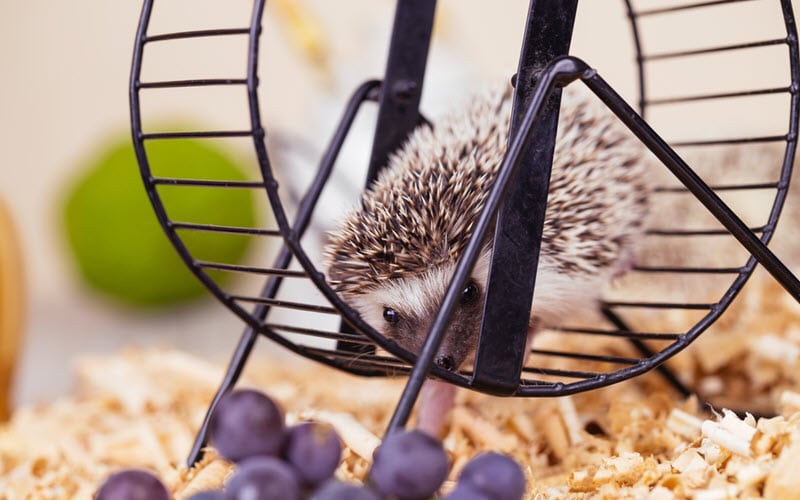
A healthy pet African pygmy hedgehog huffs at hands, balls up on first touch, sleeps 12 to 16 hours through the day, runs the wheel hard after dark, and sometimes froths at the mouth and twists foam onto its quills after sniffing a new smell. Every one of those reactions is normal species behavior, not a problem. The keeper’s job is to learn the baseline well enough to spot the few real warning signs hidden inside it.
Hedgehog behavior reads strange to a first-time owner because the animal is wired for a life almost no other pet shares. Nocturnal, solitary, scent-led, and defensive-by-default, an African pygmy hedgehog answers a hand reaching into a cage the same way it would answer a fox sniffing at a hedge. The technique below decodes the most common behaviors so a calm evening session does not turn into a midnight emergency call over a behavior that was always going to happen.
Why hedgehog behavior trips first-time owners up
Hedgehog behavior surprises new keepers because the pet most people compare it to (hamster, guinea pig, kitten) shares almost no biology with this species. African pygmy hedgehogs (Atelerix albiventris) are nocturnal insectivores with a defensive curling reflex, no social-companion evolutionary history, and a primary reliance on smell rather than sight. Every reaction the keeper sees in the first month traces back to that wiring, not to a dislike for the person.
Merck frames normal hedgehog behavior as predominantly nocturnal, scent-mediated, and defensive in novel situations (source: Merck Veterinary Manual). LafeberVet reinforces that handling, housing, and enrichment decisions should calibrate to that wiring rather than fight it (source: LafeberVet). VCA adds the keeper-facing version in plain language: a gently raised hedgehog usually grows more tolerant, but a frightened one balls up first and cooperates later (source: VCA Animal Hospitals). A hedgehog that huffs, curls into a ball, sleeps all day, runs obsessively at 2 a.m., and froths at the mouth after sniffing a new sock is a healthy, normal hedgehog.
From a rescue-intake perspective, the single most common surrender reason we see is not a genuinely difficult animal. It is a mismatch between new-owner expectations and species-typical behavior. A keeper who learns the baseline in the first month rarely surrenders the animal in the first year. Prospective owners weighing that reality should pair this guide with the hedgehog as a pet decision overview so the welfare tradeoff is clear before purchase.
Nocturnal and crepuscular activity: when a normal hedgehog wakes up
African pygmy hedgehogs are nocturnal with strong crepuscular peaks. The heaviest activity lands at dusk (roughly 7 to 10 p.m.) and predawn (4 to 6 a.m.), with wheel running and foraging continuing through the night. Daytime cage life is overwhelmingly sleep inside a covered hide.
The University of Florida College of Veterinary Medicine describes African pygmy hedgehogs as nocturnal with evening and nighttime activity peaks (source: University of Florida CVM). Merck treats nocturnal activity as the baseline for pet-care scheduling: food in at lights-out, wheel overnight, keeper contact in the evening (source: Merck Veterinary Manual). LafeberVet notes the same rhythm and warns that forcing daytime activity for photo-ops is a welfare stressor, not enrichment (source: LafeberVet).
Nighttime wheeling is normal and often loud. A wheel placed near a bedroom wall will keep the keeper awake; the fix is wheel placement, not blaming the animal. The full equipment and placement walkthrough lives in the hedgehog cage setup guide. A hedgehog that never emerges at night, stops running the wheel, or suddenly becomes day-active is signaling a health or environment change. Activity inversion (day-active in an animal that was previously night-active) is one of the earliest behavioral shifts experienced keepers correlate with illness.
Seasonal shift is real even indoors. Pet hedgehogs housed at stable room temperature still show modest winter activity reductions tied to photoperiod cues, even when the thermostat stays inside the 72 to 80°F band. Experienced keepers we work with log nightly wheel mileage year-round, because a 30 percent winter drop is species-typical while a 60 percent drop paired with a cool cage corner is an immediate prompt to verify temperature and rule out torpor.
Sleep: how much, how deep, and what to never disturb
A healthy pet hedgehog sleeps 12 to 16 hours in a 24-hour cycle, concentrated through daylight hours inside a covered hide. Sleep is deep, and a dozing hedgehog often puffs, breathes audibly, or flinches at noise without waking. The wide range reflects real variation between individuals, age, ambient temperature, and the previous night’s activity.
LafeberVet describes hedgehogs as sleeping much of the day with heavy use of a burrow or hide (source: LafeberVet). Merck frames the species as sleeping most of the day at species-appropriate temperatures (source: Merck Veterinary Manual). Young hedgehogs often sleep closer to the upper end of the range, sometimes 18 to 20 hours, because growth demands extra rest. Stable adults in a warm enclosure with a wheel typically settle at 14 to 16 hours once acclimated.
Do not wake a sleeping hedgehog for handling or a photo. Forced daytime arousal raises cortisol, shortens the evening session window of cooperation, and over weeks trains defensive responses back into an otherwise-tamed animal. A hedgehog that is unusually sleepy for a whole evening, will not emerge for food, or feels cold to the touch is a health concern, not a longer nap. The deeper sleep-versus-illness explainer lives in how long do hedgehogs sleep.
The defensive ball: what it means and how to let an animal unroll
The curl-into-a-ball response is the hedgehog’s primary defense. A ring of muscle under the skin pulls the quilled back into a tight sphere, leaving only raised spines exposed to a predator. Every pet hedgehog balls up reflexively at startle, novel smell, loud noise, or handling for weeks after arrival in a new home.
LafeberVet covers the musculature and notes that a defensive ball can last seconds to many minutes depending on the animal, familiarity, and perceived threat level (source: LafeberVet). Merck adds that a thorough physical exam usually needs chemical restraint because a committed ball is so effective at hiding face, belly, and limbs (source: Merck Veterinary Manual). Balling is not aggression and is not a refusal to bond. It is a reflex, and forcing a ball open is not a technique, it is a welfare violation that trains fear.
The keeper-side response is time and patience. Set the balled animal on a flat fleece surface, stop moving, lower your voice, and wait. Most hedgehogs uncurl within 30 to 90 seconds once the environment feels stable. A tight ball that will not open after five minutes in a calm familiar setting is abnormal for a tamed adult, and paired with cold body temperature it is the torpor presentation the hedgehog hibernation and torpor guide covers as a same-day emergency. A hedgehog that cannot fully curl despite wanting to is equally abnormal and is an early wobbly hedgehog syndrome sign.
Huffing, popping, and clicking: a defensive sound ladder
Huffing, popping, and teeth clicking form a graded defensive scale running from mild warning (back off) through active alarm (I am about to escalate). Recognizing each sound is how a keeper calibrates session pace and knows when to continue, pause, or end contact.
Merck and LafeberVet both catalogue the defensive vocalizations without fully mapping the escalation cues; the community-observed escalation ladder experienced keepers rely on looks like this:
- Huffing is a rhythmic low puff of exhaled air, often with raised forehead quills and a slight forward-body jerk on each puff. It signals discomfort. Hold position, lower the voice, and give 30 to 60 seconds for habituation. Pushing through huffing trains the animal that the warning does not work and escalates defensive responses.
- Puffing is a quieter steady breathing-out with less forward jerk, usually heard in the cage when the animal detects a new scent. It often precedes self-anointing when the stimulus is a novel smell rather than a perceived threat.
- Popping is a sharp twitch-jump in place, sometimes with an audible click, typically triggered by a hand still advancing after the huff warning. Step back, do not lean in. Popping inside the cage often means the keeper entered without a scent-transition pause; popping during a session often means a sudden noise behind the handler startled the animal.
- Teeth clicking or chattering is a rare escalation indicating genuine distress. End the session, return the animal to the cage, allow 15 to 20 minutes of settle time, and retry later with a longer scent-transition period.
Huffing and popping during a first-two-weeks handling window are normal and should shorten week over week. Persistent huffing past week six, or huffing that escalates instead of fading, deserves a session-timing review and a pain check; the hedgehog handling guide covers the full taming timeline and scent-transition routine.
Screaming: a rare vocalization that means real trouble
A hedgehog scream is a loud, high-pitched human-baby-like wail, and it is extremely rare. A screaming hedgehog is in crisis: severe pain, trapped limb, predator presence, catastrophic fear, or serious illness. Any scream is an immediate stop, search, and vet-check trigger.
LafeberVet notes that screaming is not routine communication and indicates significant distress (source: LafeberVet). Common specific causes include a hind foot caught in wire wheel mesh (the reason solid-surface wheels are mandatory), a limb fracture or dislocation, a cornered response to a predator sound such as an outdoor dog barking, or an acute pain presentation from advanced neoplasia, severe otitis, or colic. PetMD’s care sheet reinforces that any unexplained vocalization paired with a behavior shift is a vet-call threshold, not a wait-and-see (source: PetMD).
The keeper response is to stop everything, locate the hedgehog, check for physical entrapment or injury, remove the immediate stressor, and if no obvious physical cause resolves the screaming within a minute, treat the situation as an ER call. Persistent or recurring screaming without a clear trigger is a red flag the broader symptom framework escalates to same-day care.
Self-anointing: sniff, lick, froth, twist
Self-anointing is one of the strangest behaviors new keepers ever witness and one of the most commonly misread as a seizure or poisoning. A hedgehog encounters a novel smell, sniffs intensely, licks or chews the source, builds a white or yellowish foam of saliva, contorts its body, and flicks the foam onto its quills and flanks with its tongue. The sequence can last seconds to several minutes. It is normal, harmless, and common.
Merck describes anointing as a behavior unique to hedgehogs, triggered by novel smells or tastes, with the animal producing frothy saliva and distributing it across the spines via contortion and tongue-flicking (source: Merck Veterinary Manual). VCA explains the same behavior for owners who think they are watching a medical emergency the first time it happens (source: VCA Animal Hospitals). LafeberVet notes triggers range from new foods and scented soaps to leather, tobacco, perfume, plants, and specific plastics (source: LafeberVet). The behavioral function is debated; candidate hypotheses include scent camouflage, quill toxin sequestering, olfactory self-marking, and mate-signaling, with no single consensus.
The visual sequence looks like this:
- Sniff. The hedgehog fixates on the novel source, nose pressed close, often with puffing.
- Lick or chew. The animal mouths or chews the source, sometimes aggressively.
- Froth. Saliva builds into a visible white or yellowish foam around the mouth.
- Twist and flick. The hedgehog contorts neck and trunk, pretzel-folding to reach one flank, and flicks foam onto its quills with an extended tongue.
- Cover and resume. Once several quill patches are anointed, normal activity resumes.
Anointing is not a medical emergency. It is not a seizure (no loss of consciousness, the animal intentionally targets specific spine patches), not respiratory distress (breathing is normal, foam is saliva not lung exudate), and not rabies. First-time keepers regularly misread anointing and rush to the emergency vet; a quick triage call with a hedgehog-experienced practice usually avoids the trip.
The exception warranting a vet call is a foaming episode with altered consciousness, whole-body convulsions, post-ictal confusion, or the animal collapsing sideways rather than flexibly contorting. Those signs fit a seizure, not anointing. When in doubt, video the episode; the contort-and-flick pattern is visually distinct from a neurologic seizure.
Quilling: the normal life-stage spine shed
Quilling is the periodic shed of spines as the hedgehog grows, with two main waves and a slow replacement rate continuing through life. A quilling hedgehog is sore, grumpier than usual, sometimes huffier during handling, and drops loose quills across the cage, hoodie pocket, and fleece lap.
LafeberVet describes the timeline: nest spines shed at around one month of age and are replaced with permanent spines, which last up to 18 months and then replace one at a time (source: LafeberVet). A second heavy wave lands at roughly four to six months during the main growth phase. After that, quills replace sporadically through adulthood without a dramatic mass shed. Normal quilling looks like loose quills on fleece, a temporarily cranky animal (more huffing, shorter cooperation window), and small pink points on the skin where new quills are emerging.
Quilling is not mites and is not ringworm. Abnormal quill loss shows bald patches, brown or white crusting at the quill bases (the mite-dropping pattern), red or thickened skin, facial or ear-margin quill loss (more typical of dermatophytosis than the dorsum-dominant quilling pattern), or quill loss paired with weight loss, lethargy, or wobbly gait. Any of those signs shifts the picture from normal quilling to a vet workup. Experienced keepers we work with track quilling with a weekly weight log and a photo log of skin patches: stable weight plus no crusting plus no bald patches equals normal quilling, even if the animal feels loose-quilled and cranky.
Scent recognition: why olfaction rules this species
African pygmy hedgehogs are olfactory-primary. Scent recognition drives nearly every behavioral response to a human handler, a new cage, a novel object, and another animal in the household. Vision is comparatively weak, hearing is good but secondary, and smell is the high-bandwidth channel the keeper has to work with.
Merck and LafeberVet both emphasize olfactory primacy in normal behavior (source: Merck Veterinary Manual; source: LafeberVet). A primary handler building a stable scent profile in the first two to four weeks is the single largest driver of taming speed. The most common taming setback we see is an unintentionally rotated handler pattern where dad handles Monday, mom Tuesday, the teen Wednesday, and a visitor Friday. The animal never builds a single primary scent association, and progress stalls.
Practical responses: use the same unscented hand soap before every session, keep one or two primary handlers for the first month, and introduce secondary handlers only after week four with a scent-transfer step. Expect a one- to two-week regression after any major scent event (moving house, new detergent, a new pet in the household). A hedgehog recognizes scent, not face; a keeper back from absence with unfamiliar soap often meets a defensive ball until the scent re-establishes.
Solitary by default: why hedgehogs live alone
Captive African pygmy hedgehogs are solitary. Housing two together produces frequent fighting, injury, and chronic stress, with male-male pairings by far the highest-risk combination. The Hedgehog Welfare Society keeper doctrine is explicit: house pet hedgehogs singly (source: Hedgehog Welfare Society).
Male-male aggression is the most dangerous pattern, with biting, popping, and territorial urine-marking escalating to injury within 24 hours. Male-female pairings produce fighting plus accidental breeding; female-female pairings are less explosive but conflict remains the expected outcome. Littermates may cohabit calmly through weaning and diverge into fighting between 8 and 16 weeks as hormones rise. Any multi-hedgehog household needs separate enclosures.
Ignore breeder or retailer framing that suggests companion pairs are beneficial. The welfare-honest standard is one hedgehog per enclosure, with the full footprint covered in the cage setup guide.
Activity as a health signal: wheeling, foraging, exploration
A healthy hedgehog runs the wheel nightly, forages with visible interest, explores novel objects cautiously, and returns to the hide for daytime sleep. Dropping out of any of these is an early behavioral flag, often appearing before the animal looks visibly sick.
- Wheel running. Most pet hedgehogs run several kilometers nightly. Stopping wheel use suddenly or refusing the wheel for two or more nights with no environment change is a concrete health flag.
- Food interest. A normal hedgehog is strongly food-motivated. Sudden appetite refusal is a 24-hour same-day vet trigger; the deeper diet workup lives in the broader feeding plan.
- Exploration. In a bonded evening session, a healthy hedgehog moves with curiosity (nose working, occasional popping at surprises, brief pauses). An animal that hunkers in a familiar play area for the first time is signaling discomfort or illness.
- Hide use. Sleeping in a covered hide during the day is normal. Abandoning the hide for open sleeping, or refusing to leave the hide at lights-out, is deviating from baseline.
The signal is pattern change against the animal’s own history. Experienced keepers we work with log weekly activity alongside weight, and the combination catches illness earlier than either signal alone.
What is normal versus what deserves a closer look
Most hedgehog behaviors that worry new owners are normal species defaults. The few that deserve a closer look usually arrive paired with a physical sign, which is the combine-signs principle that exotic vets use to triage. A quick split:
| Likely normal | Worth a closer look |
|---|---|
| Huffing, popping, ball-up at first touch | Open-mouth gaping or wheezing at rest |
| Hiding all day, running hard at night | Sleeping all night and dragging through the evening |
| Self-anointing after sniffing a new scent | Foaming with seizure activity, collapse, or no novel scent |
| Quilling in juveniles, with intact skin | Patchy quill loss with crusty or inflamed skin |
| Stable weekly weight in the normal range | Steady weight loss across 2-3 weekly checks |
| Calm exploratory walk on your lap | Wobbly gait or rear-leg weakness |
| Loud wheel running at 2 a.m. | No wheel use for two or more consecutive nights |
| Loose quills on fleece during a growth phase | Bald patches plus crusts at the quill bases |
The escalation rule: one behavioral change alone warrants a log entry; behavior change plus any physical sign (weight loss, discharge, posture change, breathing change) raises the triage tier by one. The single most common preventable pattern we see in rescue intake is a first-year owner who noticed the hedgehog seemed off for a week, delayed the call, and arrived with an animal at significant weight loss. The week of off behavior is the window where a vet call changes outcomes.
Hoglet versus adult behavior: how age shifts the baseline
Behavior changes with life stage. A six-week-old hoglet fresh from the breeder is typically more skittish, more prone to balling on contact, more food-insecure, and more reactive to handling than the same animal at nine months. Expecting adult-hedgehog predictability from a hoglet produces false alarms.
The rough age-behavior map:
- 6 to 12 weeks, hoglet arrival. Defensive balling on most pick-ups, frequent huffing, heavy sleep, and the first quilling wave around weeks four to eight. Establishing scent familiarity with one primary handler is the main behavioral task.
- 3 to 6 months, taming window. Balling softens, huffing shortens, bonded sessions extend. The second quilling wave at four to six months pauses progress temporarily.
- 6 months to 2 years, stable adult. Personality is established. Handling is predictable within the individual’s range. Activity is consistent.
- 2 years and older. Sleep lengthens, wheel mileage may decline, and late-life disease risk rises. Behavioral changes after age two deserve the full triage framework.
Individual variation is wide. The pattern to watch is each individual’s trajectory, not cross-animal comparison.
Frequently asked questions
Why does my hedgehog huff at me?
Huffing is a normal defensive warning, not aggression and not dislike. The hedgehog is communicating discomfort and asking for space. Hold position, lower the voice, and wait 30 to 60 seconds. New hedgehogs huff on most pick-ups in the first two weeks; by weeks four to six, huffing usually drops to rare events triggered by a specific startle. Persistent huffing past week six deserves a look at session timing, scent consistency, handler rotation, or potential pain.
Is my hedgehog having a seizure when it foams at the mouth?
No. White or yellowish foam plus contorting the body to lick the foam onto the quills is self-anointing, a normal behavior triggered by novel smells. The animal is alert, intentionally targeting specific spine patches, and resumes normal activity afterward. A true seizure presents with loss of consciousness, whole-body convulsions, and post-ictal confusion, and the animal is not flexibly twisting to reach its own back. When in doubt, video the episode; the contort-and-flick sequence is visually distinct from a seizure.
Why does my hedgehog ball up every time I pick it up?
Balling is the species’s primary defense reflex. Every hedgehog balls up at startle, novel smell, loud noise, or unfamiliar handling for weeks after arrival. Set the balled animal on a flat fleece surface, stop moving, lower your voice, and wait. Most uncurl within 30 to 90 seconds once they recognize the scent and the environment feels stable. A ball that releases a little faster each week is real progress; persistent balling past month two with no scent or routine change deserves a session-timing review.
Why is my hedgehog losing quills?
Normal quilling happens in two main waves at roughly one month (nest spine shed) and four to six months during growth, then sporadically through adult life one quill at a time. Normal quilling produces loose quills on fleece, occasional grumpiness, and sometimes pink points on the skin where new quills emerge. Abnormal quill loss shows bald patches, crusts at quill bases, red or thickened skin, facial or ear-margin quill loss, or quill loss paired with weight loss or wobbly gait. Abnormal features warrant a vet workup.
Can I keep two hedgehogs together?
No. African pygmy hedgehogs are solitary and housing two together produces fighting, injury, and chronic stress. Male-male pairings are the highest risk. Littermates may cohabit calmly through weaning and diverge into fighting between 8 and 16 weeks as hormones rise. Any multi-hedgehog household needs separate enclosures. The Hedgehog Welfare Society doctrine is one hedgehog per enclosure.
Why does my hedgehog scream?
Screaming is rare and indicates severe pain, fear, entrapment, or acute illness. Stop everything, locate the animal, check for a limb caught in wire, a fracture, a predator sound, or an obvious physical cause. If nothing resolves within a minute or the screaming recurs, treat the episode as an ER call. Persistent or recurring unexplained screaming is a same-day vet conversation at minimum.
How do I tell normal quilling from mites?
Normal quilling produces loose quills on fleece and a temporarily cranky animal, with skin under the quills looking clean or showing small pink points where new quills emerge. Mite infestation produces brown or white crusts at the quill bases, bald patches, thickened irritated skin, and often persists or worsens outside the expected quilling windows. The diagnostic gate is a vet skin scraping or tape impression, not home inspection. Any crusting, bald patch, or persistent quill loss deserves a vet workup.
Why does my hedgehog hiss or puff at new smells?
Puffing and intense sniffing on a novel scent frequently precede self-anointing. The hedgehog is processing an olfactory input, not signaling aggression. The behavior is normal and may or may not progress to full anointing depending on how novel and interesting the smell is. New soaps, new foods, a new piece of furniture, or an unfamiliar visitor’s scent are all common triggers. No keeper response is needed unless the animal escalates to huffing and popping, at which point the usual defensive-signal protocol applies.
Researched and written by the ExoPetGuides editorial team with AI-assisted drafting. All husbandry parameters and veterinary references independently verified against the Merck Veterinary Manual hedgehog management chapter, the LafeberVet Basic Information Sheet for the African pygmy hedgehog, VCA Animal Hospitals owner-facing references, PetMD’s vet-reviewed hedgehog care sheet, the University of Florida CVM Zoological Medicine hedgehog care page, and Hedgehog Welfare Society resources.
Disclaimer: This content is for educational purposes only and is not a substitute for professional veterinary advice. Always consult a qualified veterinarian — ideally an exotic-animal specialist — for any health concern about your pet. Care recommendations may vary based on species, individual animal, and local regulations.