


By the ExoPetGuides Team | Jumping Spider Enclosure
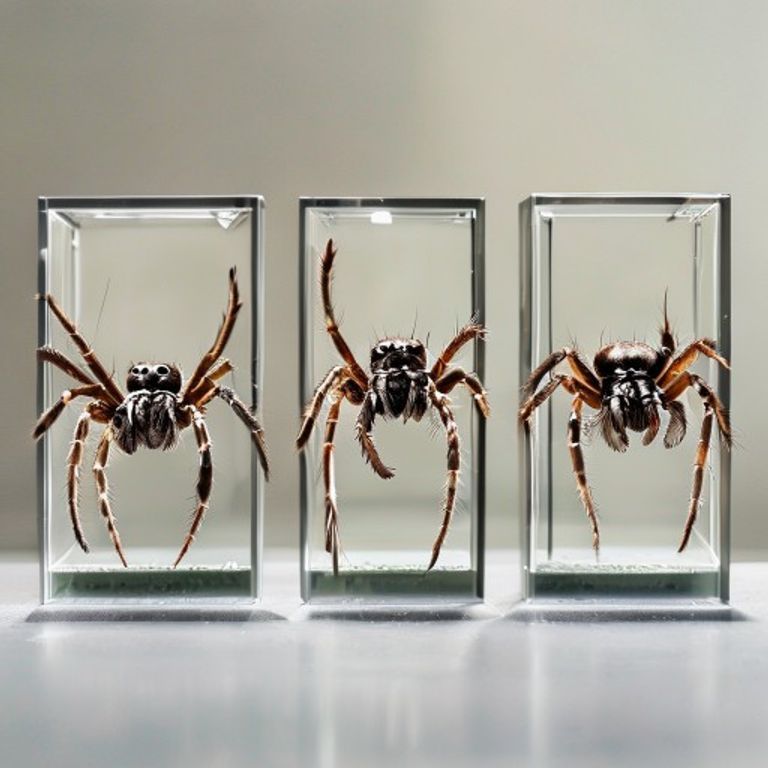
A jumping spider needs an enclosure that is at least 3 to 5 times its diagonal leg span in width and 4 to 6 times its leg span in height, oriented vertically rather than horizontally. For US-kept species in 2026 that translates to a 32 oz deli cup or 2 to 4 oz cup for slings, a 4 x 4 x 6 inch front-opening cube for juveniles, and 5 x 5 x 8 inch to 6 x 6 x 9 inch arboreal terrariums for adults of the four common Phidippus species. Hyllus diardi is the exception that breaks the rule: it needs 8 x 8 x 12 inch as a minimum and does better at 10 x 10 x 14 inch. Undersized enclosures cause pacing, missed molts, and shortened adult lifespan; oversized enclosures cause feeder loss and dehydration in slings. This guide is the dimensional deep dive that the jumping spider enclosure setup guide hands off to.
The Diagonal Leg Span Rule
The single most useful sizing heuristic for jumping spiders is 3 to 5 times the spider’s diagonal leg span (DLS) in floor area, and 4 to 6 times DLS in height. DLS is the distance from the tip of leg I to the tip of leg IV measured across the body, not body length alone (source: UF/IFAS Featured Creatures). Height takes priority because Salticidae are diurnal arboreal hunters that build their silk retreats in the upper corners of any enclosure they live in, hunt from elevated perches, and use the lower third of the space only when descending to a fallen feeder.
Worked example. An adult Phidippus regius female with a 22 mm DLS (about 0.87 inch) needs a minimum of 2.6 x 2.6 x 3.5 inches and a comfort target of 4.4 x 4.4 x 5.2 inches. A standard 4 x 4 x 7 inch acrylic cube exceeds that comfort target with margin. A standard adult Hyllus diardi female with 35 mm DLS (1.4 inch) needs 4.2 x 4.2 x 5.6 inches minimum and 7 x 7 x 8.4 inches comfort, which is why the 8 x 8 x 12 inch recommendation is the minimum, not an upgrade.
The DLS rule is a floor, not a ceiling. There is no upper enclosure limit for an adult spider; large enclosures simply mean the spider establishes its retreat in a preferred upper corner and uses the remainder as hunting and exploration territory. The rule fails in the other direction for slings, where too-large is a welfare problem (see the spiderling section below).
Size by Life Stage: The Three-Stage Upgrade Path
A single jumping spider passes through three enclosure sizes across its 12 to 24 month captive life: deli cup for slings i2 to i4, juvenile cube for i5 to i7, and adult arboreal terrarium for sub-adult through adult. The upgrade is triggered by instar markers and body length, not the calendar. The table below summarizes the three stages and is the source-of-truth size matrix for the rest of this guide.
| Life Stage | Body Length | Minimum Enclosure | Comfort Enclosure | Upgrade Trigger |
|---|---|---|---|---|
| Sling (i2 to i4) | 2 to 5 mm | 2 oz deli cup with 8-12 pinholes | 5 oz or 8 oz deli cup with 12-15 pinholes | Reaching i5 or 5 mm body length |
| Juvenile (i5 to i7) | 5 to 10 mm | 32 oz deli cup or 3 x 3 x 5 inch cube | 4 x 4 x 6 inch front-opening cube | Reaching sub-adult instar or 10 mm body length |
| Sub-adult / adult | 10 to 22 mm (species-dependent) | 4 x 4 x 6 inch arboreal cube | 5 x 5 x 8 inch or 6 x 6 x 9 inch arboreal cube | Final adult home (re-evaluate for H. diardi) |
Slings (First through Fourth Instar)
Slings live in deli cups, full stop. A 2 oz to 8 oz clear plastic cup with 8 to 12 pinholes punched through the lid using a heated insect pin or a 1.5 to 2 mm drill bit is the standard housing. The cup is intentionally small for one reason: flightless fruit flies and pinhead crickets need to stay within visual range of the spider so the sling can hunt them down before they desiccate, escape, or hide. In a 4 x 4 x 6 inch cube a 3 mm sling can lose a fruit fly in the substrate within seconds, then go three to five days without a successful catch, by which point the keeper has no idea whether the spider is eating.
Use a 32 oz deli cup as the upper bound for slings only if the spider has reached i5 and the keeper wants to delay the juvenile-cube transition by a single instar. Anything bigger than 32 oz before i6 is welfare-questionable for a sling under 5 mm.
Sling substrate and decor. A folded square of damp paper towel covering 30 to 50 percent of the cup floor (not the whole floor) plus a single small piece of cork bark or a small leaf gives the sling a humid microclimate, a hide, and an anchor for its silk retreat. Mist one side of the cup every 2 to 3 days; the small volume of air means even light misting holds humidity for 24 to 48 hours.
Juveniles (Fifth through Seventh Instar)
Juveniles get their first real enclosure: a 3 x 3 x 5 inch acrylic cube minimum, or a 4 x 4 x 6 inch front-opening enclosure as the comfort target. This is the stage where the spider starts using the full vertical space: climbing the back wall, building silk anchor lines between cork bark and the upper corners, and ambush-hunting from elevated positions. A purpose-built front-opening acrylic cube is the standard choice; deli cups at this stage limit movement and prevent the spider from establishing the upper-corner retreat it would naturally choose.
Juvenile decor. Add a single small cork bark slab leaned against the back wall at 60 to 75 degrees, one or two hardwood twigs bridging cork to the front wall, and one sheltered upper corner (a silk leaf or additional cork piece) that becomes the retreat anchor. Substrate is 0.5 to 1 inch of coco fibre.
Sub-Adult and Adult
The final adult enclosure depends on species. For the four common US Phidippus species (P. regius, P. audax, P. otiosus, P. johnsoni), a 4 x 4 x 6 inch front-opening arboreal cube is the welfare minimum and a 5 x 5 x 8 inch is the comfort target, with 6 x 6 x 9 inch being a common upgrade for large mature females. For Phidippus regius females (the largest of the four), some keepers move to 6 x 6 x 9 inch or even 8 x 8 x 12 inch and report the spider using the additional volume actively.
Hyllus diardi is a separate case and gets its own section below. Hasarius adansoni at the small end of the hobby (8 to 13 mm body length) does well in 3 x 3 x 5 inch enclosures and never needs anything larger than 4 x 4 x 6 inch.
Size by Species: The Adult Matrix
Adult enclosure size scales with adult DLS, which varies meaningfully across the species commonly kept in the US hobby. The table below sets minimum and comfort targets for each species, plus a note on welfare-critical species-specific considerations. All dimensions assume a vertically oriented enclosure (height > width and depth).
| Species | Adult DLS | Minimum Adult Enclosure | Comfort Adult Enclosure | Welfare Note |
|---|---|---|---|---|
| Phidippus regius (regal) | 20-30 mm | 4 x 4 x 6 inch | 5 x 5 x 8 inch or 6 x 6 x 9 inch | Large mature females (DLS 28-30 mm) benefit from 6 x 6 x 9 inch or larger |
| Phidippus audax (bold) | 15-25 mm | 4 x 4 x 6 inch | 4 x 4 x 7 inch or 5 x 5 x 8 inch | Active hunters; prioritize vertical climbing surface over floor area |
| Phidippus otiosus (canopy) | 18-25 mm | 4 x 4 x 6 inch | 4 x 4 x 8 inch or 5 x 5 x 8 inch | Higher arboreal preference; favor taller over wider |
| Phidippus johnsoni (red-backed) | 15-22 mm | 4 x 4 x 6 inch | 4 x 4 x 7 inch | Western US species; tolerates slightly drier rooms but same dimensions |
| Platycryptus undatus (tan) | 13-20 mm | 3 x 3 x 5 inch | 4 x 4 x 6 inch | Smaller and flatter; ground hunters use more of the floor than other species |
| Hasarius adansoni (Adanson’s house) | 8-13 mm | 3 x 3 x 5 inch | 3 x 3 x 5 inch or 4 x 4 x 6 inch | Smallest commonly kept species; oversize risk is real |
| Hyllus diardi (heavy) | 25-40 mm | 8 x 8 x 12 inch | 10 x 10 x 14 inch or Exo Terra Nano Tall (8 x 8 x 12) | Largest hobby species; significantly more active; needs the full Nano Tall footprint |
The numbers reflect 2026 consensus across UF IFAS species accounts, Spoodville, BugsInCyberspace, Por Amor Art, Spiders Web HQ, and BigFATPhids care sheets cross-referenced with current keeper-community practice. The minimums are welfare-safe floors; the comfort sizes are what large adult females in particular use actively.
The Hyllus diardi Exception
Every dimension on the four Phidippus rows of the table above is doubled or tripled for Hyllus diardi. There are three reasons this species breaks the standard sizing rule:
- Body size. A mature female H. diardi reaches 25 mm body length and 40 mm DLS, roughly 50 percent larger than the largest Phidippus regius female. Floor space scales with DLS by definition.
- Activity level. Captive observers consistently report H. diardi as the most actively roaming species in the US hobby. The animal patrols the full enclosure volume daily rather than holding a single preferred perch.
- Tropical microclimate needs. H. diardi requires 75 to 80 percent ambient humidity vs the 50 to 65 percent that Phidippus species tolerate, which means a larger air volume to buffer humidity between mistings without going stagnant.
Keepers who try to house H. diardi in a standard 4 x 4 x 6 inch Phidippus enclosure see the same welfare cluster every time: pacing along the front wall, refusal to settle into a retreat, food refusal lasting weeks, and missed molts that result in stuck exoskeletons or limb loss. The 8 x 8 x 12 inch minimum exists for this reason, and our jumping spider temperature and humidity guide covers the tropical-microclimate math that makes the larger air volume necessary.
Why Vertical Beats Horizontal Every Time
Jumping spider enclosures must be oriented vertically with height greater than width and depth, ideally with a 1.5:1 to 2:1 height-to-floor ratio. Salticidae are arboreal ambush hunters whose entire behavioral repertoire (silk retreat construction, prey scanning, mate display, predator avoidance) happens in the upper two-thirds of available space. A 7 x 7 x 4 inch horizontal enclosure with the same internal volume as a 4 x 4 x 7 inch vertical enclosure wastes 60 percent of its capacity from the spider’s perspective (source: WSU Entomology).
The corollary: standard rectangular fish tanks, plastic shoebox containers, and any “long” terrarium oriented on its base are wrong-shaped for jumping spiders. They can be repurposed by orienting them on a short end so the original side becomes the floor and the original top becomes a side, but that adds ventilation modification work. Buying a purpose-built arboreal terrarium is almost always cheaper than retrofitting a horizontal tank.
The Upper-Two-Thirds Rule
A properly sized vertical enclosure is only useful if the decor lives where the spider does. Place at least 60 percent of climbing surface area in the upper two-thirds of the enclosure: cork bark slabs leaned against the back wall with the top edge reaching the upper third, twigs bridging from cork to the front wall in the top half, and at least one sheltered upper corner (a silk leaf, additional cork piece, or live plant canopy) that anchors the spider’s preferred retreat zone. A pretty enclosure with cork bark piled on the floor and a tall empty top fails the spider no matter how attractive it looks.
Brand-Specific Dimensions: What You Actually Buy
The US jumping spider hobby has settled on a small set of commercial enclosure brands that ship at standard sizes matching the life-stage and species matrix above. The table below maps each brand’s common SKUs to the life stage and species they fit, plus the 2026 price range from current online listings. This is the table to consult before buying.
| Brand / Model | Dimensions (W x D x H) | 2026 Price | Best Match |
|---|---|---|---|
| Pioneer / generic 2 oz deli cup | 2.5 x 2.5 x 2 inch | $0.20-0.50 | Sling i2 to i4 |
| Pioneer / generic 8 oz deli cup | 3.5 x 3.5 x 2.5 inch | $0.50-1.00 | Sling i3 to i4 |
| Pioneer / generic 32 oz deli cup | 4.5 x 4.5 x 5 inch | $0.75-1.50 | Late sling / early juvenile (i5) |
| AMAC clear display box (modified) | 3 x 3 x 5 inch | $3-8 | Juvenile / small adult (H. adansoni, P. undatus) |
| HerpCult AMAC kit (4x4x6) | 4 x 4 x 6 inch | $15-25 | Adult Phidippus minimum |
| Tarantula Cribs Salticid Cube | 4 x 4 x 6 inch | $20-30 | Adult Phidippus minimum (front-opening) |
| YKL Herp acrylic terrarium | 4.5 x 4.5 x 7 inch | $18-30 | Adult Phidippus comfort |
| Spoodville arboreal acrylic | 5 x 5 x 8 inch | $25-40 | Adult Phidippus comfort (large females) |
| HerpCult / Mantis Den medium | 6 x 6 x 9 inch | $30-50 | Adult Phidippus upgrade / canopy species |
| Exo Terra Nano Tall (glass) | 8 x 8 x 12 inch | $35-60 | Adult Hyllus diardi minimum |
| Exo Terra Mini Tall (glass) | 12 x 12 x 14 inch | $60-90 | Adult Hyllus diardi comfort / bioactive |
The HerpCult and Tarantula Cribs 4 x 4 x 6 inch cubes are the default choice for an adult Phidippus regius or P. audax from a captive-bred breeder. The Exo Terra Nano Tall is the standard H. diardi enclosure across the US hobby because the front-opening doors plus the deeper substrate capacity match the species needs without modification. Spoodville and BugsInCyberspace are the two most-cited US online sources that ship the spider, the enclosure, and the substrate together (source: Spoodville). For substrate selection that matches each enclosure size, see our best jumping spider substrate guide.
Why Too Small Is Bad: The Adult Welfare Risk
An undersized enclosure produces a recognizable behavioral and physical cluster within weeks. The risk is real and the recovery is fast once the spider moves to an appropriate enclosure, but the welfare cost of leaving an adult in a sling-sized cup is high. Watch for these five signs in any adult kept in a 2 x 2 x 4 inch cup, a small craft jar, or anything below the 3 to 4 times DLS floor.
- Pacing or glass-surfing. The spider repeatedly walks the perimeter of the enclosure walls without settling in a retreat or on a perch. This is the most reliable indicator of undersized housing.
- Excess silk webbing. Silk covering most of the enclosure walls beyond the normal single hammock retreat. The spider is essentially trying to expand the usable habitat by webbing everything.
- Refusal to eat. A healthy adult eats every 3 to 7 days. Two consecutive missed feedings outside of pre-molt is a stress signal, and undersized housing is the third most common cause after temperature drops and ventilation problems.
- Missed or stuck molts. A spider without room to lower itself from its retreat on a silk line cannot molt successfully. Stuck molts result in limb loss or death.
- Shortened adult lifespan. Adult Phidippus regius kept in 2 x 2 x 4 inch enclosures show consistently shorter post-maturation lifespans (4 to 8 months) compared to those in 4 x 4 x 6 inch or larger (12 to 18 months in females).
The fix is straightforward: move the spider to an appropriately sized enclosure with the same decor pattern transferred where possible. Recovery from undersized-housing stress is typically complete within 7 to 14 days in the new enclosure. For the diagnostic deep dive on stressed-spider behavior see our jumping spider behavior guide.
Why Too Big Is Bad: The Sling Welfare Risk
The reverse problem is real for slings and gets less attention because oversize feels generous. A 3 mm sling placed directly into a 4 x 4 x 6 inch adult enclosure is in welfare trouble for three concrete reasons, and the recovery is harder than the undersize case because the keeper often does not realize the spider is starving until it has died.
- Prey loss. Flightless fruit flies in a 4 x 4 x 6 inch enclosure disperse across roughly 96 cubic inches of internal volume. A 3 mm sling can see and stalk prey within roughly 1 to 2 inches reliably. The math is bad: most feeders find a hiding spot, desiccate, and decompose where the spider never sees them. The sling goes 5 to 10 days between successful catches when fed at a normal cadence.
- Dehydration risk. Misted water droplets in an adult-sized enclosure spread across a much larger surface area. A 3 mm sling cannot cover the same surface area to find drinking droplets and can dehydrate within 3 to 5 days of moving to oversized housing.
- Monitoring failure. A 3 mm sling in an 8 inch tall enclosure with cork bark and silk leaves is effectively invisible. The keeper cannot confirm the spider is alive, is eating, or has molted. By the time the failure is obvious, the spider has often been dead for days.
The fix is the three-stage upgrade path: start in a 2 oz to 8 oz deli cup, move to a 32 oz deli cup or 3 x 3 x 5 inch cube around i5, and move to the adult enclosure at sub-adult or roughly 10 mm body length. Each upgrade is triggered by spider growth, not the calendar. For the full sling-raising workflow including feeding schedule and molting checks see our jumping spider spiderling care guide.
When to Upgrade: Concrete Triggers, Not the Calendar
Upgrade timing is the area where new keepers struggle most. The rule is to upgrade on a body-length or instar trigger, not a fixed week count, because slings molt on temperature-dependent cycles ranging from 2 to 6 weeks between molts. The decision tree below uses observable markers.
- Sling to juvenile transition. Upgrade when the sling reaches i5 OR a body length of 5 mm, whichever comes first. The visual marker is a sling that fills the bottom third of an 8 oz deli cup and is actively patrolling the lid daily.
- Juvenile to sub-adult transition. Upgrade when the juvenile reaches a body length of 10 mm OR shows sexual dimorphism (males develop visible pedipalp bulbs around i7-i8; females develop a rounder abdomen and lighter ventral coloration). The juvenile enclosure starts to feel cramped at this point and the spider may build silk anchor lines to every available surface.
- Sub-adult to adult transition. The final adult enclosure should be in place before the spider’s final molt (i8 to i10 depending on species and sex). Once mature, the spider is settled and large transfers add stress without payoff. Plan to have the adult enclosure ready by the time the spider is two-thirds of its expected adult body length.
Avoid upgrading mid-molt, within 48 hours of a completed molt, or during any visible pre-molt phase (darkened abdomen, refusal to eat, increased silk activity). The transfer should happen when the spider is hunting and active, ideally right after a successful feeding when the spider is calm in its retreat.
Transfer Procedure
- Set up the new enclosure first. Substrate at correct depth, cork bark anchored, twigs in position, one light initial misting, lighting on its 12-hour timer for at least 24 hours before transfer.
- Move the old retreat anchor when possible. If the spider built its silk retreat on a removable cork piece or twig, transfer that whole piece into the new enclosure. The retained silk scent reduces transfer stress.
- Coax the spider into a small clear catch cup. Place the catch cup at the spider’s back, let it walk in, cap it gently. Do not grab, do not shake the old enclosure to dislodge the spider.
- Release the spider near the upper third of the new enclosure and close the door. The spider will inspect the new space within minutes and establish a retreat within 24 to 72 hours.
- Skip feeding for 24 to 48 hours after transfer. The spider needs to settle before the next feeder is offered.
Common Sizing Mistakes
The four mistakes below appear in keeper-community questions every week and account for most of the welfare problems related to enclosure sizing in the US hobby.
Adult-Sized Enclosure for a Sling
The single most common sizing mistake. A keeper buys a beautiful 4 x 4 x 6 inch acrylic cube, then receives a 3 mm captive-bred sling, and places the sling directly into the adult cube. The sling cannot find feeders, cannot find drinking droplets, and the keeper cannot monitor it. The right move is to keep the sling in its shipping deli cup until i5, then upgrade.
Horizontal Tank for an Adult
A 10 gallon horizontal aquarium oriented on its base is the wrong shape for a jumping spider regardless of total volume. The spider crowds into one upper corner, ignores the rest of the floor space, and the keeper sees the spider only when it descends to feed. Re-orient on a short end (which makes the original top a side) or buy a purpose-built arboreal terrarium.
Phidippus-Sized Enclosure for Hyllus diardi
A keeper buys an H. diardi, sees that other jumping spiders live in 4 x 4 x 6 inch enclosures, and places the diardi in the same size. The species needs 8 x 8 x 12 inch minimum. The mistake produces visible pacing, missed molts, and the welfare cluster described in the Hyllus section above.
Skipping the Juvenile Stage
Some keepers attempt to take the spider directly from a 2 oz sling deli cup to a 4 x 4 x 6 inch adult enclosure when the spider reaches i5. The jump is large enough that the juvenile still struggles to hunt down feeders in the new volume. The three-stage path (sling cup → juvenile cube → adult enclosure) is gentler and produces faster growth.
Frequently Asked Questions
What size enclosure does an adult Phidippus regius need?
An adult Phidippus regius needs a minimum of 4 x 4 x 6 inch in a front-opening arboreal terrarium, with 5 x 5 x 8 inch or 6 x 6 x 9 inch as the comfort target for large mature females. The standard 4 x 4 x 7 inch HerpCult or Tarantula Cribs cube fits the species well. Smaller than 4 x 4 x 6 inch is undersized for a full-grown female and limits her ability to build a proper silk retreat in an upper corner. Anything larger than 8 x 8 x 12 inch is unnecessary for the species but not welfare-harmful.
Can I keep a jumping spider in a 32 oz deli cup permanently?
For most species, no. A 32 oz deli cup is roughly 4.5 x 4.5 x 5 inch and falls short of the adult comfort target for any Phidippus female. It works as transitional housing for a late-stage sling or a juvenile Hasarius adansoni, but the lack of front-opening access, cross-flow ventilation, and proper vertical surface area makes it unsuitable as a permanent adult home. Move to a purpose-built front-opening enclosure once the spider hits sub-adult.
Is an 8 x 8 x 12 inch enclosure too big for a Phidippus regius?
No, just unnecessary. An adult Phidippus regius in an 8 x 8 x 12 inch enclosure will establish a retreat in one upper corner and use the rest as hunting and exploration territory. The welfare downside is zero for an adult. Feeders are still findable for an adult-sized spider, and humidity is still buffered if ventilation is set up correctly. The only real argument against the larger enclosure is cost and shelf space.
Why does Hyllus diardi need a larger enclosure than Phidippus?
Hyllus diardi is significantly larger (25-40 mm DLS vs 20-30 mm for the largest Phidippus regius), more active (patrols the full enclosure volume daily rather than holding a single perch), and requires higher humidity (75-80 percent vs 50-65 percent), which means more air volume is needed to buffer humidity without going stagnant. The 8 x 8 x 12 inch minimum reflects all three factors. Smaller enclosures produce the welfare cluster of pacing, missed molts, and food refusal documented across the US hobby.
Can I house two jumping spiders in one larger enclosure?
No, regardless of enclosure size. Jumping spiders are solitary and territorial; cohabitation leads to stress and cannibalism even in a 10 x 10 x 14 inch enclosure with hides on every wall. Each spider gets its own enclosure. The only exception is a brief supervised pairing for breeding, after which the male is removed before the female builds an egg sac. For the breeding workflow see our jumping spider breeding guide.
Does enclosure shape matter as much as enclosure size?
Yes. A 4 x 4 x 7 inch vertical enclosure is a better home than a 7 x 7 x 4 inch horizontal enclosure with the same internal volume, because Salticidae use the upper two-thirds of available space disproportionately. Height-to-floor ratios of 1.5:1 to 2:1 are ideal. Front-opening enclosures are also preferred over top-opening because reaching in from above triggers the same predator-startle reflex the spider uses against birds in the wild. For ventilation specs and the cross-flow hole-count math that goes with each enclosure size, consult the enclosure setup guide linked in the footer.
How do I know if my current enclosure is the right size?
Three quick checks. First, measure the spider’s DLS and verify the enclosure floor is at least 3 times that measurement and the height is at least 4 times. Second, watch the spider for 5 to 10 minutes daily for a week: a settled spider holds a clear preferred upper-corner retreat and patrols the upper half between feedings. A pacing spider that walks the front wall in loops is signaling undersized housing. Third, confirm prey capture: an adult should hit feeders within 1 to 2 minutes of release if the enclosure is appropriately sized.
When should I buy the adult enclosure relative to bringing the spider home?
Buy the adult enclosure before the spider reaches sub-adult (roughly two-thirds of expected adult body length). For most Phidippus regius bought as juveniles, that means the adult enclosure should be in place within 4 to 8 weeks of bringing the spider home. Buying ahead avoids the situation where a spider hits its final molt in a too-small juvenile cube and has to be transferred under stress.
Researched and written by the ExoPetGuides editorial team with AI-assisted drafting. All husbandry parameters and veterinary references independently verified against recognized species authorities including the University of Florida IFAS species account for Phidippus regius, the Washington State University Department of Entomology Salticidae outreach material, and current US hobby breeders (Spoodville, BugsInCyberspace, Por Amor Art).
For species-specific adjustments, see our care guides for regal jumpers, bold jumpers, and giant jumpers. For complete husbandry fundamentals, see our jumping spider care guide.
ExoPetGuides provides general care information and is not a substitute for professional veterinary advice. Consult a qualified exotic animal veterinarian for health, medical, or welfare concerns specific to your spider.