


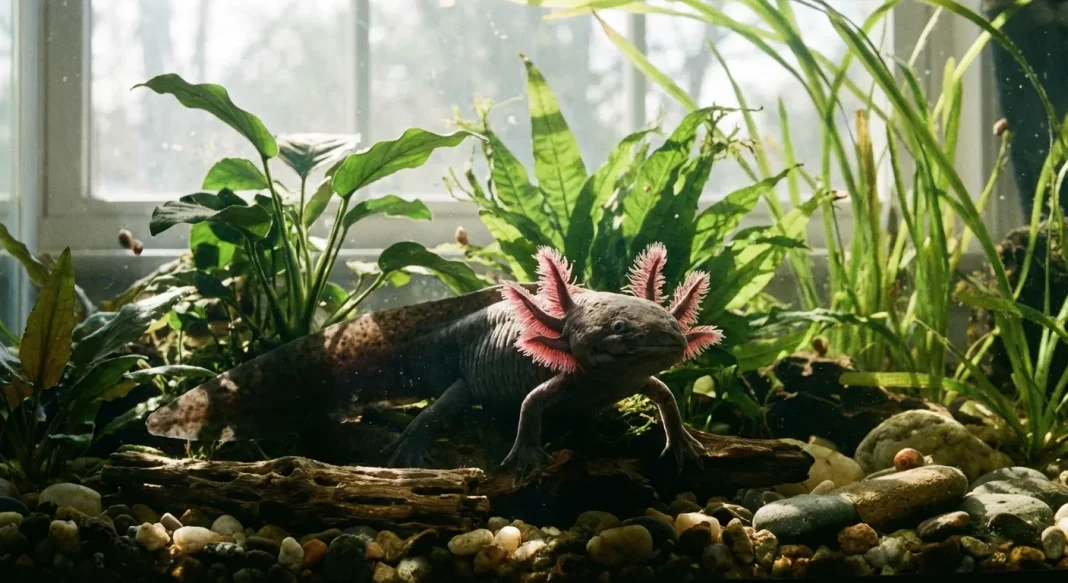
An axolotl needs a cycled cold-water tank, fine-sand or bare-bottom substrate, a stable 60 to 68 degree Fahrenheit temperature, and a vet plan before it arrives. With those fundamentals steady, a captive axolotl typically lives 10 to 15 years. This guide ties the whole care system together and routes you to deeper articles for each piece.
What an axolotl actually is
The axolotl, Ambystoma mexicanum, is a fully aquatic salamander in the family Ambystomatidae. Its defining biological trait is neoteny: axolotls reach sexual maturity without metamorphosing into a terrestrial adult form. They keep their feathery external gills, lateral-line sensory system, and aquatic body throughout their entire lives. This is not a defect or arrested development. It is the species’ normal developmental program.
That neoteny matters directly for care. An axolotl cannot live outside water, cannot be housed in a semi-terrestrial vivarium, and cannot be handled the way a terrestrial reptile or mammal can. Every husbandry decision flows from one baseline: this animal lives in cool, well-oxygenated water and breathes through gills and skin. It is acutely sensitive to dissolved chemicals that terrestrial pets never encounter (source: Merck Veterinary Manual).
Wild axolotls are native exclusively to the remnant canal systems of Lake Xochimilco in the Valley of Mexico. The IUCN classifies Ambystoma mexicanum as Critically Endangered, with fewer than 1,000 individuals estimated to remain in the wild as of the most recent assessment (source: Conservation International). Habitat destruction through urbanization, invasive tilapia and carp predation, and water pollution are the primary drivers of wild decline.
The pet trade relies entirely on captive-bred stock. Wild-caught exports from Mexico are tightly restricted under CITES Appendix II permitting and Mexican national law; in practice wild-caught quotas are effectively zero, and the international hobby moves only captive-bred lineages (source: CITES species register). When you purchase an axolotl from a reputable breeder, you are buying an animal many generations removed from Xochimilco. That captive lineage does not reduce the husbandry requirements. If anything, captive populations carry narrower genetic diversity than wild populations, which is one reason to source from breeders who maintain genetic records rather than mass-produced stock.
From a rescue-intake perspective, the cases we see most often involve axolotls that arrived in homes where the keeper treated the species like a tropical fish, wrong temperature, uncycled tank, gravel substrate. The animal looked fine on day one and showed gill deterioration and skin damage within two weeks. Getting the species identity right is not a formality. It is the foundation of everything else.
For the natural-history background and species context, the axolotl facts guide covers that territory.
Is an axolotl the right pet for you?
Axolotls are a good fit for a patient, aquarium-savvy household that commits to cool-water engineering year-round, accepts a primarily observational relationship with the animal, and has access to an exotic-animal veterinarian. They are a poor fit for households that want a hands-on interactive pet, have no aquarium experience, or cannot reliably maintain water temperatures below 68 degrees Fahrenheit in summer.
Use the filter below before purchasing. Two or more honest “no” answers suggest the species is not the right match at this time.
| Question | Honest answer needed |
|---|---|
| Can you keep the aquarium water between 60 and 68°F year-round, including summer? | Yes |
| Are you willing to cycle a tank for 4 to 8 weeks before the axolotl arrives? | Yes |
| Do you accept that this animal cannot be touched or held in normal interaction? | Yes |
| Is there an exotic-animal veterinarian within reasonable travel distance? | Yes |
| Can you budget USD 200-500 for setup, USD 20-50 per month ongoing, plus a vet emergency reserve? | Yes |
| Will unsupervised young children have access to the tank? | No |
For the full pre-purchase decision walkthrough, see the axolotl-as-pets decision guide.
Tank setup: size, substrate, and the non-negotiables
A good axolotl tank is appropriately sized, has safe substrate, provides at least one hide per animal, has effective biological filtration with low flow rate, and is located away from direct sunlight. Getting these right before the animal arrives prevents the most common beginner emergencies.
Size: A single adult axolotl requires a minimum 20-gallon (75-liter) tank. A 29-gallon or 40-gallon breeder tank is strongly recommended because larger water volume buffers temperature swings and chemistry changes more forgivingly. Floor space matters more than height; axolotls are bottom dwellers and rarely use the upper water column. A long, wide tank always outperforms a tall, narrow one of equal volume (source: AxolotlCentral). For each additional axolotl, add at least 10 gallons.
Substrate is a welfare-critical decision. Gravel is never safe for axolotls. They feed by suction, opening the mouth rapidly to pull food in, and any gravel piece small enough to enter that suction will be swallowed. Gastrointestinal impaction from gravel is one of the most common and most preventable veterinary emergencies in captive axolotls. Two substrate options are safe:
| Substrate option | Pros | Cons | Notes |
|---|---|---|---|
| Bare bottom | Easiest to clean; zero impaction risk; visually easy to monitor waste | Less natural footing; some axolotls show stress on smooth glass | Best for young axolotls under 15 cm (6 in) |
| Fine sand (< 1 mm grain) | More natural footing; axolotls prefer it behaviorally | Requires maintenance; slightly more complex cleaning | Wait until axolotl is at least 15 cm before introducing sand (source: AxolotlCentral) |
Larger river rocks too big to fit in the axolotl’s mouth are acceptable as decorative elements but do not function as true substrate. The detailed trade-off discussion lives in the axolotl substrate guide.
Filtration must balance biological capacity with low flow rate. Axolotls produce a heavy bioload relative to tank size, so effective biological filtration is essential. But axolotls are sensitive to strong water current; sustained directional flow causes gill curl, where the gill filaments fold forward chronically from water pressure. Sponge filters, hang-on-back filters with baffled outflow, or canister filters with spray bars set to diffuse the return current are the standard choices.
Hides are not optional. Axolotls are nocturnal and light-sensitive. Provide at least one hide per axolotl: PVC pipe, ceramic caves, or smooth-edged terracotta pots all work. Live plants like java fern, anubias, and elodea tolerate cool water and give added cover.
Water conditioner: When preparing tap water for the tank, choose a conditioner that does NOT contain aloe vera. Aloe vera is an irritant to axolotls and appears in many “natural” or “slime coat” products marketed in aquarium stores. Seachem Prime, Seachem Safe, and Aqueon Water Conditioner are commonly used safe options. Always read the ingredients before purchase.
For the full equipment walkthrough and tank layout before your axolotl arrives, see the axolotl tank setup guide.
Water temperature: the single most important parameter
Axolotls are cold-water amphibians that need a stable temperature of 60 to 68 degrees Fahrenheit (16 to 20 degrees Celsius), with the sweet spot at 60 to 64 degrees Fahrenheit. Sustained temperatures above 72 degrees Fahrenheit are dangerous; above 75 degrees Fahrenheit axolotls develop immune suppression, gill deterioration, and organ stress fatal within days (source: Merck Veterinary Manual).
This is not a guideline that tolerates casual bending. Temperature above the safe range is the most common cause of illness and death in captive axolotls. The animal often does not show obvious distress the way a mammal would. Heat stress manifests as reduced appetite, forward-curled gills, increased surface gulping, and a general lethargy that inexperienced keepers mistake for normal behavior. By the time white fungal tufts appear on gills or skin, the immune system has already been compromised by days or weeks of thermal stress.
The temperature challenge is keeping the water cool enough, not warm enough. Most homes stay within range during winter without equipment, but summer is the annual crisis point for axolotl keepers.
| Cooling method | Effectiveness | Notes |
|---|---|---|
| Aquarium chiller | Best; consistent year-round | USD 100-300; the reliable long-term solution |
| Clip-on fan across water surface | Good for moderate heat; promotes evaporative cooling | Limited in sustained heat waves above 85°F ambient |
| Frozen water bottles rotated through tank | Emergency stopgap only | Cannot maintain stable temperature; use while chiller is being sourced |
| Air conditioning (room level) | Excellent if available | Most cost-effective if the room is already air-conditioned |
Keepers who work with axolotls consistently report that temperature management, not diet or decor, is the variable that separates animals that reach 12 or 15 years from animals that don’t make it through the first summer. The keepers who avoid trouble check the tank thermometer daily, set up cooling equipment before summer, and treat every unexplained temperature spike as an immediate concern. A spike you catch at four hours is recoverable; one you find at 48 hours may not be.
A reliable thermometer with minimum and maximum memory, placed at the axolotl’s level rather than near the filter outflow, is the minimum monitoring tool. For full cooling-equipment guidance, see the axolotl temperature guide and the axolotl chiller guide.
For summer emergency protocols — heat-wave kits, rotated frozen bottles, chiller failover plans — keep a written response sheet near the tank so a household member can act if you are away.
Water chemistry and tank cycling: the second pillar of axolotl care
Water chemistry is inseparable from temperature as the foundation of axolotl health. A healthy axolotl tank holds ammonia and nitrite at 0 ppm, nitrate below 20 ppm, pH between 7.4 and 7.6, GH at 7 to 14 dGH, KH at 3 to 8 dKH, and zero chlorine or chloramine after dechlorination (source: WSAVA 2015 amphibian husbandry proceedings). The core parameters are:
| Parameter | Target | Why it matters |
|---|---|---|
| Ammonia | 0 ppm | Burns gills and skin; at higher pH, toxic un-ionized form increases |
| Nitrite | 0 ppm | Interferes with oxygen transport in blood; acutely toxic |
| Nitrate | < 20 ppm target; < 40 ppm absolute ceiling | Managed by weekly water changes |
| pH | 7.4-7.6 ideal; 6.5-8.0 acceptable | Acidic water damages slime coat; alkaline increases ammonia toxicity |
| GH (general hardness) | 7-14 dGH (125-250 ppm) | Axolotls need moderate mineral content for gill function |
| KH (carbonate hardness) | 3-8 dKH (54-143 ppm) | Buffers pH; low KH leads to pH crashes |
| Chlorine / chloramine | 0 ppm | Directly toxic to amphibian skin and gills; neutralize all tap water |
The nitrogen cycle is not optional and cannot be shortcut. Beneficial bacteria that convert ammonia to nitrite and nitrite to nitrate must be established before any axolotl enters the water. A fishless cycle using pure ammonia typically takes 4 to 8 weeks. An axolotl placed in an uncycled tank is exposed to ammonia and nitrite spikes that cause gill damage, chemical burns, and potentially fatal organ stress.
Here is what a new keeper needs to understand about zero nitrate: a reading of 0 ppm nitrate does not automatically mean the tank is cycled. In an uncycled tank with no biological filtration established, nitrate stays at zero because the nitrogen cycle has not yet produced any. A properly cycled tank shows 0 ppm ammonia, 0 ppm nitrite, and a small but measurable nitrate reading that increases over the week between water changes. That rising nitrate is evidence the bacteria are working. Nitrate above 20 ppm begins to induce stress in axolotls, which is why the 20 ppm figure is the management target for routine water changes rather than an arbitrary guideline (source: AxolotlCentral Cycling Guide).
From a rescue-intake perspective, the single most frequent cause of illness in newly acquired axolotls is an uncycled or incompletely cycled tank. The nitrogen cycle is not optional; it is the difference between a stable tank and a slow emergency. The step-by-step fishless-cycle process is in the axolotl tank cycling guide.
Test water parameters with a liquid test kit, API Freshwater Master Test Kit is widely used. Test strips exist but are less accurate for the narrow tolerances axolotls require. Test ammonia, nitrite, nitrate, and pH weekly in a stable cycled tank, and daily during cycling, after any disruption (medication, large water change, filter cleaning, new animal added), or if the axolotl shows any behavioral change. The water parameters guide covers parameter interpretation in depth.
What axolotls eat and how to feed them
Axolotls are obligate carnivores. In the wild they eat aquatic invertebrates, insect larvae, and small fish. In captivity, the staple diet centers on nightcrawler earthworms (Lumbricus spp.), which provide above 45 percent protein by dry weight, appropriate calcium, and the moisture content axolotls need. Nutritional analysis of Lumbricus terrestris places dry-weight protein at 56 to 61 percent with a calcium content of approximately 1.5 percent, making nightcrawlers the most nutritionally complete food available for axolotls longer than 7.5 cm (source: AxolotlCentral Nutrition Guide). Nightcrawlers are widely accepted as the single best staple food across veterinary and experienced-keeper literature.
| Food type | Role | Notes |
|---|---|---|
| Nightcrawler earthworms | Staple | Best nutritional profile; cut to size for juveniles |
| Hikari Sinking Carnivore Pellets | Secondary | Useful for juveniles too small for whole worms; not a sole adult diet |
| Frozen bloodworms | Treat only | Low nutritional density; enrichment use |
| Daphnia / brine shrimp | Juvenile treat | Appropriate for very young axolotls |
| Blackworms | Occasional supplement | Acceptable variety addition |
| Raw terrestrial meat (chicken, beef) | Banned | Wrong nutrient profile; fats axolotls cannot metabolize |
| Wild-caught insects | Banned | Parasite and pesticide risk |
Feeding frequency by age:
| Life stage | Approximate age | Feeding frequency |
|---|---|---|
| Juvenile | Under 6 months | Daily |
| Sub-adult | 6-12 months | Every other day |
| Adult | Over 12 months | 2-3 times per week |
Axolotls feed by suction, the mouth opens rapidly and creates a vacuum. They cannot chew. Food must be sized appropriately: cut earthworms into segments for juveniles, feed whole worms to adults. Remove any uneaten food within a few hours to prevent water quality degradation. An axolotl that stops eating for several days combined with other behavioral changes warrants a water-parameter check first.
For the full feeding schedule by age and portion-sizing guidance, see what do axolotls eat.
Handling: why less is more with an aquatic amphibian
Axolotls should be handled as rarely as possible. They are not a pet you pick up, hold, or interact with outside water. Their permeable skin absorbs chemicals from human hands, and their protective mucus layer is easily damaged by dry contact. Lifting an axolotl out of water removes buoyancy and can injure the spine or limbs.
When a transfer is necessary, tank maintenance, veterinary transport, emergency relocation, the container-transfer method is the only appropriate approach:
- Submerge a clean, chemical-free container (a plastic deli cup or small food-grade container) into the tank.
- Gently guide the axolotl into the container while both are still underwater.
- Lift the container with the axolotl and tank water together, keeping the animal fully submerged.
- Move to the destination and release by lowering the container into the water.
The axolotl is never in contact with your hands, and never out of water at any point. Routine water changes and spot-cleaning do not require moving the axolotl at all.
Children and visitors should be clearly told: this is an observation pet. The welfare risk from handling is immediate, not theoretical. Detailed handling technique and stress-reduction strategies are in the axolotl handling guide.
Health overview: what to watch for and when to call a vet
Healthy axolotl gills are the single best visual welfare indicator: full, fluffy, well-branched filaments that sway gently in the water signal good conditions. The most common captive axolotl health problems are bacterial and fungal infections, impaction, and ammonia burns, and nearly all trace back to elevated temperature or poor water quality. Use this five-point weekly home-screening routine:
- Gill check: Full and branched? Any white, grey, or brown fuzzy material? Any curl toward the front?
- Appetite check: Did the axolotl take food at the last feeding? Any refusal for 3 or more feedings?
- Skin check: Any red patches, especially on belly or gill stalks? Any cotton-like tufts? Any lesions?
- Behavior check: Hiding normally? Not floating involuntarily? No glass surfing (rapid back-and-forth along walls)?
- Temperature log: What was the min and max temperature since the last check?
Bacterial infections are the most commonly reported axolotl health problem in captive populations, often secondary to stress, water-quality lapses, or wound contamination, visible as red patches, ulceration, or systemic lethargy (source: axolotl.org health reference). Fungal infections (Saprolegnia and related water molds) are a close second presentation, appearing as white or grey fuzzy growths on gills, tail, or wound sites. The root cause for either is almost always environmental: elevated temperature, poor water quality, or immune suppression from chronic stress. Correct the environment first; medication without addressing the cause will not hold.
Impaction occurs when an axolotl swallows indigestible material, almost always gravel substrate. Symptoms include loss of appetite, bloating, reduced or absent fecal output, and floating. Mild impaction may resolve with fridging (placing the axolotl in a covered container of cold, dechlorinated water at about 40 to 45 degrees Fahrenheit in a refrigerator, to slow metabolism and allow the obstruction to pass). Severe impaction requires a veterinarian. Prevention is straightforward: no gravel substrate.
Ammonia burns present as reddened skin, especially on the belly and gill stalks, and rapid gill deterioration. The cause is always water quality failure. Immediate partial water changes, dechlorinated temperature-matched water, and finding the ammonia source are the first response. For the full response protocol, see the axolotl health red flags guide.
Regeneration is one of the axolotl’s most remarkable biological capabilities, they can regrow lost limbs, gills, and portions of the spinal cord and heart tissue. This ability does not make injuries trivial. Tissue regeneration consumes energy and metabolic resources, and wound sites are vulnerable to infection during the process. A vet evaluation is still appropriate for significant injuries.
An exotic-animal veterinarian experienced with amphibians is the correct provider for health concerns. General small-animal practices may not have amphibian training. The Association of Reptile and Amphibian Veterinarians maintains a practitioner directory useful for finding qualified providers before an emergency arises (source: ARAV).
Behavior basics: what normal looks like
Normal axolotl behavior is mostly inactive: an axolotl that hides during the day, flicks its gills periodically, takes occasional surface gulps, and rests on the substrate is behaving correctly. Glass surfing, persistent involuntary floating, and frequent surface gulping are the stress signals worth acting on. Understanding the difference prevents misidentifying routine actions as emergencies.
Hiding during the day is normal. Axolotls are nocturnal. An axolotl that stays in or behind its hide all day and becomes active to explore and feed in the evening is behaving correctly.
Gill flicking is normal. Axolotls periodically flick or shake their gills to circulate water across the gill filaments. This is routine respiratory behavior, not a distress signal.
Occasional surface gulping is normal. Axolotls have rudimentary lungs in addition to gills and sometimes swim to the surface to take air. Occasional gulping in an otherwise calm animal is not concerning. Frequent, repeated surface gulping indicates low dissolved oxygen, elevated temperature, or poor water quality, test parameters immediately.
Glass surfing (rapid swimming back and forth along the tank walls) is a stress indicator. Common triggers: water quality problems, temperature spike, inadequate hides, tank too small, or new environment adjustment. If glass surfing persists beyond 48 hours after setup or appears suddenly in an established animal, check water parameters and temperature before anything else.
Involuntary floating, when the axolotl cannot return to the bottom, is abnormal and may indicate gas buildup from impaction, swallowed air, or internal organ disease. Occasional deliberate floating near the surface is not alarming. Persistent involuntary floating warrants a water quality check and, if it continues, a vet visit.
For the complete behavioral reference including courtship, territorial signals, and feeding responses, see the axolotl behavior guide.
Lifespan: what to expect from a decade-long commitment
A well-kept captive axolotl lives 10 to 15 years, with exceptional individuals documented at 20 years under ideal conditions (source: Animal Diversity Web — Ambystoma mexicanum). The biggest determinants of captive lifespan are water temperature stability, water quality consistency, and genetic background. Axolotls sourced from breeders who maintain genetic records and avoid close inbreeding tend to have fewer congenital health problems.
The life stages shift what care looks like:
| Life stage | Approximate age | Care considerations |
|---|---|---|
| Juvenile | 0-6 months | Daily feeding; very sensitive to water quality; bare bottom substrate recommended |
| Sub-adult | 6-18 months | Every-other-day feeding; sexual maturity approaching; monitor for territorial behavior if housed with others |
| Adult | 18 months+ | 2-3 feedings per week; full size reached; primary health risks shift to impaction, fungal, and environmental failures |
| Senior | 8+ years | Appetite may decrease; watch for tumor signs; gill quality and regeneration speed may slow |
This is a genuine long commitment. A keeper who brings home an axolotl at age 20 may still be caring for that animal at 33. Consider the life-stage implications seriously before purchasing.
Legal status and responsible sourcing
Axolotl ownership is not legal everywhere. In the United States, axolotls are prohibited in California, Maine, New Jersey, and Washington D.C. as of 2026-05. New Mexico and Hawaii require permits. Arkansas placed axolotls on its Prohibited Captive Wildlife Species list on May 16, 2024; owners who had axolotls before that date could register their animals for lifetime keeping, but no new axolotls may be acquired in the state (source: Arkansas Game and Fish Commission). Virginia lifted its ban in August 2021.
Outside the United States, the UK, Canada (with some provincial restrictions), and most of the EU permit private axolotl keeping. Australia broadly prohibits exotic amphibian ownership. Japan permits ownership without specific permits.
Legal status is volatile. Verify with your state fish and wildlife agency or department of agriculture before purchasing. The axolotl legal ownership guide maintains a jurisdiction-by-jurisdiction breakdown.
Every captive axolotl should come from a reputable breeder who can provide genetic background information. Signs of a reputable source include documented breeding lineage, willingness to answer questions about parents and lineage, appropriate housing for animals being sold, and no claims about wild collection. Avoid mass-produced livestock when possible; genetic diversity matters for long-term health. The Ambystoma Genetic Stock Center at the University of Kentucky publishes husbandry standards that serious breeders align with (source: Ambystoma Genetic Stock Center).
Cost: what axolotl ownership actually costs
Cost is where most prospective keepers underestimate commitment. Expect USD 30 to 75 for a standard-morph axolotl, USD 200 to 500 for initial tank setup, USD 100 to 300 for a chiller if summer cooling is needed, and USD 20 to 50 per month ongoing for food, water conditioner, and filter media. The animal itself is the smallest line item.
| Cost category | Typical range (USD, as of 2026-05) |
|---|---|
| Purchase price, standard morph (wild-type, leucistic) | 30-75 |
| Purchase price, rare morph (melanoid, copper, GFP) | 50-300+ |
| Overnight shipping (live aquatic animal) | 40-60 |
| Initial setup (29-40 gal tank, filter, thermometer, test kit, hides, dechlorinator) | 200-500 |
| Aquarium chiller (if summer cooling needed) | 100-300 |
| Monthly ongoing (earthworms, pellets, water conditioner, filter media amortized) | 20-50 |
| Annual exotic-vet wellness check | 50-100 |
| Emergency vet reserve | 200-500 |
Over a 10-to-15-year lifespan, total cost of ownership spans several thousand dollars and varies widely depending on whether a chiller is needed, the number of vet visits, and local exotic-vet pricing. Equipment up-front (tank, filter, chiller if applicable, lighting, hides) drives the largest single year-one outlay; recurring costs are dominated by food, water conditioner, and electricity for the chiller. A major health event such as surgical impaction treatment can add USD 300 to 800 or more in a single visit beyond routine care. The axolotl cost of ownership guide breaks down annual costs by category with regional variation.
Frequently asked questions
Are axolotls a good pet for beginners?
Axolotls are rewarding but require consistent aquarium fundamentals including nitrogen cycling, water testing, and cool-water temperature management. Beginners who learn the basics before the animal arrives, invest in proper equipment from the start, and keep realistic expectations about a non-handleable observational pet can succeed. A more accurate description is an intermediate-level aquatic pet that rewards careful setup with a manageable daily routine once the tank is established.
Can axolotls live with fish or other tank mates?
Generally no. Fish small enough for an axolotl to eat will be eaten. Fish large enough to avoid predation often nip at axolotl gills, causing injury and chronic stress. Other axolotls can cohabitate if they are similar in size, but cannibalism of limbs and gills is common in juvenile and sub-adult groups. Solitary housing is the safest default. The axolotl tank mates guide covers the limited compatible-species list.
How often should I change the water in an axolotl tank?
Weekly partial water changes of 20 to 30 percent are the standard maintenance schedule for a cycled tank with adequate filtration. Test nitrate before and after the change to calibrate your specific tank’s needs. If nitrate exceeds 20 ppm before your scheduled change, increase change frequency or volume. Always match the replacement water to the tank’s temperature and treat with dechlorinator before adding it.
Do axolotls need a heater?
No. Axolotls need cool water between 60 and 68 degrees Fahrenheit. A heater would actively harm the animal. The challenge for most keepers is keeping water cool enough, not warm enough. If your room stays consistently between 60 and 68 degrees Fahrenheit year-round, no temperature equipment beyond a thermometer is needed. If your room exceeds 72 degrees Fahrenheit seasonally, you need a cooling solution.
Can axolotls regenerate lost limbs?
Yes. Axolotls can regenerate limbs, gills, and portions of internal organs including parts of the spinal cord and heart tissue. Regeneration does not make injuries harmless, the process requires energy, and wound sites are infection-prone during regrowth. Keep water quality pristine during recovery and consult a vet for significant injuries.
What does it mean when my axolotl’s gills are curled forward?
Forward-curled gills typically indicate chronic water-flow stress from a filter that is too powerful or a directional outflow aimed at the axolotl’s resting area. Reduce or baffle the filter outflow. Gill curl can also indicate poor water quality or elevated temperature. Correct the environment, and mild gill curl often reverses over several weeks.
How can I tell if my axolotl is stressed?
The primary stress indicators are glass surfing, forward-curled gills, loss of appetite, frequent surface gulping, and reduced gill filament fullness. Any single sign warrants a parameter check. Multiple simultaneous signs are urgent: test water quality, verify temperature, and assess the tank environment immediately.
When should I call a vet about my axolotl?
Seek exotic-vet evaluation for: white fuzzy fungal growth on gills or skin that does not resolve within 48 hours of water quality correction; suspected impaction (bloating, no fecal output, involuntary floating, appetite loss for 5+ days); significant physical injury; any signs of bacterial infection (red streaking on skin, open wounds); and any situation where correcting all obvious environmental factors does not stop the decline.
Related guides
- Axolotl care SOP: daily and weekly routine
- Axolotl emergency care checklist
- Axolotl quarantine guide
- Axolotl responsible sourcing guide
- Axolotl beginner mistakes
By the ExoPetGuides editorial team (AI-assisted drafting; human-reviewed), reviewed by an exotic-animal veterinarian
Updated 2026-05-16
Primary sources: Merck Veterinary Manual (amphibians), IUCN Red List (Ambystoma mexicanum), AxolotlCentral care reference, ARAV practitioner directory, Ambystoma Genetic Stock Center (University of Kentucky)
Disclaimer: ExoPetGuides content is educational. Husbandry and health recommendations are not a substitute for direct examination by a licensed exotic-animal veterinarian. If your axolotl shows persistent abnormal symptoms (gill curl, fungal patches, refusing food for more than 5 days, involuntary floating, lethargy), consult an experienced amphibian vet.