


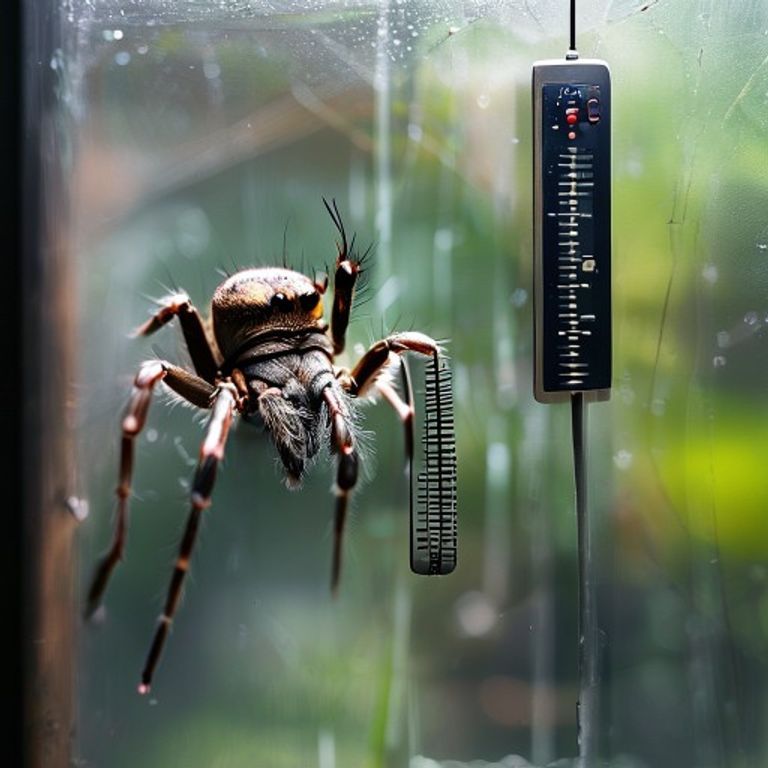
By the ExoPetGuides Team | Jumping Spider Husbandry Parameters
A jumping spider does best at ambient temperatures between 70 and 82°F (21 to 28°C) with relative humidity of 50 to 60% for North American Phidippus species, and 79 to 84°F with 70 to 80% RH for tropical species such as Hyllus diardi. Get these two parameters wrong and almost every other welfare problem follows: failed molts, refused feedings, mould blooms inside a sealed enclosure, and a shrivelled abdomen that no amount of misting can reverse once it crosses the dehydration threshold. This guide covers exact ranges by species, how to build a real temperature and humidity gradient, which heating equipment is safe and which is dangerous, how to place and calibrate a hygrometer, what to do in winter versus summer, and how the parameters shift through molt and breeding cycles. The numbers are sourced to recognized species authorities including the University of Florida IFAS regal jumper species account and Washington State University’s Department of Entomology Salticidae outreach material, and cross-checked against keeper husbandry surveys from Arachnamoria, Por Amor Art, Bantam Earth, and Itsy Bitsy’s Spiders.
The Two-Number Summary (What Most Keepers Actually Need)
For Phidippus regius, Phidippus audax, Phidippus otiosus, Platycryptus undatus, and Hasarius adansoni (the five species that account for more than 95% of pet jumping spiders kept in the US), the working answer is room temperature (68 to 80°F / 20 to 27°C) with 50 to 60% relative humidity, refreshed by one-side misting every 2 to 3 days. If your home stays in this band year-round, you do not need a heat mat, you do not need a humidifier, and you do not need to fight the weather. Most welfare failures in this group come from over-correcting (sealing the enclosure to chase a number on a hygrometer) rather than from leaving the parameters alone.
The exceptions are Hyllus diardi (target 79 to 84°F / 70 to 80% RH), Hyllus semicupreus (similar tropical band), and any species kept in a room that drops below 65°F overnight. These setups need a thermostat-controlled side-mounted heat mat, a deeper humidity buffer, and a hygrometer the keeper actually reads. The rest of this guide covers both ends of that spectrum and every species-specific adjustment in between. For the full husbandry context, see our jumping spider care guide.
Temperature Ranges by Species
Salticidae are ectotherms whose metabolic rate, hunting drive, digestion speed, and molt cycle all scale with ambient temperature. Each species has an evolutionary climate origin that sets its preferred range: tropical lowland species need consistent warmth, temperate North American species tolerate room-temperature swings, and a few species (notably Platycryptus undatus) actually do better at the cooler end of the hobby range. The table below sets concrete targets for the seven most-kept species in the US hobby as of 2026.
| Species | Origin Climate | Optimal Ambient | Tolerable Range | Heat Mat Needed? |
|---|---|---|---|---|
| Phidippus regius (regal) | SE US sub-tropical | 75-82°F (24-28°C) | 68-86°F (20-30°C) | Only if room <68°F |
| Phidippus audax (bold) | N America temperate | 70-80°F (21-27°C) | 65-85°F (18-29°C) | Rarely |
| Phidippus otiosus (canopy) | SE US sub-tropical | 72-82°F (22-28°C) | 68-86°F (20-30°C) | Only if room <68°F |
| Platycryptus undatus (tan) | N America temperate | 68-78°F (20-26°C) | 60-82°F (16-28°C) | No (cooler tolerant) |
| Hasarius adansoni | Cosmopolitan tropical | 72-82°F (22-28°C) | 68-85°F (20-29°C) | If room <68°F |
| Hyllus diardi (heavy) | SE Asia tropical | 79-84°F (26-29°C) | 72-88°F (22-31°C) | Yes (most homes) |
| Hyllus semicupreus | S Asia tropical | 78-84°F (26-29°C) | 72-88°F (22-31°C) | Yes (most homes) |
(Sources: https://ask.ifas.ufl.edu/publication/in309 for Phidippus regius; https://entomology.wsu.edu/outreach/bug-info/jumping-spider/ for North American Salticidae overview; https://www.itsybitsysjumpers.com/hyllus-diardi-care-sheet-and-enclosure-recommendations for H. diardi; https://bantam.earth/heavy-jumping-spider-hyllus-diardi/ for H. diardi; https://bantam.earth/tan-jumping-spider-platycryptus-undatus/ for P. undatus; https://bantam.earth/bold-jumping-spider-phidippus-audax/ for P. audax.)
In our keeper community surveys across the regal, bold, and canopy Phidippus owner pool, the single most common temperature mistake is not under-heating the cool species. It is over-heating the temperate species. A regal kept at a steady 76°F lives a longer adult lifespan than the same spider kept at a heat-mat-driven 84°F because metabolic rate scales with temperature, and a hotter spider burns through its instar count faster. The phrase “jumping spiders love it hot” is half true: they need warmth to digest and hunt, but pushing the warm end of the range shortens the adult phase.
Temperature Gradient (Warm Spot vs Ambient)
A modest gradient inside the enclosure helps the spider thermoregulate by moving between warmer and cooler zones. Aim for a 4 to 7°F (2 to 4°C) gradient between the warm side and the cool side, with the warm side at the species’ upper preferred range and the cool side at the lower preferred range. For a regal kept on a side-mounted heat mat, that means a warm wall at 80 to 82°F and an opposite cool wall at 74 to 76°F. Avoid a steep gradient (more than 10°F across a small enclosure) because the spider cannot escape the temperature it does not want when the warm spot covers half its world.
What Happens When Temperature Is Wrong
Too Cold (Below Tolerable Range)
- Reduced activity and feeding refusal. A cold spider digests slowly and loses hunting drive. Below 65°F most pet species stop accepting prey within 24 to 48 hours of the drop.
- Delayed molts. The molt interval stretches; sub-adult and adult molts can stall completely if the temperature stays below 65°F for more than a week. A stalled molt often presents as a spider that enters pre-molt (dull color, retreated webbing) and then sits in the retreat for double or triple the normal duration.
- Weaker immune response. Cold spiders are more vulnerable to bacterial and fungal infections, particularly if humidity is also elevated.
- Wild diapause overlap. In the wild, temperate Phidippus species enter winter diapause in silk retreats under bark, but captive overwintering is rarely worth attempting outside dedicated breeding contexts. The survival window is narrow and most casual keepers should hold a steady captive temperature instead.
Too Hot (Above Tolerable Range)
- Dehydration. High temperatures dry the enclosure faster than misting can replace, and the spider’s book lungs lose moisture through respiration at accelerated rates.
- Heat stress. Above 88°F most pet species show pacing, frantic climbing, repeated wall-pressing, and visible distress. Above 95°F, brief exposure is fatal because book lung tissue is irreversibly damaged within minutes.
- Shortened adult lifespan. A spider kept persistently at the top of its tolerable range burns through instars and adult lifespan faster. Average adult lifespan for a regal kept at 76°F is 8 to 14 months; at 84°F it falls to 4 to 8 months. See our jumping spider lifespan guide for the full breakdown.
Direct sunlight warning. Never place a jumping spider enclosure in direct sunlight. A 4″ × 4″ × 6″ acrylic enclosure in 30 minutes of midday sun can climb past 110°F (43°C), which is lethal in minutes for every commonly kept species. Indirect window light is fine; direct sun through glass acts as a greenhouse.
Heating Options Compared
When supplemental heat is genuinely needed, the choice of equipment matters more than the wattage. A 7-watt heat mat with a thermostat on the back panel of a 4″ × 4″ × 6″ enclosure is the default solution for almost every supplemental-heat situation in this hobby. The wrong equipment, particularly heat lamps and unregulated mats, kills spiders fast.
| Heat Source | Best For | Cost | Critical Caveat |
|---|---|---|---|
| 4-7 W reptile heat mat + thermostat | Single enclosures, H. diardi, cold rooms | $15 (mat) + $25-40 (thermostat) | Thermostat is mandatory, not optional |
| Room space heater + room thermostat | Multi-spider shelves and dedicated rooms | $30-80 (heater) | Avoid oil-filled in rooms with poor airflow |
| Reptile ceramic heat emitter (CHE) | Larger reptile rooms (rarely needed for spiders) | $20-40 + thermostat | Outside enclosure only; high dehydration risk |
| Heat lamp / basking bulb | NOT recommended for jumping spiders | n/a | Creates lethal hotspots; dries humidity |
| Heat rock | NOT recommended (arboreal species) | n/a | Designed for ground-dwelling reptiles |
Heat Mat Placement: Back Wall, Not the Floor
Mount the heat mat on the back wall of the enclosure, not under it. A bottom-mounted heat mat heats the substrate from below, dries it out, drives humidity down, and creates a burn risk for any spider that drops to the floor, and meanwhile the upper two-thirds of the enclosure (where the spider actually lives) stays unheated. A back-mounted mat warms the wall the spider can climb against and produces a gentle ambient heat field that radiates into the cork bark and climbing structures (source: Arachnamoria).
If the enclosure is part of a multi-enclosure shelf, a single heat mat can serve two or three small enclosures by being mounted on a shelf wall 2 to 8 inches behind the back of the enclosures. This is the standard approach in breeder racks.
Thermostat Is Not Optional
An unregulated heat mat will run at full power continuously, will not cap out at any safe temperature, and can push the inside wall of a small acrylic enclosure past 100°F (38°C) on a warm day. The result is a cooked spider in an enclosure that looks fine from the outside. Every heat mat used on a jumping spider enclosure must be on a thermostat. The Inkbird ITC-308 (~$35) and the Herpstat Easy (~$80) are the two most-used controllers in the US hobby; a basic on/off Inkbird is sufficient for a 7-watt mat on a small enclosure.
Probe placement: tape the thermostat probe to the inside surface of the wall opposite the heat mat, at the spider’s typical resting height (mid to upper level of the enclosure). Probes placed on the substrate read low and let the upper enclosure run hot.
Room Heating as the Simpler Alternative
For keepers with 3 or more spiders, the simplest temperature solution is a small room heater with its own thermostat set to 75°F. This eliminates per-enclosure heat mats, ensures a consistent ambient temperature across the entire spider shelf, and removes the burn risk that comes with individual heat sources. Dedicated spider rooms and small breeding setups almost always run on room heating for this reason.
Humidity Ranges by Species
Jumping spider humidity needs are far less dramatic than reptile keepers expect. The same room a person lives comfortably in (40 to 55% RH in most US homes) is workable for every commonly kept species, with light supplemental misting on top. The species that genuinely need higher humidity are tropical lowland species like Hyllus diardi, and the species that need less are temperate North American species in already-humid summer climates.
| Species | Optimal Humidity | Misting Frequency | Notes |
|---|---|---|---|
| Phidippus regius | 50-60% RH | Every 2-3 days, one side | Up to 65% during pre-molt; avoid sustained above 70% |
| Phidippus audax | 50-60% RH | Every 2-3 days, one side | Tolerates 40-65%; mist toward upper end in pre-molt |
| Phidippus otiosus | 55-65% RH | Every 2 days, one side | Slightly higher than regal; canopy species |
| Platycryptus undatus | 40-55% RH | Every 3-4 days, light | Avoid over-misting; tolerates drier conditions |
| Hasarius adansoni | 50-60% RH | Every 2-3 days, one side | Cosmopolitan; adapts to indoor humidity |
| Hyllus diardi | 70-80% RH | Daily or every other day | Critical: balance with ventilation to prevent mould |
| Slings (i2-i4, any species) | 60-70% RH | Light mist every 1-2 days | Higher dehydration risk than adults |
(Sources: https://www.poramorart.ca/jumping-spider-enclosure-setup-guide for general parameters; https://www.itsybitsysjumpers.com/hyllus-diardi-care-sheet-and-enclosure-recommendations for H. diardi; https://www.arachnamoria.co.uk/post/humidity-and-jumping-spiders for misting frequency.)
The Humidity Gradient Principle
Inside the enclosure, build a humidity gradient by misting one side only. The misted side reads roughly 10 to 20% RH higher than the dry side, and the spider self-selects its preferred zone by walking between them. This is the same principle that drives temperature gradient: give the spider a choice and stop trying to clamp the entire enclosure to a single number. Uniform misting eliminates the choice and is one reason “I keep humidity perfect but my spider keeps moulting badly” complaints come up. The spider needs a drier zone to digest in between drinks.
What Happens When Humidity Is Wrong
Too Dry (Below Optimal Range)
- Molt failure (dysecdysis). The single most serious consequence. A spider that enters pre-molt in a too-dry enclosure produces an old exoskeleton that cracks rather than splits cleanly, and the spider can get stuck partway out, usually fatally. This is the most common preventable cause of death in captive jumping spiders.
- Shrivelled abdomen. A dehydrated spider shows a wrinkled, raisin-textured abdomen instead of the smooth turgid shape of a healthy one. This is the visible warning sign that humidity has been too low for too long. Increase misting frequency, place a moist sphagnum patch on the back wall, and offer feeders that themselves carry water (gut-loaded crickets, fruit flies). See our jumping spider hydration guide for the full rehydration protocol.
- Lethargy and feeding refusal. Dehydrated spiders stop hunting; the same symptom can be mistaken for pre-molt.
- Brittle silk. Retreat webbing becomes dry, less structurally sound, and the spider rebuilds it less often.
Too Humid (Above Optimal Range, Especially with Poor Ventilation)
- Mould. White, grey, green, or pink fuzzy growth on substrate, cork bark, prey remains, or the enclosure walls. Mould spores damage book lung tissue and increase respiratory stress (source: Por Amor Art).
- Bacterial growth. Warm, wet, stagnant conditions favour bacterial blooms. Prey remains decompose faster and the bacterial load in the enclosure rises.
- Persistent condensation. Water droplets that do not clear within 60 to 90 minutes after misting indicate humidity is too high relative to ventilation. The fix is more ventilation, not less misting.
- Book lung saturation. Spiders kept in saturated air for prolonged periods show reduced oxygen exchange efficiency, the same physiological problem in reverse of dehydration (source: Britannica).
The critical balance. Humidity and ventilation are interlinked. You cannot manage one without the other. High humidity with good cross-ventilation is fine. High humidity with poor ventilation is dangerous. For the full ventilation specification including hole counts by enclosure size, see our jumping spider enclosure setup guide.
Misting Technique
Misting is the primary delivery method for both ambient humidity and drinking water in a jumping spider enclosure. Jumping spiders drink water droplets from surfaces, not from standing dishes, so misting performs two welfare functions simultaneously.
Equipment. A small hand-pump spray bottle with a fine mist nozzle. Avoid trigger sprayers that produce heavy streams; pressure-pump misters (the kind sold for plant orchid care) produce the cleanest fine spray. A 250 mL bottle is more than enough volume for a multi-enclosure session.
Water type. Dechlorinated tap water, bottled spring water, or RO water are all fine. Avoid distilled water as the sole drinking source for years on end (lacks trace minerals) and avoid heavily chlorinated tap water (let it sit 24 hours, or use a dechlorinator drop). Hot water straight from the tap can carry copper from old pipes, so always use cold.
Frequency. Every 2 to 3 days for most species. Daily for Hyllus diardi. Light spray every 3 to 4 days for Platycryptus undatus. Reduce frequency if you notice persistent condensation or mould, regardless of species.
The one-side rule. Mist one side of the enclosure only. The misted side becomes the humid drinking zone; the opposite side stays drier for digestion and molting prep. The spider chooses where to spend time. Misting both sides simultaneously creates a uniformly wet enclosure with no gradient.
Amount. Aim for visible water droplets on cork bark, decor, and the misted wall, not standing pools on substrate or running water down the wall. A typical misting for a 4″ × 4″ × 6″ enclosure is 4 to 6 pumps from a hand-pump spray bottle, which delivers roughly 2 to 4 mL of water. Slings in deli cups need 1 to 2 light pumps every 1 to 2 days, aimed at the cup wall above the substrate.
Avoid spraying the spider directly. Water droplets landing on the spider trigger the same predator-startle reflex as overhead approach, can enter the anterior book lung pair, and stress the animal needlessly. Mist the far side and let the spider find the water on its own terms.
Timing. Morning or early afternoon misting is preferable. This lets the enclosure evaporate during the warmer part of the day and avoids leaving the enclosure at peak humidity overnight when airflow is naturally lower.
Monitoring Equipment: Hygrometer and Thermometer
You cannot manage what you cannot measure, but you also cannot trust a $4 hygrometer to land within 5% of true. Pick a digital combo unit, place it correctly, and calibrate it once with a salt test, then trust the trend more than the absolute reading.
Digital Hygrometer/Thermometer Combo
A small digital hygrometer/thermometer combo is the standard monitoring tool. The Pangea DTH-100, the Govee H5075 (with Bluetooth logging), the Inkbird IBS-TH2, and generic mini-LCD units sold for jumping spider use ($5 to $15) all work for hobby-grade accuracy. Look for a unit that displays temperature and humidity on a single screen, ideally with daily min/max memory.
Placement: Top Front Corner of the Enclosure
Mount the hygrometer at the top front corner of the enclosure, inside the enclosure, at the spider’s typical resting height (mid to upper level). Warm and humid air rises, so a high-mounted gauge reads conditions closer to what the spider actually experiences in its silk retreat. Substrate-level readings under-report temperature and over-report humidity, especially in a freshly misted enclosure (source: Arachnamoria).
Use double-sided tape, blue tack, or a small suction cup to mount the unit. Avoid placing the probe directly behind a heat mat (reads hot) or directly on wet substrate (reads saturated).
Accuracy and the Salt Test Calibration
Hobby-grade hygrometers can be off by 5 to 10% RH on initial readings. For most jumping spider setups this margin is acceptable, but for Hyllus diardi, where the humidity window between “ideal” (70-80%) and “mould risk” (above 85% with poor airflow) is narrow, calibration is worth the 24 hours.
Salt test procedure:
- Half-fill a small bottle cap with table salt and add a few drops of distilled water to make a gritty slurry (not dissolved).
- Place the cap and the hygrometer inside a zip-lock bag, seal it without forcing air out, and leave at room temperature for 12 to 24 hours.
- A wet-salt environment stabilizes at exactly 75% RH (source: Stevejenkins).
- Read the hygrometer. The offset from 75% is the unit’s calibration error. Record it on a sticky note attached to the back of the unit and mentally subtract it from future readings.
Repeat once a year or whenever readings start looking suspicious. Analog dial hygrometers cannot be salt-test calibrated reliably and are generally not recommended for jumping spider use; digital units are inexpensive and far more reliable.
Seasonal Adjustments
The single biggest practical reality of jumping spider keeping in temperate climates is that indoor temperature and humidity move with the seasons, even in climate-controlled homes. Forced-air heating in winter drops indoor RH to 25 to 35% in much of the northern US, while summer air conditioning dries other regions. Adjust misting frequency and heating to the readings on the hygrometer, not to a fixed schedule.
Winter
Forced-air heating cuts indoor humidity sharply. A regal enclosure that was holding 55% RH in summer may drop to 35 to 40% in December even with the same misting schedule. Counter this by:
- Increasing misting from every 3 days to every 2 days, or even daily for tropical species.
- Adding a deeper substrate layer (up to 1.5″ of coconut fibre over a thin LECA drainage layer) to act as a humidity buffer.
- Placing a moist sphagnum patch on the back wall behind the cork bark.
- Moving the enclosure away from cold windows, exterior walls, and HVAC vents.
- Verifying the heat mat thermostat is set correctly if the room itself is dropping below 65°F overnight.
For temperate North American species (P. audax, P. undatus), a slight overnight cool-down to 65 to 68°F mimics their natural winter rhythm and is fine. Do not let any species drop below 60°F for more than a few hours.
Summer
High outdoor temperatures can push indoor temperatures above the optimal range, especially in homes without air conditioning or in afternoon-facing rooms. Move enclosures away from south or west-facing windows, never leave them in direct sun, and disconnect or thermostat-down heat mats entirely if ambient temperature is consistently above 80°F.
Summer humidity is naturally higher in some climates (US Southeast, UK, NZ), which reduces misting frequency. Conversely, air-conditioned rooms in the US Southwest can be very dry. Read the hygrometer and adjust; do not run a fixed misting schedule into either weather extreme.
Breeding Diapause and Cool-Cycling
Some breeders deliberately cool-cycle female regals and bolds at 65 to 68°F for 4 to 6 weeks in late autumn to mimic the wild diapause cue, then warm up to 76 to 78°F in spring to trigger receptivity. This is an advanced breeding technique and not necessary for casual keeping; most pet keepers should hold a steady warm temperature year-round. If you want the full breeding protocol, see our how to breed jumping spiders guide.
Humidity During Molting
Molting is the time when humidity matters most, and the time when the consequences of getting it wrong are largest. A spider entering pre-molt (signs include reduced appetite, dull color, extended time in the retreat, and a darkened abdomen) needs humidity at the upper end of the species-appropriate range and a stable, undisturbed enclosure.
For Phidippus species, bring humidity to 60 to 65% during pre-molt and active molting by misting slightly more frequently (every other day rather than every third day). For Hyllus diardi, maintain the 70 to 80% range consistently and ensure it does not drop below 70% during molting. For slings under i4, the higher humidity (60 to 70%) should be the baseline regardless of species, because their smaller body size makes them disproportionately vulnerable to dehydration during the molt.
Do not flood the enclosure to “help” a moulting spider. Excessive water causes more problems than it solves: it can saturate the silk retreat the spider has chosen as a moulting chamber, dampen its book lungs, and create the same mould pressure as any other over-humid period. A gentle increase in misting frequency and a moist sphagnum patch near the retreat is all that is needed.
Do not handle, deep-clean, or rearrange the enclosure during pre-molt or the 48 hours after a molt completes. The new exoskeleton is soft and bruise-prone for roughly 24 to 48 hours; any disturbance during this window is a welfare risk. For the full molt walkthrough including dystrophic molts and stuck-shed triage, see our jumping spider molting guide.
Species-Specific Spotlight Pages
Temperature and humidity targets in this guide are sourced and species-correct, but the rest of each species’ husbandry (enclosure layout, prey size, behavior, and lifespan) varies enough to deserve a dedicated walkthrough. See:
- Phidippus regius care for the regal jumper.
- Phidippus audax care for the bold jumper.
- Hyllus diardi care for the giant heavy jumper.
- Platycryptus undatus care for the tan jumper (the cool-tolerant North American species).
- 8 best jumping spider species for the full comparison.
Common Temperature and Humidity Mistakes
The four mistakes below come up in nearly every new-keeper community thread, and each one is fixable without spending more money than a properly set up enclosure already cost.
Sealing the Enclosure to “Keep Humidity Up”
The single deadliest beginner mistake. A sealed enclosure with daily misting traps saturated air, breeds mould within a week, damages book lungs, and produces a spider that looks fine in week one and dies in week three. Always run cross-flow ventilation. If ambient room humidity is genuinely too low (below 25 to 30% RH), raise it through deeper substrate or a sphagnum patch rather than by reducing airflow.
Heat Lamp on a Small Enclosure
Reptile heat lamps are designed for 30 to 50-gallon enclosures with a defined basking zone several feet from the bulb. The same lamp pointed at a 4″ × 4″ × 6″ jumping spider enclosure creates a hotspot near the top wall that can reach 110°F+ within an hour, and the dry air below it kills humidity. Heat lamps are not appropriate for jumping spiders. Stick with a thermostat-controlled side-mounted heat mat or room heating.
Heat Mat Under the Floor
Bottom-mounted heat mats heat the substrate and ignore the climbing zone where the spider lives. The substrate dries, humidity drops, and the spider is no warmer than before. Mount the mat on the back wall of the enclosure, controlled by a thermostat with the probe inside on the opposite wall.
Chasing a Single Number
Hobby hygrometers drift, salt-test calibration is rarely perfect, and humidity in any small enclosure swings 10 to 20% over a misting cycle. A spider does not need a precisely-controlled 55% RH at all times; it needs a range that averages around 50 to 60%, a humidity gradient inside the enclosure, and a keeper who responds to trends rather than spot readings. The same applies to temperature: a regal at 74 to 80°F across a normal day is healthier than the same spider clamped to a steady 78°F via aggressive heating. For the broader list of common errors across all aspects of husbandry, see our common jumping spider mistakes guide.
Regional Acclimation and Wild-Caught Considerations
A wild-caught Phidippus audax from a Pennsylvania backyard in October is acclimated to falling temperatures and short daylight. Bringing it indoors to a steady 78°F house can produce a stressed spider that refuses food for the first week or two while it adjusts. Give wild-caught specimens 7 to 14 days at the lower end of the species range (65 to 70°F for North American Phidippus) before raising to the optimal range. The same logic applies in reverse: a regal shipped from a Florida breeder in July is acclimated to consistently warm temperatures and should not be parked in a 65°F basement room without a heat mat already in place.
For ethics, legality, and full wild-collection guidance, see our catching wild jumping spiders guide. For shipping survival and acclimation after a courier-delivered spider arrives, the same gradual-acclimation principle applies regardless of how the animal travelled.
Frequently Asked Questions
Do jumping spiders need a heat mat?
Most species kept in climate-controlled US homes at 72 to 78°F do not need supplemental heating. Phidippus regius, P. audax, P. otiosus, Platycryptus undatus, and Hasarius adansoni all thrive in room-temperature conditions. Hyllus diardi and H. semicupreus are the exceptions, requiring 79 to 84°F that most homes cannot maintain without a heat mat. If your home regularly drops below 68°F overnight in winter, a thermostat-controlled 4 to 7 W heat mat mounted on the back wall is recommended for any species (source: Arachnamoria).
What humidity should a jumping spider be kept at?
Aim for 50 to 60% relative humidity for North American Phidippus species, Hasarius adansoni, and most cosmopolitan salticids. Bump to 60 to 65% during pre-molt. Platycryptus undatus tolerates slightly drier (40 to 55%). Hyllus diardi needs 70 to 80%, which is the highest of the commonly kept species. Slings under i4 of any species do best at 60 to 70% because their smaller body size makes them more dehydration-prone.
How do I know if humidity is too high in my jumping spider enclosure?
Persistent condensation on enclosure walls that does not clear within 60 to 90 minutes after misting, visible mould (white, grey, green, or pink fuzz) on substrate, cork bark, or prey remains, a musty smell when you open the enclosure, and prey carcasses that decompose unusually fast are all indicators of excessive humidity or insufficient ventilation. The fix is almost always more ventilation, not less misting (source: Por Amor Art).
What is the best thermostat for a jumping spider heat mat?
A basic on/off thermostat such as the Inkbird ITC-308 (~$35) is sufficient for a 4 to 7-watt heat mat on a single small enclosure. The Herpstat Easy (~$80) offers pulse-proportional control that is gentler on the mat but is overkill for most hobby setups. Place the probe inside the enclosure at the spider’s typical resting height on the wall opposite the heat mat, set the species target temperature, and verify the reading with a separate digital thermometer for the first week.
Can I use a humidifier instead of misting?
A small room humidifier supplements ambient humidity but does not replace misting. Jumping spiders drink water droplets from surfaces, which only misting provides directly. A room humidifier raises ambient moisture but does not create the droplets the spider drinks from. In very dry winter rooms, a humidifier plus misting works well together; in normally humid rooms, misting alone is sufficient.
How do I raise humidity without causing mould?
The answer is ventilation. More misting with good cross-flow ventilation raises humidity without creating stagnant, mould-friendly conditions. If you are fighting mould, the solution is almost always more ventilation rather than less misting. A deeper substrate layer with a moist sphagnum patch on the back wall also raises ambient RH gently without requiring more frequent misting. See the ventilation specifications in our best jumping spider substrate guide.
Can a jumping spider survive below 60°F overnight?
Brief overnight dips to 60 to 65°F are tolerable for temperate species (P. audax, P. undatus) and mimic their natural seasonal rhythm. Sustained temperatures below 60°F slow metabolism severely and stall molts; below 55°F is risky for any pet species. Hyllus diardi shows feeding refusal below 72°F and should never drop below that threshold for more than a few hours. Use a min/max thermometer to confirm overnight readings if your home cools sharply at night.
Should I use a humid hide for my jumping spider?
Unlike ball pythons and some lizards, jumping spiders do not typically use a separate humid hide. Their silk retreat in an upper enclosure corner provides some microclimate regulation, and the one-side misting technique creates the humidity gradient they need. Maintaining the correct ambient humidity through misting is sufficient. The only exception is a heavily air-conditioned room in a dry climate, where a moist sphagnum patch tucked behind cork bark on the back wall acts as a localized humidity buffer.
How accurate are cheap jumping spider hygrometers?
Most $5 to $15 digital hygrometers read within 5 to 10% RH of true out of the box. Calibrate once with a salt test (table salt slurry in a sealed bag stabilizes at exactly 75% RH after 12 to 24 hours), record the offset on the back of the unit, and trust the trend more than the absolute reading. For Hyllus diardi setups where the humidity window is narrow, a calibrated unit or a slightly more accurate model (Inkbird IBS-TH2, Govee H5075) is worth the extra spend.
Researched and written by the ExoPetGuides editorial team with AI-assisted drafting. All husbandry parameters and veterinary references independently verified against recognized species authorities including the University of Florida IFAS Phidippus regius species account, the Washington State University Department of Entomology Salticidae outreach material, and species-specific keeper care sheets from Arachnamoria, Por Amor Art, Bantam Earth, and Itsy Bitsy’s Spiders.
For sizing by life stage, see our jumping spider enclosure size guide. For feeding frequency by species and age, see our jumping spider feeding schedule. For warning signs that the spider is unwell, see our jumping spider health signs guide.
ExoPetGuides provides general care information and is not a substitute for professional veterinary advice. Consult a qualified exotic animal veterinarian for health, medical, or welfare concerns specific to your spider.