


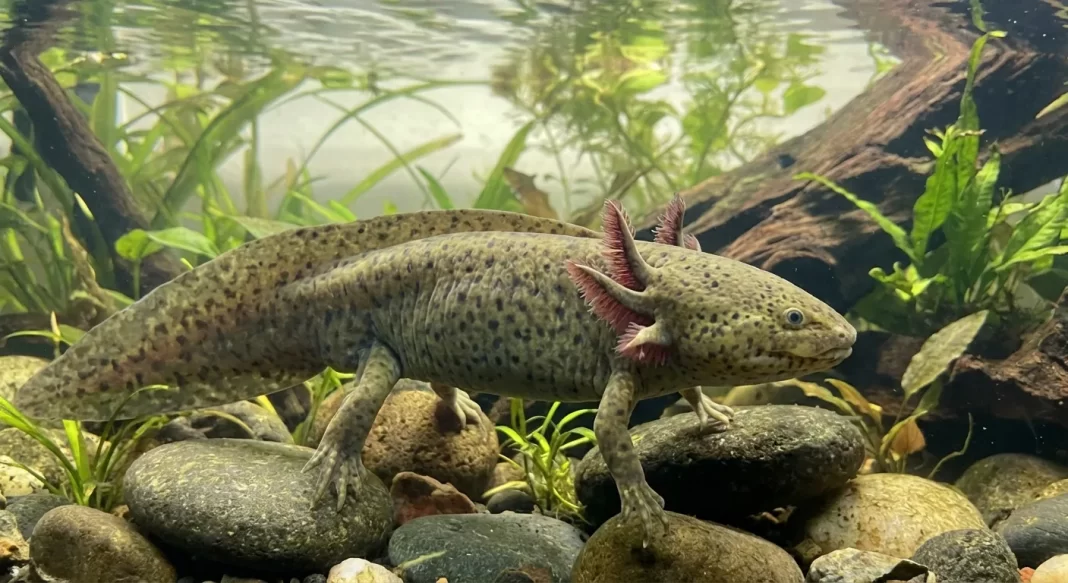
Line breeding — repeatedly pairing related axolotls to fix a desired trait like color morph or pattern — is one of the fastest ways to narrow an already fragile captive gene pool. Because nearly all pet-trade axolotls descend from a founding group of roughly 34 animals collected from Lake Xochimilco in 1863, every deliberate inbreeding event compounds a genetic bottleneck that has been accumulating for over 160 years. This article explains why line breeding happens in the axolotl hobby, the documented health consequences it produces, how to identify stock that may be inbred, and what breeders and buyers can do to reverse the trend.
This article does not cover Mendelian inheritance mechanics or Punnett square predictions (see the axolotl genetics basics guide), morph identification and pricing (see the axolotl colors guide), full breeding protocols and egg management (see the breeding guide), or GFP fluorescence biology (see the GFP axolotl guide).
Why does line breeding happen in captive axolotls?
Line breeding persists in the axolotl hobby for practical and economic reasons that make it seem logical until you examine the genetic consequences. The captive axolotl population offers fewer outcross options than almost any other commonly kept exotic species, and the financial incentives around color morphs push breeders toward decisions that accelerate inbreeding.
Small captive gene pool
The entire captive axolotl population traces to a remarkably small genetic foundation. In 1863, a French military expedition collected approximately 34 axolotls from the canals of Xochimilco, Mexico, and shipped them to the Jardin des Plantes in Paris. From that group, approximately five males and one female became the effective breeding founders whose descendants were distributed to laboratories and eventually to the pet trade across Europe and North America https://academic.oup.com/bioscience/article/65/12/1134/223981.
The Ambystoma Genetic Stock Center (AGSC) at the University of Kentucky, which maintains the largest managed axolotl colony and has historically supplied animals to both research labs and the pet trade, currently shows an average inbreeding coefficient of approximately 35%. For context, zoo conservation programs classify captive populations with inbreeding coefficients above 12.5% as emergency management situations https://academic.oup.com/bioscience/article/65/12/1134/223981. The AGSC figure is nearly three times that emergency threshold, meaning any two random captive axolotls are more closely related than the offspring of human first cousins.
Assessment of the AGSC’s current genetic diversity identifies only 5.82 founder genome equivalents — a measure of how much of the original founding population’s genetic variation has been retained. Simulations using PMx population management software suggest that 89% of the remaining genetic variation could be maintained for 100 years, but only if mean kinship analysis guides every breeding decision https://academic.oup.com/bioscience/article/65/12/1134/223981. Most hobby breeders do not use mean kinship analysis.
Color morph chasing
The financial premium on uncommon morphs creates a direct incentive for inbreeding. Rare color combinations — copper melanoid, axanthic copper, or unusual GFP layered morphs — command significantly higher prices than wild types. Producing these morphs requires animals homozygous at multiple recessive loci, which is fastest achieved by pairing related animals that share the desired recessive alleles. A breeder who has one copper male and one copper female from the same clutch can produce an entire line of copper offspring immediately by crossing siblings, rather than sourcing an unrelated copper animal from a separate breeder.
Breeders who work with axolotl genetics in community forums consistently report that morph-chasing sibling crosses are the single most common source of avoidable inbreeding in the hobby https://www.watercritters.ca/2019/03/20/axolotl-breeding-part-1-genetic-and-health-considerations/. The short-term yield of desirable offspring masks the long-term genetic cost, which typically surfaces one or two generations later as reduced clutch viability, smaller body size, and developmental abnormalities.
Limited local breeder availability
In many regions, only one or two breeders produce axolotls. Buyers who want a specific morph may have no practical option except to acquire both animals from the same source. If that source bred from a single founding pair, the buyer’s "breeding pair" may already be full siblings or half-siblings without either party knowing it. This problem is compounded by the lack of standardized pedigree records in the hobby: unlike dog or horse breeding, there is no centralized studbook for axolotls, and most small-scale breeders do not maintain or share multi-generational lineage data.
What health consequences does inbreeding cause in axolotls?
Inbreeding depression in axolotls follows the same biological mechanism as in any diploid species: when closely related parents are crossed, their offspring have an elevated probability of inheriting two copies of harmful recessive alleles that would otherwise be masked by a functional dominant copy from an unrelated partner. The consequences are well-documented in both laboratory research and hobby breeding reports.
Reduced immune function
Inbred axolotls show measurably weaker immune responses. The major histocompatibility complex (MHC), which encodes proteins critical for recognizing and responding to pathogens, requires genetic diversity to function effectively. When MHC diversity is reduced through inbreeding, the animal’s ability to mount an adaptive immune response narrows. Laboratory data confirms that inbreeding "decreases the viability of axolotls as a genetic model and potentially increases their disease susceptibility" https://pmc.ncbi.nlm.nih.gov/articles/PMC9536427/.
In practical keeping terms, this manifests as axolotls that develop fungal infections more readily, recover from bacterial infections more slowly, and require more aggressive intervention for conditions that genetically diverse animals resolve with basic water quality improvements alone. Experienced breeders who have maintained multiple bloodlines over several breeding cycles report that inbred lines produce animals noticeably more susceptible to opportunistic infections than outcrossed stock from genetically distinct parents.
Developmental deformities
Inbreeding elevates the rate of visible structural defects in larvae and juveniles. Documented deformities in inbred axolotl lines include:
- Shortened or missing toes. The "short toes" lethal trait, first studied by Humphrey in 1967, was one of the earliest genetic defects formally linked to inbreeding in laboratory axolotl stocks https://onlinelibrary.wiley.com/doi/abs/10.1002/jez.1401640211. Affected larvae are born with truncated or absent digits and typically do not survive to adulthood.
- Kinked or curved spinal columns. Vertebral malformations that create a visible bend or S-curve in the body axis. These defects range from mild (slight tail kink that does not affect mobility) to severe (spinal curvature that prevents normal swimming and feeding).
- Gill deformities. Stunted gill stalks, asymmetric gill branching, or abnormally short gill filaments present from hatching — distinct from gill curl caused by water quality stress, which develops later and resolves when conditions improve. For guidance on distinguishing stress-related gill changes from congenital defects, see the gill curl guide.
- Dwarfism and reduced adult body size. Some inbred lines produce animals that plateau at 15-18 cm total length rather than the 20-30 cm range typical of healthy adults. These animals may appear proportionally normal but never reach full size. For size benchmarks by age, see the size and growth guide.
Reduced fertility and clutch viability
Inbred pairs produce clutches with significantly higher rates of infertile eggs and eggs that fail to develop past the neurula stage. A healthy outcrossed pair might see 80-95% of eggs develop to hatching; an inbred pair from the same line may see 40-60% or lower. Larvae that do hatch from inbred clutches tend to show higher mortality in the first two weeks, with a disproportionate number failing to begin feeding independently.
Shortened lifespan
Axolotls in well-maintained captive conditions typically live 10-15 years, with some documented cases exceeding 20 years. Inbred animals from lines with COI above 30% tend to show earlier onset of age-related decline, including organ dysfunction and reduced appetite, often dying between 5-8 years even with optimal water quality and nutrition. For context on normal lifespan expectations, see the axolotl lifespan guide.
Increased metamorphosis risk
Axolotls are neotenic — they normally retain larval features throughout life and do not undergo metamorphosis into a terrestrial form. However, inbred animals show a higher incidence of spontaneous metamorphosis, particularly at 5-10 months of age https://www.axolotlcentral.com/post/why-to-avoid-purchasing-axolotls-from-pet-stores. Metamorphosis in captive axolotls is a welfare emergency: terrestrial axolotls have dramatically shortened lifespans (typically 1-5 years versus 10-15 in aquatic form), require completely different husbandry, and experience significant physiological stress during the transition.
How can you identify potentially inbred stock?
No visual inspection can confirm inbreeding the way a genetic test or pedigree analysis can. However, several practical indicators help buyers and breeders assess risk before committing to a purchase or pairing.
Breeder transparency as a primary indicator
The single most reliable signal is whether a breeder can and will share parentage information. Responsible breeders maintain records of sire and dam for every clutch, know the source of their founding animals, and can describe at minimum two generations of lineage. A breeder who cannot answer "where did the parents of this animal come from?" or who describes their entire colony as originating from one pair purchased years ago is describing a high-inbreeding-risk operation, regardless of how healthy the animals currently appear.
Questions to ask any breeder before purchasing:
- What are the parents’ morphs and genotypes?
- Where did the parents originate (which breeder or facility)?
- Are the parents related to each other? If so, what is their relationship (siblings, half-siblings, parent-offspring)?
- How many generations has this line been bred within your facility without introducing outside genetics?
- Have you observed any developmental abnormalities, fertility issues, or unusual mortality rates in recent clutches?
Physical red flags in individual animals
While physical signs alone do not confirm inbreeding, certain presentations correlate with inbreeding depression and should prompt further investigation:
- Persistently small body size despite adequate feeding and water quality, particularly in animals older than 12 months
- Shortened, stubby, or missing toes not attributable to a documented injury or tank-mate bite
- Visibly asymmetric or stunted gill development present from a young age, not caused by water flow or ammonia exposure
- Chronic susceptibility to fungal infections that recur despite correct water parameters and treatment — see the fungus guide for comparison
- Unusually high mortality rates within a clutch (if buying juveniles and the seller can share this information)
- Spinal curvature or tail kinks visible at rest
None of these individually prove inbreeding, but multiple flags in the same animal or the same clutch increase the probability substantially.
Absence of lineage records
Any seller — hobbyist, pet store, or online marketplace — who cannot provide parentage documentation should be treated as a higher-risk source. This does not mean every undocumented axolotl is inbred, but it means there is no way to assess or control for relatedness. Pet stores, in particular, typically source from wholesale operations that prioritize volume and morph variety over genetic tracking. Animals from these supply chains are more likely to come from lines where sibling or parent-offspring crosses have occurred, either intentionally for morph production or unintentionally through careless colony management https://www.axolotlcentral.com/post/why-to-avoid-purchasing-axolotls-from-pet-stores.
How do responsible breeders prevent inbreeding?
Preventing inbreeding in axolotls does not require sophisticated laboratory tools. It requires intentional record-keeping, a willingness to source outside genetics, and the discipline to prioritize genetic health over short-term morph production.
Outcross from unrelated lines
Outcrossing — pairing two animals with no known recent common ancestors — is the single most effective tool for reducing inbreeding depression. In practical terms, this means sourcing breeding stock from geographically separate breeders whose lines trace to different founding animals. An outcross between two genuinely unrelated lines typically produces offspring with higher egg viability, faster juvenile growth, fewer developmental defects, and stronger immune function compared to line-bred animals.
The challenge is verification. A breeder advertising an "unrelated pair" may simply mean the two animals came from different clutches at the same facility, which does not guarantee genetic distance if both clutches came from the same founding pair. Asking for multi-generational parentage records, or at minimum the original source breeder for each parent line, provides more useful information than morph labels or price alone.
Track parentage rigorously
Every breeding animal should have a record that includes its source, parents (if known), morph, het status, date of acquisition, and breeding history. Even basic paper records prevent accidental sibling crosses. Breeders maintaining multiple lines should physically separate or clearly label animals by lineage to avoid mix-ups during breeding season. For a printable tracking framework, see the record-keeping template.
Never breed siblings or parent-offspring pairs
Full-sibling crosses increase the coefficient of inbreeding by approximately 25% per generation. After just three consecutive generations of sibling breeding, COI exceeds 50%, placing offspring at severe risk of inbreeding depression. Parent-offspring crosses produce the same 25% COI increase. Half-sibling crosses add approximately 12.5% per generation. None of these pairings should be used in any responsible breeding program, regardless of how desirable the expected morph outcome would be.
COI calculation mechanics and Punnett square examples are covered in the genetics basics guide linked in the introduction above.
Understand COI and use it as a breeding decision tool
Even without formal pedigree software, breeders can estimate COI by mapping known ancestry. The practical rule: if you can trace any shared ancestor within four generations between a prospective sire and dam, the pairing will produce offspring with elevated COI. The more shared ancestors, the higher the COI. Breeders who maintain records for four or more generations can calculate COI by hand using Wright’s path coefficient formula, or use free online inbreeding calculators designed for livestock and reptile breeding programs.
The AGSC uses PMx population management software to minimize mean kinship across the entire colony — a strategy that hobby breeders can approximate by maintaining a simple spreadsheet of which lines have been crossed with which, and always selecting the least-related available pair for the next breeding event.
Rotate breeding stock regularly
No individual animal should serve as the sole sire or dam for an entire breeding program across multiple generations. Using the same proven male to sire every clutch for three years running creates a population bottleneck within the breeder’s own colony, even if the females come from different sources. Rotating sires, retiring breeding animals after 2-3 seasons, and introducing new unrelated males from outside sources prevents single-animal founder effects.
Do community breeding registries exist for axolotls?
Formalized breeding registries comparable to those used in dog, horse, or reptile breeding (such as ball python registry systems) do not currently exist for axolotls at the hobbyist level. However, several community-driven efforts partially fill this gap.
The AGSC at the University of Kentucky maintains the most rigorous genetic records for any axolotl population worldwide, tracking pedigree, COI, and mean kinship for its approximately 1,200 adult colony. While AGSC animals are primarily distributed to research institutions, some have entered the pet trade over the decades, and their lineage data represents the gold standard for what axolotl pedigree tracking could look like at scale https://academic.oup.com/bioscience/article/65/12/1134/223981.
Online communities, including dedicated axolotl forums and social media breeder groups, have attempted informal lineage-sharing systems where breeders voluntarily post parentage data for their stock. These efforts are inconsistent — participation is voluntary, verification is impossible, and record depth varies from one generation to five or more. Despite these limitations, any lineage information is better than none. Buyers who see a breeder sharing parentage data publicly are at minimum seeing evidence of intentional genetic management.
Some regional axolotl breeder cooperatives in Europe and North America have experimented with shared studbook models, where participating breeders register breeding animals, log crosses, and coordinate outcross pairings across facilities. These remain small-scale and informal, but they represent the most promising model for improving genetic diversity in the hobby long-term.
What should buyers prioritize when sourcing axolotls?
Buyers who are not planning to breed still benefit from selecting genetically healthy stock, because the same inbreeding depression that reduces fertility also reduces immune function, growth rate, and lifespan in pet animals.
Prioritize breeders who provide lineage documentation over those who offer only morph identification and price. A breeder who knows their animals’ parentage and can explain how they manage genetic diversity is more likely to produce healthy, long-lived pets than a seller whose primary selling point is morph rarity.
Ask about clutch health history. A breeder who reports consistent 80%+ hatch rates and low juvenile mortality is likely working with genetically healthier stock than one who reports high egg failure rates or frequent deformities, even if both sell the same morphs at similar prices.
Be cautious with rare morph premiums from unknown sources. A visually striking axolotl from a breeder with no lineage records may have been produced through the exact sibling crosses that maximize inbreeding depression. The morph premium may be subsidized by the animal’s reduced long-term health prospects.
Consider adopting from rescues or rehoming situations. Axolotl rescues and rehoming posts sometimes offer animals from diverse genetic backgrounds, particularly when the original owner acquired stock from multiple unrelated breeders. While lineage documentation may be limited, rescue animals expand the genetic base of your collection if you ever choose to breed.
For a comprehensive buyer checklist covering health indicators beyond genetics, see the how to choose a healthy axolotl guide. For broader ethical sourcing considerations including conservation implications, see the responsible sourcing guide.
Frequently asked questions
Is line breeding ever acceptable for axolotls?
Line breeding — crossing related animals such as half-siblings or cousins — can theoretically fix desirable traits while maintaining more genetic diversity than full-sibling crosses. In practice, the axolotl captive population is already so genetically narrow that even moderate line breeding compounds an existing problem. Professional stock managers at the AGSC avoid line breeding entirely in favor of mean-kinship-guided outcrossing. For hobby breeders, the risk-benefit calculation rarely justifies line breeding when outcross partners can be sourced from other breeders.
How many generations of sibling breeding does it take to cause visible problems?
Visible deformities, fertility decline, and immune weakness can appear within two to three generations of full-sibling crosses, though the timeline depends on the starting genetic load. A line that already has elevated COI from its source population may show problems in the first generation of sibling breeding. Lines with more genetic diversity may tolerate one generation of close breeding before effects become apparent, but this does not make the practice safe — it means the damage is accumulating invisibly.
Can I fix inbreeding damage by outcrossing once?
A single outcross to an unrelated animal substantially reduces COI in the immediate offspring, typically halving the inbreeding coefficient compared to the parent from the inbred line. However, one outcross does not eliminate all accumulated deleterious recessive alleles from the line. Sustained outcrossing over multiple generations is needed to meaningfully restore genetic health. The outcross partner must genuinely be unrelated — sourcing from the same regional breeder network that produced the inbred line may not provide sufficient genetic distance.
What is the difference between line breeding and inbreeding?
In genetics, both terms describe breeding between related animals. "Line breeding" typically refers to pairing more distantly related animals (half-siblings, cousins, grandparent-grandchild) to fix traits while theoretically maintaining more diversity. "Inbreeding" usually refers to closer pairings (full siblings, parent-offspring). The distinction is one of degree, not kind: both increase COI, both increase the probability of homozygosity for harmful recessive alleles, and both contribute to inbreeding depression. The pet trade often uses "line breeding" as a euphemism that obscures the genetic reality.
Should I avoid buying from breeders who line breed?
A breeder who acknowledges using occasional controlled line breeding, tracks COI, monitors clutch health metrics, and regularly introduces unrelated outcross stock is managing genetics responsibly — even if some pairings involve distant relatives. A breeder who breeds siblings repeatedly, cannot explain their animals’ parentage, and dismisses genetic concerns is a higher risk regardless of what terminology they use. Evaluate the breeder’s practices and transparency, not just the label they apply to their breeding strategy.
Researched and written by the ExoPetGuides editorial team with AI-assisted drafting. All husbandry parameters and veterinary references independently verified against the "Tale of Two Axolotls" population genetics study in BioScience (Woodcock et al., 2015), the "Amazing and Anomalous Axolotls" review in Developmental Dynamics (Adamson et al., 2022), Water Critters’ axolotl genetic breeding guide, and axolotlcentral.com’s sourcing guidance.
Disclaimer: This content is for educational purposes only and is not a substitute for professional veterinary advice. Always consult a qualified veterinarian — ideally an exotic-animal specialist — for any health concern about your pet. Care recommendations may vary based on species, individual animal, and local regulations.