


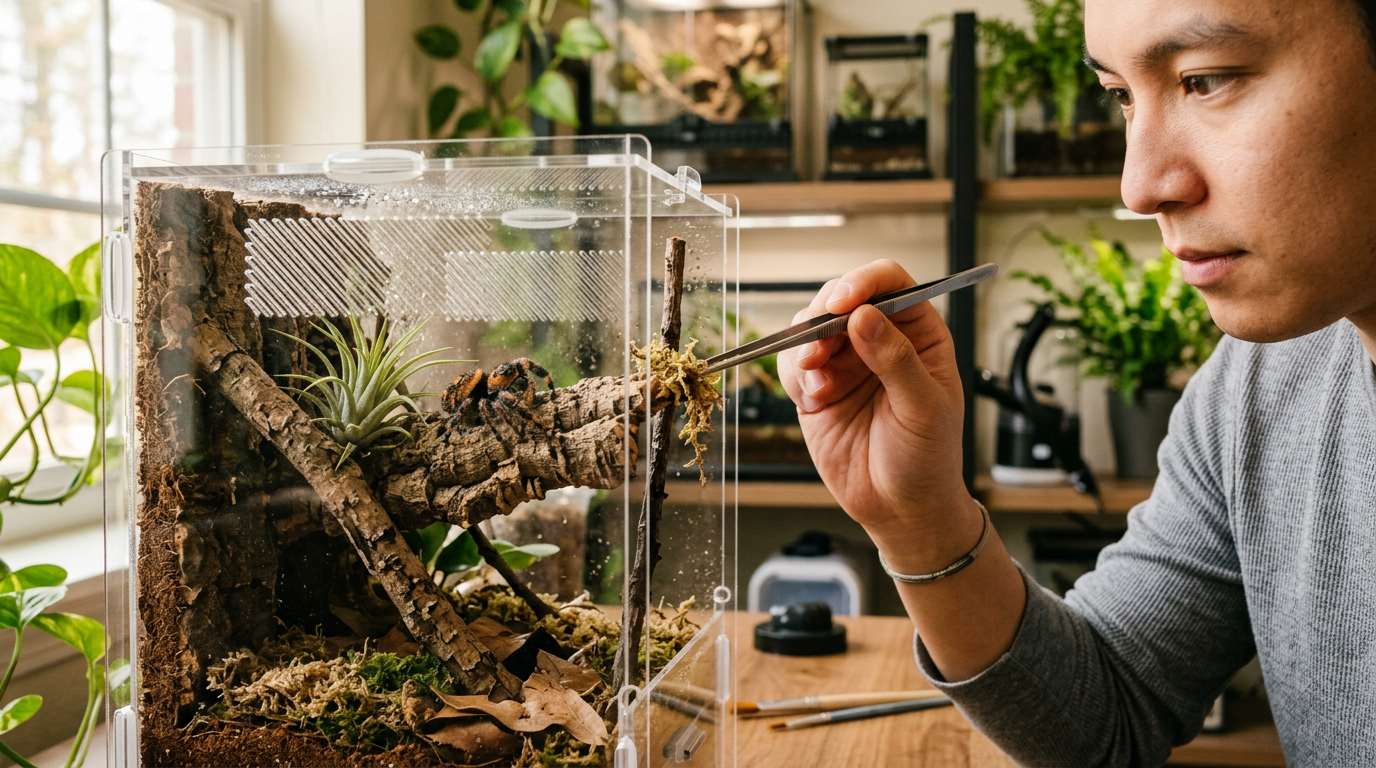
Almost every jumping spider that arrives at a vet visit, fails to molt, or dies prematurely in captivity does so because of a small handful of avoidable setup and husbandry errors, not because the species is fragile. Jumping spiders are tough, visually oriented, and forgiving, which is precisely why new keepers mistake initial survival for thriving, then run into trouble weeks or months later. This guide walks through the ten most predictable mistakes new Phidippus regius and other commonly kept jumping spider owners make, why each one matters at the biology level, what goes wrong when it is ignored, and the exact fix. If you have not yet bought your spider or built your enclosure, work through the jumping spider care guide first, then return here to pressure-test your plan against the mistake list.
Why New Jumping Spider Owners Make Predictable Mistakes
Jumping spiders are one of the most forgiving pet invertebrates available, which paradoxically causes most rookie mistakes. The spider survives the first two or three weeks despite husbandry errors, the keeper concludes the setup is fine, and the underlying problems compound silently. By the time symptoms surface (failed molt, sudden weight loss, escape, or death), the keeper is weeks past the point where a simple correction would have prevented it.
The mistakes below come from patterns documented across species authorities, keeper communities, and breeder feedback. None of them are exotic. None of them require advanced husbandry to fix. They are the same ten errors that show up in keeper forum threads, breeder return-buyer correspondence, and exotic-vet invertebrate consults again and again. Reading this list before your spider arrives will save you the welfare cost of learning each one the hard way.
A useful framing: jumping spider husbandry is high-frequency, low-effort. The decisions are small (mist this corner, not that one; offer a fly this size, not that size; wait three more days before handling) but they happen daily. Mistakes accumulate. Good defaults compound. This guide is an attempt to give you the good defaults before the bad ones lock in.
Mistake 1: Choosing an Enclosure That Is Too Large
The single most counterintuitive mistake new keepers make is buying an enclosure that feels generous and watching the spider underperform in it. Jumping spiders are sit-and-wait ambush predators that hunt by sight within a small territory. In an oversized enclosure, the spider cannot reliably encounter introduced prey, loses condition, and is read by the keeper as “lazy” or “depressed” when the real problem is spatial.
A Phidippus regius adult does well in a vertical enclosure roughly 4 by 4 by 7 inches, with 6 by 6 by 8 inches as a comfortable upper bound; anything significantly larger introduces prey-encounter problems for an ambush hunter (source: The Tarantula Collective). Slings need much less. A 2 to 4 ounce condiment cup is appropriate for first to third instar. A 10 or 20 gallon terrarium is wildly oversized for any jumping spider species commonly kept as pets, including the larger Hyllus diardi.
What goes wrong. The spider hides in one corner and stops hunting. Introduced prey wanders freely without being detected. The spider loses weight, the abdomen shrinks, and the keeper interprets the change as illness or aging when the real problem is that the spider cannot find food efficiently in a space designed for a tree frog.
The fix. Match enclosure dimensions to body length and life stage, and prefer a tall (vertical) footprint over a wide (horizontal) one because Salticidae are arboreal hunters. Our jumping spider enclosure setup guide covers stage-by-stage dimensions, orientation, and the specific enclosure models keepers in our community report the fewest problems with.
Mistake 2: Using a Top-Opening Enclosure
Jumping spiders are arboreal: they build their silk hammock retreats at the highest point of the enclosure and prefer to hunt from elevated positions. A top-opening enclosure forces the keeper to reach in from above, which startles a visually oriented animal that experiences threats as descending shadows, and it almost guarantees the spider builds its retreat on the underside of the lid where every feeding and misting session damages it.
What goes wrong. The spider builds its hammock against the lid. Every time the lid opens for feeding, misting, cleaning, or observation, the retreat is destroyed or the spider is risked falling out. Spiders that fall from a top-opening enclosure onto a hard floor can rupture their abdomen on impact, which is non-recoverable.
The fix. Use a front-opening enclosure. Acrylic terrariums with magnetic or hinged front doors (the Tarantula Cribs and Jamie’s Tarantulas lines are commonly recommended by keepers; custom acrylic from Etsy enclosure makers also works) let you access the spider without disturbing the top-anchored hammock. Cross-ventilation panels should be on the sides, not just the top. See Mistake 5 for why.
Mistake 3: Feeding Prey That Is Too Large or Too Dangerous
Jumping spiders should eat prey that is no longer than the spider’s abdomen, and the most common offenders are crickets and large mealworms. Oversized prey causes two problems: the spider refuses to engage, or the prey wounds the spider during the takedown. A jumping spider with a damaged leg or pedipalp does not regenerate that tissue until the next molt, and a bite to the abdomen from a cricket left overnight can be fatal.
Crickets in particular are a documented hazard. Adult crickets can bite hard enough to damage a jumping spider, and the danger peaks at night when the spider is less active and the cricket roams freely (source: My Pet Jumping Spider). Mealworms left uneaten pupate into beetles that are aggressive toward spiders, so any uneaten mealworm must be removed within 24 hours regardless of size.
What goes wrong. The spider is bitten or kicked during the takedown attempt, the bitten leg loses function, and the spider is also stressed by a prey item it cannot subdue. Crickets left overnight in the enclosure of a pre-molt spider have killed many otherwise-healthy jumpers.
The fix. Size-match prey to the spider and remove uneaten feeders within 24 hours, every time:
- Slings (first to third instar): springtails (Collembola) and flightless fruit flies (Drosophila melanogaster).
- Juveniles (third to fifth instar): D. hydei fruit flies and pinhead crickets (1/8 inch or smaller).
- Adults: green bottle flies (Lucilia sericata), small to medium crickets, and small mealworms or waxworms occasionally. Pre-killed feeders are safer for pre-molt or recovering spiders.
For full sizing and rotation by instar, see our jumping spider feeding schedule and the variety options in our jumping spider diet guide.
Mistake 4: Overhandling a New Spider
Jumping spiders can become comfortable with handling over time, but a new arrival needs an undisturbed settling period before any contact attempt. Handling within the first few days of bringing a spider home is the fastest way to suppress its appetite, trigger threat postures, and lose trust before the relationship has even started. Salticidae rely heavily on visual processing; those large anterior median eyes resolve fine motion detail (source: Journal of Experimental Biology). A sudden hand entering the enclosure during the disorientation window is processed as a predator strike.
What goes wrong. The spider threat-postures (front legs raised), refuses food for days, or bolts and disappears into the room. The keeper concludes the spider is “aggressive” or “sick” when the spider is simply communicating that it is not ready. A spider lost in the room often dehydrates or starves before being found.
The fix. Give the spider at least one week (ideally two) in the new enclosure before any handling attempt. The settling-in checklist:
- Spider has built a silk hammock and used it overnight.
- Spider has eaten at least two meals.
- Spider walks across the enclosure without darting or freezing when you approach.
- No threat postures when the front door opens.
Once those four signals are stable, follow the step-by-step first-session protocol in our jumping spider handling guide, which covers body-language reading, fall-prevention, and what to do if the spider bolts. Daily handling is also excessive even for well-acclimated individuals; two to three short sessions per week is plenty.
Mistake 5: No Cross-Ventilation
Jumping spiders need airflow on at least two sides of the enclosure, not just a single mesh panel on the lid. A poorly ventilated enclosure traps moisture, condensation forms on the walls, and the humid microclimate that develops is exactly where mold colonies, fungus gnats, and grain mites thrive. Spiders themselves do not have lungs in the vertebrate sense; they use book lungs, which are passive gas-exchange structures vulnerable to fungal contamination in stagnant humid air.
What goes wrong. Condensation accumulates on the walls. White or grey mold appears on substrate, decor, or the spider’s silk within days. The spider becomes sluggish, refuses food, and may show fungal lesions on its exoskeleton in advanced cases. Mite outbreaks are also a downstream consequence of trapped moisture.
The fix. Ensure cross-ventilation: airflow openings on at least two opposite sides of the enclosure. Most commercially sold jumping spider enclosures already include mesh panels in the right places; deli cups for slings need manually punched ventilation holes on two opposite sides using a heated pin or fine push pin. Test the hole size with a fruit fly before transferring a sling. If the fly escapes, the hole is too large. Our jumping spider temperature and humidity guide covers the airflow-humidity balance in detail, because the two parameters are tightly coupled.
Mistake 6: Misting the Entire Enclosure
Jumping spiders drink from water droplets, not from elevated ambient humidity, and misting the entire enclosure floods the substrate, saturates the silk retreat, and creates the wet conditions Mistake 5 was supposed to prevent. Phidippus regius husbandry guides converge on a 50 to 70 percent humidity target with light targeted misting, not a tropical rainforest. The spider needs droplets on a leaf, a vine, or a wall, not a saturated substrate floor.
What goes wrong. The substrate stays wet. Mold colonies form on decor and substrate within days. Fungus gnats and grain mites colonize the moist organic material. The spider avoids the wet zones, which shrinks the usable enclosure space, and respiratory stress can develop from chronic high humidity combined with poor ventilation.
The fix. Mist one corner or one wall of the enclosure with a fine spray bottle on the lightest setting, just enough to create a few visible droplets the spider can drink from. The rest of the enclosure stays dry. Frequency depends on ambient humidity in your home: every one to two days in dry climates, every two to four days in humid ones. If droplets are still visible 24 hours later, you misted too heavily. Our jumping spider hydration guide covers droplet drinking behavior, dehydration signs, and species-specific humidity targets for P. regius, P. audax, and the higher-humidity Hyllus diardi.
Mistake 7: Cohabiting Multiple Jumping Spiders
Jumping spiders are solitary predators outside of brief mating windows and the maternal-care cluster phase of newly hatched spiderlings. Housing two adults or two juveniles together past the cluster phase results in one eating the other. This is not a question of enclosure size, feeding frequency, or pairing the same sex. It is baseline Salticidae behavior, driven by prey-recognition wiring that does not distinguish between a fly and another spider once predatory drive activates.
What goes wrong. One spider kills and eats the other. The timeline ranges from hours (small enclosure, immediate encounter) to days (large enclosure, infrequent encounter), but the outcome is reliably predictable. The surviving spider is not “more dominant” in any meaningful sense; it simply got the first successful attack in.
The fix. One spider per enclosure. Always. The only exceptions are a brief supervised mating introduction with the male removed promptly after the encounter concludes, and the maternal-care cluster phase with newly hatched spiderlings, which is covered separately. For pairing procedure, see our jumping spider breeding guide. For spiderling separation timing, which is more nuanced than “separate within hours,” see our jumping spider spiderling care guide.
Mistake 8: Ignoring Pre-Molt Signs and Feeding Through Them
Jumping spiders fast before each molt, becoming less active, slightly duller in color, and retreating into a sealed silk hammock for several days. Pre-molt is also the most vulnerable life-cycle phase: the spider cannot move quickly, cannot defend itself, and cannot eat. Keepers who do not recognize pre-molt and continue offering live prey set up the single most preventable cause of captive jumping spider death: a cricket attacking a molting spider in its retreat.
Pre-molt timing for P. regius includes 24 hours of fasting before and after each shed (source: The Tarantula Collective), and in practice fasting often runs three to seven days for adult spiders and longer for slings. Humidity matters more than usual during this window because the new exoskeleton must form correctly under the old one; low humidity is the leading cause of stuck molts (dysecdysis), which can be fatal.
What goes wrong. A cricket left in the enclosure during pre-molt finds the sealed spider and bites through the silk. Alternatively, the keeper assumes the spider is sick, intervenes with handling, and disturbs the molt. Both scenarios are common and both are usually preventable with better pre-molt recognition.
The fix. Learn the pre-molt signal stack (refusal of food for several days, reduced activity, slightly dull or faded coloration, retreat into a sealed silk pocket) and respond by removing all live prey, raising humidity modestly toward the upper end of the species’ range, and leaving the spider alone. Skip a misting cycle if water would land on the sealed retreat directly. Our jumping spider molting guide covers each molt phase, dysecdysis triage, and post-molt re-feeding timing.
Mistake 9: Using Untreated Tap Water
Municipal tap water in many regions contains chlorine or chloramine at levels considered safe for humans but documented as harmful to sensitive invertebrates and amphibians (source: Merck Veterinary Manual). Misting an enclosure with untreated tap water deposits these compounds directly on the surfaces the spider drinks from. The effect is chronic, low-level, and difficult to attribute after the fact. It is also avoidable for almost no cost.
Chlorine off-gasses if water sits uncovered for 24 hours. Chloramine does not; it requires either a chemical dechlorinator (sodium thiosulfate, sold as reptile or aquarium water conditioner) or a different water source entirely. Many municipal systems have switched from chlorine to chloramine in the past decade, so the old “let it sit overnight” advice is no longer reliable everywhere (source: Merck Veterinary Manual).
What goes wrong. The keeper sees no acute symptoms because chloramine exposure is chronic. Over weeks or months, the spider may show reduced feeding response, increased molt issues, or shortened lifespan, but the keeper has no clean way to attribute these to water quality versus dozens of other variables.
The fix. Use bottled spring water, distilled water mixed with a drop of trace-mineral additive, or dechlorinated tap water (a single drop of reptile-grade water conditioner per quart works). Reverse-osmosis water is also fine if available. The cost is negligible and the precaution removes one variable from the welfare equation entirely.
Mistake 10: Not Identifying the Species Before Setup
Jumping spider husbandry is broadly similar across commonly kept species, but the differences that exist are welfare-significant. A Hyllus diardi needs warmer ambient temperatures and higher humidity than a Phidippus regius (source: Itsy Bitsy’s Spiders). A wild-caught P. audax brings different temperament expectations than a captive-bred P. regius, and its native habitat across North America (source: Animal Diversity Web) means it tolerates a wider thermal range than tropical species. A spiderling sold as “jumping spider sp.” at an expo can be any of half a dozen species with different needs.
What goes wrong. The keeper follows generic care advice and ends up with parameters that work for an average jumping spider but not for their specific one. A Hyllus diardi kept at P. regius humidity (50 to 70 percent) is chronically underhydrated and prone to stuck molts. A P. audax kept in tropical conditions has the opposite problem with mold and respiratory stress.
The fix. Identify your spider before finalizing the setup. Adult coloration, abdominal markings, and source (captive-bred breeder, wild-caught, or expo purchase) are usually enough to narrow the species. Our best jumping spider species ranking compares the most commonly kept species by husbandry difficulty. For deep-dive parameters, see our species-specific guides for Phidippus regius, Phidippus audax, and Hyllus diardi.
What a Mistake-Free First Month Looks Like
The simplest way to internalize the mistake list is to picture what the opposite looks like across the first thirty days. A properly set-up keeper buys a captive-bred sub-adult P. regius from a known breeder, houses it in a 4 by 4 by 7 inch front-opening enclosure with cross-ventilation on two sides, mists one corner every other day with dechlorinated water, offers size-appropriate prey (D. hydei or small green bottle flies) twice a week, and does not attempt handling until week two. At that point the spider walks calmly to the open door, the keeper offers an open hand, and the spider chooses to step on.
In our keeper community, the keepers who follow this default sequence rarely run into welfare-cost surprises in the first six months. The keepers who skip steps (overlarge enclosure, top-opening lid, daily handling from day one, undeclared cricket in the enclosure overnight) are the ones who write back asking why their spider is “depressed” or has lost weight or has just died. The mistake list compresses years of community trial-and-error into a list you can run through before your spider arrives. Use it.
For the full first-90-day setup walkthrough, including substrate selection, hide placement, and the feeder culture you should have ready before pickup day, return to the parent jumping spider care guide linked at the top of this article. The mistake list is a defensive checklist; the care guide is the offensive playbook.
Frequently Asked Questions
What is the single most important thing to get right as a new jumping spider owner?
Enclosure size, orientation, and ventilation in combination. An appropriately sized (roughly 4 by 4 by 7 inches for an adult P. regius), front-opening, vertically oriented enclosure with cross-ventilation on at least two sides solves or prevents the majority of the problems on this list. Get the housing right and feeding, humidity, and handling become straightforward. Get the housing wrong and you will be fighting downstream symptoms (mold, weight loss, refused food, escape) for the spider’s whole life.
Can jumping spiders recover from husbandry mistakes if I correct them quickly?
Most of the time, yes. Jumping spiders are resilient and recover from short-term suboptimal humidity, enclosure size, or feeding errors once the underlying issue is corrected. The exceptions are physical injuries from oversized prey, a failed molt caused by chronic low humidity, and falls from height onto hard surfaces; all of which can be permanent or fatal. Catching a husbandry mistake within the first month is usually enough; catching it after a failed molt is often not.
How do I know if my spider is genuinely stressed versus normal behavior?
A stressed jumping spider shows threat postures (front legs raised, sometimes with fangs visible), refuses food for more than a week outside of pre-molt, or spends all its time hiding rather than exploring during daylight hours. A calm spider is active during the day, hunts readily when prey is introduced, builds a tidy silk hammock for sleeping, and approaches the front of the enclosure when the keeper is visible. Our jumping spider behavior guide covers body language reading in more detail.
Is it bad to hold my jumping spider every day?
Daily handling is excessive even for well-socialized individuals. A reasonable frequency for a settled, voluntarily cooperative spider is two to three short sessions per week, each lasting a few minutes. Watch for stress signals (rapid fleeing, threat posture, refusal to step on) and end the session immediately if they appear. Handling is a privilege the spider grants, not a routine the keeper enforces. The opportunity cost of underhandling is much lower than the welfare cost of overhandling.
Do I need a heat lamp for my jumping spider?
Usually not. Phidippus regius and most commonly kept species thrive at room temperature (75 to 85 degrees Fahrenheit / 24 to 29 degrees Celsius), and if your home stays above 68 degrees Fahrenheit consistently, supplemental heating is unnecessary. Heat lamps create hotspots, dry out small enclosures within hours, and have caused enclosure fires when used unsupervised. If ambient room temperature is too low in winter, a low-wattage heat mat on the back of the enclosure controlled by a thermostat is safer than any lamp. Hyllus diardi is one exception; it benefits from a controlled heat source year-round (source: Itsy Bitsy’s Spiders).
How long do I have to fix a mistake before it becomes permanent?
It depends on the mistake. Enclosure size, ventilation, humidity, and water quality are correctable at any time and the spider usually recovers within one to two molt cycles. Prey-size injuries and falls cause damage that does not heal until the next molt, and not all damage is recoverable even then. A failed molt caused by chronic low humidity is sometimes fatal on the spot. The pattern is: husbandry parameters are forgiving, physical incidents are not. The mistake list above is structured to prioritize the irreversible ones (Mistake 3 prey injuries, Mistake 8 failed molts) over the recoverable ones.
What if I already made one of these mistakes and the spider seems fine?
Correct it anyway. Jumping spiders are good at masking subclinical husbandry stress, and “the spider seems fine” is the most common pre-failure state we see in keeper reports. Correcting a too-large enclosure, switching from tap water to dechlorinated water, or removing crickets in favor of flies costs almost nothing and removes downstream risk. The keepers who do best long-term treat the mistake list as a quarterly self-audit rather than a one-time setup checklist.
My spider stopped eating: is that one of the mistakes on this list?
It might be (oversized prey, pre-molt mismanagement, chronic stress from handling), or it might be normal pre-molt behavior on its own. Run through the diagnostic flow in our jumping spider not eating guide, which separates normal fasting (pre-molt, post-molt recovery, ambient temperature drop) from welfare-signal fasting (oversized prey, stress, dehydration, illness). Most “stopped eating” cases are not actually a problem.
Related guides
This article was researched and written by the ExoPetGuides editorial team with AI-assisted drafting. All husbandry parameters, species references, and welfare claims were independently verified against peer-reviewed arachnology literature (Journal of Experimental Biology), recognized species authorities (Animal Diversity Web, The Tarantula Collective, Itsy Bitsy’s Spiders), and an established veterinary husbandry reference (Merck Veterinary Manual). ExoPetGuides does not sell jumping spider supplies and has no affiliate relationship with any breeder, enclosure manufacturer, or supplier named in this guide.
This guide provides general husbandry information based on current species-authority consensus. It is not a substitute for professional veterinary advice. If your jumping spider shows signs of injury, a failed molt, or persistent illness symptoms that do not resolve when husbandry parameters are corrected, consult a qualified exotic-animal veterinarian experienced with invertebrates.