


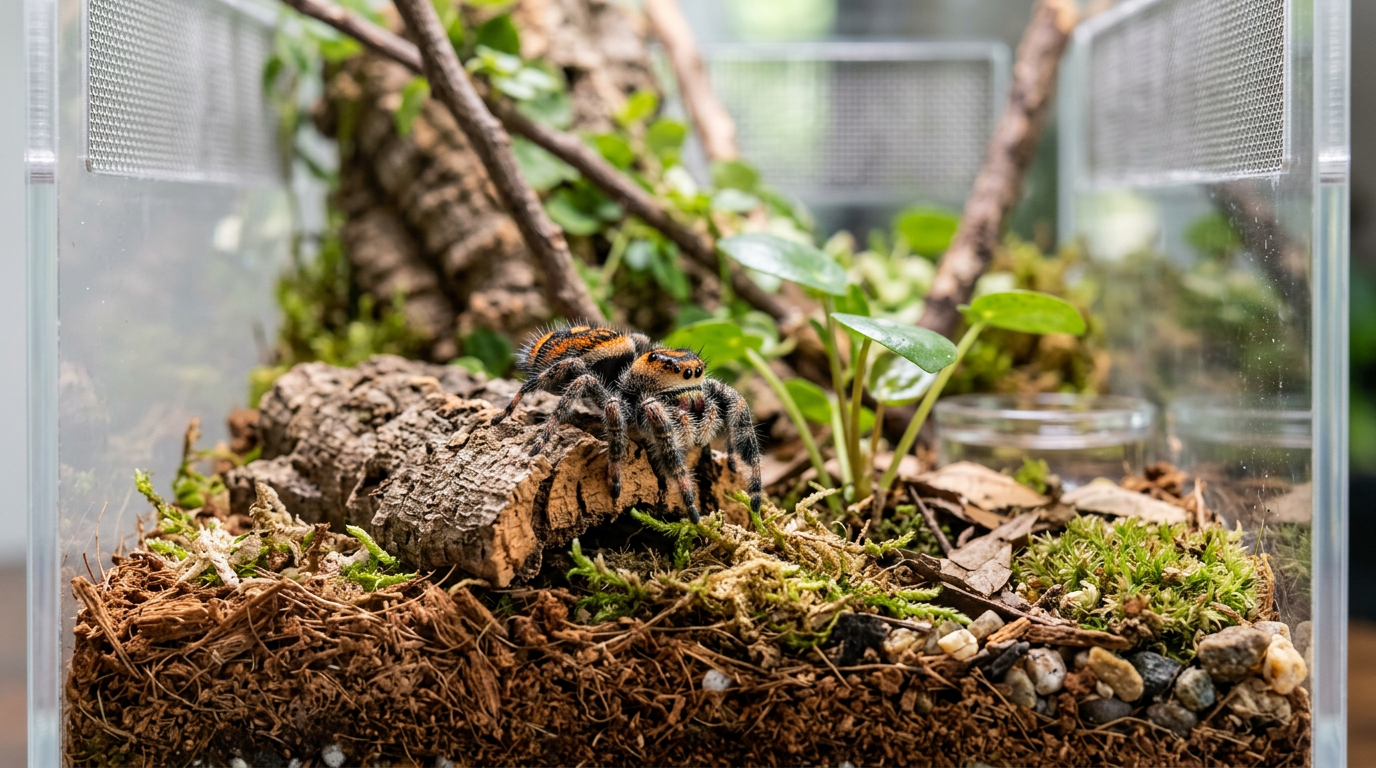
Substrate in a jumping spider enclosure does three jobs: it buffers humidity, gives the spider a safe surface if it falls off the wall, and (in bioactive setups) supports a microfauna cleanup crew that consumes prey remains, droppings, and mold. Jumping spiders are arboreal hunters that spend 90%+ of their time on walls, decor, and the retreat hammock near the ceiling, so substrate is a supporting system, not the centerpiece. The right choice still matters: dusty or chemically treated bedding irritates book lungs, soggy substrate breeds mold inside 72 hours, and any depth over an inch in a small enclosure costs climbing space the spider actually uses. This guide covers every substrate option keepers reach for in 2026, gives a pros-and-cons matrix, walks the bioactive setup down to species names, and lists what to avoid entirely.
In our keeper community we have run more than 100 jumping spider enclosures across coco fiber, paper towel, sphagnum top-dressing, and full bioactive ABG-mix builds. The patterns below reflect what holds up across Phidippus regius, P. audax, and Hyllus diardi husbandry over multiple lifecycles.
What is the best substrate for a jumping spider?
Coconut fiber (coco coir, sold as compressed bricks or loose bags under brand names like Eco Earth and Plantation Soil) is the best all-around substrate for the vast majority of jumping spider keepers. It holds moisture without staying soggy, resists mold better than peat or sphagnum, supports a humidity gradient, and is safe if the spider walks across it. A loose, lightly damp layer of half an inch to one inch is enough for a standard adult enclosure
Coco fiber works because it absorbs misting water and releases it gradually through evaporation, which is exactly the behavior you want from a humidity buffer. It does not compact into a hard crust the way bagged topsoil can, it does not produce fine respirable dust when dry, and a single compressed brick costs $4 to $8 and yields enough hydrated fiber for 6-8 small enclosures. For tropical species like Hyllus diardi, coco fiber blended with a small percentage of sphagnum moss holds humidity higher without becoming a wet mat.
How to set up coconut fiber substrate
- If using a compressed brick, soak it in warm dechlorinated water (room-temp or warmer) until it expands fully – usually 15 to 30 minutes. Break it apart with your hands until the texture is loose and fluffy, not clumped.
- Squeeze out excess water. The fiber should feel damp like a wrung-out sponge, not dripping. If a fistful releases water when squeezed, it is too wet – spread it on a tray for an hour to lose moisture.
- Spread an even layer across the enclosure floor. Half an inch is enough for most enclosures. One inch is the practical maximum – going deeper wastes vertical space the spider actually uses.
- Let the substrate sit in the assembled enclosure for 24 hours before adding the spider. This stabilizes humidity and lets any pockets of excess moisture evaporate.
Replace coco fiber every 4 to 8 weeks as part of a routine jumping spider enclosure cleaning cycle, or sooner if you see mold blooms or smell a persistent musty odor. The jumping spider enclosure setup guide covers placement of substrate relative to climbing structure and retreat anchor.
Substrate options compared: pros and cons
Five substrate strategies dominate the hobby in 2026. The table below maps each against moisture buffering, mold resistance, cost, mess factor, aesthetics, and which keeper profile it suits best.
| Substrate | Moisture buffer | Mold resistance | Cost / enclosure | Maintenance | Best for |
|---|---|---|---|---|---|
| Coconut fiber | Good | Good | $1-2 | Replace every 4-8 wks | Default for adults of most species |
| Paper towel (sterile) | None | Excellent (visual) | <$0.10 | Replace every 3-5 days | Slings, quarantine, sick spiders, breeders with many enclosures |
| Coco fiber + sphagnum top dressing | Very good | Good | $1-3 | Replace fiber every 6-8 wks; refresh moss monthly | Tropical species (Hyllus diardi), display setups |
| Bioactive (ABG mix + leaf litter + CUC) | Excellent | Excellent (microfauna) | $25-50 initial | Top-up only; spot-clean visible mold | Experienced keepers, taller display enclosures, long-term builds |
| Sand / gravel / cedar / pine | None | N/A | N/A | N/A | Avoid entirely (see Section 5) |
The decision tree most keepers should follow: paper towel for any sling under 5mm or any spider you are quarantining; coco fiber for nearly every adult; coco + sphagnum top dressing if you are keeping Hyllus diardi or another tropical species; bioactive only if your enclosure is 6x6x10 inches or larger AND you have 2-4 weeks to cycle the substrate before adding the spider.
Is paper towel a good substrate for jumping spiders?
Paper towel is the most practical substrate for spiderlings (slings), quarantine enclosures, and any keeper who values fast spot-cleaning over aesthetics. It offers zero moisture retention on its own – you control humidity entirely through wall misting – but it makes pathogens, mold spots, boluses (prey remains wrapped in silk), and droppings visible immediately against the white surface. That single advantage is why experienced breeders raising 30+ slings at a time use it exclusively.
For adult display enclosures it looks utilitarian, but it functions perfectly well. The cleaning cycle is fast: pull the old sheet, wipe the floor with a dry paper towel, lay a fresh sheet. Total time per enclosure is under a minute. The jumping spider spiderling care guide covers when to graduate a sling from paper-towel deli cups to coco fiber.
Paper towel setup rules
- Use a single layer, cut to fit the enclosure floor exactly. Avoid stacking sheets – the layer underneath traps moisture and grows mold within days in a warm enclosure.
- Change every 3 to 5 days, or whenever it becomes visibly damp, soiled, or develops any color change.
- If misting for humidity, mist enclosure walls and the upper third of the back panel – not the paper towel directly. A wet paper towel left for 48 hours in a 75°F enclosure is a mold farm.
- For slings in deli cups, a half-sheet on the floor plus a single misted droplet on the side wall is the standard pattern.
The trade-off is humidity stability. Coco fiber buffers the enclosure between mistings; paper towel does not. Keepers using paper towel typically mist once or twice per day depending on ambient room humidity. For the full misting protocol, see the jumping spider temperature and humidity guide.
What about sphagnum moss as a substrate?
Sphagnum moss works well as a humidity-boosting accent but is a bad choice as the sole floor substrate for any temperate species. A thick layer of sphagnum holds water aggressively and stays saturated for days, creating the kind of stagnant damp environment that drives book-lung stress and mold growth (source: Arachnoboards). Jumping spiders need a humidity gradient – a slightly moist zone for drinking droplets and a dry zone where they can retreat and build the hammock without moisture interference.
The correct use of sphagnum in a jumping spider enclosure is as a small clump in one corner, sitting on top of coco fiber or as a top dressing over leaf litter in bioactive setups. Mist that clump directly when you want a localized humid pocket or drinking droplets. The rest of the floor stays drier. This gives the spider access to moisture on demand without making the whole enclosure damp.
The one species where sphagnum-heavy substrate is appropriate is Hyllus diardi and other tropical Salticidae that target 70-80% ambient humidity. Even there, the standard build is coco fiber as the base with a 1-2 cm sphagnum top layer rather than pure sphagnum – the coco still provides the structural drainage.
Bioactive substrate for jumping spiders: full setup
A bioactive substrate is a self-cleaning ecosystem inside the enclosure: a layered organic substrate plus a “cleanup crew” (CUC) of springtails and dwarf isopods that consume prey remains, droppings, dead leaves, and mold spores. Done correctly, a bioactive setup reduces enclosure cleaning to occasional spot-checks and supports live plants. It is the highest-effort, highest-payoff substrate strategy – and it is realistic for keepers with display enclosures of at least 6x6x10 inches.
Bioactive substrate layer stack (bottom to top)
- Drainage layer (optional, 0.5 inch): small clay balls (LECA / hydroballs) or a fiberglass mesh divider. Prevents the substrate from sitting in a pool of water if you over-mist. Optional for vertical jumping spider enclosures because watering volume is low, but standard practice for taller displays.
- Substrate barrier (optional): a layer of fiberglass mesh on top of the drainage to keep substrate from filtering down into the LECA. Skip if you skipped the drainage layer.
- Main substrate (1.5 to 2 inches): ABG mix (Atlanta Botanical Garden mix – equal parts milled peat, sphagnum moss, fine charcoal, plus a double portion of tree fern fiber and orchid bark) or a homemade mix of 1 part coco fiber, 1 part organic topsoil (no fertilizers, no perlite), 1 part sphagnum moss, with a small handful of horticultural charcoal mixed through to retard mold (source: Terrariumtribe).
- Leaf litter (loose handful): dried magnolia or oak leaves baked at 200°F for 30 minutes to sterilize before use. Provides food and shelter for the cleanup crew.
- Sphagnum moss patches (optional, top dressing): small patches across 20-30% of the surface for localized humidity and visual texture.
Cleanup crew (CUC) species for jumping spider bioactive enclosures
The standard cleanup crew is springtails plus dwarf isopods. Both are too small to interest a jumping spider as prey, both consume mold and prey remains, and both tolerate the moderate humidity (60-75%) most jumping spider species need. The specific species used in 2026 hobby builds are:
- Dwarf white isopods (Trichorhina tomentosa): the workhorse CUC species. Eats prey remains, fecal pellets, shed exoskeletons, and decaying leaves. Reproduces parthenogenetically (no males needed), tolerates 60-80% humidity, and stays mostly underground so it does not pester the spider. Stock 15-25 individuals per small enclosure (source: Thebiodude).
- Dwarf purple isopods (Trichoniscus pusillus): alternative to dwarf whites for cooler enclosures. Slightly larger but still well below predation size for adult Salticidae. Prefers slightly damper substrate than dwarf whites.
- Tropical springtails (Folsomia candida): tiny (1-2 mm), white, fast-reproducing, mold-eating microfauna. They graze across the substrate surface, leaf litter, and any uneaten prey. Stock 50-100 individuals to seed a culture. They thrive at 65-80% humidity and will balloon their population to match available food, then plateau.
Avoid larger isopods (Porcellio species, Armadillidium) in jumping spider enclosures – they can stress a molting spider that is briefly defenseless, and the largest individuals can occasionally bite a resting spider’s leg. Stay with the dwarf species.
Bioactive cycling timeline
Do not add the spider to a freshly built bioactive enclosure. The substrate needs to cycle for 2 to 4 weeks before the spider goes in. During this window:
- Mist the enclosure to maintain damp (not soggy) substrate.
- Add the springtails and isopods. They will establish and begin reproducing.
- Toss in a small piece of dried mushroom or a crumb of fish food once per week to feed the CUC during establishment.
- Watch for mold blooms. White fuzzy mold in week one is normal; the springtails will consume it. Persistent black mold is a sign of too much moisture – ventilate more.
After 2-4 weeks, mold blooms should be gone or minimal, springtails should be visible if you mist a patch (they scatter when disturbed), and the substrate should smell earthy rather than swampy. At that point the enclosure is ready for the spider.
For deeper coverage of plant choice, drainage layers, and the complete bioactive build for an arboreal jumping spider enclosure, see the dedicated enclosure setup walkthrough. The enrichment guide covers live plant species that are safe for jumping spider enclosures (pothos, small ferns, and small bromeliads).
Which substrates should you avoid entirely?
Cedar and pine shavings. Both contain aromatic oils (phenols, including the volatile pinenes) that are directly toxic to invertebrates. These oils diffuse continuously from the wood and irritate book lungs even at low concentrations. Cedar and pine shavings are considered unsafe for virtually every exotic pet, and the risk is especially acute for invertebrates with high surface-area-to-body-mass ratios (source: Arachnoboards).
Sand. Fine sand particles can clog book lungs and spinnerets. Sand also provides zero humidity buffering, gives no grip for climbing, offers no enrichment, and produces respirable dust when dry. There is no practical scenario where sand is the right choice in a jumping spider enclosure, including for desert-origin species – those species still need a humidity microclimate at their water source.
Gravel and pebbles. Large stones create dead-end gaps where prey insects hide, die, and rot. They retain zero moisture, add unnecessary weight that can crack acrylic floors, and are functionally pointless given a coco fiber alternative costs the same per enclosure.
Vermiculite. Tiny silvery flakes that pack down into a dense layer, hold water far too aggressively, and can stick to a wet spider or its book lungs. Banned in arachnid keeping for decades. Often confused with perlite, which is the white version – both are out for jumping spiders.
Perlite. Small white volcanic mineral balls used in commercial potting mix. Light enough to be ingested or stuck to a spider’s tarsal claws. Always check the bag – “organic topsoil” with perlite included is not a usable substrate.
Dyed, scented, or antimicrobial substrates. Any substrate marketed with color dye, fragrance, or “odor control” chemistry introduces unknowns to a delicate invertebrate respiratory system. Always use plain, undyed, unscented products. The brown coco fiber sold for reptile bedding is the safe default; the colorful “rainforest” variants are not.
Reptile carpet and felt. Not chemically toxic, but the woven loops catch a jumping spider’s tarsal scopulae (the fine hair pads on the feet) and can trap or tear small legs. Jumping spiders grip surfaces with these scopulae – a fabric-loop surface fundamentally interferes with normal locomotion.
Wild-collected soil that has not been sterilized. Outdoor soil carries parasitic mites, nematodes, fungal spores, and insect eggs that can establish in the enclosure and harm the spider. If you must use field-collected soil, bake it at 200°F for 30 minutes and let it cool completely first.
How deep should the substrate layer be?
For a standard adult jumping spider enclosure (roughly 4x4x7 to 6x6x10 inches for an adult Phidippus), substrate depth should be half an inch to one inch on a non-bioactive build, and 1.5 to 2 inches on a bioactive build. Anything deeper is wasted vertical climbing space. Jumping spiders do not burrow – depth gives them nothing they cannot get from a half-inch layer.
| Setup type | Substrate depth | Notes |
|---|---|---|
| Sling deli cup (50-200 ml) | None or paper towel | Visibility for monitoring molts and feeding is more important than substrate |
| Juvenile enclosure (3x3x5 to 4x4x6 in) | 0.25 to 0.5 in coco fiber OR paper towel | Thin coco layer is fine; deeper wastes climbing space |
| Adult enclosure (4x4x7 to 6x6x10 in) | 0.5 to 1 in coco fiber | Default for Phidippus regius, P. audax |
| Adult tropical (6x6x10 in for Hyllus diardi) | 0.75 to 1 in coco + sphagnum top dressing | Holds 70-80% humidity better than coco alone |
| Bioactive display (6x6x10 in or larger) | 1.5 to 2 in mixed organic + leaf litter | Required minimum depth for CUC establishment |
The single most common new-keeper mistake is over-deep substrate in an under-tall enclosure. A 4x4x7-inch enclosure with 2 inches of bioactive substrate leaves only 5 inches of vertical climbing space – not enough for an arboreal hunter to thrive. If you want bioactive, size up the enclosure first. The jumping spider enclosure size reference covers minimum dimensions by life stage.
Substrate replacement and maintenance schedule
How often you replace substrate depends on the type. The table below summarizes the standard schedule. Spot-cleaning – removing visible prey remains, fecal spots, and obvious mold – should happen continuously regardless of full-replacement timing.
| Substrate | Full replacement | Spot-clean | Top up |
|---|---|---|---|
| Coconut fiber | Every 4-8 weeks | Within 24 hrs of any prey remain or fecal spot | Not typical – full replace at end of cycle |
| Coco + sphagnum top dressing | Coco every 6-8 weeks; sphagnum refresh every 4 weeks | Continuous | Add fresh sphagnum as it browns |
| Paper towel | Every 3-5 days | Same day – visible immediately | N/A |
| Bioactive | Not required if CUC is established and active | Spot-clean black mold immediately; trust CUC for everything else | Add fresh leaf litter quarterly; top up coco/ABG as it compacts |
Replace substrate earlier than the schedule if you see any of these red flags: persistent musty or sour smell, visible black mold expansion across multiple spots, a sudden mite explosion, or a substrate that no longer responds to misting (water beads on the surface and runs off, indicating compaction). For the full enclosure cleaning protocol (substrate replacement plus wall and decor cleaning), see the jumping spider enclosure cleaning guide.
How does substrate affect humidity control?
Substrate is the primary passive humidity buffer in a jumping spider enclosure. Coco fiber and soil-based substrates absorb misting water and release it through evaporation over 24-72 hours, which is exactly the timescale you want for an ambient humidity that drifts within a stable band rather than spiking and crashing with each mist. The temperature and humidity guide covers target ranges by species in detail; the substrate interaction matters here.
Paper towel provides no humidity buffer. All humidity comes from direct wall misting and dissipates within hours, which is why keepers using paper towel mist once or twice daily. Sphagnum moss provides the highest moisture retention of any common substrate material, which is exactly why it works best as a localized humidity source (a small clump in one corner) rather than a full-floor covering.
The goal is not to maximize humidity. Jumping spiders are not tropical-wet animals – even Hyllus diardi at 70-80% needs ventilation, not stagnant moisture. The ideal setup pairs a moisture-buffering substrate with cross-ventilation (mesh on two opposing walls), creating a humidity gradient: one slightly moist zone, one dry zone, consistent airflow. The jumping spider hydration guide covers how the spider uses that gradient to drink and self-regulate.
Mold prevention in jumping spider substrate
Mold is the single most common substrate problem keepers face, and it is almost always caused by one or more of: over-misting, dead prey left in the enclosure past 24 hours, insufficient ventilation, or a substrate that has aged past its replacement window. No substrate is fully mold-proof, but coco fiber resists better than sphagnum or topsoil, and a bioactive setup with active springtails will consume early-stage mold before it becomes visible.
Practical prevention rules that work across all substrate types:
- Mist walls, not floor. Floor-soaked substrate stays wet far longer than wall surfaces. Aim mist at the upper two-thirds of the back panel and one side wall.
- Remove uneaten prey within 24 hours. A dead cricket in a warm, damp enclosure is a mold colony within 48 hours.
- Maintain cross-ventilation. Two opposing mesh panels – not a mesh lid alone – is the airflow pattern that breaks the stagnant humid air mold needs.
- Skip the substrate misting altogether if your room is humid. In a 65%+ ambient room, the substrate buffers fine without daily misting. Mist every 2-3 days only.
- Use horticultural charcoal in homemade bioactive mixes. A small handful of activated/horticultural charcoal across the substrate retards mold growth without harming the spider or the CUC.
- Replace coco fiber early if you smell anything musty. By the time mold is visible, the spores are everywhere.
If mold appears despite prevention: remove the visible patch and an inch of substrate around it, increase ventilation, reduce misting frequency for 7 days, and let the substrate dry slightly between mistings. If mold returns within a week, do a full substrate replacement.
Species exceptions and special cases
Substrate recommendations differ slightly by species and life stage. The defaults work for the majority of Phidippus keepers; these exceptions cover the species and situations where the default needs adjustment.
Hyllus diardi and other tropical species
Hyllus diardi targets 70-80% ambient humidity, higher than the 50-60% range that suits Phidippus regius. Pure coco fiber struggles to hold the upper end of that range without daily misting. The standard setup is a 0.75-inch coco fiber base with a sphagnum moss top dressing across roughly half the surface area, plus a small water dish or misted leaf for drinking droplets. The Hyllus diardi care guide covers the full tropical setup.
Spiderlings and juveniles
Slings in small deli cups (50-200 ml) usually do best on paper towel or a thin dusting of coco fiber under a quarter-inch deep. Visibility is the priority – you need to see prey remains, mold, and developing molting issues immediately. A bioactive build for a sling is overkill and dangerous: cleanup crew species can stress a small spider during a vulnerable molt. Wait until the spider is at least at the juvenile stage (7+ mm body length, roughly the 4th-5th instar) before considering bioactive.
Quarantine and sick spiders
Any spider arriving from a new source, recovering from injury, or showing potential disease signs goes on plain paper towel in a small enclosure for 2-4 weeks. Paper towel makes pathogens visible, simplifies wipe-down cleaning, and removes the variable of substrate-borne mites. Once the spider clears quarantine without issue, graduate it to its display substrate. The jumping spider parasites and mites guide covers what to watch for during the quarantine window.
Gravid females and breeding setups
A gravid female (carrying eggs or guarding an egg sac) does best on a substrate she has already settled on – do not change her substrate mid-pregnancy. Most breeders use coco fiber for breeding setups because spiderlings emerging from the egg sac can navigate it safely (paper towel can be too smooth for sling traction in the first 24-48 hours after dispersal). For the full breeding-substrate considerations, see the jumping spider breeding guide.
Molting spiders
A spider entering premolt and sealing into its retreat needs the substrate’s humidity buffer to work consistently. Do not change substrate within 7 days of suspected premolt or for 7 days after a molt (the new exoskeleton is soft and any substrate change disturbs the recovery period). The jumping spider molting guide covers the full premolt-to-post-molt timeline.
Frequently asked questions
How often should you replace jumping spider substrate?
For coconut fiber, every 4 to 8 weeks during a full enclosure clean – weekly to biweekly spot-cleaning of prey remains and fecal spots in between. For paper towel, every 3 to 5 days, or immediately if it becomes visibly damp or soiled. For bioactive substrate, full replacement is not required – the cleanup crew maintains the substrate continuously. Top up with fresh leaf litter quarterly and add coco/ABG mix to compensate for natural compaction. Spot-clean any visible black mold immediately regardless of substrate type.
Can you mix substrate types in one enclosure?
Yes, and the most common mix is the gold standard for jumping spider keepers: a base layer of coco fiber with a small sphagnum moss clump in one corner for a humidity gradient. Some keepers add a thin scattering of dried, sterilized leaves on top for naturalistic appearance and bioactive food. The combinations to avoid are sand or gravel on top of soil (creates drainage failures and trap pockets), or any layered build that puts a wet material above a dry one (capillary action keeps everything wet).
Is there a substrate that prevents mold entirely?
No substrate is mold-proof. Mold grows wherever organic material stays wet in warm, poorly ventilated conditions. The most effective mold prevention strategy is ventilation, controlled misting, and same-day removal of uneaten prey – not substrate choice. Coco fiber resists mold better than sphagnum moss or organic topsoil, and bioactive setups with active springtails can consume early-stage mold before it spreads. Paper towel shows mold immediately, which is why it remains the choice for sterile/quarantine setups.
Do jumping spiders need substrate at all?
Technically no. A jumping spider can live in an enclosure with bare acrylic walls and no floor covering. However, substrate improves humidity stability (the primary practical benefit), gives the spider a safer landing surface if it falls off the wall, and absorbs droppings so they do not accumulate on bare floor. For slings in temporary deli-cup housing, bare floors with wall droplets are workable. For any permanent adult enclosure, at least half an inch of coco fiber is strongly recommended.
What is the cheapest safe substrate?
Paper towel is the absolute cheapest at under $0.10 per enclosure per change. For longer cycles, a single compressed coco fiber brick costs $4-8 and yields enough hydrated fiber for 6 to 8 small enclosures – roughly $0.60 to $1.30 per enclosure per fill. Both are far cheaper than buying pre-bagged “spider substrate” from pet stores, which is usually just rebadged coco fiber at 3-5x the price.
Can you use ABG mix for jumping spiders?
Yes. ABG mix (Atlanta Botanical Garden mix – milled peat, sphagnum, charcoal, tree fern fiber, and orchid bark) is the gold-standard bioactive substrate and works well for jumping spider enclosures that are tall enough to accommodate the 1.5-2 inch depth needed for cleanup crew establishment. It holds humidity, supports live plants, and feeds the microfauna. The only reasons not to use ABG mix are cost (a 4-quart bag runs $20-30) and the need to cycle the enclosure for 2-4 weeks before introducing the spider.
Are bioactive isopods safe with jumping spiders?
Dwarf white isopods (Trichorhina tomentosa) and dwarf purple isopods (Trichoniscus pusillus) are safe with adult jumping spiders. They are too small to threaten the spider, stay mostly underground, and ignore the spider entirely. Avoid larger isopod species (Porcellio, Armadillidium) which can occasionally stress a molting spider. Springtails (Folsomia candida) are universally safe with all life stages above sling (source: American Arachnological Society).
Researched and written by the ExoPetGuides editorial team with AI-assisted drafting. All husbandry parameters and veterinary references independently verified against peer-reviewed sources and species-authority publications.
Disclaimer: This content is for educational purposes only and is not a substitute for professional veterinary advice. Always consult a qualified veterinarian for any health concern about your pet. Care recommendations may vary based on species, individual animal, and local regulations.