


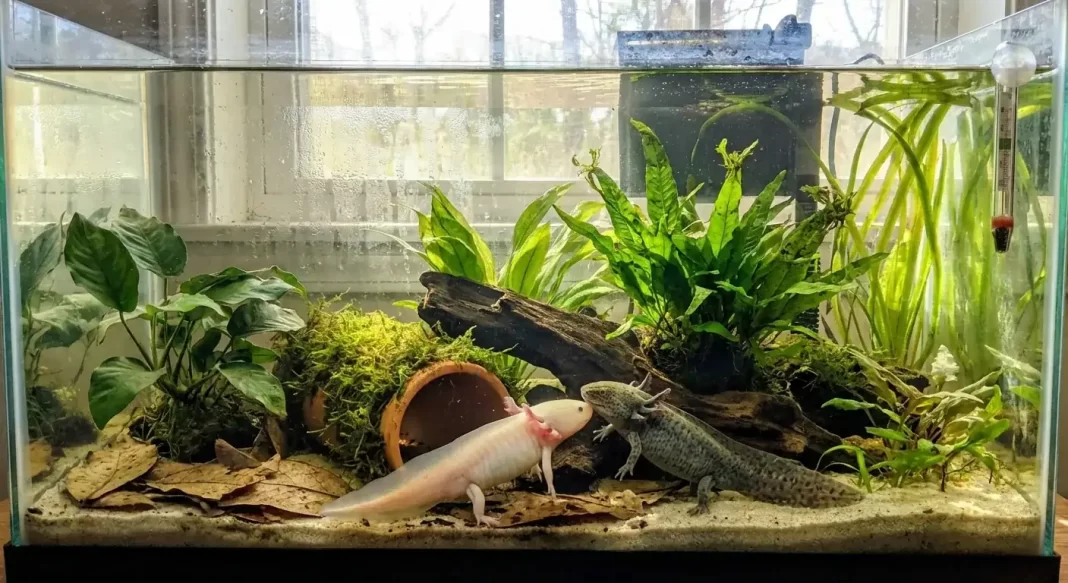
Axolotl breeding setup requires a dedicated 40-gallon tank, both adults at least 18 months old, the female over 30 cm in length, 3 to 6 weeks of high-protein conditioning, then a controlled temperature drop to 12-14°C held for 2-3 weeks before warming back to 16-18°C. Spawning surfaces, sponge filtration, and a 14-hour photoperiod complete the setup.
Should you breed axolotls? Ethics, capacity, and outcomes
Decide whether to breed axolotls only after confirming you can responsibly place 200 to over 1,000 surviving juveniles. Axolotls produce 100 to over 1,000 eggs per spawn; even modest hatch rates leave hundreds of juveniles per attempt. Rescues across the keeper community report unplanned-spawn surrenders as a recurring intake problem. Treat breeding as a multi-year commitment, not a single event.
The egg-count framing comes from the primary breeding literature. Axolotl.org’s breeding protocols page records that there may be between 100 and over a thousand eggs laid in one spawning, depending on the size of the female (source: Axolotl.org breeding protocols). Animal Diversity Web’s species account adds the wild-population baseline. In wild Ambystoma mexicanum, from 100 to 300 eggs are deposited in the water and attached to substrates (source: Animal Diversity Web). The San Diego Zoo Wildlife Alliance reproduction fact sheet records the higher end of the managed-care range. Females can lay between 200 and 1,500 eggs every 3 to 6 months in managed care (source: San Diego Zoo Wildlife Alliance reproduction fact sheet). Even at the low end of the wild figure, a single successful spawn produces more juveniles than most private keepers can rehome responsibly.
Axolotl rescue networks consistently report unplanned-spawn surrenders as one of the most common intake reasons. A keeper houses a male and female together without intending to breed, the pair spawns when room temperature drops during a seasonal change, and the keeper is suddenly responsible for placing hundreds of juveniles they have no homes for. The planned-breeding decision should include a concrete rehoming plan before the conditioning phase begins. Local axolotl groups, reputable hobbyist breeders, university research colonies, and educational institutions occasionally accept juveniles; pet shops generally do not.
The decision is not only about juvenile placement. Breeding also costs the female. Egg production is one of the most metabolically demanding processes in an axolotl’s life. A female bred too young, bred too often, or bred without adequate post-spawn recovery time develops body-condition problems that shorten her lifespan. The keeper-readiness question is whether you can commit to the full cycle, not whether the pair can produce a spawn. The axolotls as pets guide covers the broader keeper-readiness framing that applies to any axolotl commitment, including breeding. The hub axolotl care guide covers ongoing husbandry for both parents and juveniles.
Are your axolotls ready to breed? Age, size, health, and body condition
Both axolotls must be at least 18 months old. The female should exceed 30 centimeters (12 inches) in total length. Sex must be reliably confirmed via the cloacal bulge in males. Both animals must show no active health issues. The female should display visible posterior rounding when viewed from above, indicating developing eggs.
Starting the setup process with immature or unhealthy animals wastes weeks of conditioning effort and risks harming the female. The readiness criteria below come from the primary keeper-authority literature plus the established breeding-community standard.
| Criterion | Threshold | Anchor |
|---|---|---|
| Female age | 18 months minimum | Axolotl.org/breeding |
| Male age | 18 months minimum | Axolotl.org/breeding |
| Female size | Over 30 cm (12 in) total length | Keeper-community; Axolotl.org “fully grown” framing |
| Sex confirmed | Cloacal examination completed (male has rounded bulge) | Keeper-community standard |
| Health screen | No active illness, infection, or abnormal behavior | Keeper-community standard |
| Genetic background | Pair is not sibling or parent-offspring | Keeper-community standard |
| Female body condition | Visible posterior rounding from above | Axolotl.org “fully grown” framing |
| Rehoming capacity | Commitments to place 200 to 1,000+ surviving juveniles | Axolotl.org/breeding egg-count + ethics framing |
The 18-month minimum has primary-source backing. Axolotl.org’s breeding protocols state that it is advisable to not attempt to breed axolotls until they reach at least 18 months of age (per Axolotl.org breeding protocols). Sexual maturity begins earlier. The same page notes that axolotls generally begin to mature once they have reached about 18 cm (7 inches) in total length (per Axolotl.org breeding protocols). The over-30 cm and 18-month thresholds give the animal time to finish growing before egg production diverts metabolic resources from skeletal and organ development. Breeding a smaller female permanently compromises body condition.
Sex confirmation matters before any conditioning effort. Males show a persistent rounded cloacal bulge that becomes obvious at 12 to 18 months. Females lack the bulge at sexual maturity. Misidentifying sex wastes the entire conditioning period. Two males kept together for “breeding” can also produce territorial aggression. Confirm via the cloacal-region observation, ideally from multiple angles, before committing to the multi-week conditioning timeline.
Active health issues disqualify the pair from breeding. Fungal infection, chronic floating, poor appetite, gill deterioration, or any ongoing illness all warrant resolving the underlying condition first. Reproduction suppresses immune function and diverts energy from healing. The health red flags guide covers the symptom catalog that gates the readiness check.
Female body condition is the final readiness signal. A breeding-ready female appears rounded when viewed from above, with visible fullness in the lower abdomen. This fullness indicates developing eggs. A female that is thin, flat-sided, or visibly underweight needs additional conditioning time rather than immediate pairing.
Breeding tank setup: equipment and environment
Equip a dedicated breeding tank with at least 40 gallons of volume, a sponge filter for gentle filtration, a textured substrate (slate tiles or flat rocks) for spermatophore attachment, egg-deposition surfaces (plastic plants, Java moss, PVC pipes, or spawning mops), a digital thermometer with chiller and heater for controlled temperature manipulation, two or more hides for the female, and a programmable timer for the photoperiod.
The breeding tank is a separate, dedicated environment configured for two purposes. It provides a comfortable space for temperature-conditioned adults during the trigger phase and offers appropriate surfaces for spermatophore deposition and egg attachment. Do not use either animal’s home tank as the breeding tank. Neutral territory reduces territorial behavior and gives the keeper full control over conditions.
The equipment table below covers the full list with per-item spec and purpose.
| Equipment | Specification | Purpose |
|---|---|---|
| Tank | 40-gallon breeder minimum | Floor space for courtship procession |
| Thermometer | Digital probe | Accurate temperature monitoring |
| Chiller or cooling method | Capable of reaching 12-14°C | Temperature-drop trigger |
| Heater | Low-wattage submersible | Controlled gradual warming |
| Sponge filter | Rated for tank volume | Gentle filtration, no egg damage |
| Air pump + air stone | Standard aquarium | Oxygenation |
| Spawning substrate | Slate tiles, flat rocks, unglazed ceramic tile | Spermatophore attachment |
| Egg surfaces | Plastic plants, Java moss, spawning mops, PVC pipes | Egg deposition |
| Hides | Two minimum (PVC, ceramic caves) | Female retreat space |
| Timer | Programmable outlet timer | Photoperiod control |
| Lighting | Low-output LED | Dim, controllable illumination |
| Water test kit | Liquid reagent (API Master Kit or equivalent) | Pre-introduction water check |
Tank size and base configuration
The 40-gallon minimum comes from AxolotlCentral’s care standards, which recommend a 180-liter or 40-gallon breeder-style tank as a much more suitable minimum for adult pairs (source: AxolotlCentral care guide). The same source lists 29 gallons as the bare-minimum total volume for any single axolotl. A breeding tank should be at or above the recommended 40-gallon figure rather than the bare-minimum baseline, because the pair will share the space for the courtship-and-spawning period and need room for the male to lead the female in the nose-to-tail procession that the courtship sequence requires. The tank size guide covers volume-per-axolotl rules in more detail, and the tank setup guide covers base-tank assembly that applies to any tank you bring up as a breeding setup.
Temperature control equipment
The breeding tank needs a reliable digital thermometer plus the ability to both cool and warm the water in controlled steps. An aquarium chiller is the most reliable cooling method for keepers in warm climates. For the warming phase after conditioning, a low-wattage submersible heater allows gradual, controlled warming. Temperature stability matters more than precision: fluctuations of more than 2 degrees Celsius within a 24-hour period stress the animals and can interrupt the hormonal signals that drive breeding behavior. The temperature guide covers cooling-equipment selection and the underlying thermal-tolerance biology.
Spawning substrate for spermatophores
The male deposits spermatophores (small, cone-shaped jelly packets with a sperm cap) on the tank bottom during courtship. Spermatophores will not stick to bare glass or smooth plastic. The bottom of the breeding tank must be textured or must contain flat, rough-surfaced objects. The Ambystoma Genetic Stock Center at the University of Kentucky, which maintains one of the largest research breeding colonies, specifies that the bottom of the container must be textured (that is, not smooth glass), or contain rocks to which the male can attach his spermatophores (source: Ambystoma Genetic Stock Center husbandry guide). Slate tiles, flat river rocks, and unglazed ceramic tiles all work as textured surfaces.
Egg-deposition surfaces
After fertilization, the female deposits eggs individually on surfaces throughout the tank. Eggs are coated in adhesive jelly that sticks firmly to whatever the female chooses. Preferred surfaces include plastic plants (which do not rot and are easy to remove with eggs attached), clumps of live Java moss, PVC pipe interiors, and artificial spawning mops made from yarn or nylon. Place egg-deposition surfaces throughout the tank rather than concentrated in one area, because the female lays each egg individually over a period of a few hours to two days after courtship ends (per Axolotl.org breeding protocols).
Filtration and flow control
A sponge filter is the standard choice for a breeding tank. It provides biological filtration and gentle aeration without creating strong currents that stress spawning adults or damage eggs. Canister filters and hang-on-back filters generate too much flow for a breeding environment unless the output is heavily diffused with a spray bar or baffle. Strong currents also dislodge spermatophores from the substrate before the female can collect them.
Lighting and photoperiod control
Axolotls are nocturnal and photosensitive. The breeding tank should have subdued lighting on a controlled photoperiod, not direct overhead illumination. The Ambystoma Genetic Stock Center notes that changes in lighting are critical for spawning and that their colony axolotls receive about 14 hours of light each day during the breeding cycle (per Ambystoma Genetic Stock Center husbandry guide). A timer-controlled LED strip on a low setting, positioned to light the room rather than the tank directly, gives adequate visibility for monitoring without stressing the animals.
Hides for female retreat
Include at least two hides (PVC pipe halves, ceramic caves, or overturned pots) to give the female retreat space. Females that feel exposed may refuse to engage in courtship or may show stress responses such as gill curling and persistent surface behavior.
Water-quality baseline
Before introducing animals, the breeding tank must be cycled and tested. AxolotlCentral’s care guide gives the target parameters: ammonia 0 ppm, nitrite 0 ppm, nitrate below 20 ppm, pH between 7.2 and 8.4, GH 7 to 14 dGH, KH 3 to 7 dKH (per AxolotlCentral care guide). A partially cycled or uncycled breeding tank produces ammonia spikes during the multi-week conditioning period. Cycle the tank fully before beginning. The tank cycling guide covers the full cycling protocol, the water parameters guide covers per-parameter biology, and the water testing guide covers test-kit selection and procedure for the pre-introduction water check.
Conditioning the breeding pair: feeding, separation, and water quality
Condition both animals for 3 to 6 weeks in separate tanks at the standard maintenance temperature of 16 to 18 degrees Celsius (60 to 65 degrees Fahrenheit). Feed every other day with earthworms, bloodworms, and high-quality pellets. Observe the female from above weekly for visible posterior rounding. Run 25 percent water changes every 3 to 4 days to keep ammonia and nitrite at zero.
Conditioning is the nutritional and physiological preparation phase that builds the metabolic reserves both animals need for successful reproduction. The female needs energy and calcium stores for producing hundreds of eggs. The male needs protein reserves for producing multiple spermatophores during courtship. Conditioning is not just “feeding more.” It is targeted, high-quality feeding over a defined period while keeping the pair separated.
Duration: 3 to 6 weeks
The conditioning period runs for a minimum of 3 weeks and ideally 4 to 6 weeks. During this time, both animals are housed in separate tanks at their normal maintenance temperature of 16 to 18 degrees Celsius. Separation prevents premature breeding before both animals are fully conditioned and before the breeding tank is ready. Both animals remain on the standard parameters covered in the water parameters guide.
Feeding protocol
Increase feeding frequency to every other day (from the typical adult schedule of 2 to 3 times per week) and prioritize high-protein, nutrient-dense foods. Earthworms (nightcrawlers) are the gold standard for conditioning because they provide the protein, fat, and calcium content that supports egg development. Supplement with bloodworms and high-quality sinking pellets. Avoid feeder fish (parasite and disease risk) and low-nutrient foods during this period. The feeding schedule by age guide covers food options and nutritional profiles in detail.
Female body-condition monitoring
Throughout conditioning, observe the female from above weekly. A well-conditioned female develops visible roundness in the posterior abdomen as her ovaries fill with eggs. This rounded profile is the physical confirmation that conditioning is working. A female that remains flat-sided after 4 weeks of conditioning may not be mature enough, may have underlying health issues, or may need a longer conditioning period with dietary adjustments.
Male conditioning
Males require less conditioning time than females because spermatophore production is less metabolically demanding than egg production. However, underfed or poorly conditioned males may produce fewer spermatophores or fail to initiate courtship behavior. Maintain the same feeding protocol for the male throughout the conditioning period.
Water quality during conditioning
Vet-tech teams and experienced breeding keepers reviewing failed-spawn cases note that water quality during the multi-week conditioning period is one of the most overlooked failure causes. Increased feeding produces increased waste, and ammonia spikes during conditioning suppress the reproductive hormone signals that drive courtship later. Run more-frequent partial water changes during conditioning than you would on a normal maintenance schedule. A 25 percent water change every 3 to 4 days, rather than the standard weekly schedule, keeps ammonia and nitrite at zero. The water change schedule covers the conditioning-phase water-change cadence as one of its emergency-trigger contexts, and the water testing guide covers the daily ammonia and nitrite monitoring that catches problems before they crash the conditioning effort.
Breeding triggers: temperature, photoperiod, and natural seasonal options
Trigger breeding with the temperature-drop method. Hold the pair at 20 to 22 degrees Celsius during conditioning, then transfer both animals to the breeding tank cooled to 12 to 14 degrees Celsius. Hold the cool temperature for 2 to 3 weeks. Warm back to 16 to 18 degrees Celsius gradually over 5 to 7 days while increasing the photoperiod to 14 hours. Never drop below 10 degrees Celsius.
Wild axolotls in Lake Xochimilco breed seasonally in late winter and early spring, driven by falling and then rising water temperatures and changing day length. Captive breeding replicates these environmental cues through controlled manipulation. Three approaches work: the temperature-drop method (primary), the photoperiod method (secondary), and the natural seasonal approach (low-control).
Important safety boundary: never below 10 degrees Celsius
Regardless of which method you use, water temperature during the trigger phase must never drop below 10 degrees Celsius (50 degrees Fahrenheit). Temperatures below 10 degrees Celsius risk metabolic depression and organ stress rather than triggering courtship. The cold-phase target is 12 to 14 degrees Celsius (per Axolotl.org breeding protocols), with the warm-up phase returning the tank to 16 to 18 degrees Celsius to complete the seasonal-cycle signal. The temperature guide covers the broader thermal-tolerance biology that sets this floor.
Temperature-drop method: the four-step protocol
The temperature-drop method is the most commonly used approach in hobbyist breeding. It works by simulating the transition from autumn to winter and then back to spring. The four-step protocol below provides explicit day-rate-of-change guidance for each phase.
Step 1: Baseline. During the conditioning phase, hold both animals at 20 to 22 degrees Celsius (68 to 71 degrees Fahrenheit). This is slightly warmer than the long-term maintenance range but safe for several weeks.
Step 2: Cool. Transfer both animals to the prepared breeding tank at a temperature at least 5 degrees Celsius cooler than the baseline. The target is 12 to 14 degrees Celsius (54 to 57 degrees Fahrenheit). Axolotl.org records the underlying mechanism. Keeping the pair separately for a few weeks at 20-22°C and then transferring them both into a tank with a water temperature at least 5°C lower frequently triggers courtship behaviour (per Axolotl.org breeding protocols). Cool the tank gradually over 2 to 3 days (1 to 2 degrees Celsius per day) rather than dropping the temperature abruptly. Sudden thermal shock stresses the animals and can suppress rather than trigger breeding behavior.
Step 3: Hold. Maintain the cool temperature for 2 to 3 weeks. During this period, reduce feeding to once or twice per week because the animals’ metabolism slows at lower temperatures. Keep the photoperiod short (8 to 10 hours of light) during the hold phase to reinforce the autumn-to-winter cue.
Step 4: Warm and increase photoperiod. Gradually raise the temperature back toward 16 to 18 degrees Celsius over 5 to 7 days (approximately 0.5 to 1 degree Celsius per day). Simultaneously increase the photoperiod to 14 hours of light. The combination of warming water and lengthening days simulates the transition to spring and is the trigger that initiates the hormonal cascade for courtship. The Ambystoma Genetic Stock Center provides approximately 14 hours of light daily during their breeding cycle (per Ambystoma Genetic Stock Center husbandry guide).
If the male begins courtship behavior (tail raising, nudging the female) but the female does not respond within 48 hours of the warming phase, separate the pair and extend the cool-hold phase by another week before attempting the warming trigger again.
Photoperiod method: light-cycle manipulation as primary trigger
Some breeders use photoperiod adjustment as the primary trigger, with temperature changes playing a supporting role. This method gradually decreases the daylight period over several weeks (simulating shortening autumn days), holds at a short-day baseline, and then steadily increases the lighting duration (simulating the transition to spring).
A practical schedule: start at 14 hours of light, reduce by 1 hour every 3 to 4 days until reaching 8 hours of light, hold at 8 hours for 2 weeks, then increase back toward 12 to 14 hours at the same rate. The photoperiod method alone is less reliable than the combined temperature-plus-photoperiod approach. It works best when combined with at least a modest temperature reduction (3 to 5 degrees Celsius) during the short-day phase.
Natural seasonal approach: the low-intervention option
Axolotls housed in a room with a window that provides natural light and temperature variation often breed spontaneously in late winter or early spring without active intervention. The natural photoperiod shortens and lengthens with the seasons, and room temperatures in unheated or lightly heated spaces may drop enough during winter months to simulate the temperature cue.
This approach is the lowest-stress option for both animals and keeper. The trade-off is that the keeper has less control over timing. In climates with mild winters or heavily climate-controlled indoor environments, the natural seasonal variation may be insufficient to trigger breeding. The Ambystoma Genetic Stock Center notes that healthy axolotls are not difficult to get to spawn (per Ambystoma Genetic Stock Center husbandry guide).
Introducing the pair: neutral territory, monitoring, and aggression management
Introduce the pair only into the neutral breeding tank, never into either animal’s home tank. Place the male first and allow 30 to 60 minutes of acclimation before adding the female. Monitor the first 2 to 4 hours for biting; separate immediately if aggression occurs. Check the tank the following morning for spermatophores on the substrate.
Once conditioning is complete and the breeding tank is at target temperature after the trigger protocol, the pair can be introduced. Introduction protocol matters because axolotls can injure each other. A stressed or aggressive pairing produces no spawn and may produce bite wounds that require veterinary attention.
Neutral territory is the central rule. Always introduce the pair into the breeding tank, not into either animal’s home tank. Territorial familiarity gives one animal a stress advantage that can manifest as aggression toward the newcomer.
Introduction sequence can run two ways. Place the male in the breeding tank first and allow 30 to 60 minutes for him to acclimate and begin exploring; then add the female. Alternatively, introduce both animals simultaneously. Both methods work. The key principle is that neither animal should be surprised by the other in an established territory.
Watch the pair closely for the first 2 to 4 hours. Normal pre-courtship behavior includes the male approaching the female, nudging her hindquarters and cloacal area, and gentle circling. Aggressive behavior includes biting (especially at gills or limbs), rapid chasing, and persistent gill clamping by either animal. If biting occurs, separate the pair immediately. A nipped gill or limb regenerates, but repeated aggression indicates the pair is not compatible at this time. Wait at least 2 weeks before attempting reintroduction. The health red flags guide covers post-bite monitoring for secondary infection.
Courtship often begins in the evening or overnight hours because axolotls are more active in dim conditions. Check the tank the following morning for spermatophores on the substrate (small white cone-shaped packets on the slate or rocks). The presence of spermatophores confirms that the male has initiated courtship. The absence of spermatophores after 48 hours suggests the trigger was insufficient; return both animals to their conditioning tanks and extend the protocol.
Post-spawn parent removal: timing and sequence
Remove the male within 12 hours of the first visible eggs. He will eat them if left in the tank. Remove the female 48 to 72 hours later, once she has finished laying. Both adults will consume eggs if given the opportunity. The breeding tank then becomes the egg-incubation tank for the rest of the embryo-development period.
Eggs begin appearing on plants, spawning surfaces, and the tank walls once the spawning process starts. The female deposits eggs individually over a period of a few hours to two days, placing them at different locations throughout the tank. Each egg is coated in adhesive jelly that sticks firmly to whatever the female chooses.
The male should be removed first because males will consume eggs as enthusiastically as females, and the male has finished his role in the breeding cycle once he has deposited spermatophores. Removing him early eliminates one of the two egg-consumption risks. Twelve hours after the first visible eggs gives the keeper time to confirm the spawn is genuinely underway and not a single misplaced egg, while still acting before significant egg consumption can occur.
The female should be removed once she finishes laying. The 48-to-72-hour window after the first eggs covers most spawning events. The female’s body condition, the visible reduction in posterior rounding, and the absence of new eggs over a 12-hour observation period all signal completed laying. Both adults left in the tank with eggs will consume them. Removing the female protects both the eggs and the female from further metabolic strain.
After both parents are removed, the breeding tank becomes the egg-incubation tank. Egg management (fungus prevention, infertile-egg removal, hatch-timeline monitoring) is the subject of a forthcoming egg-care guide and is not covered in this breeding-setup article.
Post-spawning care: protecting the female after breeding
Allow the female at least 2 to 3 months of recovery before any subsequent breeding attempt. Feed a high-quality diet to rebuild protein and calcium reserves. Monitor body condition weekly. Watch for post-spawn complications including persistent lethargy, refused food beyond 5 days, rapid weight loss, fungal patches, or abnormal floating. Limit breeding to once per year.
The female’s welfare after spawning is a breeding-setup responsibility, not an afterthought. Egg production is one of the most metabolically expensive processes in an axolotl’s life, and the recovery period determines whether the female returns to full health or enters a decline.
Immediate separation
Remove the female from the breeding tank as soon as laying is complete and return her to her home tank. Do not house her with the male. The male may attempt to initiate another courtship sequence, and a freshly spawned female that is pushed into a second breeding attempt before recovery faces serious health risks.
Recovery period: 2 to 3 months minimum
The Ambystoma Genetic Stock Center records the standard recovery window. They allow males at least a week or two and females at least two, preferably three months, between spawns (per Ambystoma Genetic Stock Center husbandry guide). Axolotl.org’s breeding protocols agree. Females that have recently bred should be kept away from males for at least a month, preferably two or three, in order for them to recover (per Axolotl.org breeding protocols). During this period, feed the female a high-quality diet (earthworms supplemented with bloodworms) to rebuild protein and calcium reserves depleted by egg production. Monitor body condition weekly. A recovering female should gradually regain the weight lost during spawning over the first 4 to 6 weeks. The water change schedule covers the ongoing standard-cadence water changes that support the recovering female’s water quality, and the water testing guide covers the weekly testing that catches problems early in the recovery window.
Post-spawning monitoring
Watch for signs of post-spawning complications: persistent lethargy beyond the first week, refusal to eat for more than 5 days, rapid weight loss, fungal patches on skin or gills, or abnormal floating. Any of these symptoms warrants veterinary evaluation. For guidance on recognizing when veterinary care is needed, see the health red flags guide.
Breeding frequency limit
Axolotl.org’s breeding protocols state that a pair of axolotls kept in good conditions should breed at least once a year (per Axolotl.org breeding protocols). The keeper-community ceiling is approximately one spawn per year, with a lifetime cap of approximately three spawning events. Repeated spawning within a single year depletes body reserves faster than diet can replace them and shortens the animal’s lifespan. The decision to retire the female from breeding after one or two successful spawns is welfare-positive and reflects responsible long-term keeping.
Breeding readiness checklist
Confirm every readiness item before beginning the conditioning phase: female age, male age, female size, sex confirmation, health screen, unrelated genetic background, breeding tank cycled with target parameters, spawning surfaces installed, temperature control equipment in place, conditioning duration completed, female body condition, egg-care plan, and rehoming plan for surviving juveniles.
Use the checklist below to confirm readiness before beginning the conditioning phase. Every item should be confirmed by direct observation or measurement, not assumed.
| Criterion | Threshold | Confirmed? |
|---|---|---|
| Female age | 18 months or older | |
| Male age | 18 months or older | |
| Female size | Over 30 cm (12 in) total length | |
| Sex confirmed | Cloacal examination completed | |
| Health screen | No active illness, infection, or abnormal behavior | |
| Genetic background | Pair is not related (siblings, parent-offspring) | |
| Breeding tank | 40+ gallons, cycled, equipped per checklist | |
| Water parameters | Ammonia 0 ppm, nitrite 0 ppm, nitrate below 20 ppm | |
| pH and hardness | pH 7.2-8.4, GH 7-14 dGH, KH 3-7 dKH | |
| Spawning surfaces | Textured substrate + plants/mops installed | |
| Temperature control | Chiller and heater capable of 12-18°C range | |
| Conditioning duration | 3 to 6 weeks of high-quality feeding completed | |
| Female body condition | Visible posterior rounding from above | |
| Egg-care plan | Equipment and knowledge for post-spawn egg management | |
| Rehoming plan | Commitments for placing surviving juveniles |
The checklist functions as both a readiness gate and a record of the keeper’s preparation. Working through every row before introducing the pair reduces the most common setup-phase failure modes.
Common axolotl breeding setup mistakes
The six most common breeding-setup mistakes share a pattern. Skipping the cycling step on the breeding tank produces ammonia spikes during conditioning. Smooth glass bottoms cannot anchor spermatophores. Dropping below 10 degrees Celsius depresses metabolism instead of triggering courtship. Introducing the pair in a familiar tank produces territorial aggression. Leaving parents with the eggs consumes them. Breeding the same female multiple times per year depletes body reserves.
Skipping the cycling step on the breeding tank
A breeding tank that runs uncycled for the multi-week conditioning period generates ammonia spikes that stress the animals and suppress the reproductive hormone signals that drive courtship. Cycle the breeding tank fully before beginning conditioning. The tank cycling guide covers the cycling protocol; a fishless cycle on a separate tank typically takes 4 to 8 weeks. Plan the breeding-tank setup early so the tank is fully cycled by the time conditioning begins.
Using a smooth-glass tank bottom
Spermatophores will not stick to bare glass. A breeding tank that ships from the store with a smooth bottom needs textured substrate added before the spawning trigger. Slate tiles, flat river rocks, and unglazed ceramic tiles all work. Adding the substrate after the spawning trigger has begun is too late; the male may begin depositing spermatophores during the warming phase and find no surface that will hold them.
Dropping below 10 degrees Celsius
Temperatures below the 10-degree-Celsius floor depress metabolism rather than trigger courtship. The animal goes into a low-activity stress state, appetite stops, and the hormonal signals required for breeding are suppressed. The cold-phase target is 12 to 14 degrees Celsius, with the warm-up phase returning the tank to 16 to 18 degrees Celsius. Use a digital probe thermometer and confirm the cool-phase temperature stays at or above 12 degrees Celsius at all times.
Introducing the pair in a familiar tank
A male or female that is introduced into the other animal’s home tank arrives with a territorial disadvantage. Aggression, gill clamping, and persistent chasing all become more likely. Always use the dedicated breeding tank as neutral territory. The breeding tank should not be either animal’s recent or long-term home environment.
Leaving parents in the tank after eggs appear
Both male and female axolotls will eat eggs given the opportunity. The male should be removed within 12 hours of the first visible eggs. The female should be removed 48 to 72 hours after the first eggs once she has finished laying. Leaving either parent in the tank with developing eggs is the most common cause of zero-egg breeding outcomes after a successful spawn.
Breeding the same female multiple times per year
A female bred more than once per year depletes body reserves faster than diet can replace them. Body condition deteriorates over multiple spawning cycles, immune function declines, and lifespan shortens. The standard keeper-community ceiling is approximately one spawn per year, with a lifetime cap of approximately three spawning events. Retiring the female from breeding after one or two successful spawns is welfare-positive.
Frequently asked questions
How long does it take to condition axolotls for breeding?
Conditioning takes a minimum of 3 weeks and ideally 4 to 6 weeks. The timeline depends on the starting body condition of both animals. A well-fed female at healthy weight may be ready in 3 weeks. An underweight female or one recovering from illness may need 6 weeks or longer. The visible indicator of successful conditioning in the female is posterior rounding when viewed from above, indicating developing eggs. Continue conditioning until the visible roundness appears, even if that runs longer than the 3-to-6-week range.
Can you use your main tank as a breeding tank?
Using the main tank is possible but not recommended. A dedicated breeding tank gives you control over temperature manipulation, spawning surface placement, and parent removal without disrupting the main tank’s cycled environment. The main tank also likely contains substrate, decorations, and potentially tankmates that complicate egg collection and increase the risk of egg predation. If the main tank is the only option, remove all tankmates, add spawning surfaces, accept that you will have less control over the process, and prepare a separate fry-rearing tank in advance.
What if your axolotls breed without you triggering them?
Unplanned spawning happens when axolotls are housed together and environmental conditions (temperature fluctuation, seasonal light changes) provide enough of a trigger. If eggs appear unexpectedly, remove both adults immediately to prevent egg consumption. Then decide whether to raise the eggs (which commits you to placing several hundred juveniles) or to humanely cull by freezing. The eggs are already laid, so the immediate priority is adult removal. Going forward, house males and females separately to prevent unplanned breeding.
How do you know if your female is ready to breed?
A breeding-ready female meets three criteria. She is at least 18 months old and over 30 centimeters in length. She has no active health issues. Her body shows visible posterior rounding when viewed from above. The rounding indicates egg development in the ovaries. A female that meets the age and size criteria but appears flat-sided needs additional conditioning time with increased feeding before she is ready for the trigger phase. Sex must also be reliably confirmed via the absence of the male cloacal bulge.
What water temperature is too cold for breeding?
Never drop the breeding tank below 10 degrees Celsius (50 degrees Fahrenheit). The target range for the cold phase of the temperature-drop trigger is 12 to 14 degrees Celsius. Below 10 degrees Celsius, axolotl metabolism slows to the point of stress, appetite stops, and the hormonal signals needed for reproduction may be suppressed rather than stimulated. The temperature guide covers the broader thermal-tolerance biology that sets this floor.
Related guides
- Axolotl care guide: complete husbandry hub for new keepers
- Axolotl as pets: keeper-readiness and ethics framing for any axolotl commitment
- Axolotl temperature guide: cooling-equipment selection and thermal-tolerance biology
- Axolotl water parameters: per-parameter target depth at biological-mechanism level
- Axolotl tank cycling guide: full cycling protocol for the breeding tank
- Axolotl water change schedule: conditioning-phase 25% every 3-4 day cadence
- Axolotl water testing guide: pre-introduction water testing and ammonia monitoring
- Axolotl health red flags: pair-health screen and post-spawn complication catalog
- Axolotl tank setup guide: base-tank assembly for the breeding-tank setup
- Axolotl tank size guide: minimum 40-gallon breeding-tank volume rationale
By the ExoPetGuides editorial team (AI-assisted drafting; human-reviewed), reviewed by an exotic-animal veterinarian
Updated 2026-05-19
Primary sources: Axolotl.org breeding protocols, Ambystoma Genetic Stock Center husbandry guide (University of Kentucky), AxolotlCentral care guide, San Diego Zoo Wildlife Alliance reproduction fact sheet, Animal Diversity Web Ambystoma mexicanum entry
Disclaimer: This content is for educational purposes only and is not a substitute for professional veterinary advice. Always consult a qualified veterinarian, ideally an exotic-animal specialist, for any health concern about your pet. Care recommendations may vary based on species, individual animal, and local regulations.