


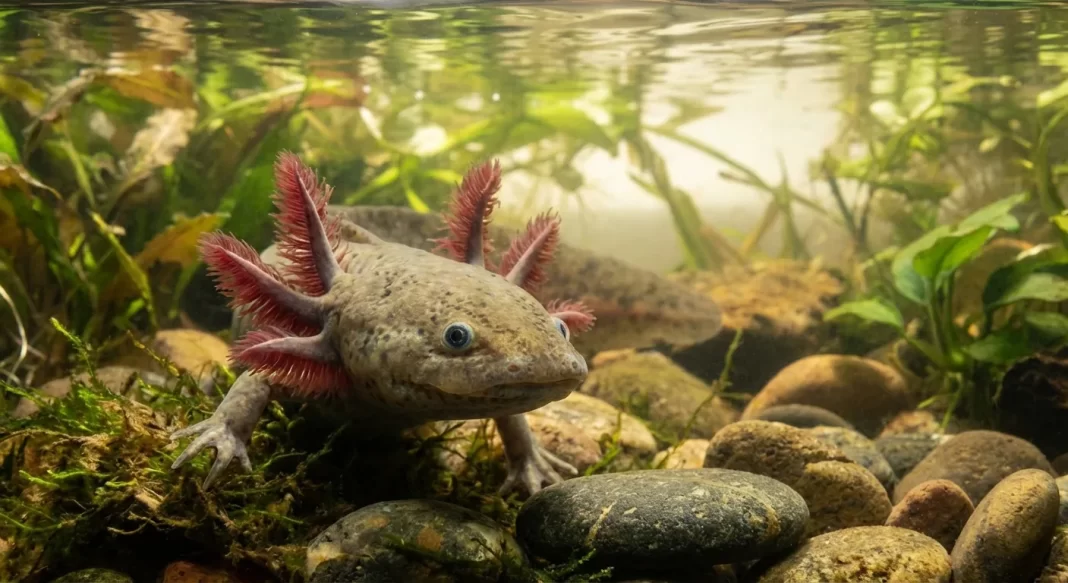
A healthy axolotl shows full feathery gill filaments, clear eyes, smooth unblemished skin, head-equal body width with a rounded abdomen, and active responses to food or gentle water movement. Check each at the point of purchase. Certain red flags should stop a sale immediately. Quarantine every new animal for 30 days regardless of source.
What a healthy axolotl looks like: the visual health-check checklist
A healthy axolotl shows three feathery gill stalks per side with dense richly-colored filaments fanned outward, a rounded abdomen roughly equal to head width, all four legs intact, smooth unblemished skin, clear responsive eyes, and alert behavior at rest. Check each trait at the point of purchase. The full 10-row checklist is in the comparison table below.
These visual traits take less than a minute to assess at the seller’s tank, and they reliably separate a well-kept animal from one carrying stress, disease, or genetic problems that will surface weeks after purchase. The checklist applies whether the seller is a specialized breeder, a chain pet store, or an online marketplace seller. The axolotl care guide covers the broader husbandry framework you will need to maintain once the animal is home. The axolotl symptoms guide covers the full symptom-to-diagnosis reference for any of the appearance issues called out in the table.
| Trait | Healthy appearance | Red-flag indicator |
|---|---|---|
| Gill stalks | Three feathery stalks each side, fanned outward and slightly backward, dense filaments, richly colored | Short stubby stalks; sparse filaments; pale or white filaments; visible white or grey patches; forward-curled stalks |
| Body condition | Rounded abdomen roughly head-equal width; thick tail base tapering gradually | Visible spine or ribs; concave belly; severely distended abdomen; tail thin or wasted |
| Limbs | All four legs present; all digits intact; coordinated movement | Missing limb or digit; deformed leg; visible bite injury |
| Skin | Smooth uniform texture; no lesions; no white patches; no red blotches | White or grey fuzzy patches (Saprolegnia); red patches on legs or ventral surface (Aeromonas red-leg); peeling skin; excessive slime; visible wounds |
| Eyes | Clear, appropriately sized for head, responsive to light changes | Cloudy or sunken eyes; eyes that do not track movement |
| Behavior at rest | Sits calmly on substrate or in hide | Floating at surface; lying on side; tightly curled tail |
| Behavior when stimulated | Orients toward stimulus; shows interest; alert response | Frantic darting; apathetic non-response; uncoordinated swimming |
| Tail tip | Straight or gently curved at rest | Tightly curled tail tip (acute distress signal) |
| Tank water | Clear and clean; no excess waste; appropriate temperature | Cloudy or yellow water; visible waste accumulation; obvious warm water |
| Tank conditions | One axolotl per appropriate volume; no inappropriate tank mates | Overcrowding; aggressive tank mates; dead or dying tank mates; gravel substrate |
Gills
Gills are the single most reliable external health indicator. Healthy axolotl gills extend outward from the head in a relaxed, slightly fanned position. Each of the three gill stalks on each side carries dense feathery filaments that give the gills a full, bushy appearance. The filaments are richly colored, ranging from deep red in lighter morphs to dark burgundy or near-black in melanoids. Pale or white filaments suggest anemia or chronic poor water quality. Short, stubby gill stalks with sparse filaments indicate prolonged exposure to high ammonia, nitrite, or elevated temperatures. Forward-curling gills, where the stalks bend toward the face, are a stress response typically caused by strong water flow or chemical irritation.
Gill color can fluctuate throughout the day depending on activity level, temperature, and blood flow. An axolotl resting in cool water may show paler gills than the same animal after feeding. This normal variation is not a concern. The concern is persistent pallor, visible white or grey patches on the gill stalks indicating fungal or bacterial colonization, or filaments that have dropped off entirely leaving bare stalks. The axolotl stress signs guide covers the broader stress-recognition triage including forward gill curl and related signs.
Body shape and condition
A well-fed axolotl has a rounded abdomen roughly the same width as its head when viewed from above. The tail is thick at the base and tapers gradually. Visible ribs or a concave belly indicate malnourishment, which also means a weakened immune system. An overly distended abdomen, particularly if it appears suddenly, suggests impaction, fluid retention, or internal infection. The axolotl impaction guide covers bloating and impaction differential diagnosis if the animal you are considering shows that pattern.
Limbs
Check the limbs. All four legs should be present, fully formed, and move normally when the animal walks or repositions. Missing limbs or digits are common in pet-store axolotls housed with too many animals in the same tank, because hungry axolotls will bite tank mates. While axolotls can regenerate limbs, a missing leg at the point of sale means the animal was kept in stressful, overcrowded conditions, and the injuries you can see may not be the only damage. The axolotl injury and regeneration guide covers what axolotls can and cannot heal on their own.
Skin quality
Healthy skin is smooth, uniformly textured, and free of lesions, white patches, cotton-like growths, or red blotches. Per Axolotl.org/health, Saprolegnia is the most common sort of true fungus found in freshwater (source: Axolotl.org health), and it colonizes damaged or immunocompromised skin. White or grey fuzzy patches on the animal in front of you are almost always Saprolegnia. Red patches on the legs, feet, or ventral surface are a hallmark of red-leg syndrome. Per Axolotl.org/health, Aeromonas hydrophila is one of the red-leg bacteria and is one of the most common diseases that axolotls can suffer (per Axolotl.org health). The bacterial septicemia can be fatal even with treatment, so a red-patched animal at the seller’s tank is not a rescue project. Peeling skin or excessive slime coat production suggests chemical burns from poor water quality or active parasitic infection. The axolotl fungus guide covers the full Saprolegnia treatment protocol if a fungal patch appears after purchase.
Eyes and behavior
Eyes should be clear, appropriately sized for the head, and responsive to light changes. Cloudy eyes suggest infection or systemic illness. Sunken eyes indicate severe dehydration or prolonged starvation. Behaviorally, a healthy axolotl at rest sits calmly on the substrate or in a hide. When stimulated by food, a tap on the glass, or gentle water movement, it should orient toward the stimulus and show interest. Lethargy, floating at the surface, frantic swimming in circles, or a tightly curled tail tip are all stress indicators. A curled tail tip specifically signals acute distress, often from ammonia exposure or handling trauma.
Body-condition scoring 1 to 5: the BCS framework for axolotls
Body-condition scoring on a 1-to-5 scale assesses how much fat and muscle the animal carries. BCS 1 shows visible spine and ribs with a concave belly indicating severe underweight. BCS 3 is ideal with head-equal width and a rounded abdomen. BCS 5 shows pathological distension indicating bloat or impaction. BCS 2 or 4 are intermediate and warrant questions.
A BCS framework gives you a single number to anchor the visual assessment. Two axolotls in the same tank can have the same gill quality and the same skin clarity but very different BCS values. The BCS reveals which animal has been fed enough but not too much, which is a baseline indicator of seller husbandry quality. The table below lists the five BCS tiers with the visual descriptor for each.
| BCS | Visual descriptor | Interpretation |
|---|---|---|
| 1 | Visible spine; visible rib outlines; concave belly; head dramatically wider than body | Severely underweight; long-term inadequate feeding or chronic illness |
| 2 | Mildly visible rib outlines; slight belly concavity; tail tapered narrowly | Underweight; recent inadequate feeding or recent illness |
| 3 | Rounded abdomen roughly head-equal width; no visible spine or ribs; thick tail base | Ideal; well-fed and well-husbanded |
| 4 | Abdomen wider than head; no rib outline; tail base thick to slightly puffy | Overweight; overfed; risk of impaction if recently fed substrate-based food |
| 5 | Severely distended grossly bloated abdomen; tight skin; sometimes raised scales | Pathological; impaction or systemic illness; not a candidate for purchase |
Animals at BCS 3 are the ideal purchase. Animals at BCS 2 or 4 are intermediate and warrant questions to the seller about feeding schedule, age, recent illness, and parameter history. Animals at BCS 1 or 5 should not be purchased; they need immediate veterinary care that the buyer should not be inheriting. The axolotl symptoms guide covers the symptom-to-diagnosis catalog that contextualizes BCS 1 and BCS 5 presentations.
What healthy axolotl behavior looks like at the point of purchase
A healthy axolotl at rest sits calmly on the substrate or in a hide with relaxed gill posture and no body tension. When stimulated by food, a gentle tap, or water movement, it orients toward the stimulus and shows interest. Lethargy, floating, frantic swimming, glass surfing, or a tightly curled tail are all stress indicators that warrant skipping the animal.
Behavior at the seller’s tank is informative because every axolotl in the tank has been experiencing the same conditions for some time. An animal showing acute stress behavior in front of you has been showing it for a while. Pet store and breeder tanks differ in baseline behavior because the underlying conditions differ.
Resting baseline
The healthy resting axolotl sits low to the substrate or in a hide. The body is relaxed, neither tense nor uncoordinated. The tail is gently positioned, sometimes curled comfortably around the animal but not tightly hooked at the tip. The gill stalks fan outward and slightly backward in their natural posture. Animals at rest may make small subtle movements, gentle gill ventilation, or occasional surface visits for air gulping. These are normal.
Response to stimulus
A gentle tap on the glass, a quick reach toward the tank, or a small piece of food at the surface should produce orientation, alertness, and interest. The animal may approach the stimulus, watch it, or position itself for food. The animal may also choose not to engage and retreat, which is also normal. The unhealthy response is no response at all. An apathetic non-responsive animal, or one that produces only a sluggish disconnected movement, is showing systemic illness or chronic exhaustion.
Abnormal behavior red flags
Five behavioral patterns are red flags. Floating at the surface with no ability to return to the bottom indicates impaction or buoyancy disorder. Lying on the side with no righting reflex indicates severe systemic illness. Frantic darting or thrashing indicates acute chemical or thermal distress. Persistent glass surfing indicates chronic environmental stress. A tightly curled tail tip indicates acute distress, often from ammonia exposure or handling trauma. The axolotl stress signs guide covers each behavioral red flag in detail.
Reputable-seller signs vs red flags in the seller environment
A reputable axolotl seller maintains clear clean water in display tanks with no overcrowding, displays a thermometer reading inside the 12 to 20 degrees Celsius comfort band per AxolotlCentral, can share water parameter logs on request, has knowledgeable staff who can answer specific care questions, willingly feeds an animal at point of sale to demonstrate appetite, and houses each axolotl in an appropriate volume with no inappropriate tank mates.
The seller’s tank tells you almost as much about the animal’s near-term future as the animal itself. The same animal sourced from a reputable seller versus from a poor seller has very different prognosis numbers because the chronic stress, parameter exposure, and pathogen load differ. The comparison table below frames the reputable-seller signs against the parallel red flags.
| Dimension | Reputable-seller sign | Red-flag indicator |
|---|---|---|
| Tank water | Clear and clean; appropriate temperature; no excess waste | Cloudy or yellow water; warm to the touch; visible waste accumulation |
| Temperature visible on thermometer | Inside 12 to 20 degrees Celsius comfort band | No thermometer present; or reading above 20 degrees Celsius |
| Parameter logs | Available on request or displayed on tank | Not maintained; seller cannot share readings |
| Staff knowledge | Can answer specific care questions including temperature range, feeding, water changes | Generic answers; deflects to packaging; gives advice that contradicts species care |
| Feeding demonstration | Willing to feed an animal at point of sale | Refuses to feed; animals do not show appetite when offered food |
| Tank stocking | One axolotl per appropriate volume; tank size matches stocking | Overcrowding; multiple animals per small tank |
| Tank mates | Axolotls only, or species-appropriate cohabitation only | Tropical fish, goldfish, or other inappropriate species in same tank |
| Substrate | Bare-bottom or fine sand | Gravel substrate (impaction risk) |
Clean water and parameter logs
Clear clean water in the display tank means basic husbandry is being maintained. A reputable seller can share parameter readings on request. Ammonia and nitrite should read 0 ppm. Nitrate should be below 20 ppm. Temperature should be inside the comfort band. A seller who cannot or will not share these numbers is not testing their water, which is a fundamental failure of axolotl husbandry. The axolotl water testing guide covers the test cadence the seller should be running.
Knowledgeable staff
Knowledgeable staff can answer questions about temperature range, feeding schedule, water-change cadence, and species cohabitation. They distinguish between juvenile and adult care. They know about cycling, ammonia, and the cool-water requirement. They do not give generic aquarium advice that applies to tropical fish but not amphibians. They do not recommend bloodworm-only diets, gravel substrate, or warm water.
Cool-water husbandry as a baseline check
Per the AxolotlCentral care guide, axolotls are most comfortable kept in water between 12 and 20 degrees Celsius; over 22 degrees Celsius for extended periods is stressful and suppresses immune response, while over 24 degrees Celsius can be fatal (source: AxolotlCentral care guide). A seller whose display tank water is visibly warm or whose thermometer reads above 22 degrees Celsius is exposing every animal in the tank to chronic temperature stress. The 22 degrees Celsius immune-suppression threshold (per AxolotlCentral care guide) is the most useful single check at the seller’s tank because it converts a fuzzy “is the water warm” question into a concrete number. Animals from such tanks may look healthy at the visual check but are already starting from a compromised baseline. The axolotl temperature guide covers the broader temperature framework for the home tank.
The categorical red flags that should stop a sale
Seven red flags should stop a sale regardless of how the seller explains them. A tightly curled tail signals acute distress. Missing limbs or gill stalks signal overcrowded conditions with hungry tank mates. White cotton-like growths indicate Saprolegnia fungal infection. Red patches indicate Aeromonas red-leg bacterial septicemia. Severe bloating or persistent floating indicates impaction or systemic illness.
Recognizing these red flags saves money, prevents heartbreak, and avoids introducing disease into an established setup. The same red flags apply at every sourcing channel: breeder, pet store, online marketplace, in-person handoff.
Curled tail
A tightly curled tail is the most universally recognized distress signal in axolotls. It indicates the animal is actively suffering from a water-quality problem, chemical exposure, or severe stress. Do not accept any explanation that frames this as normal. A curled tail tip combined with forward-curled gills, appetite loss, and lethargy is a veterinary-level concern that the buyer should not be inheriting.
Missing limbs or gill stalks
Missing limbs or gill stalks mean the animal was housed with aggressive tank mates in overcrowded conditions. The physical injuries may heal through regeneration, but the stress exposure and potential disease transmission from those conditions are not visible. While the regenerative capacity is impressive, the question at point of sale is not whether the animal can heal, it is what other less-visible damage exists.
White cotton-like growths (Saprolegnia)
Per Axolotl.org/health, Saprolegnia, the most common sort of true fungus found in freshwater, can be treated by similar measures as Columnaris and this fungus is only rarely fatal if treated early (per Axolotl.org health). Treatable does not mean the buyer should be the one treating it. Buying an actively infected animal means importing a pathogen into your home, accepting veterinary costs before the animal even settles in, and committing to a daily 100 percent water change tubbing protocol from day one. The axolotl fungus guide covers treatment protocols for animals already in your care, but prevention through careful selection is far better than cure.
Red patches on legs or body (Aeromonas red-leg)
Red patches on legs or body suggest red-leg syndrome from Aeromonas hydrophila bacterial infection. This bacterial septicemia can progress so rapidly that irreversible organ damage occurs before visible symptoms appear. Even with antibiotic treatment from an exotic veterinarian, survival rates are poor. An animal showing red-leg symptoms is not a rescue project for a new owner.
Bloating or persistent floating
Severe bloating beyond normal post-meal fullness indicates impaction, fluid accumulation, or advanced internal disease. A healthy axolotl’s belly rounds gently after eating and returns to normal within 24 to 48 hours. Floating at the surface or inability to stay on the substrate can indicate gas buildup from impaction, swim bladder dysfunction, or systemic infection. This is not a behavioral preference. The axolotl impaction guide covers the bloating-and-floating differential diagnosis if the symptom appears after purchase.
Long-time hobbyist breeders consistently observe a useful purchasing shorthand. The water in the seller’s enclosure tells you as much as the animal itself. Cloudy water, visible waste accumulation, dead or dying tank mates, and overcrowding signal that every animal in that system has been chronically stressed, including the one that looks healthy enough to buy. Stress that has not yet produced visible symptoms is still stress, and chronic-stress immune suppression makes secondary infections more likely once the animal is home and the stress source is removed.
Where to source your axolotl: breeder vs pet store vs marketplace
Three sourcing channels differ sharply in reliability. Specialized breeders are the lowest-risk option with documented lineage and species-appropriate husbandry. Chain pet stores are the highest-risk option due to tropical-fish temperature ranges, overcrowding, and inconsistent staff training. Online marketplaces sit between the two and require the same evaluation framework as breeders.
The source of your axolotl determines its genetic background, health history, and the quality of care advice available to you after purchase. The table below frames the three channels against pros, cons, and risk profile.
| Sourcing channel | Pros | Cons | Risk profile |
|---|---|---|---|
| Specialized breeder | Documented lineage; species-appropriate husbandry; staff knowledge; health guarantee common | Higher price; geographic limits; shipping logistics | Lowest risk; well-suited for first-time buyers |
| Chain pet store | Local availability; immediate purchase possible; lower price for standard morphs | Tropical-fish temperature; overcrowding common; staff training inconsistent; incomplete source records | Highest risk; quarantine non-negotiable; extra scrutiny on visual check |
| Online marketplace | Wider morph variety; competitive pricing; some serious hobbyist breeders | Variable seller quality; no in-person assessment; shipping stress | Moderate risk; apply same evaluation framework as direct breeder |
Specialized breeders
A reputable breeder maintains records of parent lineage, tracks heterozygous traits, breeds individual pairs no more than two to three times per year to avoid depleting the female, and can tell you the exact age and diet of any animal for sale. Specialized breeders keep their stock in species-appropriate temperatures inside the comfort band with cycled, tested water. Most ship overnight with temperature-appropriate packing. Expect higher prices than chain pet stores, especially for premium morphs.
Chain pet stores
Chain pet stores are the riskiest source for axolotls. Per AxolotlCentral, pet store tanks rarely have cooling, resulting in the axolotls constantly being subjected to stress-inducing temperatures (source: AxolotlCentral pet-store article). Per the same source, overstocked tanks are fairly common, and the axolotls are usually underfed (per AxolotlCentral pet-store article), which leads to injuries from tank mates competing for food. Per AxolotlCentral, staff are not required to be properly educated on the store’s animals, and they often have no choice but to distribute the incorrect information that their superiors tell them to (per AxolotlCentral pet-store article). If a pet store is your only option, apply every health-check criterion in this guide with extra scrutiny. Check the water temperature with a portable thermometer if possible. Ask when the animal arrived and where it was sourced. Assume a quarantine period is mandatory rather than optional. The axolotl health red flags guide covers the chronic-symptom catalog that pet-store animals may carry asymptomatically. The axolotl as pets overview covers what ownership actually involves across all sourcing channels.
Online marketplaces and classified listings
Platforms like MorphMarket, dedicated axolotl Facebook groups, and local classifieds sit between breeders and pet stores in reliability. The seller might be a serious hobbyist breeder with excellent stock or an accidental breeder rehoming surplus animals with no health or genetic documentation. Ask the same questions you would ask a dedicated breeder and assess the answers critically. Use the breeder-questions framework in the next section as your call-and-response template.
Questions to ask the breeder before buying
Asking the right questions before committing to a purchase reveals whether the seller is a responsible breeder or simply someone with axolotls to sell. These questions apply regardless of whether you are buying in person or online.
The six-question framework below is the call-and-response template. The seller’s answers are as informative as the visual check. A seller who answers each question crisply and with detail is showing the same care that the animal in the tank has been receiving.
Lineage
What is this axolotl’s lineage? A reputable breeder can identify the parents and, in many cases, the grandparents. Unknown lineage means unknown genetics, which raises the risk of inbreeding-related health problems like shortened lifespan, poor gill development, and reduced disease resistance.
Heterozygous traits
What are the heterozygous traits? Knowing whether an axolotl carries hidden genes (het melanoid, het albino, het copper) matters if you ever plan to breed. It also signals that the breeder understands genetics deeply enough to track these traits, which correlates with overall husbandry quality.
Age and diet
How old is this axolotl, and what has it been eating? A breeder should know the hatch date within a week and provide a specific diet history. Axolotls raised on a varied diet of live earthworms, bloodworms, and high-quality pellets develop better than those raised exclusively on a single food source. Bloodworm-only diets are a red flag for nutritional shortcuts. The what do axolotls eat guide covers the appropriate diet framework.
Water parameters
What are your water parameters? Temperature, pH, ammonia, nitrite, and nitrate readings should be available on request. A breeder who cannot or will not share these numbers is not testing their water, which is a fundamental failure of axolotl husbandry. Acceptable ranges are: temperature inside the 12 to 20 degrees Celsius comfort band (per AxolotlCentral care guide), pH 7.2 to 8.4 (per AxolotlCentral care guide), ammonia 0 ppm, nitrite 0 ppm, nitrate below 20 ppm. The axolotl water parameters guide covers the safe ranges and correction protocols.
Breeding frequency
How many times has the mother been bred? Responsible breeders limit breeding frequency to two or three clutches per year to protect female health. Overbreeding shortens the female’s lifespan and can produce weaker offspring.
Health guarantee
What is your health guarantee or return policy? Many reputable breeders offer a live-arrival guarantee and a short health-guarantee window, typically 24 to 72 hours. A seller unwilling to stand behind the animal’s health at arrival is transferring all risk to you. The axolotl when to see a vet guide covers the vet-escalation decision tree for any health problem that surfaces after the guarantee window closes.
The 30-day quarantine on arrival: universal first-line
Quarantine every new axolotl for 30 days minimum in a separate clean container before introducing to a display tank or joining existing animals. Use a 6-quart food-safe tub for juveniles or a 16-quart-or-larger tub for adults. Perform daily 100 percent water changes with temperature-matched dechlorinated water. Add a hide and an optional Indian almond leaf.
The 30-day quarantine on arrival is non-optional regardless of source. Per Axolotl.org/health, in all cases of disease or stress, isolation of the affected animal is strongly recommended (per Axolotl.org health), and a new arrival is, by definition, in stress recovery from transport even before any pathogen is considered. Many experienced keepers extend the quarantine to 6 weeks, which provides enough time for most latent infections, parasites, and stress-related conditions to become visible.
Quarantine setup
Use a clean plastic tub large enough for the axolotl to turn around comfortably. For a juvenile, a 6-quart food-safe container works. For a sub-adult or adult, use a 16-quart or larger tub. The container should have a secure lid with ventilation holes to prevent escape while maintaining airflow. Fill the tub with dechlorinated water at the same temperature as the water the axolotl shipped in. Target the cool end of the comfort band of 12 to 20 degrees Celsius (per AxolotlCentral care guide) for the quarantine water. Add a hide (PVC pipe segment or small terracotta pot) for security. An airstone connected to a small pump provides gentle oxygenation but is optional if you are performing daily water changes.
Monitoring during quarantine
Watch for appetite (healthy axolotls will accept food within 24 to 48 hours of arrival), gill condition changes, skin abnormalities, stool quality and regularity, and any behavioral changes. If any symptoms develop during quarantine, treat in the quarantine tub rather than moving the animal. The axolotl quarantine guide provides treatment protocols for common issues that emerge during this period.
Vet-tech teams who staff exotic-animal rescue clinics describe the 30-day quarantine as non-optional even when the breeder is someone you trust. Chytrid fungus and ranavirus can both be carried asymptomatically by a healthy-looking axolotl, and the quarantine period is the only reliable screening window. The 30 days serve two roles at once: latent-pathogen screening and stress-recovery for an animal that just shipped or transported from a different water chemistry.
Introducing to the display tank
After 30 or more days of quarantine with no health issues, acclimate the axolotl to the display tank by floating the quarantine container in the tank for 15 to 20 minutes to equalize temperature. Then gradually mix small amounts of tank water into the quarantine container over another 15 to 20 minutes before releasing the animal. Never dump quarantine water into the display tank. Confirm the display tank water parameters are within safe ranges before introducing the new animal. The axolotl tank setup guide covers the full environment requirements that the display tank should meet.
First-week observation in your tank
During the first week in your tank, test water parameters in your tank versus the shop tank to compare baseline. Gradually acclimate temperature if shop water was warmer than your tank. Observe appetite and gill condition daily. Photograph and log baseline appearance for future comparison. New arrivals normally show some adjustment behavior for 48 to 72 hours.
The first-week observation period overlaps with the back half of the 30-day quarantine and is where you build the baseline reference for future symptom comparisons. The animal you observe in the first week is the baseline you will compare against months and years later.
Parameter testing in your tank vs shop tank
If you brought a small water sample from the shop or breeder, run a parameter comparison. The shop water may have been warmer, harder, or differently mineralized than your tank. Note any meaningful differences. Acclimate the animal slowly if the shop water was significantly different. The axolotl water testing guide covers the test cadence for the first weeks at home.
Gradual acclimation
If shop water was warmer than your tank, drop temperature gradually over the first 48 to 72 hours rather than all at once. A temperature drop of more than a few degrees in a short period is itself a stress event that can produce signs that look like illness but are simply acclimation stress.
Photograph and log baseline
Photograph the axolotl from above and from the side under consistent lighting on day 1 of arrival, day 7, and day 14. Note any changes. The photo log becomes the reference for evaluating future symptoms because it shows the healthy baseline. The axolotl emergency care checklist covers the broader 5-step emergency-response framework that the baseline photos support.
Frequently asked questions
Can axolotls regenerate missing limbs after I bring one home?
Axolotls can regenerate limbs, gill stalks, and even portions of their spinal cord and brain. A juvenile axolotl missing a foot may fully regrow it within 8 to 12 weeks in clean cool water with good nutrition. Regeneration is not a reason to accept a damaged animal at purchase. Missing limbs at the point of sale indicate the animal was kept in conditions that caused the injury, and stress-related immune suppression or latent infections from those conditions are not visible. Buy healthy and let regeneration be a backup capability rather than an expected outcome.
How can I tell if an axolotl at a pet store is healthy enough to buy?
Apply the same physical criteria described in this guide: check gill fullness and color, body proportions, skin clarity, eye condition, and behavior. Also assess the tank conditions. Measure the water temperature if you can bring a thermometer. Ask when the animals arrived and whether any have died since arrival. If the store cannot answer basic questions about the animals’ source, age, or diet, that lack of information is itself a red flag. Even a healthy-looking pet-store axolotl should be quarantined for a full 30 days after purchase.
Is it better to buy a juvenile or an adult axolotl?
Adults are the lower-risk choice for first-time owners. They tolerate shipping stress better, adjust to new water chemistry faster, and their gill quality and overall health are already established rather than developing. Juveniles cost less and offer the experience of watching the animal grow, but they require a fully cycled tank, more frequent feeding, and more precise temperature control. Choose based on your setup readiness and experience level rather than purchase price alone.
What should I do if my new axolotl refuses to eat after arrival?
Appetite suppression for 24 to 72 hours after arrival is normal and reflects shipping stress and environmental adjustment. Keep the quarantine tub dark and quiet, maintain the water temperature inside the 12 to 20 degrees Celsius comfort band, and offer a single earthworm or bloodworm cube after 24 hours. If the axolotl refuses food for more than 5 days, check water parameters (temperature, ammonia, pH) first. Persistent appetite loss beyond one week warrants consultation with an exotic veterinarian via the vet-escalation framework.
Do I need to check axolotl legality before buying?
Yes. Axolotl ownership is illegal in California, Maine, New Jersey, and the District of Columbia. Arkansas requires registration for axolotls acquired before its 2024 ban. New Mexico and Hawaii require import permits. A 2025 Lacey Act change affects importation and interstate transport to U.S. territories. Check your state’s fish and wildlife agency regulations before purchasing, and verify any local or municipal restrictions.
- Axolotl care guide: complete husbandry hub for new keepers
- Axolotl emergency care checklist: broader 5-step emergency-response framework
- Axolotl fungus guide: white-fuzzy-patches Saprolegnia treatment protocol
- Axolotl when to see a vet: vet-escalation decision tree for post-purchase symptoms
- Axolotl symptoms guide: A-to-Z symptom-to-diagnosis reference
- Axolotl stress signs: stress-recognition triage and 48-hour rule
- Axolotl impaction guide: bloating and floating cross-protocol
- Axolotl injury and regeneration guide: missing-limb and wound context
- Axolotl quarantine guide: 30-day quarantine protocol detail
- Axolotl water testing guide: first-week parameter testing
- Axolotl water parameters: parameter targets reference
- Axolotl temperature guide: cool-water husbandry framework
- Axolotl tank setup guide: display tank readiness
- Axolotl substrate guide: gravel-as-impaction-risk framework
- Axolotl health red flags: chronic-symptom catalog
- Axolotl as pets: broader ownership overview
- What do axolotls eat: diet framework and feeding history quality signal
By the ExoPetGuides editorial team (AI-assisted drafting; human-reviewed), reviewed by an exotic-animal veterinarian
Updated 2026-05-20
Primary sources: Axolotl.org health, AxolotlCentral care guide, AxolotlCentral pet-store article
Disclaimer: This content is for educational purposes only and is not a substitute for professional veterinary advice. Always consult a qualified veterinarian, ideally an exotic-animal specialist, for any health concern about your pet. Care recommendations may vary based on species, individual animal, and local regulations.