


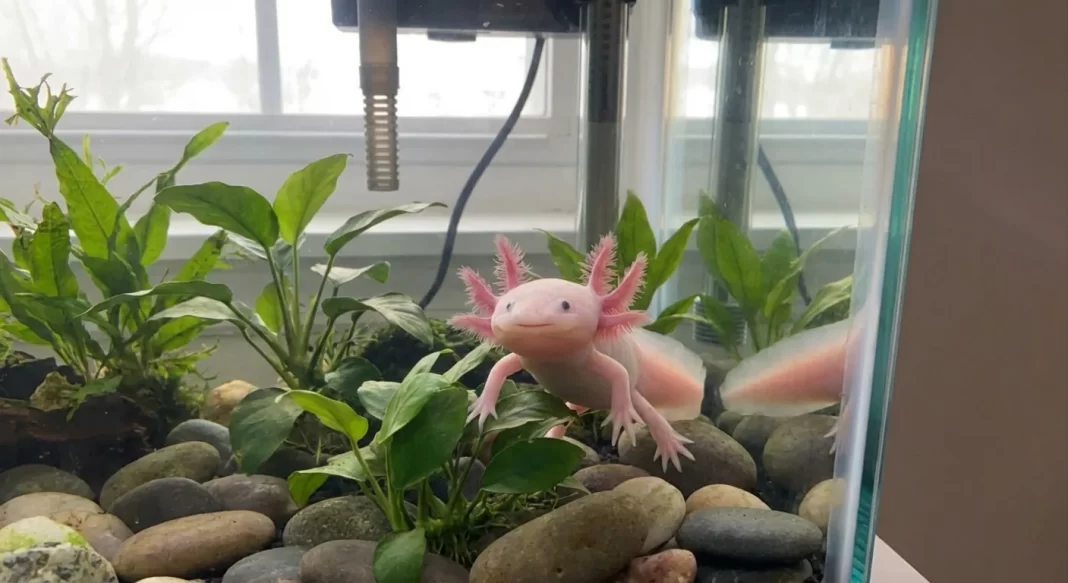
A healthy captive-bred axolotl costs between $30 and $100 from a reputable breeder, but the animal itself is the smallest line item in the first-year budget. Tank setup, filtration, a temperature-control solution, water-quality testing supplies, and a cycled biological filter push first-year spending to $450 to $900 depending on equipment tier. Monthly maintenance runs $20 to $45 after the initial outlay stabilizes. This guide breaks down every cost category with current 2026 pricing, flags the hidden expenses most guides skip, and explains where spending more upfront saves money over the axolotl’s 10-to-15-year lifespan.
How much does an axolotl cost to buy
The purchase price of an axolotl depends on morph, age, breeder reputation, and whether shipping is involved. Standard wild-type, leucistic, and albino juveniles from established breeders typically sell for $30 to $60. Adults of the same common morphs range from $50 to $100 because the breeder has already invested months of feeding and grow-out. Melanoid axolotls fall in the same price band as other standard morphs.
Premium and rare morphs cost substantially more. GFP (green fluorescent protein) variants, where the animal fluoresces under blue or UV light, sell for $75 to $200 depending on the base morph and the intensity of expression. Copper morphs range from $100 to $250. Mosaic axolotls, which display asymmetric patchwork coloration from chimerism during early cell division, sell for $200 to $500 when genuinely verified. Chimera specimens, the rarest morph category, can exceed $1,000 because they cannot be selectively bred and arise spontaneously from the fusion of two genetically distinct embryos during early development https://www.amphipedia.com/chimera-axolotls/.
Shipping adds $40 to $60 for overnight delivery with a heat or cold pack, and most reputable breeders require overnight shipping to minimize transit stress. Local pickup eliminates this cost entirely.
Experienced axolotl keepers we work with consistently recommend buying from breeders who can provide the animal’s lineage, age, and health history rather than from chain pet stores where sourcing is opaque. A $40 axolotl from a breeder with documented lineage is a better investment than a $25 axolotl from an unknown supply chain, because genetic health problems like shortened lifespan and poor gill development are more common in mass-bred stock with narrow genetic pools https://www.caudata.org/threads/axolotl-genetics-and-inbreeding.64829/.
For a deeper look at morph identification and pricing patterns, see the axolotl colors and morphs guide.
Initial tank and equipment setup cost
The tank and equipment represent the largest single expense in axolotl ownership. This is not a cost to minimize. Inadequate equipment causes water-quality failures, temperature spikes, and stress-related illness that cost more in veterinary bills and replacement animals than the equipment savings.
Tank
A single adult axolotl needs a minimum of 20 gallons (approximately 75 liters), and a 29-gallon or 40-gallon breeder tank is strongly recommended for better water-volume stability and floor space. Each additional axolotl requires at least 10 more gallons. New glass aquariums from major manufacturers (Aqueon, Marineland) cost $50 to $150 depending on size. A 40-gallon breeder tank, the most practical single-axolotl option, typically retails for $80 to $120. Used tanks from local aquarium groups or secondhand platforms can reduce this to $30 to $60, but must be leak-tested before setup. The tank size guide covers minimum dimensions and stocking calculations.
Filtration
Biological filtration is non-negotiable for axolotl tanks. The three viable filter types for axolotls are sponge filters, hang-on-back (HOB) filters with baffled outflow, and canister filters with spray bars. Sponge filters are the most economical option at $10 to $25, but require a separate air pump ($15 to $30). HOB filters run $25 to $50 for a 20-to-40-gallon-rated unit. Canister filters provide the highest biological capacity and are the best long-term investment for tanks above 29 gallons, but cost $60 to $150. Replacement filter media adds $10 to $30 per year depending on the system. The filtration guide compares flow-rate management and biological capacity across all three types.
Temperature control
Axolotls require water temperatures between 60 and 68 degrees Fahrenheit (16 to 20 degrees Celsius). For keepers in warm climates or homes without air conditioning, an aquarium chiller is the most reliable cooling method. Inline and drop-in chillers rated for 20-to-40-gallon tanks cost $150 to $400 for units from JBJ, IceProbe, or Active Aqua. Clip-on fans designed for evaporative cooling cost $15 to $40 and work as a moderate-climate supplement but cannot maintain safe temperatures during sustained heat waves. A reliable aquarium thermometer with min/max memory costs $5 to $15 and is mandatory regardless of cooling method. The temperature guide details the clinical consequences of temperature excursions and cooling-method comparisons.
Substrate and decor
Safe substrate options are bare bottom (free) or fine sand with a grain size below 1 millimeter ($10 to $25 for a 20-pound bag). Hides are mandatory: PVC pipe segments, ceramic caves, or smooth terracotta pots cost $5 to $20 per hide, and you need at least one per axolotl. Live plants that tolerate cool water (java fern, anubias, elodea) cost $5 to $15 per plant. The substrate guide covers impaction risk by grain size.
Water-quality testing and conditioning
A liquid test kit (API Freshwater Master Test Kit) costs $25 to $35 and lasts approximately 800 tests. This is not optional. GH/KH test kits add $8 to $12. Dechlorinator (Seachlor Prime or equivalent) costs $8 to $15 per bottle and lasts 3 to 6 months depending on water-change volume. Pure ammonia for fishless cycling costs $5 to $10. The water testing guide explains parameter interpretation and test frequency.
Setup cost summary table
| Category | Budget tier | Mid tier | Premium tier |
|---|---|---|---|
| Tank (40-gallon breeder) | $50 (used) | $100 | $120 |
| Filtration system | $25 (sponge + pump) | $50 (HOB) | $130 (canister) |
| Temperature control | $20 (fan) | $180 (entry chiller) | $350 (quality chiller) |
| Substrate + hides + plants | $15 | $40 | $70 |
| Water test kit + dechlorinator | $35 | $40 | $50 |
| Thermometer | $8 | $12 | $15 |
| Equipment subtotal | $153 | $422 | $735 |
| Axolotl (standard morph) | $35 | $50 | $80 |
| Shipping (if applicable) | $0 (local) | $45 | $55 |
| First-day total | $188 | $517 | $870 |
The mid-tier column represents the most common spending profile for keepers who want reliable equipment without overspending. Experienced keepers in the communities we work with generally recommend spending more on filtration and temperature control than on the tank itself, because those two systems determine daily water quality and directly affect the animal’s health trajectory over its full lifespan.
Monthly and ongoing costs after setup
Once the tank is cycled and the axolotl is settled, monthly costs stabilize into a predictable range.
Food
Nightcrawler earthworms, the dietary staple, cost $5 to $15 per month depending on whether you buy from a bait shop, a pet supplier, or raise your own colony. A single adult axolotl eating two to three times per week consumes roughly 15 to 25 worms per month. Supplementary foods like frozen bloodworms ($5 to $8 per pack, lasting 2 to 3 months) and sinking pellets ($8 to $12 per container, lasting 3 to 6 months) add minor ongoing cost. The feeding schedule guide covers meal frequency and portion sizing by age.
Electricity
Filtration runs continuously and adds $3 to $8 per month to an electricity bill depending on filter type and local rates. An aquarium chiller is the largest electrical cost: depending on ambient temperature and duty cycle, a chiller adds $10 to $30 per month during warm months. In temperate climates where the chiller only runs 4 to 6 months per year, annualized chiller electricity averages $5 to $15 per month. LED lighting on a timer adds negligible cost (under $1 per month).
Water-quality maintenance
Dechlorinator replacement runs $8 to $15 every 3 to 6 months. Filter media replacement costs $10 to $30 per year for sponge or HOB systems, and $15 to $40 per year for canister media. API test kit reagent refills cost $20 to $30 when the original kit runs out (typically 12 to 18 months of use for a single tank with weekly testing).
Monthly cost summary
| Expense | Low estimate | Typical estimate | High estimate |
|---|---|---|---|
| Food (earthworms + supplements) | $8 | $15 | $25 |
| Electricity (filter + chiller) | $5 | $15 | $35 |
| Water conditioner | $2 | $3 | $5 |
| Filter media (amortized) | $1 | $2 | $4 |
| Monthly total | $16 | $35 | $69 |
Veterinary costs and when to budget for them
Axolotls do not require routine annual checkups the way mammals do, but exotic-vet access is essential for emergencies. Finding an exotic veterinarian who treats amphibians before you need one is a critical step that most cost guides omit. The Association of Reptile and Amphibian Veterinarians (ARAV) maintains a searchable directory at arav.org https://arav.org/.
A standard exotic-vet consultation costs $50 to $100 per visit. Diagnostic work (skin scrapes, fecal analysis, water-quality review) adds $30 to $80 depending on the clinic. Treatment for common conditions like fungal infections or impaction ranges from $75 to $250 including medication. Emergency after-hours visits at specialty clinics can run $150 to $400.
Most axolotls in well-maintained tanks never need a vet visit. The conditions that generate veterinary bills are almost always preventable with proper husbandry: impaction from unsafe substrate, fungal infection from elevated temperatures, ammonia burns from uncycled or poorly maintained tanks. Spending appropriately on equipment and maintenance is the most effective way to keep veterinary costs at zero. The symptoms guide and emergency care checklist cover triage decisions before a vet visit.
Hidden costs most guides do not mention
Several real costs of axolotl ownership are routinely absent from basic price guides.
Fishless cycling time. A new tank needs 4 to 8 weeks of fishless cycling before an axolotl can safely enter the water. During this period, you are paying for ammonia, test kits, dechlorinator, and electricity with no animal in the tank. If you buy the axolotl before the tank is cycled, you face daily tubbing (housing the axolotl in a temporary container with daily 100-percent water changes), which is stressful for the animal and labor-intensive for the keeper. The tank cycling guide covers the timeline and process.
Backup cooling. If your primary cooling method fails during a heat wave, you need an emergency plan. Frozen water bottles (free if you already have them) provide hours of buffer, but a backup fan or a second chiller for a high-value breeding setup adds $15 to $200. The hot weather setup guide details emergency cooling protocols.
Quarantine supplies. New axolotls or sick animals need a separate quarantine container. A basic quarantine tub (10-gallon plastic container, sponge filter, thermometer, hide) costs $20 to $40 to assemble. The quarantine guide explains setup and duration.
Replacement equipment. Filters, air pumps, heater-controller probes, and thermometers fail. A reasonable annual replacement reserve is $20 to $50. Chiller compressors last 5 to 8 years before efficiency degrades noticeably.
Multi-axolotl scaling. Housing two axolotls requires a 30-to-40-gallon tank, double the hides, higher bioload filtration, and a chiller rated for the larger water volume. The second axolotl itself may cost $30 to $80, but the equipment upgrade to support it safely can add $50 to $200. The tank mates guide covers compatibility and stocking limits.
Lifetime cost projection over 10 to 15 years
Axolotls live 10 to 15 years with proper husbandry. Projecting costs over the animal’s full lifespan provides a realistic picture of the financial commitment.
| Cost category | 1-year total (mid tier) | 10-year total | 15-year total |
|---|---|---|---|
| Animal + shipping | $95 | $95 | $95 |
| Initial setup | $422 | $422 | $422 |
| Monthly maintenance ($35/mo) | $420 | $4,200 | $6,300 |
| Equipment replacement ($35/yr) | $35 | $350 | $525 |
| Chiller replacement (1x at year 7) | $0 | $250 | $250 |
| Veterinary (estimate, 1-2 visits) | $0 | $150 | $200 |
| Cumulative total | $972 | $5,467 | $7,792 |
These projections assume a single axolotl on mid-tier equipment with a chiller. The annual run rate after year one is approximately $455 per year, or $38 per month. Keepers in warm climates who run a chiller year-round will trend toward the higher end; keepers in cooler climates with naturally stable room temperatures below 68 degrees Fahrenheit will spend less.
The financial commitment is comparable to keeping a single freshwater tropical fish tank of similar size, with the chiller being the main cost premium specific to axolotls. Compared to a dog or cat, the ongoing costs are substantially lower, but the initial setup-to-animal price ratio is much higher: you may spend 5 to 10 times the animal’s purchase price on equipment before the axolotl ever enters the water.
Where to save money without compromising care
Cost optimization is legitimate as long as it does not cut into the equipment categories that directly affect water quality and temperature stability.
Safe savings:
- Buy a used tank from local aquarium groups (save $30 to $70). Leak-test with water for 48 hours before use.
- Use a sponge filter instead of a canister for tanks under 30 gallons (save $40 to $120). Sponge filters provide adequate biological filtration and are easier to maintain.
- Start an earthworm colony for a one-time investment of $20 to $30 in starter worms and bedding, eliminating monthly food costs after the colony establishes.
- Buy dechlorinator in concentrated form (Seachlor Prime 500ml) rather than diluted versions. The per-use cost is dramatically lower.
- Use a clip-on fan plus air conditioning instead of a dedicated chiller if your home stays reliably below 72 degrees Fahrenheit in summer.
Unsafe savings that cost more long-term:
- Skipping the water test kit. Without parameter data, problems become visible only after the axolotl is already sick.
- Using a tank smaller than 20 gallons. Smaller water volume means faster parameter swings, more frequent water changes, and higher stress on the animal.
- Buying from unverified sellers to save $10 to $20 on the animal. Genetic health problems from inbred stock generate veterinary costs that dwarf the initial savings.
- Skipping the fishless cycle. An uncycled tank exposes the axolotl to ammonia and nitrite spikes that cause gill damage, burns, and immune suppression within days.
For responsible sourcing considerations beyond price, see the responsible sourcing guide.
Frequently asked questions
Is an axolotl expensive to keep compared to other aquatic pets?
An axolotl’s monthly maintenance cost of $20 to $45 is comparable to a single freshwater tropical fish tank of similar size. The main cost premium over standard tropical fish is the temperature-control requirement: axolotls need cool water between 60 and 68 degrees Fahrenheit, which often requires a chiller that adds $150 to $400 upfront and $10 to $30 per month in electricity during warm periods. Compared to saltwater reef tanks, which routinely cost $100-plus per month in maintenance, axolotls are substantially cheaper. Compared to a dog or cat, the monthly ongoing costs are lower, but the initial setup-to-animal price ratio is much higher.
How much does an axolotl cost per month after the first year?
After the initial setup year, expect $25 to $45 per month for a single axolotl on a mid-tier setup. This covers food ($10 to $15), electricity for filtration and cooling ($8 to $20), water conditioner ($2 to $4), and amortized filter media and equipment replacement ($3 to $6). The actual monthly cost depends heavily on whether you run a chiller and your local electricity rate. Keepers in cool climates without a chiller can maintain an axolotl for under $20 per month.
What is the most expensive part of owning an axolotl?
The aquarium chiller is typically the single most expensive item in the entire cost of ownership. A quality inline chiller costs $200 to $400 upfront and is the largest contributor to ongoing electricity costs. For keepers who cannot avoid one, the chiller often accounts for 30 to 40 percent of total first-year spending. If your home naturally stays below 68 degrees Fahrenheit year-round, you can skip the chiller entirely and reduce both initial and ongoing costs significantly.
Can I keep an axolotl on a tight budget?
A budget-conscious keeper can achieve a safe single-axolotl setup for approximately $190 to $250 total by buying a used tank, using a sponge filter, relying on a clip-on fan plus home air conditioning for cooling, and purchasing a standard-morph juvenile from a local breeder. Monthly costs under this approach run $15 to $25. The critical point is that "budget" cannot mean skipping the water test kit, the fishless cycle, or adequate tank size. Those savings create health problems that cost more than the equipment they replace.
Do axolotls need to go to the vet?
Axolotls do not require routine annual checkups, but access to an exotic veterinarian who treats amphibians is essential for emergencies. The most common conditions requiring veterinary intervention are fungal infections, impaction from unsafe substrate, and bacterial infections secondary to poor water quality. A standard exotic-vet consultation costs $50 to $100, and diagnostic or treatment visits range from $75 to $250. Finding a vet before you need one is important because not all veterinary clinics treat amphibians; the ARAV directory at arav.org lists qualified practitioners by location https://arav.org/.
Researched and written by the ExoPetGuides editorial team with AI-assisted drafting. All husbandry parameters and veterinary references independently verified against peer-reviewed sources.
Disclaimer: This content is for educational purposes only and is not a substitute for professional veterinary advice. Always consult a qualified veterinarian — ideally an exotic-animal specialist — for any health concern about your pet. Care recommendations may vary based on species, individual animal, and local regulations.